If you think strength training is something for young people, this guide is here to change your mind. After 65, muscle strengthening is one of the interventions with the best evidence for staying independent. It is also one of the few that gives back lost function, rather than just slowing down a decline.
In the Cochrane review of progressive resistance training in older adults, 121 studies and 6,700 participants, the effect on muscle strength is large, the chair stand improves from moderate to large, and serious adverse events were rare, none directly linked to the exercise programme.
Before the exercises, however, there is a part that in this article comes before everything else: understanding whether you can start on your own or whether your case calls for an assessment. After 65 it is not a formality.
This guide contains general indications and does not replace a clinical assessment. The conditions described below concretely change which exercises you can do and which you cannot.
When to stop and talk to a doctor
Some symptoms should not be put down to "age" and should not be managed with training. If one of these appears, the next step is the doctor, not the gym or the mat at home.
- Chest pain, a feeling of tightness or breathlessness out of proportion to the effort
- Fainting, or the feeling of being about to faint, during exertion or on standing up
- Weight loss you did not seek
- Bone pain, localised and present even at rest or at night
- Fever, or general malaise that does not go away
- Pain that appeared after a fall, even if it seems bearable
None of these necessarily means something serious, but all of them need an explanation before you add load. Bone pain that does not go away and unintended weight loss, in particular, are two that must always be clarified.
Osteoporosis: two movements to take out of the programme
If you have a diagnosis of osteoporosis, or vertebrae that have already fractured, the most important instruction is not about how much weight you use: it is about how you move your spine.
Flexing the trunk under load is not recommended. That means no crunches, no sit-ups, no "touching your toes", no lifting weights from the floor with a rounded back. The Australian position statement on exercise in osteoporosis explicitly lists it among things to avoid, and in the historical study by Sinaki and Mikkelsen on women with vertebral osteoporosis, new fractures or collapses appeared in 89% of those following a flexion programme against 16% of those working in extension. It should be said that the flexion group had only 9 patients and that the study dates from 1984: the number is fragile. The direction, however, is the one that later entered subsequent recommendations.
Alongside flexion, clinical practice also avoids trunk twisting under load: rotating the torso while holding a weight concentrates the load on the vertebral body in a direction that porous bone tolerates poorly. If an exercise asks you to bend forward or rotate while holding something, there is almost always a variant that trains the same muscle without asking for it.
What remains, then. Extension exercises and isometric exercises remain, that is, those in which you contract without moving the spine. All the work on the legs remains. And progressive strengthening remains, which is an ally for the bone: the same Australian authors note that bone responds well to impact activities and to high-intensity progressive strengthening, with the caveat that impact must be modified in the presence of arthritis or fragility. We explore the bone side in more detail in the exercises for preventing osteoporosis.

Heart, blood pressure and the trap of the held breath
The underlying message is reassuring: the 2023 scientific statement of the American Heart Association considers resistance training a safe and effective approach to cardiovascular health in adults with and without cardiovascular disease. The problem is not strengthening in itself.
The problem is an involuntary action: holding your breath while pushing. The Valsalva manoeuvre, that is, closing the glottis and bearing down during effort, makes blood pressure rise precisely at the moment of peak effort. In a healthy person it is a nuisance; with known heart disease, uncontrolled hypertension, an aneurysm or diabetic retinopathy it becomes a variable not to be added lightly.
The countermeasure is simple and should be learned straight away, before increasing loads: breathe out during the lifting phase, breathe in on the return, and if you notice you are holding your breath, the load is too high for now. If blood pressure is not under control or you have heart disease, the correct sequence is doctor first, loads afterwards.
The principle that matters more than any exercise
If you have more than one chronic condition, or take several medications, the starting point is not a video and not a plan found online: it is an assessment.
Not for bureaucratic reasons. Because the same chair stand is prescribed differently for someone taking a blood pressure medicine that favours drops in pressure on standing, for someone with a hip prosthesis with movement limits, and for someone with diabetic neuropathy in the feet who does not feel the ground well. The authors of the Cochrane review on progressive strengthening are explicit about a limit of their data: adverse events were poorly recorded in the studies, so transferring those exercises to clinical populations requires caution. The evidence is good; it is not a universal pass.
What really changes: the numbers, with their proportions
Here there is a nuance worth understanding, because it explains why training works even when the mirror does not show it.
On strength the effect is large and repeated across all the syntheses. The Cochrane review finds a large effect on muscle strength across 73 studies and more than 3,000 participants. The dose-response meta-analysis dedicated to healthy over 65s reaches a substantial effect on strength across 25 studies.
On muscle mass, by contrast, the changes are modest. The same dose-response meta-analysis finds a small effect on measures of muscle morphology, that is, cross-section, volume or muscle thickness, and on just nine studies, to the point that the authors describe that finding as preliminary.
On function the picture is intermediate and very concrete. Standing up from a chair improves with a moderate to large effect. Walking speed gains on average 0.08 metres per second: a real but modest improvement. Physical capacity measured on general scales improves slightly. And those with arthritis report a reduction in pain.
Put into one sentence: the muscle changes little in volume and a lot in performance. Much of the early gain comes from the nervous system, which learns to recruit better the fibres you already have. This is also why the first results are felt on the stairs and in getting out of a chair before they show in the circumference of the thigh. If the issue is loss of mass in the strict sense, we discuss it in the guide on sarcopenia. There, the most recent network meta-analysis indicates resistance exercise, alone or combined with aerobic and balance work, as the intervention with the best effect on quality of life, with evidence of moderate to high certainty.
Falls: exercise works, but the component that counts is balance
This is the part almost no article tells in full, and it changes the way you build the programme.
The Cochrane review on exercise for preventing falls in older people living at home gathers 108 randomised trials and 23,407 participants. The main result is solid: exercise reduces the rate of falls by 23% and the number of people who fall at least once by 15%, in both cases with high-certainty evidence.
Then the authors break the figure down by type of exercise, and this is where the point comes.
- Balance and functional exercises: fall rate reduced by 24%, high certainty
- Multicomponent programmes, typically balance and functional work plus strengthening: reduction of 34%, moderate certainty
- Tai chi: reduction of 19%, low certainty
- Mainly strength-only programmes: uncertain effect
The last line is the one to keep in mind. It does not say that strengthening is useless; it says the evidence does not allow us to claim that strengthening alone, without balance exercises, reduces falls. The same goes for dance and for walking-only programmes.
It has a precise practical consequence: if your stated goal is not to fall, a programme made only of dumbbells and chair stands is not enough, and the best combination is precisely the one that unites the two. Alongside strengthening, add a routine of balance exercises for older adults. The reviewers also add a note of honesty about other outcomes: exercise may reduce fall-related fractures and medical visits, but for these outcomes the certainty is low.
Intensity: the counterintuitive point
Here the most widespread and most harmful idea needs to be dismantled: that older people need little half-kilo weights.
In the Cochrane review, the programmes that produced those results were, in most studies, carried out two or three times a week at high intensity. This is not a marginal detail: it is a description of what was actually tested.
The dose-response meta-analysis on healthy over 65s goes deeper and finds that intensity is one of the variables that significantly influence strength gains, with the greatest effects around 70-79% of the one-repetition maximum. In the same analysis, the most effective pattern, variable by variable, was two sessions a week, two or three sets per exercise and seven to nine repetitions per set. A load that lets you do twenty-five comfortable repetitions is not strength training: it is movement, which has other merits.
Two clarifications are necessary, because without them this paragraph becomes dangerous.
The first is that the authors of that meta-analysis state that the overall methodological quality of the included studies is low and the heterogeneity very high: those numbers are a guide, not a prescription to copy.
The second is that "high load" is a destination, not a starting point. 70% of the maximum only makes sense after someone has established what your maximum is, that your technique holds up and that your joints tolerate the movement. Guided progression is the non-negotiable part of the sentence "older adults tolerate high loads".
Bones: what is proven and what is not
The load that muscle transmits to bone stimulates bone formation, but the measured benefit is smaller and less certain than that on strength.
A meta-analysis dedicated to over 65s measured, after progressive strengthening programmes, an increase in bone mineral density at the femur and hip of 2.77%. At the lumbar spine the difference, 1.60%, did not reach statistical significance. The authors are clear: the certainty of improvement is greater for strength than for bone density, with enormous heterogeneity in the bone data.
So yes, training strength is good for bones. But if the stated goal is bone density, strengthening is one piece of the pathway and not the whole pathway, and the management of osteoporosis remains a clinical matter.
Protein and vitamin D: what the literature says, and what it does not
Promises about nutrition circulate more than proofs. The umbrella review by the Belgian geriatrics society, which assessed 15 systematic reviews on nutritional interventions after 65, brings useful order.
On protein the conclusion is that protein supplementation added to resistance training is recommended to increase muscle mass and strength, particularly in obese people and for durations of at least 24 weeks. Both conditions matter: on top of training, not in place of it, and for months, not for two weeks. On leucine the authors indicate the best evidence for an effect on muscle mass in older adults with sarcopenia. On everything else, including essential amino acids and multi-nutrients, the level of evidence remains low to moderate, and the authors themselves say so.
On vitamin D the broadest synthesis is also the most uncomfortable: 81 randomised trials and more than 53,000 participants found no effect of supplementation on total fractures, hip fractures or falls, nor clinically relevant differences in bone density, and the results did not change with doses above 800 IU per day. The authors' conclusion is that there is little justification for using vitamin D supplements to maintain or improve musculoskeletal health.
Be careful about what this does not say. It does not say that vitamin D is useless in medicine, and it does not concern treating a documented deficiency, which is a decision for the doctor based on a test. It says that taking vitamin D as a strategy to avoid falls and fractures did not work. From this comes the honest conclusion: if you take vitamin D because your doctor prescribed it, continue and talk to them about it; if you take it in place of training, you are replacing what works with what did not.
Legs: this is where you start
The legs take priority, because they support walking and balance, and because they are the muscles in which the decline is felt first.
The first exercise, the one worth more than all the others, is the chair stand: seated, stand up using only your legs, without pushing with your hands on the armrests or your thighs. It is the literal translation of a movement you repeat dozens of times a day, and it is also one of the tests used to measure the result.
The wall squat is the most protected variant. With your back against the wall, bend your knees as if sitting down, stop halfway down and rise again. The wall removes the fear of losing balance and lets you concentrate on the push.
Heel raises strengthen the calves: standing, with one hand on a stable support, rise onto your toes and lower slowly. The slow lowering is the part that trains the most.
Side leg raises work the lateral glutes, the muscles that keep the pelvis level when the weight is on one foot. Standing with support, move the leg out to the side and lower it back down, controlling the return.
Step-ups are the most functional exercise of the group. With a low step and a handrail within reach, go up and down alternating legs: it is the stairs at home in a controlled setting.
Arms and shoulders: the strength of everyday gestures
Work on the upper limbs maintains the ability to do things nobody considers training: carrying shopping, getting dressed, taking a pan down from a cupboard, pushing yourself up from the armrests of an armchair.
Biceps curls can be done seated or standing: with a weight in your hand, bend the elbow towards the shoulder and lower it again slowly, controlling the return.
Triceps extensions work the back of the arm. If you have osteoporosis or back pain, prefer the variant with the band fixed up high and the trunk upright to the version with the weight behind the neck, which under strain tends to make you arch or bend the trunk.
Front and lateral raises serve the shoulders: lift the arms forward or to the side up to shoulder height, not beyond.
Bands and small dumbbells are both fine. What matters is that, after a few weeks, the band becomes stiffer and the dumbbell heavier.
Core: stability without sit-ups
The core, that is, the abdominals, lower back muscles and pelvic floor, is the link between the upper and lower body. The good news is that after 65 you do not need sit-ups, and this is also the choice compatible with a fragile spine.
Seated abdominal bracing is the starting point: sitting with your back upright, tighten your abdomen as if drawing the navel towards the spine, hold for five seconds and release. It is an isometric, it does not move the spine.
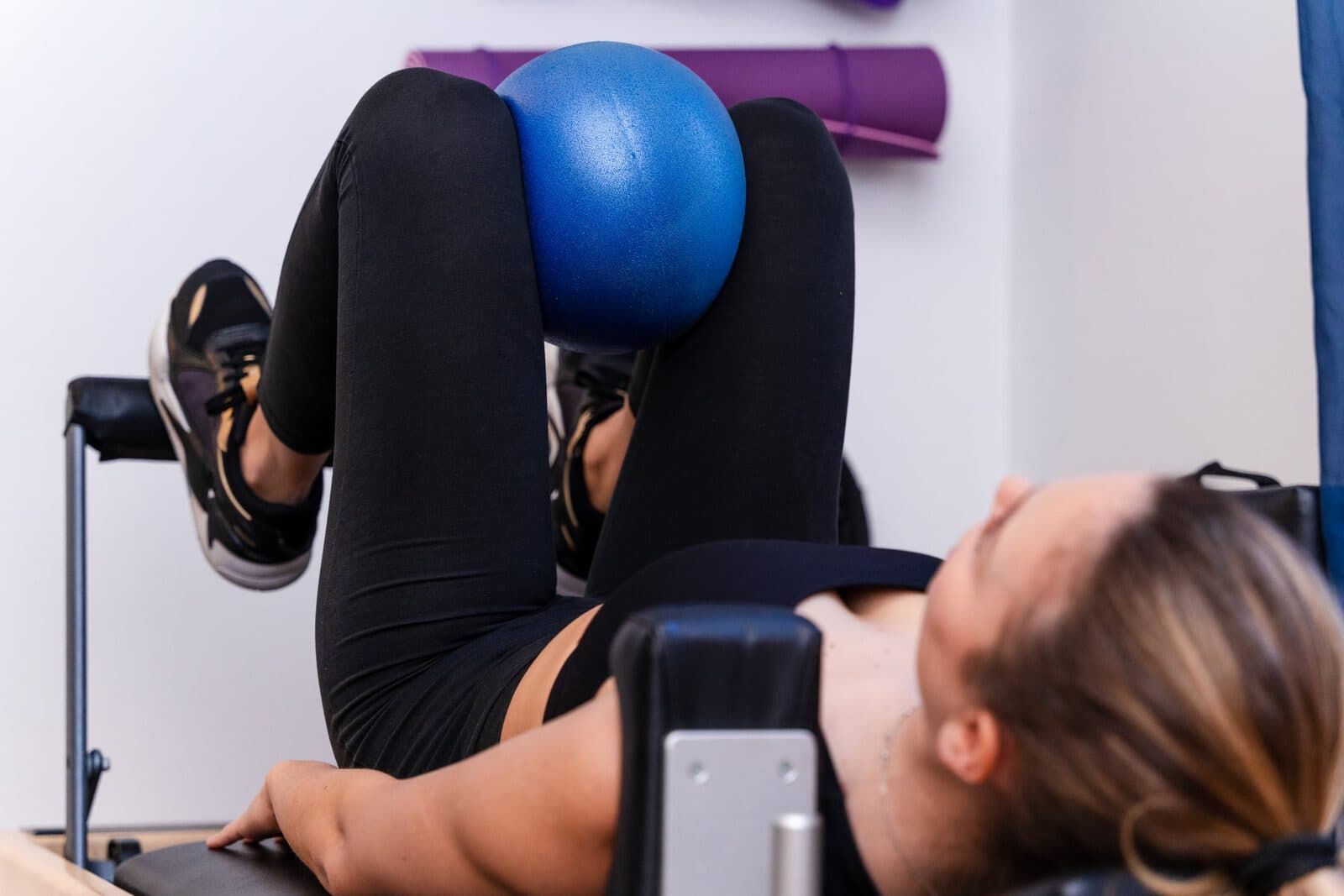
The glute bridge is safe and effective: lying on your back with knees bent, lift your hips by contracting the glutes and abdomen, hold for five seconds and lower slowly. It works in extension, not in flexion.
Seated marching trains the hip flexors, the muscles that lift the leg when you climb a step or get into a car.
What you do not find in this list is deliberate: no crunches, no sit-ups, no trunk twists holding a weight. Not because they are forbidden for everyone, but because in the population this article addresses the chance of a fragile spine is high and the benefit of those exercises is low.
The weekly programme and how to increase the load
Two or three sessions a week, never on consecutive days, so that there is at least one day of recovery. Twenty to thirty minutes, and in every session something for the legs, arms and core.
A concrete example: five minutes of warm-up with marching on the spot and joint movements; three sets of chair stands; three sets of biceps curls; three sets of glute bridges; two sets of heel raises. For strength sets, aim for around eight repetitions, with a load that is noticeable in the last two repetitions.
Progression is built in order: first technique, then repetitions, then load. When you get comfortably to twelve or fifteen repetitions, the signal is not "well done", it is "time to add resistance". Ten small progressions are better than one large one followed by a week off.
If your goal includes falls, add a balance component to every session, even just a few minutes: it is what, in the data, distinguishes the programmes that reduce falls from those on which we remain uncertain.
Mistakes to avoid
Doing too much, too soon. It is the most common mistake. Start with less than you think you can do: the advantage of slow progression is that it does not get interrupted.
Holding your breath. Breathe out during the lifting phase. If you cannot breathe normally during a set, the load is too high today.
Confusing effort and pain. Muscle soreness and passing joint discomfort are the most frequent adverse effects in studies of progressive strengthening, and they are expected. Sharp pain, joint pain that persists the next day, and any bone pain are instead a signal to stop.
Training without knowing what you have. A strengthening programme built on a wrong diagnosis can make the problem worse, and this applies particularly to shoulder pain and back pain, where apparently harmless exercises can be contraindicated for the real cause.
Postponing while waiting for the perfect programme. The American Heart Association statement notes that fewer than a third of American adults do the two recommended days of strength training a week. The gap between those who train and those who do not is much larger than the gap between two different plans.
How to really get started
Start with one exercise, not ten. In most cases the right exercise is the chair stand: it needs no equipment, it is easy to count, and it trains the movement whose loss changes the day more than any other.
Anchor it to something you already do: three sets before lunch, every even-numbered day. Consistency does not come from motivation; it comes from pairing with a habit that already exists.
Keep a sheet with two columns, the date and what you did. It serves a technical reason, not a moral one: without a written record, progression of load stops, and without progression, strengthening stops being strengthening after a few weeks. A mediocre programme done for eight months beats a perfect one done for three.
And choose the right time horizon: in the dose-response meta-analysis, the greatest strength effects were seen in programmes lasting fifty weeks. One year, not one month.
When it makes sense to be followed
The doubt, after 65, is almost never "which exercise". It is "am I doing it right?" and "can I increase?". These are the two questions where an outside eye changes the result, because progression of load is precisely the variable the literature identifies as decisive and the hardest to manage alone.
With Ri-Hub you can follow a strengthening programme from home, on a video call with a physiotherapist who watches you perform the exercise as you do it, adapts the variations to your clinical history, to osteoporosis or heart disease if present, and decides with you when to progress. We explain how this works in practice in the guide to telerehabilitation. If you want to understand where to start in your case, the first step is an assessment with a physiotherapist.
Need a consultation?
Start with the questionnaire on Ri-Hub: a few questions about your case, you register, and you see who will follow you: a physiotherapist registered with the Albo, whom you write to in chat whenever you like. If you prefer to talk it through by voice, the first consultation is free, lasts 20 minutes and commits you to nothing: they arrive having already read what you wrote, and together you decide whether and how to go on. No credit card is needed: the first consultation does not commit you to anything.
If among the reasons you move less there is also the bladder, menopause changes what works: Incontinence in menopause.
You will find this and eighty-two other exercises, each with execution, common mistakes and variations, in the exercise library.
For the bigger picture, with data on falls and mortality: moving after 65.
And on how much strength matters, measured on 139,691 people in seventeen countries: grip strength and health.
Sources
- Progressive resistance strength training for improving physical function in older adults, Cochrane Database of Systematic Reviews, 2009
- Exercise for preventing falls in older people living in the community, Cochrane Database of Systematic Reviews, 2019
- Dose-Response Relationships of Resistance Training in Healthy Old Adults: A Systematic Review and Meta-Analysis, Sports Medicine, 2015
- Progressive Resistance Training for Concomitant Increases in Muscle Strength and Bone Mineral Density in Older Adults, Sports Medicine, 2022
- Exercise for sarcopenia in older people: A systematic review and network meta-analysis, Journal of Cachexia, Sarcopenia and Muscle, 2023
- Nutritional interventions to improve muscle mass, muscle strength, and physical performance in older people: an umbrella review, Nutrition Reviews, 2021
- Effects of vitamin D supplementation on musculoskeletal health: a systematic review, meta-analysis, and trial sequential analysis, The Lancet Diabetes & Endocrinology, 2018
- ESSA position statement on exercise prescription for the prevention and management of osteoporosis, Journal of Science and Medicine in Sport, 2017
- Postmenopausal spinal osteoporosis: flexion versus extension exercises, Archives of Physical Medicine and Rehabilitation, 1984
- Resistance Exercise Training in Individuals With and Without Cardiovascular Disease: 2023 Update, Circulation, 2024
Last source check: August 2026.