You have been told that your pelvis is "tilted backwards" and now you wonder whether that is what hurts your back. Let us start from a fixed point: pelvic retroversion is first of all a normal movement, one that your pelvis makes dozens of times a day. And the idea that a certain pelvic inclination is a fault to straighten out, a cause of back pain, is much weaker than the web suggests.
This article explains what retroversion is, why the "crooked pelvis equals pain" link does not hold up as it is told, and where it makes more sense to spend your time instead. Your pain, if you have it, is real: what we question is not the symptom, it is the explanation you were given.
What pelvic retroversion is
A word on synonyms, because the pelvis is described in many ways and you end up looking up the wrong term. Retroversion and retroflexion of the pelvis mean the same thing: the pelvis rotating backwards, with the pubis rising and the lumbar curve flattening. The opposite movement, the pelvis rotating forwards, with the buttocks protruding and the lumbar curve increasing, is called anteversion (or anteroversion). These are not two faults: they are the two ends of a movement we all make, and the pelvis moves continuously between one and the other during the day. The verb you hear in gyms and clinics is to retrovert the pelvis, and it simply describes the act of bringing it backwards: it is what you do by flattening the lower back against the floor in the lowest exercise on this page.
A term that circulates by mistake also needs clarifying: pelvic introversion is not a technical name and does not exist in anatomy texts. Those who search for it almost always mean retroversion, that is, the pelvis rotated backwards (intra- and retro- get confused because both sound like "inwards"). If you came here looking for that word, the description you need is this one.
The pelvis can tilt forwards (anteversion) or backwards (retroversion). When it goes into retroversion, the pubis rises, the sacrum tucks under and the lumbar curve tends to flatten. It is the movement you make when you push the pelvis forwards while standing, or when you sit leaning against the backrest with the lower back rounded.
Two clarifications change everything else in this article.
- It is a movement, not a condition. You do not "have" a retroversion the way you have a mole: you have a pelvis that moves through an arc and that, at rest, sits somewhere along that arc. Where it sits depends on the shape of your bones, not only on how careful you are.
- The starting position is not a diagnosis. A side photo, a mirror or an online test do not tell you whether that pelvis is the cause of anything. They only tell you what yours looks like.
How much the pelvis varies among people who have no pain
Here the numbers are useful. The international MEANS study took standing X-rays of 468 adult volunteers without significant back or neck pain, across France, Japan, Singapore, Tunisia and the United States. The average pelvic inclination was about 12 degrees, but with a standard deviation of over 7 degrees: this means perfectly symptom-free people sat comfortably both around 5 degrees and around 20.
The more interesting finding is another one. The authors checked how many of these healthy volunteers fell within the alignment parameters considered "targets" in spinal surgery: about 60 per cent did, while 32 per cent were well outside on one side. A substantial share of people without pain therefore have an alignment that, on an assessment chart, would look non-ideal.
There is more. When researchers try to define an "ideal" lumbar lordosis, they do not find a value valid for everyone: they calculate it from individual morphology, in particular from that person's pelvic incidence and thoracic kyphosis. In a study of 233 asymptomatic adults, the expected lordosis turned out to be a function of each person's bones, and the authors specify that those models serve surgeons to plan a reconstruction, not to assess the posture of people who are well.
In short: a "correct" pelvis valid for everyone does not exist.

"Crooked pelvis equals back pain": what the data really say
This is the part that matters. A systematic review with meta-analysis from 2025 collected 46 studies comparing the static posture of people with and without low back pain: over 5,000 people with pain and almost 7,000 without. It is the broadest attempt to answer the question.
The results, reported as they are:
- Pelvic inclination was statistically higher in people with low back pain. This should be said, not hidden. But the size of the difference was small (standardised mean difference 0.23) and the heterogeneity between studies very high: the distributions of the two groups overlap widely, so that the figure does not allow you to look at a single pelvis and say which group it belongs to.
- Lumbar lordosis and sacral inclination, where they differed, tended to be lower in people with pain, not higher. Neither difference was statistically significant, and here too the heterogeneity was high.
- Thoracic kyphosis and leg length difference showed no difference between the groups.
The point is the direction of the second result: the popular story goes that back pain comes from excessive lordosis or from a "wrong" curve that needs flattening. In the data, if anything moves, it moves in the opposite direction. The authors conclude that lumbopelvic mechanisms may be altered in people with low back pain, but that no firm conclusions can be drawn and that postural measures should be standardised.
Two limitations remain that studies of this type cannot overcome. The first: they are comparisons taken at one moment, not over time. If the pelvis of someone in pain is tilted slightly differently, that difference may be a consequence of the pain, not its cause: people in pain move and position themselves differently, which is normal. The second: an average difference between groups is not an individual explanation, and says nothing about why your back hurts.
In the same direction goes a study of 273 adolescents that measured sagittal curves, pelvic inclination, hamstring extensibility and lifestyle habits. What was associated with pain was age and sedentary behaviour, not postural values; a weak association with lumbar misalignment appeared only in boys. Again this is a snapshot, which does not prove causes: but when the only strong signal is "how much you move", it is worth listening to. A separate matter is a true curve of the spine that appears in those years: there we are no longer talking about posture to correct but about adolescent idiopathic scoliosis, which is measured in Cobb degrees and has its own criteria for when exercises are needed and when a brace is.
There is no "correct" pelvis to reach
If there is no correct value to aim for, the goal of "fixing your posture" loses its meaning, and with it the hours spent checking yourself. The hunt for the perfect posture is not just wasted time: it can do harm.
Monitoring the position of the pelvis all day means contracting more, moving less, avoiding the positions labelled as wrong. It is exactly the kind of behaviour that tends to worsen persistent pain, because it builds the idea that the back is fragile and must be protected. A back treated as fragile gets used less, and a back used less tolerates less.
If you have started to be "careful about how you sit" and since then you are tenser and less free in your movements, that is not a solution that settles: it is the problem changing shape. You do not need to reach a pelvis: you need a pelvis that moves in both directions without you having to think about it.
Does sitting in retroversion ruin the back?
It is the most widespread fear, and the data are less dramatic than expected. In a prospective study of 665 workers, mostly blue-collar, the time spent sitting at work was measured with an accelerometer and low back pain was followed with monthly messages for a year. Long sitting sessions were associated with a more favourable course of low back pain, not a worse one.
Two clarifications, so as not to turn this into another slogan. The effect was very small, and the population was made up mainly of manual workers: for them sitting is a break from physical load, and the comparison is not with a life that is already sedentary. Nobody is saying that twelve hours on a chair is a good idea.
The useful conclusion holds, however: the position you sit in is not the progressive structural damage you have been told about. The problem with sitting is not the angle of the pelvis, it is immobility. The answer is not to learn to sit "well", it is to change position often.
One exception deserves mention: someone who, after childbirth, feels pain concentrated on the tip of the coccyx as soon as they sit down has coccydynia, which has its own causes and timelines and is managed with different measures from those discussed here.
What is worth working on
Let us move the target: not alignment, but capacity. What your body can do and how much load it tolerates.
Moving, and with variety. Alternating positions, walking, not staying in the same shape for hours. Not because a posture is poisonous, but because tissue tolerates loads that change better. It matters especially in periods when the load arrives all together and always in the same form, such as the months of breastfeeding: even there what relieves pain is lightening and varying the supports, not straightening the pelvis.
Building strength. A systematic review of eight randomised trials, for 381 participants in total, evaluated specific strength training for the lumbar extensors in non-specific low back pain: a favourable effect on pain intensity, but a non-significant effect on disability, and evidence certainty judged very low by the authors themselves. It is not overwhelming evidence, and it is right to present it for what it is. It does indicate, however, that the route of capacity gives something, which is more than the hunt for the perfect angle has ever given.
Finding your direction, not the right one in absolute terms. Some people feel better moving towards extension, others towards flexion. A review with meta-analysis of five randomised trials (743 patients) found that an approach based on individual directional preference produced clinically relevant improvements in pain and disability compared with other interventions, with evidence certainty from low to moderate and with one author openly a trainer in the method studied. So caution about the size of the effect. But the logic is clear and runs in the opposite direction to the myth: what counts is the direction that relieves your symptoms, not a single position for everyone.
For honesty, the figure pulling the other way must also be cited. A small randomised study of 60 women with sedentary jobs compared exercises personalised on the basis of measured lordosis with the same exercises given without distinction, obtaining better pain results in the personalised group. It is a signal in favour of reasoning about the individual. It is not, however, proof that a correct curve exists: the sample was small, both groups were exercising, and there was no comparison with people who did nothing.
Exercises for a pelvis that moves little
Let us clarify the goal: not to change your posture at rest, but to regain confidence across the whole range of movement. If one of the two directions feels clumsy, it is only a movement you do little, not a fault to repair.
A simple way to understand this: standing, hands on your hips, tilt the pelvis forwards by arching the lower back slightly, then backwards by flattening it. Repeat five or six times slowly. You are not interested in where you start from, you are interested in whether the transition is smooth in both directions.
Pelvic tilt lying down. Lying on your back, knees bent, feet on the floor. Arch the lower back slightly, lifting it off the floor, then flatten it against the ground. A small, slow movement, accompanied by the breath. Two or three sets of ten slow repetitions, even every day.
Cat-cow. On hands and knees, alternate arching and rounding the back, letting the pelvis guide the movement. Two sets of eight to ten cycles. You will find the detailed execution in the guide to cat-cow.
Hamstring stretch. Lying on your back, one leg raised with a strap or towel behind the thigh, extend the knee until you feel tension, not pain. Thirty seconds, two or three times per side, four or five days a week. A note of honesty: the idea that tight hamstrings "pull the pelvis back" is a plausible and very widely repeated mechanism, but the evidence that they cause back pain is weak. Do it because it gives you relief and freedom of movement, not to straighten something out.
Hip hinge with a stick. Standing, a stick placed along the back in contact with the head, upper back and sacrum. Bend at the hips, sending the pelvis backwards while keeping the three contacts. Three sets of eight or ten repetitions, three times a week. It serves to move the hips with control, the basis of squats and deadlifts.
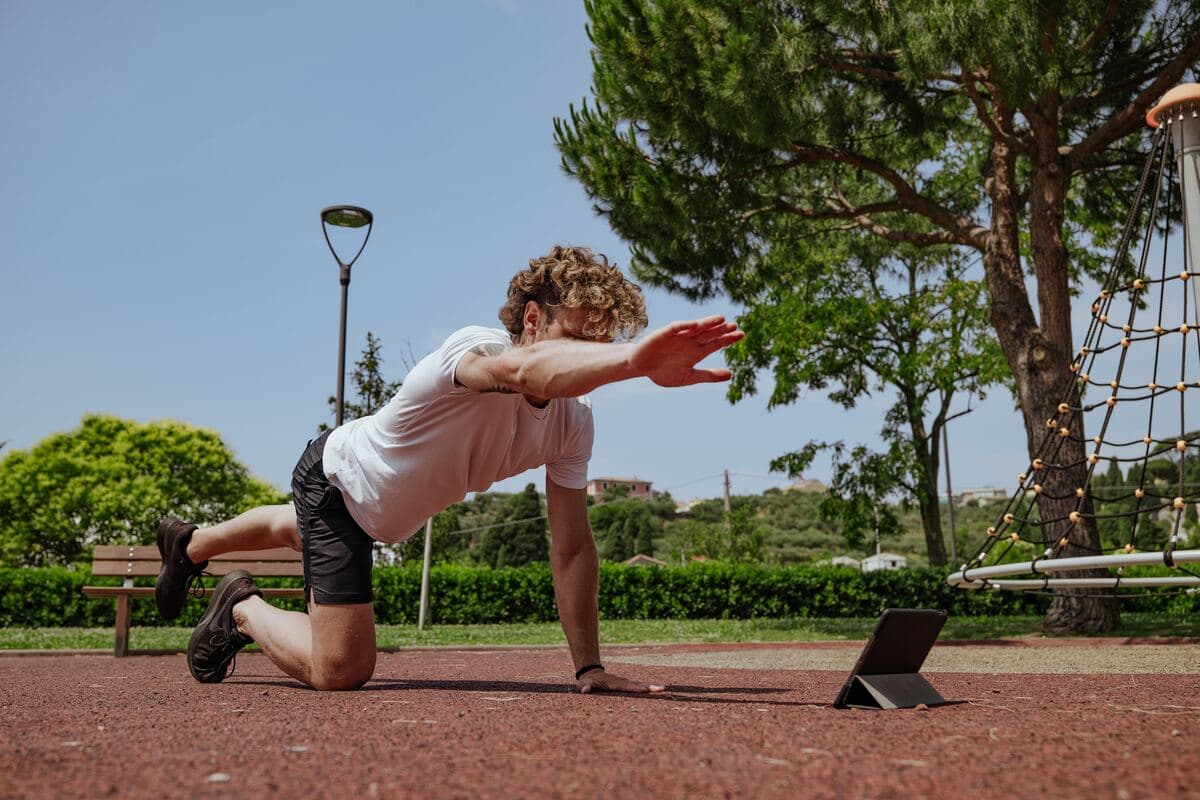
Bird dog. For trunk control while you move arms and legs. Two or three sets of six to eight repetitions per side, three times a week. The full progression is in the guide to the bird dog.
If under load the pelvis rolls under at the bottom of a deep squat, the so-called "butt wink", caution with heavy loads is reasonable, but let us also say what we do not know: it has not been shown that this movement causes damage. Sensible work concerns hip mobility and control, not postural corrections while standing still.
If lower back discomfort has stayed with you for weeks and you cannot tell which positions and loads your body is tolerating poorly right now, being watched while you move is worth more than any assessment made from a photo. Start with the questionnaire to be seen by one of our physiotherapists.
When pelvic inclination really matters
There are situations in which measuring the orientation of the pelvis is clinically decisive. They all share one feature: they are the domain of the specialist, and none is addressed with postural self-correction.
Outcomes of neuromuscular conditions. In cerebral palsy, for example, the orientation of the pelvis is part of the instrumental gait analysis. In a study of 29 adolescents, those with a knee flexion greater than 25 degrees showed less anterior pelvic tilt and altered muscle lengths during the stance phase: data used to plan tailored surgical and non-surgical interventions, not to do exercises at home.
Spinal surgery. In planning a fusion or a reconstruction of alignment, pelvic parameters are surgical targets. This is the context in which the formulas for ideal lordosis were born, and the reason those numbers end up badly when applied to someone with no surgical indication.
Deformity and structural conditions. In a series of 205 patients with lumbar stenosis, pelvic inclination was closely correlated with the mismatch between pelvic incidence and lordosis: the pelvis rotates to compensate, not because the person sits badly. Here inclination is a sign to read, not an error to correct.
If you fall into one of these categories, you already have a specialist reference. If you do not, those parameters are not your measure.
Signs that need a doctor, not an exercise
These are not negotiable. Stop the exercises and get checked without delay if any of these pictures appears.
- Difficulty urinating or holding urine and stools, loss of sensation in the saddle area between genitals, perineum and inner thighs: suspect cauda equina syndrome, go to the emergency department straight away. It is rare (estimated at around 0.04 per cent of back pain in general practice), but it is an emergency in which time changes the outcome.
- A worsening neurological deficit: strength progressively falling in a leg or foot, an area of numbness that spreads. Urgent assessment.
- Fever, chills or general malaise together with back pain: an infectious problem must be ruled out.
- Pain that appeared after a trauma, a fall or an accident, especially if you have osteoporosis or have been taking corticosteroids for a long time.
- History of cancer, unexplained weight loss, night pain that does not ease in any position. Back pain can be the first manifestation of malignant spinal cord compression, which is described in the literature as a picture that at first resembles simple low back pain.
Exercises that clearly increase your symptoms for more than twenty-four hours are also a reason to stop and ask. If instead it is an acute episode without these signs, in the first 48 hours the priorities are different.
The essential point
Pelvic retroversion is not a diagnosis and it is not a fault. Among people without any pain, pelvic inclination varies enormously, and a substantial share of those who are doing very well have an alignment that would be judged non-ideal. The postural differences found between those with and without low back pain are small, inconsistent across studies and, for lordosis, oriented in the opposite direction to the myth: no study allows us to say that your pelvis is the cause of your pain.
This does not make the pain less real. It only shifts the useful work: moving, varying position, building strength and tolerance to load, understanding which direction gives you relief. And leaving pelvic parameters to those who really need them, namely people with a neuromuscular condition, a structural deformity or a spinal operation on the horizon.
If doubt remains, the most effective thing is an assessment of how you move. Talk to a physiotherapist and build a plan together that fits you, without chasing a posture that does not exist.
If you have been told your back is too arched, it is worth reading what the data really say: Lumbar hyperlordosis: exercises and what the research says.
The mirror picture, which concerns pelvis and lower back, is called lower cross syndrome.
Sources
- Postural asymmetry in low back pain: a systematic review and meta-analysis of observational studies, Disability and Rehabilitation, 2025
- Age and Gender Based Spinopelvic and Regional Spinal Alignment in Asymptomatic Adult Volunteers: Results of the Multi-Ethnic Alignment Normative Study (MEANS), Spine, 2022
- Predictive formulae of ideal lumbar lordosis determined by individual pelvic incidence and thoracic kyphosis in asymptomatic adults, Journal of Orthopaedic Science, 2022
- Prolonged sitting at work is associated with a favorable time course of low-back pain among blue-collar workers: a prospective study in the DPhacto cohort, Scandinavian Journal of Work, Environment and Health, 2018
- Back Pain Related with Age, Anthropometric Variables, Sagittal Spinal Curvatures, Hamstring Extensibility, Physical Activity and Health Related Quality of Life in Male and Female High School Students, International Journal of Environmental Research and Public Health, 2020
- Impact of isolated lumbar extension strength training on reducing nonspecific low back pain, disability, and improving function: a systematic review and meta-analysis, Scientific Reports, 2025
- The McKenzie Method delivered by credentialed therapists for chronic low back pain with directional preference: systematic review with meta-analysis, Journal of Manual and Manipulative Therapy, 2025
- Evaluation of the effects of a novel exercise program in the treatment of low back pain in women working in a seated position: A randomized trial, Journal of Back and Musculoskeletal Rehabilitation, 2023
- Lower Extremity Muscle Tendon Interaction Around Knee During Gait Among Adolescent Children with Cerebral Palsy with Varying Crouch Angle, Indian Journal of Orthopaedics, 2024
- Sagittal Parameters of Spine-Pelvis-Hip Joints in Patients with Lumbar Spinal Stenosis, Orthopaedic Surgery, 2022
- Neoplastic malignant cord compression mimicking low back pain: A case report, Physiotherapy Research International, 2023
Last source check: August 2026.