Single-leg balance, standing on one leg alone, looks like child's play, yet it is one of the most reliable signs of how your movement control system is doing. The test lasts thirty seconds and requires nothing: just a wall nearby, for safety.
⚠ Important: read this before continuing
The exercises and advice in this article are general guidance and may not suit your situation. Every person has a unique clinical history: what works for others could be counterproductive for you.
Want a professional's opinion? Start with the questionnaire: you sign up and see who will follow you, a physiotherapist registered with the Albo chosen for your case, whom you can write to in chat. If you would rather hear a voice first, the first consultation is free and we look at your situation together.
How to train single-leg balance: the steps
- Standing, gradually shift your body weight onto one leg.
- Lift the other foot off the floor, keeping the knee of the supporting leg slightly bent.
- Fix your gaze on a point in front of you and engage your core to stabilise yourself.
- Hold for 20-30 seconds, then switch legs. Do 3 repetitions per side.
- To increase the difficulty: close your eyes, or stand on a cushion or soft surface.
Why single-leg balance matters more than it seems
It is not a gym exercise: it is something you already do hundreds of times a day without noticing.
Walking. Every step has a phase in which one foot is in the air and all the weight is on the other. Walking is a sequence of single-leg stances.
Running. The same, but with much higher forces at each impact and no moment when both feet are on the ground.
Going up and down stairs. Every step requires you to control your body on a single support, and going down the load is greater.
Sport. Changes of direction, jumps, kicks, sprints: almost no sporting movement happens on two feet.
The risk of falling. In older adults, the ability to hold on one limb is one of the indicators used to estimate the risk of falling: it is precisely what the studies cited at the end measure.
An important point: before trying these exercises, make sure you have received a correct diagnosis. People often assume they have one problem, but the real cause of the pain is something else. Doing the wrong exercises can make things worse instead of better.
The three systems behind single-leg balance
Proprioception. Receptors inside muscles, tendons and joints tell the brain where the body is, moment by moment, without needing to look.
The vestibular system. In the inner ear, it records the position and movements of the head in space.
Vision. It provides external reference points. This is why with eyes closed everything suddenly becomes much harder: a substantial share of the information is removed.
The brain puts the three streams together and generates continuous micro-corrections. When one of the three weakens, after a sprain, with age, or after a period of inactivity, the other two have to compensate, and stability drops.
The muscles that work
| Area | Muscles | What they do |
|---|---|---|
| Ankle | peroneals, tibialis posterior, calf triceps | correct the smallest and fastest sways |
| Knee | quadriceps, hamstrings | keep the joint stable under load |
| Hip | gluteus medius and minimus | stop the pelvis from dropping on the raised side |
| Trunk | core muscles | keep the torso aligned above the support |
The most common weak point is the gluteus medius: when it gives way, the pelvis drops on the side of the raised leg and the knee caves inwards. It is a compensation that can be seen with the naked eye, and it is the same pattern behind many knee and hip pains.
How to measure your single-leg balance
Single leg stance, eyes open. Standing on one leg, timed. As an orientation threshold, 30 seconds is used: below that, there is usually room for improvement.
Eyes closed. Much harder, because you remove the visual reference points. Here the reference threshold drops to around 10 seconds.
Y-Balance test. On one leg, you extend the other in three directions trying to reach as far as possible. It measures control in motion, not only static holding.
Single leg squat. A squat on one leg: it shows how you cope under load and it is the test where compensations are most visible.
Two honest caveats. The first: these values are orientation thresholds, not a medical report. They help you understand where you are starting from and measure your progress, and normal holding time decreases with age. The second, which matters most: always compare the right and the left. A marked difference between the two sides says more than the absolute number.
If the foot you are looking at belongs to your child, these thresholds are not for them: they are designed for adults. In children, the two questions that come up most often are flat feet, which is almost always a normal variant that resolves on its own, and walking on tiptoes, where the signal that matters is not the toe walking itself but the difference between one side and the other, the same right-left comparison I mentioned above. And if you are watching because your child falls often, the number of falls matters less than it seems: what guides you is the direction over time, that is, whether they fall less as the weeks go by. How many falls are expected at each age is covered in when falling is normal and when it is not. If the concern is about your child, a physiotherapist who works with children and teenagers is the one to look at them: that is the Ri-Hub Junior line.
Where to start
Tandem stance. Feet in line, one in front of the other. A reduced base of support but not yet a single foot. 30-60 seconds.
With light support. On one leg, lightly touching a wall or the back of a chair. 30 seconds per side.
Without support. On one leg, eyes open, stable surface. 30-60 seconds per side.
Alternating weight. Standing, shift the load from one leg to the other, lifting the opposite foot just slightly.
Intermediate level
With eyes closed. Start from 10 seconds and build up gradually.
With movement. On one leg, move your arms or the free leg: add disturbances that the body has to absorb.
On a soft surface. A cushion or a thick mat makes the support unstable. 30 seconds per side.
Single leg reach. On one leg, touch points in different directions with the other: control in all directions, not only forward.
Advanced level
On a BOSU. An unstable semi-spherical surface.
Cushion with eyes closed. The most demanding combination: instability without vision.
Single leg RDL. The Romanian deadlift on one leg: balance under load and in motion together.
Pistol squat. A full squat on one leg. It requires strength as well as control.
Hopping on one leg. Forwards, sideways, diagonally: this is the level that serves those returning to sport.
How much single-leg balance really prevents
Ankle sprains. After a sprain, proprioception stays impaired even when the pain has gone: retraining it is what reduces recurrences.
Anterior cruciate ligament. Work on one limb alone is a recognised component of cruciate ligament injury prevention programmes.
Patellofemoral pain. Improving control of the pelvis and knee in single support takes load off the joint.
Falls in older adults. This is the area with the strongest evidence: programmes that include balance work significantly reduce the risk of falling.
How to fit it into the week
- Frequency: 3-5 times a week. Consistency matters more than intensity.
- When: during the warm-up, as activation, or in short breaks through the day, even while you brush your teeth.
- Duration: 5-10 minutes is enough.
- Progression: one difficult element at a time (eyes closed first, then the unstable surface), not all together.
The mistakes I see most often
- Rushing the progressions. Master one level before moving to the next: haste gets you nowhere here.
- Holding your breath. It happens to almost everyone when concentrating. Breathe.
- Stiffening up. Tense shoulders and a locked body make stability worse: balance is maintained by continuous micro-adjustments, not by rigidity.
- Training only the good side. It is natural to avoid the weak side, and that is exactly the side that needs the most training.
Doing it with a physiotherapist watching
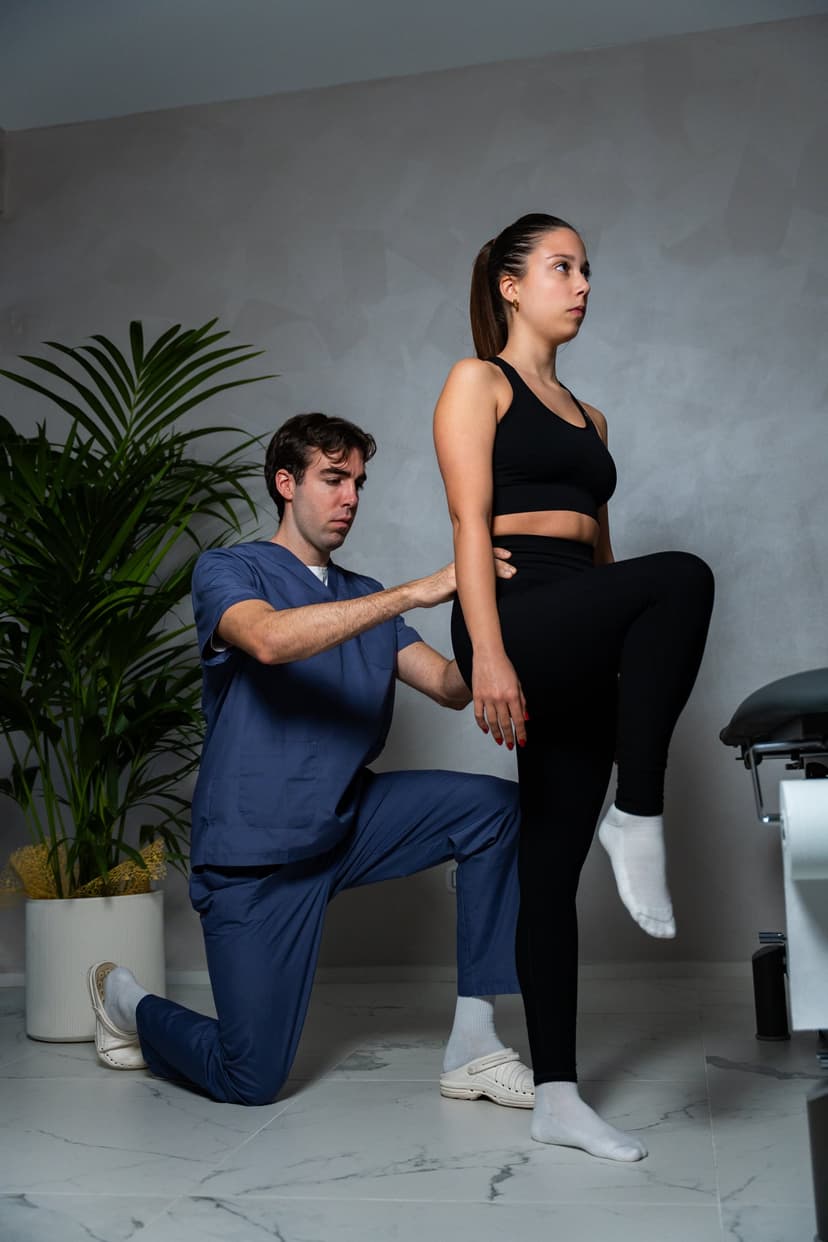
In single-leg balance, the part you cannot see on your own is the compensations: the pelvis dropping, the knee caving in, the big toe gripping the floor. These are what tell you which link in the chain is weak, and they are corrected by watching the execution.
With Ri-Hub the assessment is done by video call, the physiotherapist sets the progression to your level and corrects it while you perform it. The session costs 29,90€ and the first consultation is free.
You might also like:
Stay in touch with us
Join our dedicated Facebook group: we answer all patients, give practical advice and clear up the most common doubts.
If your balance is affected by dizziness rather than weakness, the path is different: Dizziness and light-headedness.
Standing on one foot is also a developmental milestone: when it arrives, and what comes next, is covered in When a child starts to jump, run and climb stairs.
Sources
- Predicting falls in older adults: an umbrella review of instruments assessing gait, balance, and functional mobility, BMC Geriatrics, 2022
- Functional Reach Test, Single-Leg Stance Test, and Tinetti Performance-Oriented Mobility Assessment for the Prediction of Falls in Older Adults: A Systematic Review, Physical Therapy, 2021
Last source check: September 2026.
If you are looking for other movements explained this way, you will find them in the exercise library: eighty-three guides with execution, mistakes and progressions.
Need a consultation?
Start the questionnaire on Ri-Hub: a few questions about your case, you sign up, and you see who will follow you: a physiotherapist registered with the Albo, whom you can write to in chat whenever you like. If you would rather talk it through by voice, the first consultation is free, lasts twenty minutes and commits you to nothing: they arrive having already read what you wrote, and together you decide whether and how to go on.
Sources
- Standing balance test for fall prediction in older adults: a 6-month longitudinal study, BMC Geriatrics
- Narrow Walk, Condition II, Semi-Tandem, Tandem, and Single Leg Stance Test Failure Could Predict Falls in Older Adults, Inquiry
- Falls, World Health Organization
Last source check: August 2026.