A home physiotherapy session in Italy usually costs 60-120 €, compared with 40-70 € for a session in a clinic. It is the most expensive option available, and over a full course of 8-10 sessions it comes to 480-1,200 €.
The point, however, is not just the figure: it is understanding when that extra cost buys something real and when you are instead paying more for a service that, in your specific situation, you could get in another way. This guide answers both questions, with the figures that almost nobody writes out in full.
| Indicative cost | |
|---|---|
| Single session at home | 60 – 120 € |
| Course of 8 sessions | 480 – 960 € |
| Course of 10-12 sessions | 600 – 1,440 € |
| Travel supplement outside the city | 10 – 30 € per session |
| Session in a clinic (comparison) | 40 – 70 € |
| Online session with Ri-Hub (comparison) | 29,90 € |
These are indicative ranges drawn from practitioners' public price lists, not an official price schedule: in physiotherapy the price is set by nobody. If you want the full picture of prices, clinic by clinic and by type of treatment, we have collected it in the guide on how much physiotherapy costs. Here we stay on home visits.
Why home visits cost more
The surcharge compared with a clinic is not a clever mark-up: it is the cost of a resource the practitioner cannot recover in any way, their own travel time.
A physiotherapist who works in a clinic sees four or five patients in a morning. The same physiotherapist driving to homes, in that same morning, sees two or three: between travel, parking, going up and down stairs, and setting up and packing away the portable couch, each session costs them forty extra minutes of unbillable work. The higher rate is that time, not better treatment.
Understanding this serves two purposes: to stop perceiving the price as unfair, and to know which levers you can pull, because almost all of them concern logistics, not the service itself.
What really determines the price
Distance. This is the number one factor. Many practitioners have a base rate for a radius of a few kilometres and a supplement beyond that threshold, usually 10-30 €. If you live on the outskirts or in a neighbouring town, ask explicitly before booking: it is the item that most often appears on an invoice without having been announced.
The city. In metropolitan areas prices are consistently above 80 €, not only because of the cost of living but because traffic lengthens journeys. In medium and small towns, paradoxically, home visits cost relatively less than clinic sessions: distances are short and the practitioner loses less time.
Actual duration. A home session "of one hour" is sometimes forty real minutes, because setting up is included in the hour. Ask how long the treatment lasts, not the visit.
Time slot. Evenings after 7 pm, Saturdays and public holidays often carry a supplement. For people who work, that is precisely the slot they need, and it is right to factor it in from the start.
Number of sessions. This is the lever that shifts the final spend the most. Many practitioners apply a reduced rate to someone who books a full course, because they can organise their weekly round with certainty. A package of ten sessions can cost 10-20% less than the sum of the individual sessions.
Equipment that does not fit in the home. This is the factor nobody considers, and it deserves a separate discussion.
What the physiotherapist cannot bring to your home
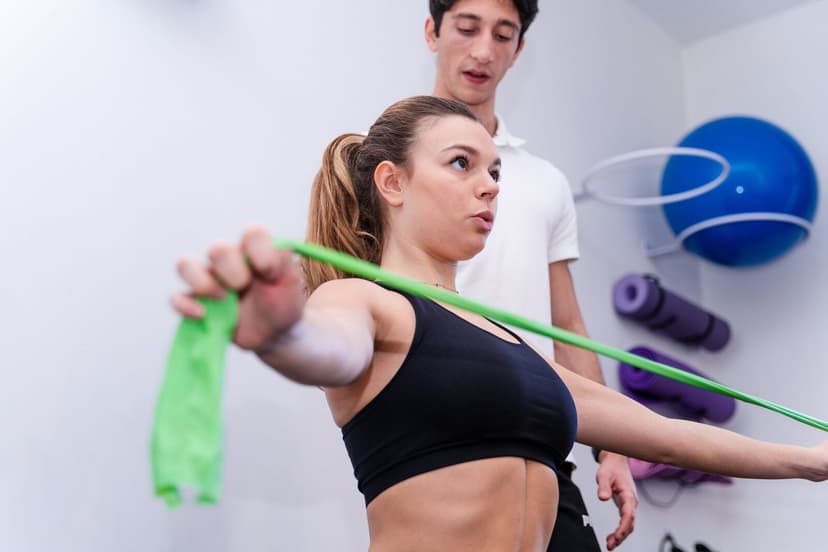
A home visit brings the portable couch, resistance bands, light weights and sometimes a small device for instrumental therapy. What does not come, and never will, are force plates, isokinetic machines, treadmills, rehabilitation pools and the gym equipment that allows a operated limb to be loaded progressively.
This has a concrete financial consequence. If your course needs, at some point, measured progressive loading (typically the return to sport after a knee operation, or the advanced phases of post-operative care), home visits become the most expensive option and at the same time the least suitable: you pay the top price for a minimal gym.
The sensible reading is not "home visits are unnecessary", but: home visits are useful in one phase, not in all of them. Many well-designed courses start at home when the person cannot move and move elsewhere once they are mobile again.
When home visits are the right choice even though they cost more
There are situations in which paying 100 € instead of 50 € is simply the correct decision, and it is worth saying so clearly from those of us who work by video call.
Those who are not self-sufficient. If the person is bedridden or cannot move around the house without help, an in-person practitioner is the only serious option. There are no shortcuts and it would not be honest to suggest otherwise.
The early phase after a major operation. After a hip or knee replacement, after a surgically treated fracture, there are days when getting up and getting into a car is risky or forbidden by the surgeon. In that window, home care is not a luxury: it is what allows rehabilitation to start when it is needed, that is, straight away.
It is worth knowing that, once that initial phase is over, the available evidence is reassuring about rehabilitation done at home. A systematic review with meta-analysis comparing home-based and outpatient rehabilitation after knee replacement found no significant differences in range of motion, functional scores or quality of life, nor in complications or readmissions, with an advantage in costs for the home-based option (Zhao B et al., J Orthop Surg Res, 2023). If you are in this situation, we have gathered the concrete work of the next phase in the guide to exercises to do at home after knee replacement.
Returning home after a stroke. Here is one of the strongest pieces of evidence in favour of home-based rehabilitation. A meta-analysis of individual patient data from 1,597 patients in eleven randomised trials showed that early supported discharge services, that is, leaving hospital sooner and continuing rehabilitation at home with a dedicated team, reduce the risk of death or dependency, with about six fewer unfavourable outcomes per hundred patients, and shorten the hospital stay by eight days. The greatest benefit was seen in people with mild to moderate disability and when the service was coordinated by a multidisciplinary team (Langhorne P et al., Lancet, 2005). This is not an organisational detail: it is rehabilitation brought into the environment where the person will then have to live. We cover this in more depth in the guide to the recovery pathway after a stroke.
Severe neurological conditions and disabilities that require direct physical assistance and aids available in the home.
The frail older person with a history of falls. Here home care has an added value that no other setting replicates: the practitioner sees the house. The rug that slips, the dark corridor, the bathroom step, the handhold that is missing beside the bed. The larger network meta-analysis on this topic, which analysed 192 randomised trials on older people living in their own homes, found that exercise as a single intervention reduces the number of people who fall (RR 0.83) and the rate of falls (RR 0.79), and that among the components of combined programmes associated with fewer falls are precisely the assessment and modification of the home environment (Dautzenberg L et al., J Am Geriatr Soc, 2021). If this is your goal, we have an in-depth article on preventing falls in older people.
In all these cases home care is worth every euro, and anyone who tells you otherwise is selling you something.
The point that changes the sum: most people are not in these situations
And this is where the economic reasoning turns over. A large share of people looking for home physiotherapy do not fall into any of the situations above: they walk, drive or could be accompanied, and have a common musculoskeletal problem: back pain, neck pain, shoulder, hip, knee, osteoarthritis. They simply have no time, or the clinic is inconvenient, or they do not want to go out after work.
For these people there is a third option that is neither the clinic nor the home: video-call sessions with a qualified physiotherapist, who assesses, shows the exercises, corrects how you perform them in real time while you do them, and adapts the programme week after week. If you want to understand how it works in practice, we explained it in the guide on teleRehabilitation.
Let us say precisely what it covers and what it does not, so that the comparison is fair.
It does not cover: hands-on assistance for those who cannot stand, manual therapy, passive mobilisation, support in the first transfers after an operation. If you need this, you need someone in the room with you. There is no room for interpretation on this point.
It covers well: therapeutic exercise, which is the core of treatment for the great majority of musculoskeletal problems and for the intermediate and advanced phase of almost all post-operative care. The literature on teleRehabilitation in musculoskeletal conditions reports results comparable to in-person treatment for pain and function. And there is a practical advantage that is not small: you learn the exercises in the spaces where you will actually do them, your chair, your stairs, your corridor, without having to translate anything from a well-equipped study.
For the self-sufficient older person who needs to maintain strength and balance in particular, this is often the most sensible solution: we have written about it in the guide to home rehabilitation for older people.
With Ri-Hub a session costs 29,90 €, and the first assessment consultation is free. If you are not sure which of the three options is right for you, start from the questionnaire: in twenty minutes a physiotherapist registered with the Albo will honestly tell you how your case should be handled. And if you need hands-on work, you do not have to look for anyone yourself: the in-person session, whether in a clinic in our network or at your home, is established by them, based on your case.
Home, clinic and video call: an honest comparison
| At home | In a clinic | Online (video call) | |
|---|---|---|---|
| Cost per session | 60-120 € | 40-70 € | 29,90 € |
| Session length | 45-60 min | 45-60 min | 30 min, entirely focused on you |
| Travel | None | At your expense | None |
| Manual therapy | Yes | Yes | No |
| Guided and correct exercise | Yes | Yes | Yes, in real time |
| People who are not self-sufficient | Only option | Difficult | Not suitable |
| Early post-operative care | Ideal | Difficult | Not suitable |
| Progressive loading with equipment | No | Yes | No |
| Assessment of the home environment | Yes, direct | No | Partial, by video |
| Common musculoskeletal pain | Effective, expensive | Effective | Effective, affordable |
| Schedule flexibility | Medium | Low to medium | High, including evenings |
| Continuity over long courses | Often interrupted by cost | Depends on distance | Easy to keep up |
The right reading of this table is not "one wins on everything". It is that the best option is the one you can see through to the end. A course interrupted at the fourth session because it has become unsustainable is not half a result: it is spending that did not produce the change it was meant to produce.
And the three do not exclude each other. The most common route among well-designed courses is mixed: home visits in the phase when the person cannot move, clinic sessions when equipment and loading are needed, and video calls for the long part of exercise and maintenance, which is the part that lasts months and decides the final result.
Tax deduction at 19% and prescription
Home physiotherapy expenses are deductible at 19% in the income tax return, on the part above the 129,11 € threshold. On a course of 800 € that means about 127 € of tax saved: it does not change the decision, but it should be factored in.
There are two practical conditions, often misunderstood.
The invoice. It must show the professional figure (physiotherapist) and the service provided. According to the Agenzia delle Entrate (Italian Revenue Agency), for services by rehabilitative health professions a specific medical prescription is not required, provided that these two elements appear on the document. A generic receipt that just says "treatment" is the most frequent reason why a real expense is not subsequently recognised.
Traceable payment. Since 2020 the deduction for health services provided by unaccredited private practitioners requires payment by traceable means: bank transfer, card, debit card, app. Cash is not deductible, even with a regular invoice. For home physiotherapy this is the most common trap, because it is the setting where paying cash at the front door comes most naturally.
There is also the public route: home rehabilitation through the ASL home care services, which fall within the Essential Levels of Care. It is designed for people who cannot be transported to a clinic, the request starts with the family doctor, and access criteria and timings vary considerably from region to region. If the person to be treated is in that situation, it is the first channel to check before paying privately.
How to choose a home physiotherapist
Check their registration. Physiotherapy is an ordered health profession: the practitioner must be registered with the provincial register at the TSRM and PSTRP order, and the register is public and can be searched. This is not a formality: at home, without the framework of a facility, you are the only quality check. If you want to know what they can and cannot do, we explained it in the guide on what a physiotherapist does.
Ask these things before the first session, all together, by phone:
- the rate per session and whether there is a travel supplement for your address;
- how many minutes the actual treatment lasts;
- whether they issue an invoice and accept traceable payments;
- how many sessions they expect, with the caveat that a serious estimate comes after the assessment, not before;
- what happens if after three or four sessions nothing has changed;
- whether they have specific experience of your condition, especially in neurological or post-surgical settings.
Be wary of some things, which count as warning signs whatever the price:
- anyone who promises a cure or talks about guaranteed success rates: no serious professional does this;
- anyone who sells a package of twenty sessions before having assessed the person;
- anyone who offers only passive treatments (machines, massage) without ever moving on to exercise: for common musculoskeletal problems, guidelines indicate therapeutic exercise as first-choice treatment;
- anyone who does not issue an invoice, or asks for cash "to be quicker": apart from the tax issue, you lose the deduction;
- anyone who never reassesses and repeats the identical session for weeks.
One last criterion, not very intuitive: ask what happens when the person starts moving again. A practitioner who has your course in mind, rather than their own weekly round, will tell you spontaneously at what point home visits stop making sense. Those who never mention it usually have no end point in mind.
In short
Home physiotherapy costs 60-120 € per session because you are buying the practitioner's travel time, and over a full course it comes to 480-1,200 €. That cost is fully justified when the person cannot move, has just had an operation, has had a stroke, or is a frail older person for whom the home itself is part of the problem: in those situations the evidence favours work done at home.
When instead the person is mobile and the problem is musculoskeletal, the sum needs to be redone: you are paying the most expensive option to obtain a thing, guided and correct exercise, which can be obtained well by video call at a third of the price. Not because online is equivalent to everything: it is not, and we have said so above without beating around the bush, but because for that specific need it is enough.
Frequently asked questions about home physiotherapy
How much does a home physiotherapist cost?
A home physiotherapy session usually costs 60-120 €, compared with 40-70 € for a session in a clinic. The difference pays for the practitioner's travel time, not a different service: in the same hour in which they reach your home, they could have seen another patient.
How much does a course of home physiotherapy cost?
A serious rehabilitation course rarely goes below 8-10 sessions: at home that means 480-1,200 € in total. The number of sessions determines the final spend, far more than the rate of a single session.
What determines the price of home physiotherapy?
The distance to cover and the traffic, the city, the actual length of the treatment, the time slot (evenings and weekends cost more), the number of sessions booked together and the fact that some equipment cannot be brought into the home.
Is home physiotherapy tax deductible in the 730 return?
Yes, at 19% on the part above the 129,11 € threshold, provided the invoice shows the professional figure (physiotherapist) and the service provided. Payment must be traceable: bank transfer, card or debit card, never cash.
Can you get home physiotherapy through the national health service (SSN)?
Yes, through the ASL home care services, which fall within the Essential Levels of Care. They are intended for people who cannot be transported to a clinic, and the request starts with the family doctor. Access criteria and timings vary from region to region.
When is home care the better choice and when is online enough?
Home care is the right choice, even though it costs more, when the person is not self-sufficient, is in the early phase after an operation or needs direct hands-on assistance. If instead the person is mobile and the core of the treatment is therapeutic exercise, guided exercise by video call covers the same need well at a much lower cost.
How do you choose a home physiotherapist?
By checking their registration with the provincial register of physiotherapists at the TSRM and PSTRP order, asking in advance about rates, duration, travel costs and the number of sessions planned, and steering clear of anyone who promises certain cures or sells very long courses before the assessment.
The third way: online, with hands close to you
There is a piece that until a year ago was missing from any comparison between clinic, home and video call, and that today changes the sum: the hands do not necessarily have to come to your home, and you do not necessarily have to go to a clinic every week.
The course is done online: assessment, exercises, progression, check-ups, with the same physiotherapist from start to finish. When the course shows that your case needs manual work, it is they who tell you and send you to a physiotherapist in the network close to your home, with the plan already written: you do not have to recount your story a second time, and the following session you are back with yours, online.
The sum, for those who can travel: once in a while you move, instead of paying 60-120 € every time for someone else to move. For those who cannot move, home care remains the right answer, and this article exists precisely to say so.
And the figures, in full, because they are the question you came with. The online course costs 29,90 € per individual session, with the first consultation free. When manual work is needed, at a clinic in the network a session costs 59,90 € for fifty minutes; at your home it starts from 79,90 €, because home visits rise with distance, and you see the exact figure before paying, it does not reach you afterwards. Compare them with the market ranges shown above: 40-70 € for a clinic and 60-120 € for home.
One thing you will not find in the price list, and it is the point: you do not choose them. There is no button to buy a session at your home. It is offered to you by the physiotherapist who follows you online when your course shows it is needed, and if it is not needed they do not offer it: this is also why the final bill for a course with us does not look like ten home sessions in a row.
How the in-person session works · formats and prices
Let us talk before you spend
If you are looking for home physiotherapy for yourself or a family member, the most useful thing you can do before committing 800 € is to understand which of the cases above you are in: start from the questionnaire, twenty minutes on a video call with a physiotherapist registered with the Albo, with the time reserved for you. If the answer is that you need hands, you do not have to look for anyone: the in-person session, whether in a clinic in the network or at your home, is established by the physiotherapist who follows you online, based on your case, and they offer it to you in chat. If we cannot reach you in your area, we will tell you that too: our interest is that you take the right course.
Sources
- Zhao B et al., Effectiveness and safety of outpatient rehabilitation versus home-based rehabilitation after knee arthroplasty: a systematic review and meta-analysis. Journal of Orthopaedic Surgery and Research, 2023
- Langhorne P et al., Early supported discharge services for stroke patients: a meta-analysis of individual patients' data. The Lancet, 2005
- Dautzenberg L et al., Interventions for preventing falls and fall-related fractures in community-dwelling older adults: a systematic review and network meta-analysis. Journal of the American Geriatrics Society, 2021
- Cottrell MA et al., Real-time telerehabilitation for the treatment of musculoskeletal conditions is effective and comparable to standard practice: a systematic review and meta-analysis. Clinical Rehabilitation, 2017
- Seron P et al., Effectiveness of telerehabilitation in physical therapy: a rapid overview. Physical Therapy, 2021
- Deductible healthcare expenses, Agenzia delle Entrate
Last source check: August 2026.