


Shoulder dislocation rehabilitation: this is the search of someone who has just left the emergency room with a brace on and wants to understand what happens now. This guide answers, but it starts from a clarification you will rarely find elsewhere: the belief that rehabilitation eliminates the risk of a new dislocation has not been demonstrated by research. That does not mean it is not needed. It means it is needed for other reasons, and knowing which ones changes the way you approach the coming months.
Earlier versions of this article reported that "up to 90% of young people under 20 who do not follow adequate rehabilitation go on to dislocate again". That figure has been removed because it does not stand up to comparison with the sources: high recurrence rates in young people are documented also in those who did have physiotherapy, and no randomised study has ever compared "rehabilitation yes" against "rehabilitation no".
⚠ Important: read this before continuing
The exercises and advice in this article are general indications and may not be suitable for your situation. Every person has a unique clinical history: what works for others could be counterproductive for you.
Want a professional's opinion? Start with the questionnaire: you register and see who will follow you, a physiotherapist registered with the Albo chosen for your case, whom you write to in chat. If you would rather hear their voice, the first consultation is free and we look at your situation together.
Shoulder popped out, dislocated, subluxed: the three words
"Shoulder popped out" is how most people describe what the report calls a dislocation: the head of the humerus has come out of its socket. They are the same thing described in two ways.
A subluxation is instead a different event, and the difference matters for what happens next: the head of the humerus comes out only partly and goes back in by itself, in an instant. People who experience it often describe it as "the shoulder slipped out and then went back into place", sometimes without even strong pain. It does not require anyone to reduce it, but it is not an episode to file away: it is the same mechanism as a dislocation, and the work on stability described on this page serves the same purpose.
First of all: the signs that require a doctor, not an exercise
A dislocated shoulder is a joint trauma, not a muscle pain. Some situations must be managed in hospital and not with an exercise programme. If you recognise one of these pictures, stop here and see a doctor.
The shoulder is still out of place. Squared-off profile, arm that seems locked slightly away from the body, complete inability to rotate it. Reduction is a medical manoeuvre: attempts done at home or by friends or teammates can turn a simple dislocation into a dislocation with a fracture.
Tingling, numbness or a "dead zone" on the outer side of the shoulder. This is the territory of the axillary nerve, which runs in close contact with the head of the humerus and can suffer during the displacement. It needs to be assessed: if the deltoid does not contract, no strengthening exercise is appropriate until the situation is clear.
The hand is cold, pale, or the pulse at the wrist is hard to feel. This is a suspicion of vascular compromise and requires urgent access to the emergency room.
After reduction you cannot actively raise the arm. This is the most overlooked signal, and it mainly concerns people who are no longer young. In the young, a dislocation typically damages the glenoid labrum; in the mature adult it often affects the rotator cuff. In a series of 67 people who had had an anterior dislocation after the age of 60, 36 had associated injuries, and in 33 of these it was a rotator cuff tear. It is a case series, so the level of evidence is low, but it is enough to justify a diagnostic investigation rather than starting straight away with bands.
Pain that does not ease, persistent deformity, fever. These must be reported to the doctor who treated you, not managed on your own.
The shoulder "comes out" with everyday movements. If after the first episode a movement above the head or a turn in bed is enough to feel it slipping, it is not a strength problem to fix with more repetitions: it is a picture of instability that deserves specialist assessment, also to check for bone loss.
What the studies really say about rehabilitation after a dislocation
This is the uncomfortable part, and you find it at the top because it conditions everything else.
No randomised study has ever compared rehabilitation with its absence. The 2019 Cochrane review on conservative treatment after closed reduction included seven studies (six randomised and one quasi-randomised) for a total of 704 participants, with literature searched up to May 2018, and all seven compared the same thing: immobilisation in external rotation against immobilisation in internal rotation. The authors state explicitly that no study had evaluated other interventions or comparisons, including rehabilitation, and add that in the meantime the evaluation of other interventions, rehabilitation included, is desirable; identifying the optimal rehabilitation interventions remains one of the goals they assign to future research. There are randomised studies comparing different rehabilitation programmes with each other (you will find one further down this page), but none that compares "rehabilitation yes" against "rehabilitation no". When you read that "physiotherapy prevents recurrences", you are reading a widespread clinical belief, not an experimental result.
Those who did have physiotherapy still had many recurrences. A prospective study of 252 people aged 15 to 35, treated with brace immobilisation followed by a physiotherapy programme, recorded, in survival analysis, the appearance of instability in 55.7% of shoulders within the first two years, a percentage that rose to 66.8% by the fifth year. These are two thirds of a population that had carried out the rehabilitation programme. The same study reports that 86.7% of people with a known recurrence developed it within the first two years: that is the period in which it is worth being cautious.
The real risk factors are mainly age and anatomy. A systematic review with meta-analysis of ten studies and 1,324 participants calculated an overall rate of recurrent instability of 39% after the first traumatic anterior episode. The risk was increased in people aged 40 or under (odds ratio 13.46), in men (odds ratio 3.18) and in the presence of hypermobility (odds ratio 2.68), while a fracture of the greater tuberosity was associated with a reduced risk (odds ratio 0.13). Physiotherapy treatment appears among the factors examined, but the authors classify that evidence as weak according to GRADE criteria, because it is based on studies of lower quality or inconsistent with each other. Put plainly: how young you are weighs more than how diligent you are with the bands.
If the goal is to reduce recurrence, the best-demonstrated lever is surgical. A systematic review with meta-analysis compared, in nine studies of 533 young patients, surgical treatment after the first episode with non-operative treatment, and found high-quality evidence of a recurrence rate of 10% after primary surgery against 55% after non-operative treatment, at over ten years of follow-up. Two honest clarifications: that "high quality" judgement concerns the specific comparison on recurrence, while the review as a whole is classified at evidence level III; and the result refers to young patients, it cannot be transferred to those who dislocate their shoulder at an advanced age. In the series of people over 60 cited above, for example, those treated without surgery recovered better function than those who were operated on, and over an average of 55 months of observation no new dislocation had occurred, with the caveat that in that series the two groups were not comparable, because the operated patients were precisely those with associated injuries. It is information the patient has a right to know before choosing, and it does not take away value from rehabilitation: it moves it onto a different plane.
The external rotation brace did not keep its promises. A meta-analysis of six randomised studies involving 632 patients found no significant differences in the recurrence rate between immobilisation in external and in internal rotation (relative risk 0.69, 95% confidence interval from 0.42 to 1.14, p = 0.15), nor differences in quality-of-life scores related to instability. The Cochrane review reaches the same conclusion with very low certainty of evidence. The point in its favour must also be stated: in the Cochrane review two studies with 135 participants recorded a better return to sport with external rotation, but only in the subgroup of those who had been injured while playing sport. If your orthopaedic surgeon chose the classic brace, you are not receiving a lower standard of treatment.
What rehabilitation does, instead, with some evidence behind it. A randomised study of 56 people with a primary or recurrent traumatic anterior dislocation compared a neuromuscular programme supervised by a physiotherapist with a standard self-managed home programme, over twelve weeks. The supervised programme was superior on the WOSI score, which measures perceived function and quality of life: a mean difference between the groups of 228.1 points in favour of the supervised programme (95% confidence interval from 25.6 to 430.5). It must be stated in full, in both directions: that difference remains below the clinical relevance threshold of 250 points that the authors themselves had set before the study, so the benefit is real but of uncertain size; on the other hand, the supervised programme was also superior on three of the four WOSI subdomains, on pain reported over the last seven days and on clinical signs of anterior instability. In the same study, participants who underwent or were referred to stabilising surgery numbered 3 out of 27 in the supervised group against 6 out of 24 in the self-managed group, a difference that was not statistically significant (p = 0.204).
The practical message is this: shoulder dislocation rehabilitation has good evidence for helping you recover movement, strength and confidence in the arm, and for getting you using it again. It does not have the evidence to promise that the shoulder will never come out again. Anyone who promises you that is selling a certainty that the literature does not offer.
An important tip: before trying these exercises, make sure you have received a correct diagnosis. People often think they have one problem, but the real cause of the pain is another. Doing the wrong exercises can make the situation worse instead of better.
The phases of rehabilitation after a shoulder dislocation
The pathway is traditionally divided into four phases. It is a clinical structure useful for organising the work, not a protocol validated by randomised studies: the weeks indicated are conventions of practice, and your orthopaedic surgeon may change them based on what they saw on the images.
Phase 1, protection (roughly the first weeks). The aim is to let the capsular and ligamentous tissues heal without asking anything of them. The arm stays in the brace for most of the time. The joints below the shoulder are moved and the muscles are kept active with isometric contractions, without moving the shoulder.
Phase 2, mobility. The range of movement is gradually recovered, starting from assisted and passive movements. External rotation with the arm away from the body is the position in which the anterior shoulder is most exposed, and it is the one recovered last and with the most caution.
Phase 3, strength. Progressive strengthening of the rotator cuff and of the muscles that control the shoulder blade. It is the longest phase and the one that brings the greatest functional gain.
Phase 4, return to activities. Sport- or work-specific movements, rapid loading, reactions to unexpected perturbations. It is the phase in which you check whether the arm holds up outside the controlled environment of the gym.
A note on the numbers that follow: the repetitions and sets indicated in the exercises are conventional starting points of clinical practice, not dosages derived from studies. They are there to give you an order of magnitude, not to set a rule.
Phase 1 exercises: protect without immobilising everything
In the first weeks after a shoulder dislocation, rehabilitation is not yet strengthening: it is keeping in motion everything that can move without disturbing the tissues that are healing.
Mobilisation of the elbow, wrist and hand. Even with the brace on, the joints below the shoulder should be moved every day to avoid stiffness and swelling in the hand. Elbow flexion and extension, wrist rotations, opening and closing the fingers. Around 15-20 repetitions, several times a day.
Isometric contractions of the cuff. With the arm protected, press the back of your hand against the wall or against your other hand without the shoulder moving: this is an isometric external rotation. Then repeat pressing with the palm, for internal rotation. Hold the contraction for a few seconds, for about ten repetitions, several times a day. It helps keep the muscle switched on while the tissues heal.
Gentle shoulder blade retraction. Bring the shoulder blades together without lifting the shoulders towards the ears and without moving the arm away from the body. Hold for a few seconds, about ten repetitions.
Phase 2 exercises: getting movement back
Pendulum exercises. Standing, leaning forward with the trunk supported, let the arm hang and use the movement of the body to make it swing in small circles and forwards and backwards. The arm must stay passive: if you are moving it with the shoulder muscles, you are not doing a pendulum. A couple of minutes, several times a day. We discuss it in detail in the guide to Codman's pendulum exercise.
Assisted flexion with a stick. Lying on your back, hold a stick with both hands and use the healthy arm to lift the operated or dislocated one upwards. The good arm does the work. About 15 repetitions for 3 sets.
Assisted abduction. Same logic, but moving the arm sideways, away from the body. Progress by a few degrees at a time.
Assisted external rotation, with caution. Elbow resting bent at the side, the stick pushes the forearm outwards. After an anterior dislocation this is the direction that puts the healed structures under the most tension: start from reduced arcs and gain gradually, never forcing to the point of "giving way".
Phase 3 exercises: the part that really changes the arm
This is the phase in which shoulder dislocation rehabilitation produces measurable results: strength, endurance, control. The study cited above compared whole programmes, not single phases, so it does not say that this is where supervision matters most: it says that a programme followed with a physiotherapist did better than a self-managed one over twelve weeks.
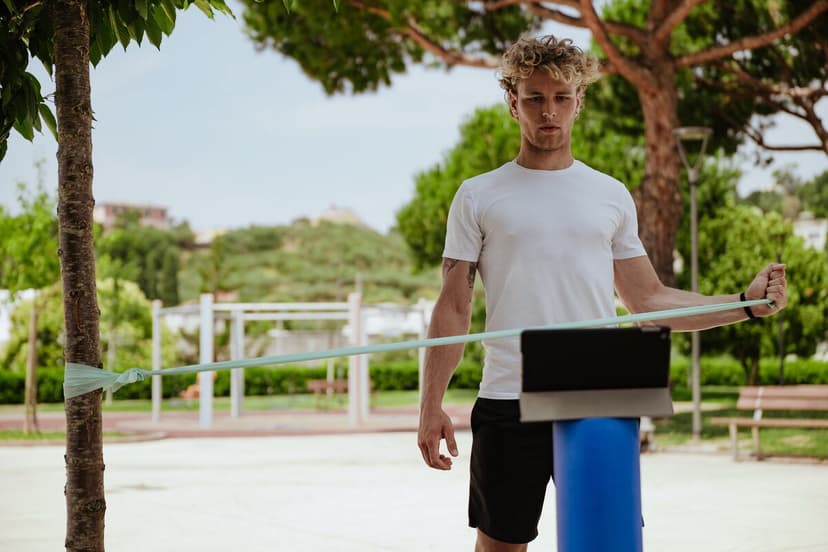
External rotation with a band. Elbow at the side bent at 90 degrees, a rolled towel between elbow and ribs so it does not drift backwards, rotate the forearm outwards against resistance. About 15 repetitions for 3 sets, a few times a week.
Internal rotation with a band. Same position, resistance from the opposite side. Internal and external rotators must both be trained: the balance between the two matters more than the absolute strength of one alone.
Horizontal row with a band. Pull the band towards you bringing the elbows back and bringing the shoulder blades together. It works the muscles that hold the shoulder blade in position, without exposing the anterior shoulder.
Y-T-I series lying face down. Lying prone, lift the arms tracing the three letters. They are three different angles on the scapular stabilisers. About 10 repetitions per position, without weights at first.
Wall push-ups. These are a closed-chain load, that is with the hand fixed: the shoulder receives compression and this helps joint control. Progress towards lower surfaces when strength allows.
If you are looking for a broader progression on strengthening, you will find it in the shoulder strengthening exercises.
Phase 4: returning to the real world
Sport-specific movements. Throwing, serving, the grip in judo, the push in climbing: they must be rebuilt in stages, first slowly and with reduced load, then at real speed. It is the part that injured people skip most often, and it is what separates a strong shoulder from a reliable one.
Rapid and multidirectional loading. Throws and catches with a medicine ball, hand-support exercises, changes of direction. They serve to ask the shoulder to react, not just to support.
Stabilisation with perturbations. The physiotherapist or a band applies unexpected pushes while you hold a position. It is the most direct way to train the reflex response, which is what comes into play when the shoulder is caught off guard.
Checks before returning. It makes sense to compare strength and control between the injured side and the healthy side before returning to full activity. The percentage thresholds circulating online have no solid validation for the unstable shoulder: use them as a common-sense reference, not as a green light. If you are looking for a broader picture of the problem, the guide to shoulder instability goes deeper into causes and symptoms.
Recovery times after a shoulder dislocation
The timelines that follow are commonly used clinical guidance, not study results. They vary widely depending on age, the type of dislocation, associated injuries and any surgery.
Light daily activities. Dressing, washing, working at a computer usually become possible within a few weeks, often before full recovery of strength.
Work with moderate demands. These generally require a few months, depending on how much the arm has to be above the head or carry loads.
Non-contact sports. Swimming, cycling, running return sooner, because they expose the shoulder little to sudden movements.
Contact sports and overhead sports. Football, rugby, martial arts, volleyball require the longest times after a shoulder dislocation. Here it is worth recalling the figure from Robinson: 86.7% of known recurrences occur within the first two years. That is not a reason to stay still for two years; it is a reason not to consider the game closed at the third month.
Individual variability. Age at the first episode, sex, hypermobility, the presence of bone lesions and the sport practised change the picture far more than any standard calendar.
After surgery
If you have had a stabilising operation, shoulder dislocation rehabilitation changes substantially. The protection times are set by the healing of the repair, not by the disappearance of pain, and the limits of movement are decided by the surgeon who operated. Post-operative instructions always take precedence over any generic programme, including this one.
The advantage of surgery, as seen above, is well documented on the recurrence front: 10% against 55% at over ten years in the meta-analysis on young patients. The cost is a longer pathway, with a return to sport that in practice lies several months after the operation and that must be agreed case by case.
Physiotherapy and telerehabilitation: where it makes sense
Shoulder dislocation rehabilitation is, for most of the pathway, a daily exercise programme done at home with minimal equipment: a stick, a band, a wall. It is exactly the type of programme that lends itself to remote supervision. Here, however, it must be said precisely where the evidence ends: in the study cited above the supervision was given by a physiotherapist in person, not on a video call, and the comparison was between a supervised programme and a self-managed one. That study therefore suggests that being supervised adds something to perceived function compared with doing it alone, with a real but not huge benefit; it does not show that the same supervision delivered at a distance produces the same result, because no study on this condition has yet checked that.
With Ri-Hub you can be followed by video call: the physiotherapist watches how you perform the movement, corrects compensations (the shoulder rising towards the ear, the elbow drifting backwards, the trunk leaning to steal a few degrees) and decides when to increase the load. What telerehabilitation cannot do is replace the diagnosis: if you have not yet had the shoulder assessed after the episode, or if you fall into one of the signals listed at the beginning, the first step is medical.
One last thing, which is in fact the reason this article has been rewritten. A well-conducted shoulder dislocation rehabilitation gives you back an arm that works, strong and controlled, and this holds for everyone. It does not guarantee that the shoulder will never come out again, and someone who is twenty, male and plays rugby deserves to know this before the second episode rather than after: with that information in hand, the conversation with the orthopaedic surgeon about conservative treatment versus surgery becomes a conscious choice instead of a fallback.
You might also be interested in:
Piriformis Syndrome: Symptoms, Causes and Effective Exercises Pancake Stretch: How to Work Up to It Gradually Muscle Strain: What to Do and Recovery Times
Stay in touch with us Join our dedicated Facebook group: we answer all patients, give practical advice and clear up the most common doubts.
Sources
- Conservative management following closed reduction of traumatic anterior dislocation of the shoulder, Cochrane Database of Systematic Reviews, 2019
- Functional outcome and risk of recurrent instability after primary traumatic anterior shoulder dislocation in young patients, The Journal of Bone and Joint Surgery (American), 2006
- Risk factors which predispose first-time traumatic anterior shoulder dislocations to recurrent instability in adults: a systematic review and meta-analysis, British Journal of Sports Medicine, 2015
- Operative Versus Nonoperative Treatment Following First-Time Anterior Shoulder Dislocation: A Systematic Review and Meta-Analysis, JBJS Reviews, 2021
- Neuromuscular Exercises Improve Shoulder Function More Than Standard Care Exercises in Patients With a Traumatic Anterior Shoulder Dislocation: A Randomized Controlled Trial, Orthopaedic Journal of Sports Medicine, 2020
- Immobilization in External Rotation Versus Internal Rotation After Primary Anterior Shoulder Dislocation: A Meta-analysis of Randomized Controlled Trials, The American Journal of Sports Medicine, 2016
- Treatment of traumatic anterior shoulder dislocation in patients older than 60 years, The American Journal of Sports Medicine, 2012
Last source check: August 2026.
Also read: Rehabilitation after Shoulder Arthroscopy.
Need a consultation?
Start with the questionnaire on Ri-Hub, a few questions about your case, you register, and see who will follow you: a physiotherapist registered with the Albo, whom you write to in chat whenever you like. If you prefer to talk it over by voice, the first consultation is free, lasts 20 minutes and commits you to nothing: they arrive having already read what you wrote, and together you decide whether and how to go on.



