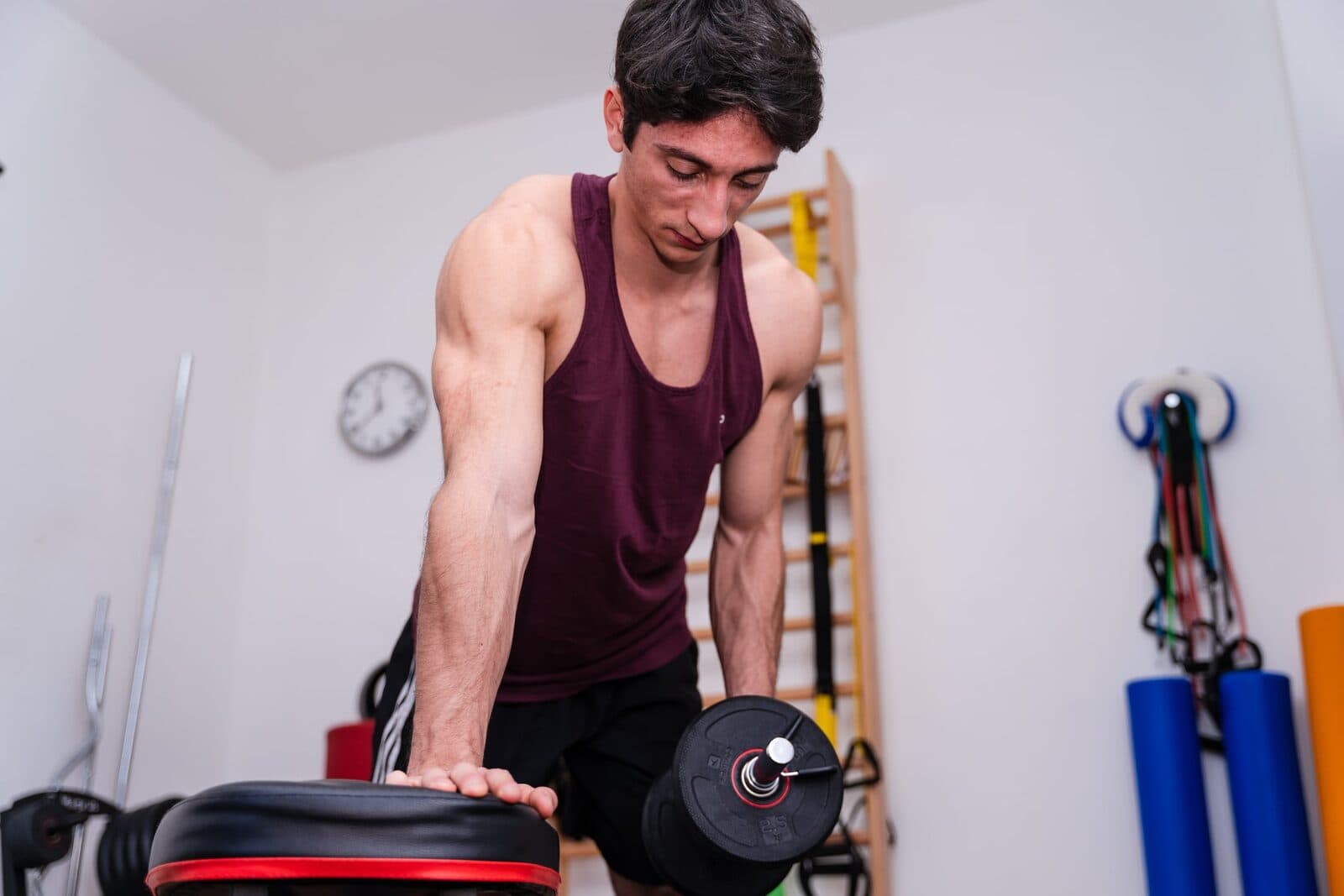
If your Achilles tendon hurts, the temptation is to stop and wait for it to pass. With tendons total rest works badly, and this is the point on which there is the most agreement: the tendon is a tissue that lives on load. The rest, which programme, at what doses, over how long, is talked about with far more certainty than the studies allow, and it is worth saying so before listing the exercises.
Here you will find a practical three-phase programme, but also what to really expect from each phase: which part holds up to the test of the data, which is a handed-down convention, and which is the sign that should make you close this page and call someone.
⚠ Important: read this before continuing
The exercises and advice in this article are general guidance and may not suit your situation. Every person has a unique clinical history: what works for others could be counterproductive for you.
Want a professional's opinion? Start with the questionnaire: you sign up and see who will follow you, a physiotherapist registered with the Register (Albo) chosen for your case, whom you can write to in chat. If you would rather hear their voice, the first consultation is free and we look at your situation together.
Before the exercises: the cases in which you do not exercise
This part should be read first, not at the end, because a couple of situations are not tendinopathies and treating them as such does harm.
A sudden snap behind the ankle, like a whip crack, with difficulty pushing off the forefoot or rising onto your toes: a tendon rupture must be ruled out, and it must be done immediately. This is not the time to try exercises.
A tendon that is very swollen, hot, and painful even at rest and at night, perhaps with other joints involved, does not behave like typical overload and merits a medical assessment.
Fluoroquinolone antibiotics and corticosteroids. This is not a marginal detail. A systematic review with meta-analysis of 15 observational studies estimated an increased risk of Achilles tendon rupture for people taking fluoroquinolones (odds ratio 2.52, 95% confidence interval 1.81 to 3.52) and of Achilles tendinitis (odds ratio 3.95, 3.11 to 5.01). The risk remained significant even above the age of 60. As for corticosteroids, the point must be made in full: in the analyses the risk estimates did not change significantly depending on whether they were taken or not, but the authors nonetheless conclude that advanced age and concomitant corticosteroid use should be considered additional risk factors. If you are in this situation, loading should be decided with whoever is following you, not from a generic guide.
Not knowing what the pain actually is. Retrocalcaneal bursitis, bone involvement, hindfoot problems and tendinopathy look rather alike and are not treated in the same way. To help you orient yourself on the symptoms, the article on Achilles tendinitis may help.
What the studies really say about exercises
Here one usually reads that exercises are the therapy. The honest version is a little different, and more useful.
The most up-to-date synthesis on Achilles tendon pain is a living systematic review with network meta-analysis: 29 randomised studies, 42 different treatments compared. The result has two halves. The first, which holds for pain in the body of the tendon, the form on which 86% of the studies rest: at three months every class of active treatment seemed superior to waiting and watching, so "stay still and it will pass" is not a good strategy. The second, less publicised: among the different active treatments no clinically relevant difference emerged, either at three or at twelve months. None of the studies was at low risk of bias in its results, 22 of 29 were at high risk, and the certainty of the evidence is classified as low to very low.
So why start with exercises? The authors themselves write it: because they are easy to prescribe, cost little and have few side effects. It is a reasonable choice for the balance of benefit, risk and cost, not a proven superiority over everything else. This changes quite a lot about how they should be approached: if nothing happens after a well-done cycle, it is not that you did them wrong, and it is legitimate to revise the plan.
On timing, too, it is worth being precise. The five-year follow-up of the most studied heel-drop programme reassessed 46 patients: the VISA-A score, which measures pain and function, had risen on average from 49.2 to 83.6, a substantial improvement sustained over time. But only 39.7% were completely pain-free, and 48.3% had in the meantime had at least one other treatment. Put simply: improvement is the rule, total disappearance of the symptom is not.
That said, a loading programme remains the most sensible thing to start with. Let us look at it.

The rules before you begin
The pain rule. Some discomfort during the exercise is acceptable, provided that by the next morning the tendon is back to how it was. If the following day it is more painful or stiffer than usual, the dose was too much: reduce the load or the repetitions, do not drop everything. This way of regulating yourself was tested in a randomised study of 38 patients, in which those who continued running and jumping while monitoring pain improved as much as those who stopped for six weeks, with no demonstrable negative effects.
Progression is slow by nature. Tendons adapt over weeks and months. The studies that showed solid results used twelve-week programmes: that is the order of magnitude, not ten days.
Where it hurts changes the programme. If the pain is in the body of the tendon, a few centimetres above the heel, what follows is fine as it is. If it is right at the attachment on the heel bone, the insertional form, the positions of maximum stretch need to be removed, and the reason is not generic caution: you will find it in the paragraph on stretching, with the numbers. If there is also a bony prominence rubbing against the shoe, the picture is called Haglund's syndrome and has its own page: Haglund's deformity.
One point matters: most of the available research concerns pain in the body of the tendon. In the network meta-analysis 86% of the studies were on this form, and for the insertional form the analysis could not be carried out. So when you read that something "has been shown", it has almost always been shown for one of the two forms.
Phase 1: Isometrics, loading when movement is too much
Isometric holds load the tendon without movement and are a good starting point when the tendon is too irritable to do anything else.
The promise that goes with them, however, needs to be scaled back. The idea that a heavy hold "switches off" pain comes from a study on a different tendon, the patellar one: six volleyball players, in whom heavy isometric contractions reduced pain immediately and for at least 45 minutes. Six people and a different tendon: that is where the recommendation spread from. On the Achilles tendon, when put to the test, it did not hold up: in an exploratory study of 16 people with Achilles tendinopathy, after a heavy 45-second isometric hold, average pain during a functional task went from 4.2 to 4.9 on a numerical scale, a non-significant difference, and only 9 of the 16 participants had pain in that task. Pressure sensitivity did not change significantly. The authors write that these holds cannot be recommended for immediate pain relief.
They therefore remain a loading tool, not a painkiller. Use them if full movement is too much, and move on to phase 2 as soon as you can.
Two-leg toe hold
- Stand facing a wall or a chair for balance.
- Rise onto your toes to about half height.
- Hold the position for 30-45 seconds, breathing normally.
- Lower slowly and rest for 1-2 minutes.
When it becomes easy, progressively shift more weight onto the painful leg, until you reach the hold on one leg.
An important tip: before trying these exercises, make sure you have received a correct diagnosis. People often think they have one problem when the real cause of the pain is another. Doing the wrong exercises can make things worse instead of better.
Phase 2: Slow, heavy strengthening, the heart of the programme
Here is the good news: there is no single mandatory protocol. A randomised study of 58 patients with chronic tendinopathy of the body of the tendon compared, over twelve weeks, the classic eccentric protocol with heavy slow resistance. Both groups improved significantly in function and pain, with reductions in tendon thickness and neovascularisation, and the results were maintained at 52 weeks. None of the clinical and structural improvements differed between the two groups. What differed was everything else: adherence, 92% of sessions completed in the heavy slow resistance group against 78% in the eccentric one, and satisfaction at 12 weeks, 100% against 80%, which did not reach significance and narrowed by 52 weeks.
It is a detail worth more than many discussions about the best protocol: the programme you can actually do beats the theoretically perfect one you skip.
On doses, the broadest meta-analysis on the subject, 110 studies, 148 treatment arms, 3,953 participants, of which 43 arms were on the Achilles tendon, found two consistent trends: effects were on average greater when an external load is added compared with bodyweight alone, and effects were on average greater with the lower frequencies (less than daily) compared with daily or multiple-times-a-day training. Volume, meaning the total number of repetitions, showed no clear associations. If you have taken away the idea that eccentrics must be done twice a day, this is the point to revise: more weight and more recovery, not more sessions.
Two-leg calf raise (from the floor)
- Stand with your feet hip-width apart, hands on the wall for balance.
- Rise onto your toes in 2-3 seconds, as high as possible.
- Pause for a second at the top.
- Lower in 3 seconds, controlling the descent.
Eccentric step variant (when the floor version is manageable, and only if the pain is in the body of the tendon)
- Balls of the feet on the edge of a step, heels hanging over.
- Rise onto your toes pushing with both legs.
- Lift the healthy leg and lower only on the painful leg, slowly, bringing the heel below the level of the step.
- Put the other leg back down to rise again.
Bent-knee calf raise
The same movement, but with the knee slightly bent: it shifts the work onto the soleus, the deep calf muscle, which contributes enormously to the load on the tendon. It is the half of the programme that almost everyone forgets.
A note on the choice between concentric and eccentric. The broadest synthesis of evidence on exercise for tendinopathies, 555 studies mapped, 204 included in the effectiveness analyses, suggests that combining the concentric and eccentric phases may do better than eccentric alone, but the credibility interval of the estimate crosses zero and the quality of the studies is low: it is an indication, not proof. In practice, going up and down slowly under load is as reasonable a choice as pure eccentric work, and it is usually better tolerated.
To increase the load, use a backpack with books or weights: when the repetitions become comfortable, add weight and reduce repetitions.
Phase 3: Back to springing, fast loading
When you can rise and lower on one leg without problems and the daily pain has almost disappeared, the Achilles tendon needs re-accustoming to the rapid loads of running and jumping: two-legged jumps on the spot, then light running on alternate days, then changes of pace.
This is the phase in which it is easiest to get the dose wrong. Increase only one variable at a time, either distance or speed, and use the same rule as before: look at how the tendon is the next morning. The well-known 10% per week threshold is a convention widespread among runners, not a verified rule: take it as a reminder not to increase everything together, not as a measurement.
Stretching: the most overrated part
The reasoning is intuitive, tight calves pull harder on the tendon, so stretching them unloads the tendon, but it is a mechanical argument, not a demonstrated result. Stretching does not repair the tendon and does not replace strengthening.
In the insertional form there is more, and it should be said clearly. A randomised study from 2025 of 42 athletes with chronic insertional tendinopathy compared two progressive loading programmes in four stages, identical in everything except one thing: in one, the compression on the tendon was reduced by limiting ankle dorsiflexion, eliminating calf stretching and introducing heel lifts. The low-compression group improved much more: 24.4 VISA-A points against 12.2 at 12 weeks (difference between groups 12.9, from 6.2 to 19.6) and 29.0 against 19.3 at 24 weeks (difference 10.4, from 3.7 to 17.1), both above the clinical relevance threshold of 10. If your pain is at the heel attachment, stretching is not a neutral add-on: removing it was part of the programme that worked best.
If, instead, the pain is in the body of the tendon, stretching does no harm and gives momentary relief to some people. Treat it as a warm-up or a pleasant habit, not as a cure.
- Gastrocnemius: standing against a wall, back leg straight, heel on the ground, push your hips forward. 30 seconds.
- Soleus: same position but with the knee of the back leg bent. 30 seconds.
You will find the full routine in the guide to calf stretching.
Summary table
| Phase | Exercise | Sets x Repetitions | Frequency |
|---|---|---|---|
| 1 | Toe hold | 4-5 x 30-45 sec | In the most irritable phase, then move on |
| 2 | Slow calf raise (straight leg) | 3 x 12 → 4 x 6 increasing the load | 3 times a week |
| 2 | Bent-knee calf raise | 3 x 12 → 4 x 6 | 3 times a week |
| 2 | Eccentric on a step (body of the tendon only) | 3 x 15 per leg | alternate days |
| 3 | Jumps / light running | gradual progression | alternate days |
| Stretch | Gastrocnemius + soleus stretching | 3 x 30 sec each | optional; remove in the insertional form |
The frequencies here are lower than those usually circulating, and this is deliberate: the dose meta-analysis found better effects with fewer sessions and more load, not the other way round.
Common mistakes
- Prolonged total rest. The pain drops, the tendon weakens, and on the first return to activity the problem comes back the same.
- Doing everything fast. Time under tension is the active ingredient: a three-second descent is worth more than ten bounces.
- Only stretching, no strength. It is the most widespread error, and it is the one the evidence dismantles most clearly.
- Multiplying sessions instead of load. Two bodyweight sessions a day produce on average less than three sessions a week with a real load.
- Increasing everything together. More weight, more repetitions and a return to running in the same week: a perfect recipe for relapse.
- Ignoring the kilometres. If the overload came from a sudden increase in running or walking, exercises alone are not enough: that too needs adjusting.
- Treating the insertional form like the body-of-tendon form. They are two different problems, with opposite indications on stretching.
When to stop and get seen
Beyond the warning signs at the start, ask for an assessment if the pain shows no sign of changing after a few weeks of well-dosed exercise, if the tendon progressively worsens despite load reductions, or if you cannot work out for yourself which of the two forms of tendinopathy you have. The distinction between the body of the tendon and the insertion is not an academic detail: it changes the exercises and changes what you need to avoid.
If the question is more general, that is, whether in this phase it is better to move or to protect yourself, the article on rest or movement may be useful.
In summary
Progressive loading is the most sensible route for the Achilles tendon: it costs little, is safe and improves most people. It is not, however, proven to be superior to other active treatments, and it almost never leads to a tendon completely free of symptoms. Knowing this changes how you work: you aim at the programme you can really do three times a week with increasing loads, you stop expecting isometrics to act as a painkiller, you drop the stretching if the pain is at the heel, and you accept that the unit of measurement is the month.
Sources
- Which treatment is most effective for patients with Achilles tendinopathy? A living systematic review with network meta-analysis of 29 randomised controlled trials, British Journal of Sports Medicine, 2021
- A 5-year follow-up study of Alfredson's heel-drop exercise programme in chronic midportion Achilles tendinopathy, British Journal of Sports Medicine, 2012
- Heavy Slow Resistance Versus Eccentric Training as Treatment for Achilles Tendinopathy: A Randomized Controlled Trial, The American Journal of Sports Medicine, 2015
- Effect of resistance exercise dose components for tendinopathy management: a systematic review with meta-analysis, British Journal of Sports Medicine, 2023
- Acute sensory and motor response to 45-s heavy isometric holds for the plantar flexors in patients with Achilles tendinopathy, Knee Surgery, Sports Traumatology, Arthroscopy, 2019
- Isometric exercise induces analgesia and reduces inhibition in patellar tendinopathy, British Journal of Sports Medicine, 2015
- Effectiveness of reducing tendon compression in the rehabilitation of insertional Achilles tendinopathy: a randomised clinical trial, British Journal of Sports Medicine, 2025
- Continued sports activity, using a pain-monitoring model, during rehabilitation in patients with Achilles tendinopathy: a randomized controlled study, The American Journal of Sports Medicine, 2007
- Fluoroquinolones and the risk of tendon injury: a systematic review and meta-analysis, European Journal of Clinical Pharmacology, 2019
- Exercise therapy for tendinopathy: a mixed-methods evidence synthesis exploring feasibility, acceptability and effectiveness, Health Technology Assessment, 2023
Last check of the sources: August 2026.
You might also be interested in:
Achilles Tendinitis: Causes, Symptoms and How to Heal
Stay in touch with us
Join our dedicated Facebook group: we answer all patients, share practical advice and clear up the most common questions.
Need a consultation?
Start with the Ri-Hub questionnaire: a few questions about your case, you sign up, and you see who will follow you: a physiotherapist registered with the Register (Albo), whom you can write to in chat whenever you like. If you would rather talk it through by voice, the first consultation is free, lasts twenty minutes and commits you to nothing: they arrive having already read what you wrote, and together you decide whether and how to continue.