


You rest a hand over your kneecap and feel that this knee is hotter than the other: burning, as people say, and sometimes both are burning. Maybe it is also swollen, a bit red, and bending it all the way no longer works. It is a sensation that sets off alarm bells, and partly that is a good thing: heat is never just a decorative detail.
In most cases a hot knee is the predictable reaction to excessive load or a blow. But a few causes, rare and serious, look exactly the same. That is why we start from the end here: first the signs that change your day, then everything else.
⚠ Important: read this before continuing
The exercises and advice in this article are general guidance and may not suit your situation. Every person has a unique clinical history: what works for others could be counterproductive for you.
Is it worth starting a programme? Answer a few questions: you register and see who will be following you, a physiotherapist on the professional Register chosen for your case, whom you write to in chat. If you would rather hear a voice, the first consultation is free and we look at your situation together.
When a hot knee is an emergency
There are four pictures that are not managed at home and not put off until Monday. If you recognise yourself in one of them, stop reading and seek urgent medical help today: the emergency department, the out-of-hours doctor or the emergency number.
Red, hot, swollen knee with fever or feeling unwell: suspected septic arthritis
It is the possibility nobody can afford to ignore. Septic arthritis is an infection of the joint, and both the review dedicated to the native adult knee and the 2024 Spanish guidelines define it as an emergency: without treatment it can lead to significant joint damage, and the diagnosis requires a high index of suspicion from the very first moment.
A detail worth reading twice. In the review on the knee, the diagnosis rests mainly on the history and on the clinical picture of a joint that is red, hot, swollen and painful with limited movement. Fever does not appear in that description. Put simply: do not wait for a fever to start worrying, and do not rule out infection just because the thermometer is normal.
Some conditions raise the risk, and the review lists them: age over 60, a recent bacteraemia, diabetes, cancer, cirrhosis, kidney disease, alcohol or substance abuse, a cortisone injection, a recent trauma or surgery, a joint prosthesis and a history of rheumatoid arthritis. If you have any of these, the threshold for going to the emergency department drops even further.
The test that clarifies the situation is the analysis of the joint fluid, and it is done in hospital. Ice, an anti-inflammatory taken on your own initiative and "let's see tomorrow" are not neutral here: they waste time and can dampen the very symptoms needed to decide. The opposite also holds, and surprises many: if a painkiller does not work it is not a sign that the problem is serious, it is a common outcome, and it says something else.
Swelling that appeared right after a trauma: haemarthrosis
If the knee swelled within an hour or two of a sprain, a blow or a twist, the fluid you feel inside is generally blood: it is called haemarthrosis, and it means that something inside the joint has torn. It is different from an inflammatory effusion, which usually takes half a day or more to form.
How common is serious damage? In a prospective study of 331 acute knee injuries with haemarthrosis sent for MRI, 187 patients (56%) had a ligament injury, and a third of them had several ligaments involved at the same time.
It should be read for what it is: these are people already selected because they were sent for an MRI, so it is not the percentage in the general population. It remains a number that explains why immediate swelling after trauma deserves a prompt assessment and not waiting.
A fracture and a kneecap dislocation must also be ruled out. If the trauma was followed by being unable to put weight on the leg, or if the knee looks deformed, the right place is the emergency department.
Swollen, painful calf: suspected deep vein thrombosis
If, besides the knee, it is the calf that is swollen, tense, painful and perhaps warmer than the other one, the suspicion changes nature: it could be a deep vein thrombosis, that is, a clot in a vein of the leg. It is not an orthopaedic problem and it is potentially dangerous, because the clot can travel.
The American Society of Hematology guidelines on the diagnosis of venous thromboembolism indicate ultrasound as the test for deep vein thrombosis of the limbs; in patients with low clinical probability, D-dimer as a first test reduces the use of imaging. Both are prescribed after a medical assessment, and that is the first step.
Watch out for a trap: a Baker's cyst that ruptures empties its contents into the calf and produces an almost identical picture. The fact that the two look so alike is not a reason to feel reassured, it is exactly the reason to get seen.
Swollen knee that will not straighten: mechanical block
If the knee is swollen and there is a point beyond which you cannot straighten it, as if there were a stop inside, there may be a fragment of meniscus or cartilage caught between the joint surfaces. It is not a protective block, that is, one due to pain: it is a real physical obstacle.
It needs to be assessed quickly. In the surgical literature on anterior cruciate ligament reconstruction, promptly treating associated meniscal injuries improves outcomes, and repair of bucket-handle tears is considered urgent. Insisting on forced mobilisation at home does not help and can make the injury worse.
The operational summary
Seek urgent medical help, today, if you have even just one of these:
- fever, chills or a general feeling of being unwell together with a hot, swollen knee
- a knee that has become red, swollen and very painful within a few hours without any trauma
- swelling that appeared within a couple of hours of a trauma, or being unable to put weight on the leg
- a swollen, tense, painful calf, with or without breathlessness
- being unable to straighten the knee completely
- a knee prosthesis, a recent injection, a wound near the joint or a weakened immune system
If none of these applies to you, the rest of the article helps you work out which scenario you are in.
Why a joint heats up
(If the problem is felt mostly at night, the positions and the mistake to avoid after surgery are in how to sleep with knee pain.)
The heat you feel to the touch is the direct result of inflammation. When a tissue is damaged or irritated, the vessels in the area dilate and more blood arrives: more blood means more temperature at the surface, and that is why an inflamed knee is warmer than its healthy twin.
That mechanism, however, can be switched on by very different families of causes: mechanical (trauma, overload), degenerative (osteoarthritis flaring up), crystal-related (gout, pseudogout), autoimmune (rheumatoid arthritis) and infectious (septic arthritis, septic bursitis). Telling them apart is not an academic exercise: the treatment changes radically.
Heat almost never travels alone. It usually brings swelling (which, if it is fluid inside the joint, is called a joint effusion), redness, pain and difficulty bending or straightening. It is the combination, and above all the context, that points the way.
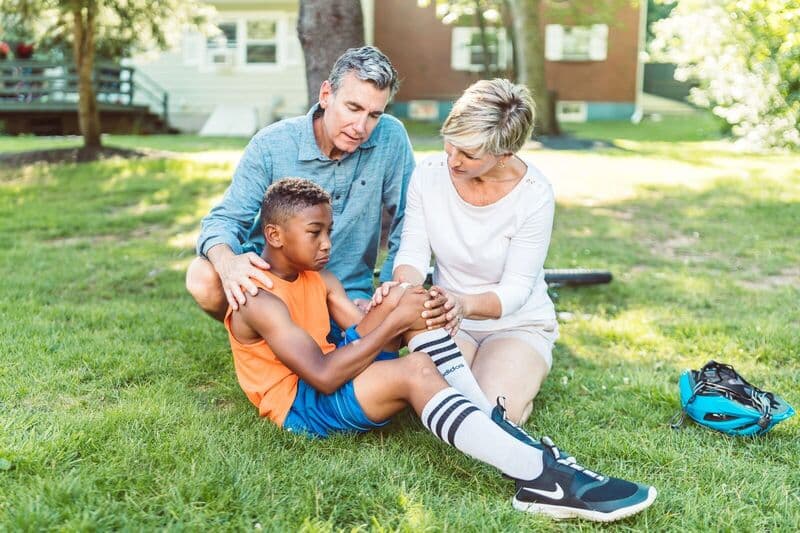
The five questions that really point the way
Before even thinking of a name, try to answer these five questions. They are the same ones the person examining you will ask, and it pays to arrive with the answers ready.
How quickly did it appear? Minutes or hours without trauma point towards crystals or infection. Hours after a trauma, towards a structural injury. Days or weeks, towards overload, osteoarthritis or inflammatory arthritis.
Is there a fever or a general feeling of being unwell? If so, infection must be ruled out first, always, no matter how plausible another explanation seems.
Was there a trauma? A recognisable trauma makes a mechanical cause much more likely, but it does not rule out the others: an infection can set in right after a trauma or a wound.
Is it one joint or more than one? A single isolated knee (what medicine calls a monoarticular picture) suggests infection, crystals, trauma or osteoarthritis. Several joints at once, perhaps symmetrical, point towards systemic inflammatory arthritis.
Has it happened before? Identical episodes that come and go, with intervals in which the knee is perfectly fine, are the portrait of a crystal arthropathy. A background pain that is always there and flares up every so often is more typical of osteoarthritis.
Traumatic causes
When there has been a trauma, heat is the predictable reaction of the tissue that was hit. The fact that matters most is not how much it hurts, but how quickly it swelled.
Sprain. A stretch or an injury to the ligaments triggers local inflammation: the knee heats up in the following hours, together with swelling and pain. If the swelling comes after a few hours and not immediately, it is a detail worth reporting to the person examining you.
Meniscal injury. It can cause an effusion and a rise in local temperature. It is often accompanied by a feeling of locking or instability, as if the knee gives way or gets stuck at one point of the movement.
Bruise. A direct blow produces inflammation confined to the area hit: here the heat is well localised and by pressing you can pinpoint the painful spot fairly precisely. If an extensive bruise appears or the knee swells quickly, go back to the section on haemarthrosis.
Overload causes
You do not need a traumatic event to inflame a knee: often it is enough to ask more of it than it is used to, and to ask it for days.
Tendinitis. Inflammation of the tendons (the patellar tendon below the kneecap, the quadriceps tendon above) makes the area warmer in a localised way, right where the affected tendon is. The pain gets worse when that tendon works: climbing stairs, getting up from a seat, jumping.
Bursitis. Knee bursitis inflames one of the fluid-filled sacs that act as a cushion between the sliding surfaces. The heat is often at the front, above the kneecap. The swelling here is superficial and well defined, and should not be confused with fluid inside the joint.
There is, however, an important warning, and it comes from the 2023 French recommendations dedicated to prepatellar and olecranon bursitis: septic bursitis, that is, infected bursitis, accounts for a third of all cases of inflammatory bursitis, and is often linked to work activity.
Those who spend hours on their knees (floor layers, tilers, gardeners, plumbers) are therefore more exposed, and a small graze is enough for bacteria to get in.
So: a bursitis that becomes very red, very hot, that hurts at the lightest touch or that comes with fever is not a "work-related" bursitis to keep an eye on. It needs to be seen by a doctor.
Osteoarthritis in a flare-up
Osteoarthritis is often described as a "purely mechanical" condition, simple wear and tear. In practice it is not so: an osteoarthritis that is usually silent can flare up and cause heat, swelling and a real effusion, with days when the knee is visibly bigger than the other.
Almost always the flare-up follows a period of unusual activity: a house move, a walk much longer than usual, days spent on your knees fixing something, the abrupt return to a sport. Sometimes a change of shoes or a long descent is enough.
How to recognise it. There is almost always a previous history: pain that comes and goes over months or years, stiffness in the morning or after being still that eases within a few minutes of moving, perhaps some crackling. The swelling is moderate and inside the joint, bright redness is usually absent and there is no fever.
Beware of the most common trap: having osteoarthritis does not protect you from anything else. An arthritic knee can become infected, and can deposit crystals. If the picture is much more violent or much faster than your usual episodes, do not put it down to osteoarthritis out of habit.
Gout and pseudogout: crystal arthritis
They are the most frequent cause of a knee that becomes red, hot and very swollen within hours without any trauma. They are also the picture that most resembles infection, which is why in these cases the distinction is not made at home.
Gout. It is due to the deposit of monosodium urate crystals in the joints and nearby structures, and the rise of uric acid in the blood is the main risk factor. The Lancet review describes it as a chronic disease that shows up in intermittent episodes: between one attack and the next the person is well, but the process underneath continues.
The attack is typically sudden and very intense, often at night, with the joint becoming untouchable.
In the 2015 international classification criteria, finding urate crystals in the joint fluid or in a tophus is in itself sufficient for classification. In their absence, the pattern of joints involved and the time course of the episodes are weighed, together with laboratory tests and imaging.
It is the formal way of saying what matters for you too: how the episode is built and how it repeats.
Pseudogout. The correct name is calcium pyrophosphate deposition disease, and the knee is one of the most typical sites. It resembles gout but more often affects older people.
Here too the 2023 ACR/EULAR classification criteria establish that finding calcium pyrophosphate crystals in the joint fluid is sufficient to classify the disease. Alternatively, clinical features, associated metabolic disorders, laboratory tests and imaging are combined.
The practical point for the reader is just one: gout and pseudogout are confirmed by analysing the joint fluid, exactly as infection is ruled out. If your knee blew up within a few hours, aspirating the fluid answers both questions in one go. It is another reason not to stay at home improvising.
Rheumatoid arthritis and inflammatory arthritis
Rheumatoid arthritis. It is an autoimmune disease that inflames the joints. Here the heat often comes with involvement of other joints, typically in a symmetrical way, and with prolonged morning stiffness that does not ease in five minutes but takes much longer.
The 2023 Lancet review insists on a point worth picking up: early diagnosis and the treat-to-target strategy have changed the prognosis, so much so that a growing number of patients reach remission. There is a real window of opportunity, and getting there in time depends largely on how early you get seen.
So a swollen, hot knee accompanied by stiff hands on waking, by other painful joints or by unexplained tiredness is not a problem for the physiotherapist: it is a case for the rheumatologist, and the sooner you go, the better.
Reactive arthritis. It can appear weeks after an infection, typically intestinal or urinary, with the joint as a delayed manifestation. The link with the earlier episode is easily missed, so it is worth telling the doctor even if it seems unrelated.
Baker's cyst and ruptured Baker's cyst
A Baker's cyst is a collection of fluid in the popliteal fossa, behind the knee. It does not come out of nowhere: almost always it is the consequence of something else that produces fluid inside the joint, such as osteoarthritis or a meniscal injury. When intact it gives a sensation of tension and fullness behind the knee, which gets worse when you bend the knee a lot.
When it ruptures, the fluid goes down into the calf and the picture changes face: sudden pain behind the knee, a swollen, tense, warm calf, sometimes with a bruise that appears at the ankle after a few days. It is the picture that imitates deep vein thrombosis, and no clinical examination done at home can tell them apart.
The rule is simple: swollen, painful calf equals medical assessment, today. If it later turns out to be a ruptured cyst it will be good news, but that conclusion is reached after the ultrasound, not before.
You will find the full picture of that area in the article on pain behind the knee.
What to do while you wait
What follows applies only if you have already ruled out the warning signs in the first section. If there is a fever, if the swelling appeared within a few hours without trauma, if the calf is swollen or if you cannot put weight on the leg, these measures are not a first line: they are a postponement.
Relative rest. Reduce the activities that overload the knee, but avoid complete immobility: a still joint stiffens and the fluid struggles to be reabsorbed. Gentle movements, within the range that does not hurt, are useful precisely in this phase.
Elevation. When you are lying down keep the leg raised, with a pillow under the calf: it helps drain fluids and reduces swelling.
Ice. Cold reduces the perception of pain and helps contain swelling. Apply it for 15-20 minutes every 2-3 hours in the first 48 hours, always with a cloth between the ice and the skin.
It is worth being honest about the level of evidence behind this advice. Controlled studies on cryotherapy for the knee almost only concern the period after knee replacement surgery.
Even there, the most recent systematic review with meta-analysis included just 5 studies for a total of 648 participants and judged the risk of bias to be high or moderate almost everywhere, concluding that the available data do not allow the effect to be confirmed.
For a hot knee from other causes the evidence is even scarcer: the rationale remains mostly symptomatic. If it gives you relief, use it; if nothing changes, that is not the missing piece.
Heat or cold? As long as there is heat and the inflammation is alive, cold is the better tolerated choice, and it is the one used in the first 48 hours. Heat (hot water bottle, a long lukewarm shower) is kept for chronic stiffness, those joints that struggle to get going in the morning but are neither swollen nor red.
Take notes. Write down when it started, how long it took to swell, whether there was a trauma, your body temperature twice a day and the other joints involved. These are exactly the pieces of information that make the first consultation useful.
What not to do
Do not use ice "instead of" an assessment. Cold dampens pain and swelling even when there is an infection inside. Dampening the symptoms of septic arthritis does not slow it down: it only wastes the hours in which the diagnosis would have been easier.
Do not take leftover antibiotics from previous times. Besides being ineffective when taken blindly, they can make the joint fluid cultures negative and complicate the diagnosis.
Do not let non-medical hands "free up" your knee when you cannot straighten it and do not know why. A mechanical block is not solved by force.
Do not massage or warm a swollen, painful calf until a thrombosis has been ruled out.
Do not keep going with the activity that set it all off, not even "at reduced intensity", until the swelling has gone down. It is the most common way of turning one episode into a series of episodes.
Do not wait for Monday. This applies to all the signs in the first section, without exception.
When to see a doctor, beyond emergencies
Outside the warning signs there are situations that are not emergencies but still deserve an assessment, and within a reasonable time: swelling that does not improve after 48-72 hours of relative rest, swelling that limits movement, being unable to put weight on the leg properly, episodes that keep coming back.
To these add the symptoms that suggest a systemic cause: persistent low-grade fever, involvement of other joints, long morning stiffness, weight loss or marked tiredness.
The doctor has the tools to close the loop: blood tests, aspiration and analysis of the joint fluid (which, when in doubt between infection, crystals and mechanical inflammation, is the decisive test) and imaging when it is necessary to rule out structural damage or assess the popliteal fossa.
Physiotherapy: after the acute phase
Once the inflammation has settled and the cause is clear, the work changes aim: no longer containing, but rebuilding. This is where physiotherapy makes its biggest contribution, because a knee that has been hot and swollen for days has almost always lost mobility and strength, and those two things are exactly what protect it from relapses.
In knee osteoarthritis, one of the most frequent causes of repeated flare-ups, a network meta-analysis of 39 controlled studies and 2,646 participants compared five exercise modalities: aquatic, stationary cycling, resistance strengthening, traditional exercise and yoga.
All five improve the picture compared with the control group, but the ranking changes depending on what you look at (pain, stiffness or function) and none wins on every front.
Put practically: the modality is chosen on what you need and on what you can really keep up over time, not because there is a "right" exercise for everyone. The physiotherapist assesses the situation, teaches the exercises to reduce swelling, restore mobility and strengthen the muscles, and adapts the loads to how the knee reacts week by week.
The strengthening exercises for the knee after an inflammatory episode are the most important part of the programme: strong muscles distribute load better across the joint and reduce the risk of new episodes.
Prevention
Preventing, here, mostly means not repeating the mistake that set off the inflammation the first time.
Gradual progression. Increase the intensity of the activity one step at a time. Abrupt changes (running resumed after months with the same mileage as before, a week of trekking without preparation) are the most common cause of flare-ups from overload.
Muscle strengthening. A regular programme for the quadriceps, hamstrings and glutes is the most concrete protection you can give the joint, and it should be kept up even when the knee is fine.
Protection at work. If your job keeps you on your knees, use knee pads and alternate positions: it is the most direct measure against bursitis, including the kind that gets infected.
Body weight. Excess weight increases the load the knee has to handle at every step. Maintaining a healthy weight reduces stress on the joint and the frequency of inflammatory episodes.
Look after underlying conditions. Treated gout gives fewer attacks, followed rheumatoid arthritis damages the joints less. They are the two causes of a hot knee on which medicine has the most influence, and they depend on regular check-ups.
Conclusion
Heat in the knee is a signal, not a diagnosis. In most cases it tells of an overload or a trauma that will settle with relative rest and a little patience. In a minority it tells of crystals, inflammatory arthritis or a joint infection.
The practical discriminator lies in the first questions: how quickly it appeared, whether there is fever, whether there was a trauma, whether it is a single joint. If a fever appears, or swelling that blew up within a few hours without trauma, or a swollen calf, or being unable to put weight on the leg or to straighten it, you seek urgent care today. If they are not there, you have 48-72 hours to see how it evolves.
And when the acute phase has passed, do not stop halfway: a knee that heats up again every few months is almost always a knee that lacks strength, or a knee whose underlying cause has never been fully clarified.
You might also be interested in:
Knee Effusion: Causes, Symptoms and How to Treat It
Stay in touch with us Join our dedicated Facebook group: we reply to all patients, give practical advice and clear up the most common doubts.
Wondering how much it would cost to be followed? The expense depends on how many sessions are needed, not on the single rate: you will find the calculations in How much does physiotherapy for the knee cost.
If instead the knee swelled after a specific trauma, the first question is a different one: do you need an X-ray? The answer is in Knee sprain: what to do in the first days.
Do You Need a Consultation?
Let's see if a programme makes sense for you: a few questions about your case, you register, and you see who will be following you: a physiotherapist on the professional Register, whom you write to in chat whenever you like. If you would rather hear them, the first consultation is free, lasts twenty minutes and commits you to nothing: they arrive having already read what you wrote, and together you decide whether and how to continue. 20 minutes by video call with a physiotherapist on the professional Register, who joins the call having already read your case. No credit card is needed: the first consultation commits you to nothing.
If magnetotherapy has been suggested to you for the knee, what the studies really say is in Magnetotherapy: what it is for.
In a child, a hot, swollen knee, or a limp that appeared suddenly, must be looked at immediately and in a different way: Child who limps.
If you have a diagnosis of rheumatoid arthritis and the question is how to move without making things worse, the summary of the evidence is in rheumatoid arthritis and exercise.
Sources
- Elsissy JG, et al. Bacterial Septic Arthritis of the Adult Native Knee Joint: A Review. JBJS Reviews, 2020. PubMed
- Benito N, et al. Guidelines for the diagnosis and treatment of septic arthritis in adults and children (GEIO-SEIMC, SEIP, SECOT). Enfermedades Infecciosas y Microbiologia Clinica, 2024. PubMed
- LaPrade RF, et al. A prospective magnetic resonance imaging study of the incidence of posterolateral and multiple ligament injuries in acute knee injuries presenting with a hemarthrosis. Arthroscopy, 2007. PubMed
- Lim W, et al. American Society of Hematology 2018 guidelines for management of venous thromboembolism: diagnosis of venous thromboembolism. Blood Advances, 2018. PubMed
- Rodriguez AN, et al. Combined Meniscus Repair and Anterior Cruciate Ligament Reconstruction. Arthroscopy, 2022. PubMed
- Darrieutort-Laffite C, et al. 2023 French recommendations for diagnosing and managing prepatellar and olecranon septic bursitis. Joint Bone Spine, 2024. PubMed
- Dalbeth N, et al. Gout. The Lancet, 2021. PubMed
- Neogi T, et al. 2015 Gout classification criteria: an American College of Rheumatology/European League Against Rheumatism collaborative initiative. Annals of the Rheumatic Diseases, 2015. PubMed
- Abhishek A, et al. The 2023 ACR/EULAR classification criteria for calcium pyrophosphate deposition disease. Annals of the Rheumatic Diseases, 2023. PubMed
- Di Matteo A, et al. Rheumatoid arthritis. The Lancet, 2023. PubMed
- Mo L, et al. Exercise Therapy for Knee Osteoarthritis: A Systematic Review and Network Meta-analysis. Orthopaedic Journal of Sports Medicine, 2023. PubMed
- Krampe PT, et al. Cryotherapy in Knee Arthroplasty: Systematic Review and Meta-Analysis. Therapeutic Hypothermia and Temperature Management, 2023. PubMed
Sources last checked: August 2026.


