

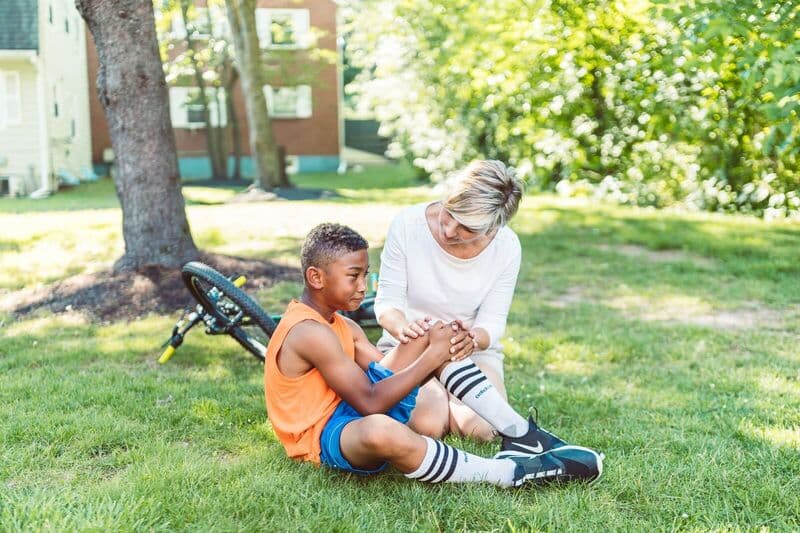
Knee giving way suddenly: the knee "escapes" for a fraction of a second while you walk, go down stairs or turn towards the fridge, and for a moment you are convinced you are about to hit the floor. It is a frightening sensation, and the thought that comes right after is almost always the same: a ligament has snapped.
In most cases it is not so. And it is a pity that this idea is so widespread, because it leads people to look for the answer in an MRI scan, where there is often nothing, instead of in the two things that the studies really link to giving way: pain and thigh strength. In this guide you will find what the literature says about a knee that gives way, when on the other hand it is a sign not to manage on your own, and what it makes sense to do.
⚠ Important: read this before continuing
The exercises and advice in this article are general indications and may not be suitable for your situation. Every person has a unique clinical history: what works for others could be counterproductive for you.
Want a professional's opinion? Start with the questionnaire: you register and see who will follow you, a physiotherapist registered with the Albo chosen for your case, whom you write to in chat. If you would rather hear their voice, the first consultation is free and we look at your situation together.
First of all: when it is not a problem to solve with exercises
This section is placed at the top on purpose. A knee giving way suddenly is almost always a muscle and pain problem, but some situations need to be seen by a doctor before any exercise programme.
See a doctor or go to the emergency room if:
- the giving way appeared after a trauma (a twist with the foot planted, a collision, a fall), especially if the knee swelled within a few hours: rapid swelling after a trauma indicates blood in the joint and deserves an orthopaedic assessment;
- the knee locks in addition to giving way, that is you cannot straighten it fully or it stays "stuck" in one position: this is a mechanical symptom different from giving way, and it must be distinguished (I discuss it in the guide on what to do when the knee locks);
- you cannot put weight on the leg;
- the knee is hot, swollen, red, perhaps with fever or general malaise: here the suspicion is inflammatory or infectious, and it is urgent;
- the leg gives way together with other nerve signals: tingling, loss of sensation, difficulty climbing a step, lower back pain running down the thigh, or a weakness you also feel when seated. In these cases the problem may not be in the knee but in the lumbar spine or a nerve, and the knee is just where you feel it;
- you have already fallen during an episode. This is not a detail: in a prospective study of adults with knee osteoarthritis or at risk, those who had fallen during a giving-way episode were about four and a half times more likely to have recurrent falls two years later, as well as at greater risk of injury from falling. Giving way that makes you fall is a problem to address, not to tolerate;
- finally, if the sensation is not "the knee gave way" but "I blacked out" (a sudden faint, a dizzy spell, a loss of contact), then the knee has nothing to do with it: that is a symptom to have assessed by your GP, not by a physiotherapist.
Outside these cases, a knee that gives way is almost always a recoverable problem. Let us see why.
"Yielding", "weak", "giving out": are they the same thing?
No, and distinguishing them changes where you look.
A knee that gives way suddenly, the giving way, is an episode: for an instant the joint does not hold and the leg goes. It is what this page is about.
A knee that feels unreliable or weak without a clear episode is a different sensation: it does not buckle, but you do not trust it. Almost always behind it there is a quadriceps that does not hold, and in particular the difficulty in controlling the last degrees of extension. It is trained, and not with knee exercises alone.
A weak knee without pain is the version that worries those who experience it most and is often the simplest: loss of strength from inactivity, after a period of rest or a cast. If, however, the weakness gets worse instead of stabilising, or also affects other movements, it must be seen by a doctor: in that case the problem is not the knee.

"The knee that gives way": how people really describe it
People who experience it almost never say "giving way": they say that their knees give way, that the knee "goes", that it "slips" going down stairs. These are all descriptions of the same thing, a sudden loss of support, and the technical name (giving way) adds nothing for those who live it.
The distinction that matters is not what you call it but whether it gives way once or whether it gives way again: an isolated episode after an unusual effort and a recurrence that repeats on normal movements do not have the same causes and are not handled in the same way.
What the research really says about a knee that suddenly gives way
Here I need to scale back the most widespread idea about this symptom, the one you read everywhere: if the knee gives way, it is because a ligament no longer holds. The evidence does not support it.
Giving way is common, and mostly without structural damage. In the Framingham population study, among over 2,300 adults almost 12% had had at least one episode of knee giving way in the previous three months, and most had had more than one. The interesting point is which factors were independently associated: the presence of knee pain and quadriceps weakness. More than half of the people with giving way had no osteoarthritis visible on X-ray. The authors themselves note that, being a cross-sectional study, one cannot conclude that pain and weakness cause the giving way; but it is nonetheless there that the signal concentrates, not in ligament laxity.
Even where the ligaments really are lax, laxity does not explain the sensation. In a cohort of 283 people with knee osteoarthritis, 67% reported instability (especially when walking). When the researchers compared muscle strength, proprioceptive precision and varus-valgus laxity, only lower muscle strength was associated with the reported instability. Proprioceptive precision and laxity were not associated. It is an uncomfortable result for the way this symptom is usually described, and also for the way the earlier version of this article described it.
The sensation matters even when the knee does not really give way. In the Multicenter Osteoarthritis Study, 18% of participants reported true giving way and 27% a sensation of instability without giving way: both groups were more afraid of falling, had less confidence in their balance and more limitations in activities. Put differently: the main harm of a knee that suddenly gives way is often not the knee itself, it is that you stop trusting the leg and reduce what you do.
How to use this information. If your knee gives way without any trauma having occurred, the right question is not "which structure has broken" but "why the quadriceps does not respond in time". And if you have had an MRI that shows nothing relevant, that report does not mean the symptom is imaginary: it means you are looking in the wrong place.
The causes of a knee giving way suddenly, in order of real frequency
Pain that switches off the quadriceps. This is the most common mechanism and the most underestimated. A painful or swollen joint reflexively reduces the activation of the quadriceps: the muscle is there, but it does not switch on with the required readiness. A moment's delay while going down a step is enough for the knee to give way. This is why the giving way often appears together with pain and improves when the pain subsides.
Quadriceps weakness. The chronic version of the same story, typical after a period of inactivity, an immobilisation, a surgery, or simply with age. It is the only factor, together with pain, that consistently appears in the studies.
Knee osteoarthritis. Giving way is frequent in knee osteoarthritis, but, as seen above, osteoarthritis is not the only explanation, since more than half of those with giving way have no radiographic signs of it.
Anterior cruciate ligament (ACL) injury. It exists, it is real, and it is the most dramatic cause: the knee typically gives way on rotations and changes of direction with the foot fixed to the ground. But it has a precise profile: often a young and sporty person, an identifiable trauma, swelling that appears rapidly that same day. If there has never been a trauma, the anterior cruciate is an unlikely explanation. If there has been one, the route is that of cruciate ligament rehabilitation.
Posterior cruciate ligament injury. Much less common, usually from a direct blow to the shin with the knee bent (the classic knock against the dashboard). It can give rise to instability on descent.
Patellofemoral problems. In patellofemoral pain syndrome and patellar chondropathy the giving way comes with pain at the front of the knee and appears on stairs, descents and squats. Here the mechanism is again pain inhibiting the quadriceps, more than a true loss of stability. A different matter is kneecap dislocation or subluxation, in which the kneecap really comes out of its position: it is a recognisable, painful and sudden event.
Meniscus and loose bodies. A meniscal injury can cause giving way, but its characteristic symptom is locking, not giving way. It is a distinction that also matters for treatment choices: in degenerative tears, from middle age onwards, the first recommended line is conservative, and true mechanical symptoms such as locking are the exception in which surgery is considered.
Causes that are not in the knee. Damage to the upper lumbar nerve roots or to the femoral nerve can weaken the quadriceps and make the leg give way without any pain in the knee. It is rare, but it is the reason why, if the giving way arrives "cleanly", without pain, without swelling, without trauma, the assessment must extend beyond the joint.
How to read your giving way
None of these signs makes a diagnosis on its own, but together they point the way.
When it gives way. On rotations and changes of direction, after a known trauma: suspicion of a ligament. On descent, on stairs, getting up from a low chair: much more often pain and insufficient eccentric control of the quadriceps. Walking on the flat, in someone whose knees have been painful for a long time: the typical picture of the osteoarthritis studies.
Whether there is pain or not. Giving way accompanied by front-of-knee pain points towards the kneecap. Giving way without any pain, in a knee that has never been traumatised, is the one that deserves more medical attention, not less.
Whether you have lost volume in the thigh. Measure the circumference of the thigh with a tailor's tape about ten centimetres above the kneecap, on both sides. A visible difference in favour of the healthy leg tells you almost everything you need to know about why that knee gives way.
How much it is changing your life. If you have stopped going down stairs, walking in the dark or going out alone, the problem has already crossed the threshold at which it is worth being assessed, regardless of the cause.
What works (and what has been scaled back)
Quadriceps strengthening: the first line. It is the intervention that targets exactly the factor associated with giving way in all the studies cited. In the synthesis of systematic reviews on rehabilitation after anterior cruciate ligament injury, the evidence of moderate certainty concerns precisely ways of recovering quadriceps strength: neuromuscular electrical stimulation as a complement, and the equivalence between open and closed kinetic chain exercises. (It is worth saying: that synthesis also looked for studies on the rehabilitation of isolated meniscal injuries and found none, so on that front the evidence simply does not exist.) You will find a dedicated progression in the guide to quadriceps strengthening and in the more general one on the muscles that protect the knee.
Reducing pain, because pain switches off the muscle. It is not a secondary "symptomatic" step: as long as the joint is painful and swollen, the quadriceps remains inhibited and strengthening works less.
Proprioception and balance: useful, but not the cure. Here I must be honest, because this is the point where common practice runs ahead of the evidence. In the osteoarthritis study cited above, proprioceptive precision was not associated with the sensation of instability. Knee proprioception exercises remain sensible: they train the reaction, reduce fear and are part of prevention programmes, but if you are only doing unstable boards and not loading the thigh, you are working on the outline.
Surgery: much less automatic than people think. Even in the face of an acute anterior cruciate rupture, a randomised trial compared early reconstruction and rehabilitation with delayed surgery only if necessary: at two years the group operated on straight away had better scores, but the difference was small and of uncertain clinical relevance, and half of the patients in the rehabilitation group did not need surgery. Put plainly: after a cruciate ligament injury, trying rehabilitation first is a legitimate choice, not a waste of time.
An important tip: before trying these exercises, make sure you have received a correct diagnosis. People often think they have one problem, but the real cause of the pain is another. Doing the wrong exercises can make the situation worse instead of better.
Exercises for a knee that gives way suddenly
These are examples of progression, not a protocol. The rule that matters more than any repetition: stop when control gets worse, not when you reach a number.
Knee extension against resistance. Seated, with a resistance band or on the machine, straighten the knee and control the return. It is the most direct way to load the quadriceps when squatting hurts; in studies on cruciate rehabilitation, closed kinetic chain was not found superior to open chain for strength, so you can choose the one you tolerate.
Mini squats and chair rises. Go down only within the range where no pain appears and where the knee does not "collapse" inwards. Few clean repetitions are better than many sloppy ones.
Controlled step down. Lower yourself slowly from a low step, touching the heel of the other foot to the floor, with a hand near a handrail. It is the exercise closest to the movement in which the knee really gives way, and that is why it is introduced last and with support available.
Single-leg balance. In a corner or near a support surface, stay on one leg as long as you can do so without marked wobbling, then switch. You can make it harder by closing your eyes or turning your head, but only when the basic version is stable, and knowing that it mainly serves to regain confidence. If your goal is also to reduce the risk of falls, it makes sense to pair it with a complete fall prevention programme.
Hip loading. Glutes and abductors control the position of the femur above the knee: ignoring them is the most common error in self-managed programmes.
Does a brace really help?
Here common practice and the evidence do not coincide, and it is worth saying so clearly.
A functional brace can give a sense of security and, in specific and temporary situations, allow you to do things you would otherwise avoid. But it is not a treatment. In systematic reviews on rehabilitation after anterior cruciate ligament injury, the use of a brace after surgery is found with moderate certainty to be ineffective for both knee function and laxity. It is not direct evidence on braces worn by people who have not been operated on, but it is the best data we have, and it points in the opposite direction to the marketing of these devices.
The practical risk is concrete: relying on the brace every day means postponing the only thing that the studies link to giving way, that is recovering strength. If you use it, use it as a temporary crutch in defined situations, not as a solution.
Online physiotherapy for a knee that gives way
A remote pathway works well in this case, for a precise reason: the work to be done is largely progressive strengthening with supervision and control of technique, exactly what can be guided on a video call. In the synthesis of systematic reviews on rehabilitation after anterior cruciate ligament injury, structured home programmes and those done in person turn out to be similar for quadriceps and hamstring strength and for the function reported by the patient, with moderate certainty. It is important to be precise about what that finding does and does not say: it compares home programmes with clinic programmes, it is not direct proof about video calls, and it concerns people with a cruciate ligament injury. But the transferable lesson is there, and it is that the place matters less than people think: structure, progression and consistency matter.
With Ri-Hub you can be followed by qualified physiotherapists at 29,90€ per session. In practice: the history of the giving way is reconstructed (with or without trauma, where, when, with what pain), the signs that require a doctor are ruled out, the strength of the leg is measured and a progression is built that is updated over time. If elements emerge that do not belong to physiotherapy, the first task is to tell you so and point you in the right direction.
In summary
A knee that suddenly gives way is a frequent symptom and almost always recoverable, but the story told around it is wrong: in the studies, it is neither ligament laxity nor proprioceptive precision that explains it, it is pain and quadriceps strength. Ligament injuries exist, they have a trauma behind them and must be recognised, but they are not the rule.
Two things not to do: ignore it, because those who fall during a giving-way episode have a markedly higher risk of further falls; and chase a structural diagnosis at all costs when the tests show nothing. In between lies the route that works: understanding when it gives way, ruling out the warning signs, and rebuilding the strength of the leg.
You might also be interested in:
Lumbar X-Ray for Back Pain: When It Is Needed and What It Shows Hip Thrust: Complete Guide to Doing It Correctly First Physiotherapy Visit: What to Expect and How to Prepare
Stay in touch with us Join our dedicated Facebook group: we answer all patients, give practical advice and clear up the most common doubts.
Wondering how much it would cost to be followed? The expense depends on how many sessions are needed, not on the single rate: you will find the figures in How much physiotherapy for the knee costs.
Need a consultation?
Start with the questionnaire on Ri-Hub, a few questions about your case, you register, and see who will follow you: a physiotherapist registered with the Albo, whom you write to in chat whenever you like. If you prefer to talk it over by voice, the first consultation is free, lasts 20 minutes and commits you to nothing: they arrive having already read what you wrote, and together you decide whether and how to go on.
On the possible causes when the knee suddenly gives way, see also Knee that gives way suddenly.
Sources
- Knee buckling: prevalence, risk factors, and associated limitations in function, Annals of Internal Medicine, 2007
- Association of lower muscle strength with self-reported knee instability in osteoarthritis of the knee: results from the Amsterdam Osteoarthritis cohort, Arthritis Care & Research, 2012
- The impact of knee instability with and without buckling on balance confidence, fear of falling and physical function: the Multicenter Osteoarthritis Study, Osteoarthritis and Cartilage, 2014
- Symptoms of Knee Instability as Risk Factors for Recurrent Falls, Arthritis Care & Research, 2016
- Rehabilitation after anterior cruciate ligament and meniscal injuries: a best-evidence synthesis of systematic reviews for the OPTIKNEE consensus, British Journal of Sports Medicine, 2022
- Early surgical reconstruction versus rehabilitation with elective delayed reconstruction for patients with anterior cruciate ligament rupture: COMPARE randomised controlled trial, BMJ, 2021
- Meniscal pathology, the evidence for treatment, Arthritis Research & Therapy, 2014
Last source check: August 2026.


