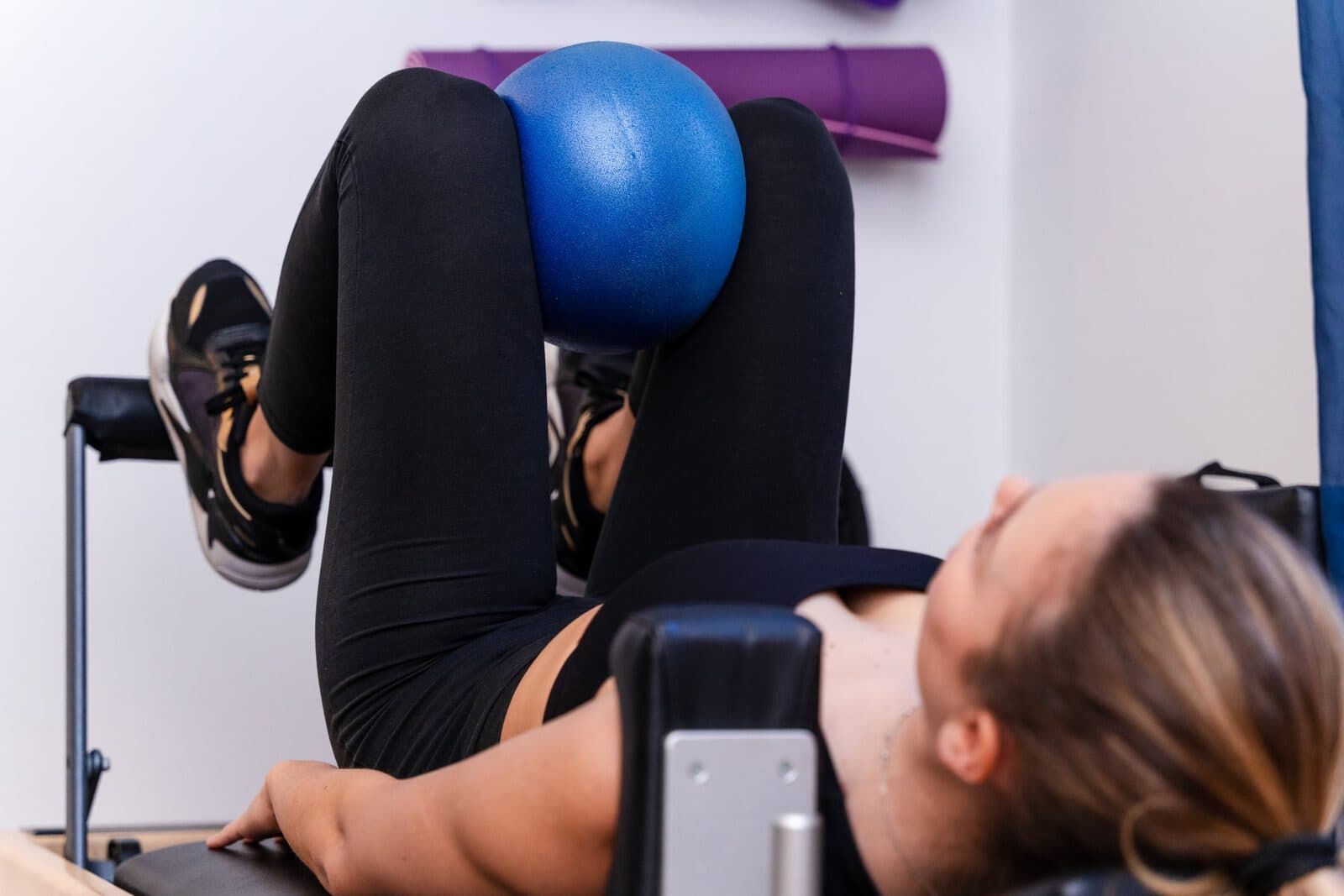
Knee replacement, exercises at home: at discharge they hand you a sheet with a few drawings and a sentence that sounds like a threat, "the result depends on how much you work at home". That is only partly true, and it is worth knowing how far the evidence goes before you start, because it changes both how you train and how anxious you get on the bad days.
The reviews of recent years say two things that seem to contradict each other but do not. The first is reassuring: doing rehab at home is not a fallback compared with the clinic or inpatient rehab, the results are similar. The second puts the promises in proportion: the proven benefit of an exercise programme shows up mostly in the first few months, while over the long term the reviews have not identified a benefit, partly because the available studies are small and not powerful enough to find one. Exercises matter, but for what they actually do: moving the knee, rebuilding strength, getting you independent sooner. They are not the single thing that decides how your life looks two years after surgery.
⚠ Important: read this before continuing
The exercises and advice in this article are general guidance and may not suit your situation. Everyone has a unique clinical history: what works for others could be counterproductive for you.
Want a professional's opinion? Start from the questionnaire: you register and see who will follow you, a physiotherapist registered with the Albo chosen for your case, whom you can write to in chat. If you prefer to hear a voice, the first consultation is free and we look at your situation together.
Before the exercises: signs to report straight away
After a knee replacement, swelling, moderate warmth, bruising that drifts down towards the ankle and a knee that feels tight are normal in the first weeks. Some situations, however, are not a rehab problem and will not resolve by doing more repetitions. If you recognise one of these, call your surgeon or your GP before continuing:
- Fever, chills or feeling generally unwell, especially if they appear after days in which you were improving.
- A very red, hot and increasingly painful knee, with pain that grows instead of easing: periprosthetic infection is a serious complication, to which over a quarter of revision knee replacements are attributed, and that is why it should be suspected early.
- Wound discharge that continues or restarts after drying up, or wound edges that open again.
- A swollen, warm and painful calf on one side only: this is a suspected deep vein thrombosis and needs assessing promptly.
- Sudden breathlessness, chest pain or a racing heartbeat: this is an emergency, not something to mention at the next check-up.
- Flexion that stops progressing or goes backwards in the first weeks, with the knee getting stiffer day by day. This is not laziness on your part: against post-replacement stiffness, the first line of defence is supervised physiotherapy, and its success depends on when it starts, how intense it is and how it progresses.
- Sudden giving way of the leg, a clear snap, or being unable to lift your heel off the bed with the knee straight.
On the subject of thrombosis, it is worth clearing up a common misunderstanding: the prevention with a solid evidence base is the one your surgeon prescribes. The American College of Chest Physicians guidelines (ninth edition, 2012) recommend, after major orthopaedic surgery, pharmacological antithrombotic prophylaxis or intermittent pneumatic compression for a minimum of 10-14 days, and suggest extending it up to 35 days. So the "minimum" is not the target: your surgeon decides the duration. Moving your foot helps circulation and is a good habit in any case, but it does not replace prophylaxis, and prophylaxis is not stopped on your own initiative.
What studies really say about rehab at home
This is the point that changes expectations, and it is worth looking at with the numbers in hand.
Home or clinic, the results are similar. A systematic review with meta-analysis published in JAMA Network Open in 2019 compared rehab in a clinic or inpatient setting with any home programme after total knee replacement. The two comparisons need to be kept apart: five studies with 752 participants for clinic versus home, and just one with 165 participants for inpatient rehab versus home. The most solid numbers come from the first, the comparison between outpatient clinic and home: on pain and function as reported by the patient (Oxford Knee Score), the average difference was -0.15 points at 10 weeks and 0.10 points at 52 weeks, that is, nothing clinically relevant, with moderate-quality evidence. On walking capacity (the 6-minute walk test) no clinically important difference emerged, and at 52 weeks the figure leaned if anything towards the home programme, but the evidence there is of low quality and should be taken with caution. The authors' conclusion is explicit: after an uncomplicated knee replacement, and for people with adequate social support at home, a home programme is an appropriate first line.
An earlier meta-analysis, of 11 randomised trials, reached the same point by looking at movement: for active extension (7 studies, 707 patients) and active flexion (9 studies, 983 patients), the differences between unsupervised home exercise and individual outpatient physiotherapy stayed within the pre-set non-inferiority margin, although the statistical heterogeneity was high, which calls for caution.
Exercises help, but the proven benefit is short-term. A meta-analysis gathered 18 randomised trials for a total of 1,739 patients who had knee replacement. Note, however, how the sums are done, because those 18 studies do not all compare the same thing: some put physiotherapy against no physiotherapy, others home against clinic, others still pool against gym or add balance exercises and stationary cycling. Only a subgroup of those studies compared people who received an exercise programme with controls who received minimal physiotherapy, and that is where the result shows up: better physical function at 3-4 months (standardised mean difference -0.37) and less pain (-0.45), with benefits that in the highest-quality studies extended up to 6 months. Over the long term no benefit has been identified, and the authors stress that the studies were small and underpowered both individually and pooled: this means a lasting benefit has not been demonstrated, not that it has been ruled out. In plain terms: physiotherapy after knee replacement gets you to where you need to be sooner and better; whether it takes you higher for good, we do not know today.
Strength responds, perceived function less so. A meta-analysis of seven randomised trials that added progressive resistance exercise to the post-replacement programme found an improvement in extension strength (standardised mean difference 0.72) and in flexion (0.47), but no significant improvement in patient-reported function or pain. On the 6-minute walk test the difference was favourable but fragile: 19 metres, which disappeared when a single study was removed from the analysis. And it was safe: no increase in the risk of adverse events.
So how do you use all this in practice? Like this: do the exercises at home after knee replacement with the seriousness of someone who knows that the first months make the difference, but without the terror that one missed day will ruin the result. And build the programme knowing that strength is trained with loads that increase, because that is the thing that responds most clearly.

First weeks: mobility, extension, activation
The exercises at home after knee replacement, in this phase, have a goal that is simple to state and hard to achieve: regain full extension and gain flexion, while the quadriceps starts responding to commands again. Movement begins already in hospital, and at home the practical rule is several short sessions spread through the day, following the instructions you received at discharge: the optimal dose is not established by the studies.
Heel slides. Lying on your back, slowly bend the knee, sliding the heel towards your buttock, then go back. If the heel does not slide well, put a towel under the foot and help yourself by pulling on it. This is the basic exercise for recovering flexion.
Passive extension with a towel. Lying down, place a rolled towel under the ankle so the heel stays lifted: let the weight of the leg push the knee downwards. In rehab practice, full extension is put ahead of flexion: a knee that does not straighten fully changes the way you walk, and in clinical experience it is harder to recover when you realise too late that it has been lost.
An important point: before trying these exercises, make sure you have received a correct diagnosis. People often assume they have one problem, but the real cause of the pain is something else. Doing the wrong exercises can make things worse instead of better.
Quadriceps isometric contraction. Lying with the leg straight, tighten the thigh muscle, pressing the back of the knee into the mattress, hold for a few seconds and release. It does not move the joint, and that is exactly the point: it switches back on a muscle that struggles to respond after surgery.
Straight leg raise. Operated knee straight, the other leg bent. Lift the whole leg keeping it straight, hold for a moment, lower with control. If the knee bends while you lift, the quadriceps is not ready yet: go back to the isometrics and try again in a few days.
Ankle pumps and circles. Point and flex the foot, with small circles, several times a day. It helps venous return and reduces the feeling of a heavy leg, but, as said above, it goes alongside the prescribed prophylaxis, it does not replace it.
Extension, swelling and cold: the three things to watch every day
Swelling after a knee replacement can last for months and is not a sign of failure: it is the response to a major operation. Managing it, however, is not a cosmetic detail, because with a very swollen knee the quadriceps struggles to switch on and movement stays limited.
Elevation. Lie with the leg resting on cushions, above the level of the heart, taking short breaks like this through the day. Be careful not to keep a cushion under the knee: it helps you get comfortable, but it works against extension, which is exactly what you are trying to regain.
Cold. Here we have data. A meta-analysis from 2024 gathered 31 randomised trials, split into two different comparisons: 18 studies compared cryotherapy with not using it, 13 compared the continuous cold-flow device with a simple ice pack. In the 18 studies of the first comparison, cryotherapy reduces pain in the first days after surgery: an average difference of 0.59 points on a 0-10 scale on day one, 0.84 on day two, 0.86 on day three, with less opioid use, less blood loss and better range of motion. These differences are small in absolute terms, but the authors conclude that cold should be used routinely in fast recovery. The most useful figure for your wallet comes from the other 13 studies: the continuous cold-flow devices, the expensive ones offered for rental, did not show better results than a simple cold pack, which remains the recommended option. Always wrap the ice in a cloth, never directly on the skin, and take particular care around the scar, where sensitivity is altered.
Compression stockings. They can be part of the programme, but the surgeon decides them together with the prophylaxis: they are not an accessory to add on your own initiative.
Intermediate phase: from movement to load
Once the first weeks are over, when you walk with a walker or crutches and the wound is calm, the exercises at home after knee replacement change nature: you move from "moving" to "loading".
Partial wall squat. Back against the wall, feet slightly forward, lower a little by bending the knees and come back up. There is no need to go low: the upper part of the movement is already enough to work the quadriceps and glutes safely.
Low step. With a step at home and one hand on a stable support, step up and down. This is the exercise that truly prepares you for stairs, where most people discover how much strength is missing.
Glute bridge. Lying on your back, knees bent, lift your hips by squeezing your glutes. It works the glutes and the back of the thigh, which almost nobody trains and which you need to get up from a chair without pushing with your arms.
Seated knee flexion. Sitting on a chair, slide the foot back under the chair as far as possible and hold for a moment. If needed, help yourself by crossing the healthy leg in front of the operated ankle to guide it, guide it, not force it with jerks.
Terminal extension with a band. Seated, anchor an elastic band behind you and pass it behind the knee: extend the leg against the resistance. It trains exactly the last degrees of extension, the ones that tend to stay weak the longest.
Advanced phase: real strength and balance
When you walk without support and the knee feels reliable, the exercises at home change objective once again and the programme becomes functional. This is the phase many people drop because "it's fine by now", and yet it is where the strength that studies show responds to progressive training is recovered.
Squats within the allowed limits. Start with support in front and progress towards the free squat. How far you can bend depends on the type of replacement and on your surgeon's instructions: what you were told at discharge is worth more than any article, this one included.
Controlled lunges. One step forward, both knees bend, come back. Start with short steps and without going down much, increasing the range over time.
Heel raises. Standing, rise onto your toes and lower slowly; later you can do it on a step with your heels over the edge. The calf is part of the engine of walking and is systematically forgotten.
Single-leg balance. Standing on the operated leg, with one hand close to a support for safety. It serves to rebuild control, not just strength.
The principle that holds this phase together is progression of load: when an exercise becomes easy, it must become more demanding, with more repetitions, less support, a harder band or a higher step. That is what builds strength; repeating the same circuit from the first discharge sheet for months does not.
The stationary bike: when to start and what to expect
It is the most frequent question after the first weeks, and it has a practical answer.
When. Generally from the third or fourth week, when flexion allows a full turn of the pedal: roughly around 100 degrees. This is a practical criterion used in clinic, not a proven threshold: if the knee does not bend enough, you can start with the saddle high and partial forward and backward movements, without completing the full turn.
How long. At full pace, 20-30 minutes, 3-5 times a week.
An honest note, one you will not find elsewhere. In the systematic review that gathered 18 randomised trials on 1,739 patients operated for total knee replacement, adding the stationary bike to an exercise programme did not change the measured results. That is no reason not to do it: it remains one of the best ways to move the knee without load and to do aerobic activity, and it is more sustainable over time than bodyweight exercises. It is a reason not to expect it to make the difference in place of the strength work.
After three months: what to keep
The point at which most people stop is also the point at which the gains are lost.
- Stationary bike, 20-30 minutes, 3-5 times a week.
- Walking, built up gradually to half an hour a day or more.
- Swimming and water aerobics, once the wound has completely healed and the surgeon has given the go-ahead.
- Strength work, 2-3 times a week, without giving it up. This is the part that gets dropped first and it is the most important: the strength deficit after a knee replacement can last a long time, and walking, however good it is, is not strength training.
The passive motion machine: what the Cochrane review says
In Italy the Kinetec, the device that bends and straightens the knee passively, is offered almost by default, often on rental and at the family's expense. The most recent Cochrane review gathered 24 randomised trials on 1,445 participants: continuous passive motion increases active flexion by 2 degrees compared with control (moderate-quality evidence), and it does not improve function or quality of life in a clinically important way. On pain, the estimate is a reduction of 0.4 points out of 10, but with a confidence interval that includes zero and with low-quality evidence: in practice you cannot even say with confidence that pain goes down. The authors conclude that these effects do not justify routine use. There is a signal that it might reduce the need for manipulation under anaesthesia, but the quality of the evidence on that point is very low.
That does not mean "throw it away if you already have one": it means the money and time invested there give less return than they would elsewhere, in active movement and progressive loading.
Mistakes that slow recovery
One of them is made at night without noticing: the cushion under the knee, which is comfortable and works against extension. We cover this in how to sleep with knee pain.
Doing too much, too soon. This is the most common mistake among motivated people. The signal is always the same: a knee that is more swollen and warmer the next day, with flexion getting worse instead of better.
Confusing discomfort with pain. Discomfort that appears during the exercise and fades shortly after is part of the process. Sharp pain, or pain that grows from session to session, is information to use to change the programme, not something to ignore out of pride.
Forcing flexion with jerks. Movement is gained through positions held and repeated, not through painful manoeuvres done once a day with gritted teeth.
Chasing only flexion and neglecting extension. Bending looks more impressive, but it is the lost extension that changes your gait, and an altered gait carries its cost into the rest of the chain.
Disappearing after the first weeks. The reviews show the benefit of the exercise programme after knee replacement mostly in the window of the first 3-4 months: that is when it is worth being consistent, and yet it is exactly the moment when most people stop because "I walk, so I'm fine".
Improvising beyond the surgeon's limits. Some replacements have specific indications on degrees of flexion, twisting and movements to avoid. These are not formalities.
When recovery is not progressing
If after the first weeks flexion has stalled, if the knee stiffens instead of loosening, or if strength does not grow despite consistency, it is not the time to increase the repetitions on your own: it is the time to talk about it. Against post-replacement stiffness the first line of defence remains supervised physiotherapy, and its effectiveness depends on timing, intensity and progression calibrated to the person; when it is not enough, more invasive options exist, which the surgeon assesses case by case. Waiting for it to "loosen up by itself" is the choice that closes the most doors.
It is also worth remembering the rest of the body. In the months before surgery you walked with a limp, and the hip, back and the contralateral knee have paid for that compensation. If you have knee osteoarthritis on the other side too, or if you have had a hip replacement in the past, the programme needs to be built around the whole chain, not just the operated knee.
Being followed from a distance
If results at home and in the clinic are similar, the question becomes a different one: what does a professional add? They add the things the discharge sheet cannot do: checking whether you lift your leg by compensating with your back, understanding when it is time to increase the load, telling normal swelling apart from swelling that deserves a call to the surgeon, and keeping you on the programme precisely in the months when the evidence says it is needed.
TeleRehabilitation is the tool that makes this support sustainable when moving around is difficult, and it is also the context in which the exercises at home after knee replacement stop being a list of drawings. A review of reviews published in 2023 examined 13 systematic reviews and meta-analyses on teleRehabilitation after knee replacement: the effects were favourable for walking capacity, knee extension and costs for the patient, and comparable to conventional rehab for quality of life, satisfaction and WOMAC score. The same authors warn that the methodological quality of the included reviews was low or very low, so it should be read as confirmation of a plausible equivalence, not as proven superiority.
With Ri-Hub, a teleRehabilitation session costs 29,90 €, and the physiotherapist watches your performance in real time, corrects it and adapts the progression session after session, without you having to travel during the phase when getting into a car is the hardest part of the day.
You might also like:
Stay in touch with us
Join our dedicated Facebook group: we reply to all patients, share practical advice and clear up the most common questions.
For the practical side of the first days with aids, see How to walk with crutches.
On electrostimulation in the early phase, when the muscle does not respond: Muscle electrostimulation: does it really work?.
Sources
- Assessment of Outcomes of Inpatient or Clinic-Based vs Home-Based Rehabilitation After Total Knee Arthroplasty: A Systematic Review and Meta-analysis, JAMA Network Open, 2019
- Efficacy and safety of home-based exercises versus individualized supervised outpatient physical therapy programs after total knee arthroplasty: a systematic review and meta-analysis, Knee Surgery, Sports Traumatology, Arthroscopy, 2017
- Effectiveness of physiotherapy exercise following total knee replacement: systematic review and meta-analysis, BMC Musculoskeletal Disorders, 2015
- Efficacy and Safety of Lower Limb Progressive Resistance Exercise for Patients With Total Knee Arthroplasty: A Meta-analysis of Randomized Controlled Trials, Archives of Physical Medicine and Rehabilitation, 2021
- Continuous passive motion following total knee arthroplasty in people with arthritis, Cochrane Database of Systematic Reviews, 2014
- Cryotherapy for Rehabilitation After Total Knee Arthroplasty: A Comprehensive Systematic Review and Meta-Analysis, Orthopaedic Surgery, 2024
- Prevention of VTE in orthopedic surgery patients: Antithrombotic Therapy and Prevention of Thrombosis, 9th ed: American College of Chest Physicians Evidence-Based Clinical Practice Guidelines, Chest, 2012
- Periprosthetic joint infection, The Lancet, 2016
- Arthrofibrosis Associated With Total Knee Arthroplasty, The Journal of Arthroplasty, 2017
- The efficacy and safety of telerehabilitation for patients following total knee arthroplasty: a overviews of systematic reviews, BioMedical Engineering OnLine, 2023
Last source check: August 2026.
Need a consultation?
Start from the questionnaire on Ri-Hub: a few questions about your case, you register, and you see who will follow you: a physiotherapist registered with the Albo, whom you can write to in chat whenever you like. If you prefer to talk it through by voice, the first consultation is free, lasts twenty minutes and commits you to nothing: they arrive having already read what you wrote, and together you decide whether and how to go on.