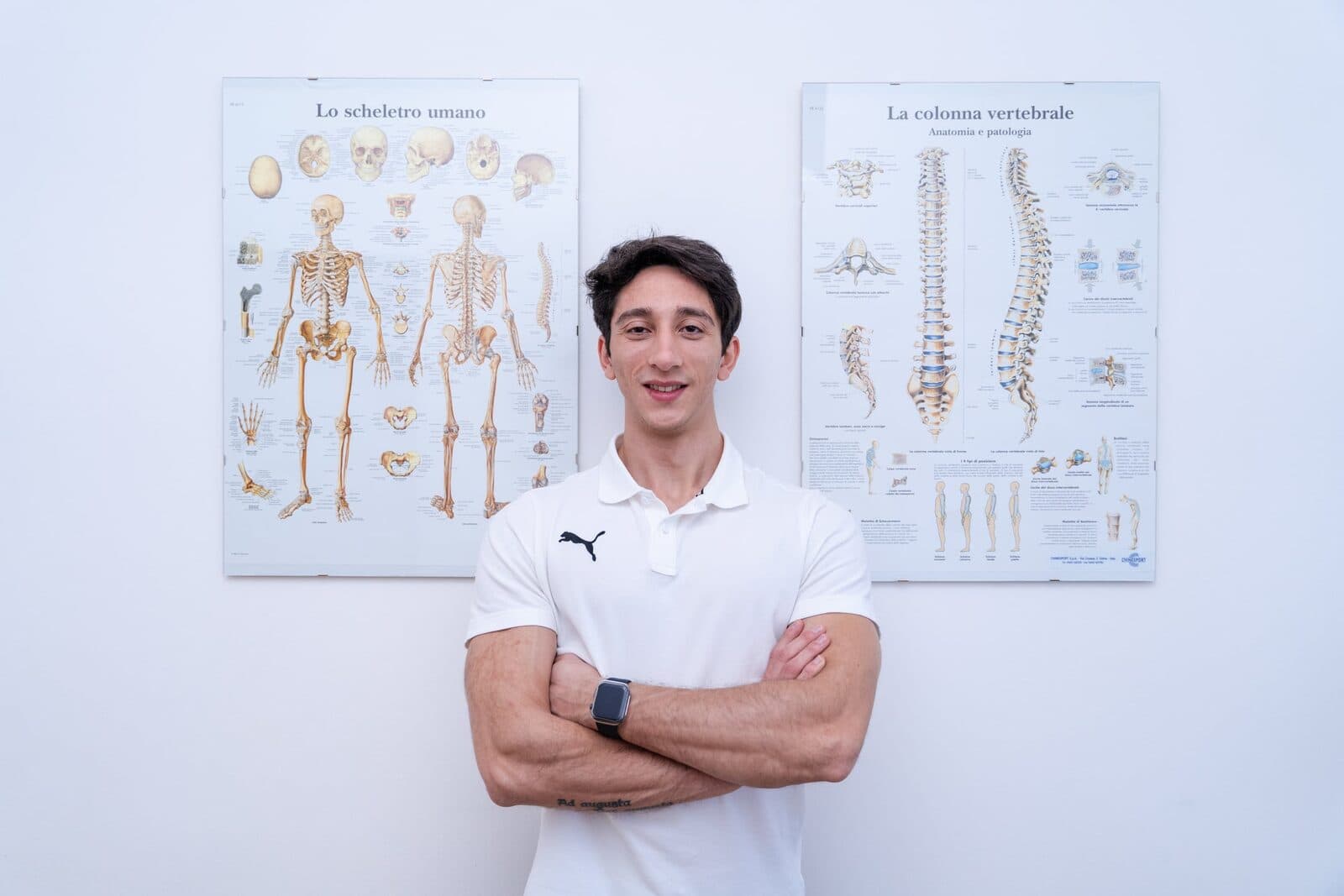
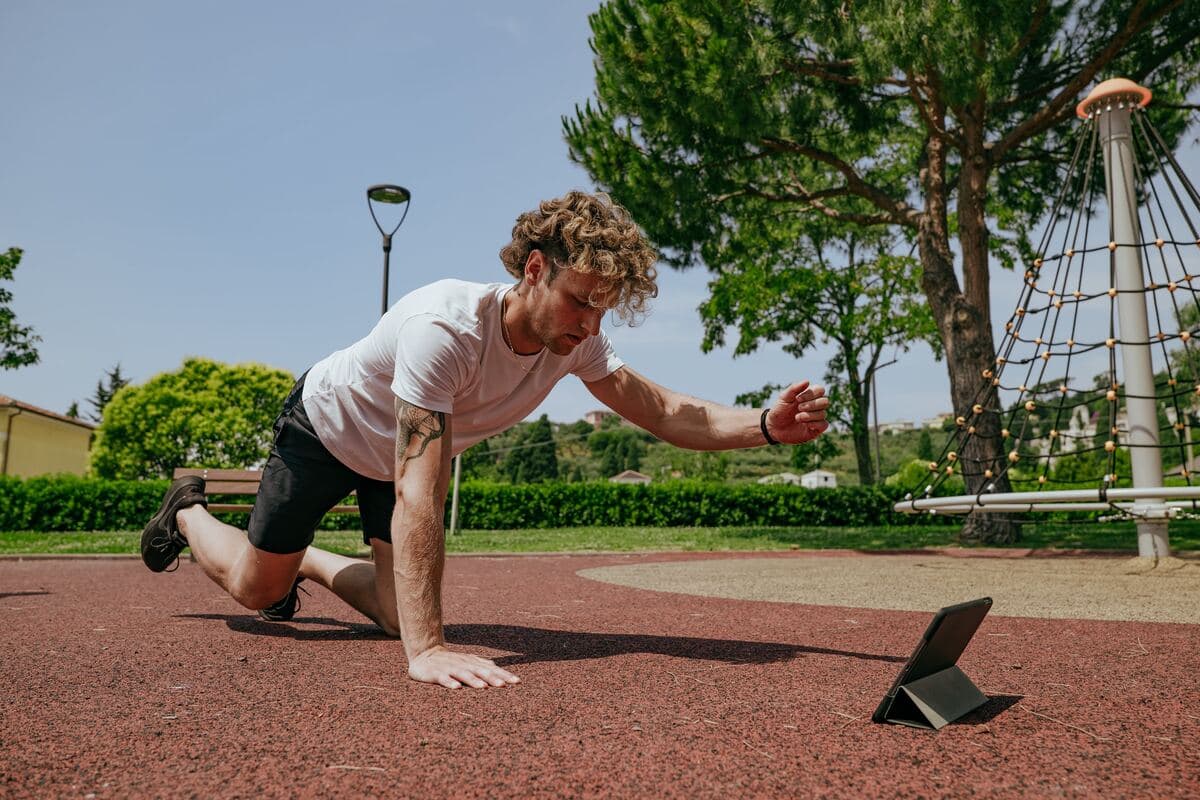
Rounded back exercises: before choosing which to do, it is worth understanding which kind of rounded back you are dealing with. Under the same word sit two different situations, with different prognoses and different goals, and confusing them is why so many people train for months waiting for a result that, in their case, was not realistic.
A rounded back, or thoracic hyperkyphosis, is an exaggeration of the natural curve of the upper back. It is common: in older people the estimated prevalence ranges from 20 to 40 per cent. And it is not a cosmetic detail, because it is associated with reduced respiratory function, lower functional capacity and a greater risk of future fractures.
This guide does not promise to straighten your spine. It tells you what can be changed, by how much, with which exercises, and when the right goal becomes something else: less pain, more strength, more independence.
Important, before continuing. What you read here is general advice and may not be suitable for you. If you have a diagnosis of osteoporosis, a known vertebral fracture or pain you do not understand, general guidance is not enough: the choice of exercises changes according to that diagnosis.
Want a professional's opinion? Start from the questionnaire, the first consultation is free with our physiotherapists: together we look at what your curve is like and what makes sense to do.
Posture or structure: the distinction that changes the goals
On reports and in visit letters the same picture is called dorsal hyperkyphosis: "hyperkyphosis" because the curve of the upper back is more pronounced than normal, "dorsal" because it is the segment where it sits. It is the same thing this page is about, and it often appears together with lumbar hyperlordosis, that is, the opposite curve exaggerated lower down: the two compensate for each other.
This is the part that almost all articles on the rounded back skip, and it is the part that decides whether your programme will make sense.
The reducible postural posture
This is the rounded back of the teenager who studies eight hours bent over, the office worker at the computer, the person who spends the evening on their smartphone. The defining feature is just one: the curve reduces when the person actively corrects it. If you tell yourself "sit up straight" and the upper back straightens, or if lying face down the curve flattens, the spine still has the mobility it needs.
Here the problem is not the shape of the vertebrae, it is the ability to hold a better position for hours without thinking about it. It requires strength and endurance in the muscles that extend the trunk, and it requires repeating the correct posture many times a day. In this scenario it is reasonable to expect a visible improvement in posture.
If you recognise yourself in this description, you will find more specific guidance on the work context in the article on desk kyphosis.
Structural hyperkyphosis
Here the curve does not reduce, or reduces only a little, even when the person pays full attention. The reason is that the structure has changed: wedged vertebrae, degenerated discs and, in many cases, vertebral collapse on fragile bone. It is the typical situation in older people, but not only.
A separate case is Scheuermann's disease, a rigid deformity of the thoracic spine defined precisely: at least three contiguous vertebrae with anterior wedging of at least 5 degrees. It develops during growth and has an estimated prevalence between 0.4 and 10 per cent. If the rounded back that worries you is that of an adolescent son or daughter, when to suspect Scheuermann's and whom to turn to is covered in how Scheuermann's is recognised in a teenager.
In forms below 70 degrees the prognosis is generally favourable, with good clinical outcomes and non-surgical management: observation, painkillers when needed, physiotherapy. Helping pain and function, yes; straightening the curve, no.
In structural hyperkyphosis the realistic goal changes: function, strength, pain control, prevention of falls. Not "straightening". This does not mean giving up: it means training for what can really be achieved, which is not little.
How to tell which side you are on
You can get a rough indication at home. With your heels a few centimetres from the wall, press your sacrum against it and try to bring your shoulder blades and the back of your head into contact with the wall, without arching the lower back and without lifting your chin. Then repeat lying face down, lifting your chest slightly.
If in both tests the upper curve reduces clearly, you are probably in a reducible picture. If it stays the same, or if pain appears, the assessment must be made by a professional: only an X-ray measures the angle, and only the clinical history says whether there is a vertebral collapse behind it.
What increases kyphosis
The causes are not all the same, and this changes the pathway.
- Weakness and loss of endurance in the trunk extensors. These muscles lose strength with age and with inactivity, and they are the factor that exercise can really work on.
- Fragility fractures of the vertebrae. An anterior collapse of the vertebral body permanently increases the curve. Be careful, however, of a widespread and mistaken idea: many older people with marked kyphosis do not have vertebral fractures, so not everything can be reduced to osteoporosis.
- Disc degeneration and changes in the sagittal alignment with age, which progressively alter the geometry of the spine.
- Scheuermann's disease, with the vertebral wedging that becomes established during growth.
- Inflammatory spinal conditions, such as spondyloarthritis, in which progressive stiffness needs a rheumatological diagnosis and medical management, not only exercises.
What the research really says about exercise
Honesty is needed here, because the literature does not say what marketing says.
The most rigorous systematic review on age-related kyphosis included only studies with a mean starting angle of at least 40 degrees and assessed the certainty of the evidence with the GRADE method. Across 24 studies it found a small improvement in the kyphosis angle (standardised mean difference -0.31, moderate certainty).
On extensor strength there is an improvement, but with very low certainty; on quality of life the effect is small with moderate certainty; on pain it is small with low certainty. No included study reported serious adverse events.
A second meta-analysis of ten randomised controlled trials reported a larger effect on the kyphosis angle, but with a very wide confidence interval and an explicit request from the authors for further studies. The same work points out a useful fact in practice: for kyphosis strengthening seems more relevant than stretching.
There is also a third finding that is worth more than a thousand slogans. A controlled clinical trial on older people who did six months of specific strengthening of the trunk extensors found an improvement in function and physical performance, but no improvement in spinal alignment. The people were feeling better and moving better, and the curve was still the same.
The correct reading is this: exercise works on what matters for living well with a pronounced kyphosis, that is strength, endurance, pain, mobility and quality of life. On the appearance of the curve the average effect is modest and not guaranteed, and in already established structural hyperkyphosis it is even more limited.
This is not a reason not to move: it is the reason to train with the right goal, which is also what keeps you going when the mirror does not change.
Warning signs: when the priority is not exercise
Some situations require a medical assessment before any programme. These are not alarmist: they are the pictures in which behind the rounded back there is something that needs to be diagnosed.
- Back pain in an older person with loss of height or rapid appearance of the curve. This is the typical picture of a fragility vertebral fracture, and in that context MRI is the reference test for diagnosis and for choosing treatment.
- Night pain or pain at rest, that does not change with position.
- Fever, general malaise, unexplained weight loss.
- A history of cancer, current or past.
- Tingling, loss of strength, disturbances of sensation in the limbs, difficulty controlling bladder or bowel.
- Rapid worsening of the curve in an adult, over weeks or months.
If you recognise any of these points, the correct sequence is medical first, exercise after. If instead your problem is diffuse pain in the upper back without these signs, it may help you to read the common causes of dorsalgia.
Osteoporosis: why forced flexion of the trunk is a risk
If you are over sixty, this is the most important paragraph of the article.
In people with vertebral osteoporosis, exercises that take the trunk into forced flexion (forward bends with straight legs, sit-ups, loaded twists, lifts from the floor with a rounded back) load the front portion of the vertebral bodies in compression, the same part that gives way in fragility fractures.
A landmark study of postmenopausal women with vertebral osteoporosis and back pain compared different programmes: new wedge or compression fractures occurred in 16 per cent of those doing extension exercises, in 89 per cent of those doing flexion exercises, and in 53 per cent of those combining the two.
The individual groups were small, but the direction of the result has entered the recommendations.
The most recent British consensus on physical activity and osteoporosis indeed recommends spinal extension exercises to improve posture and potentially reduce the risk of falls and vertebral fractures, and for safety recommends avoiding postures with a high degree of spinal flexion, both in exercises and in daily life.
Anyone with a vertebral fracture or several fractures from minimal trauma should as a rule limit impact to that of a brisk walk; anyone at risk of falls should start from strength and balance. The same document clarifies that evidence of significant harm from physical activity is scarce and that, in general, the benefits outweigh the risks.
An earlier international consensus, built with the GRADE method for people with osteoporosis or an osteoporotic vertebral fracture, strongly recommends a multicomponent programme with strength and balance, and advises against limiting oneself to aerobic work alone.
Put simply: with osteoporosis you do not stop training, you train differently. And the choice is made by someone who knows your diagnosis, not by a generic video. The overall picture is in the article on osteoporosis and exercise.
The programme: what has the best evidence
Strengthening the trunk extensors
This is the heart of the work: the best evidence concerns the strength and endurance of the muscles that extend the spine and stabilise the shoulder blades.
- Low-range prone extension. Lying face down, arms along the body, lift the chest a few centimetres while lengthening the back of the neck, without pushing the head backwards.
- Prone Y, T and W. In the same position, move the arms tracing the three letters, thumbs up, shoulder blades active.
- Band row. Pull the band down towards the ribs, elbows close to the body, shoulder blades back and down.
- Face pull. Pull the band towards the face, separating the hands: it works the upper back and the external rotators of the shoulder.
- Isometric holds. Hold the extension for 10-20 seconds: it is often the starting choice when there is pain or bone fragility.
The detail that makes the difference is supervision. In a randomised controlled trial of sixty postmenopausal women with osteoporosis and vertebral fractures, six weeks of supervised extensor strengthening improved spinal pain, strength, endurance, functional mobility and quality of life.
The same programme done at home alone, by contrast, produced no significant differences compared with the control, except on some aspects of mobility. This is not an organisational detail: it is the factor that distinguishes a programme that works from one that does not.
Mobility in extension, at a measured dose
It serves to regain the available range, when there is one. Extension in quadruped with the chest allowed to drop, thoracic rotations on all fours, opening of the chest from sitting: slow movements, medium ranges, no pushing at the end of the range.
On the foam roller an honest clarification: it is useful in a mobile back without bone fragility, but arching over a rigid cylinder concentrates the load on a few segments. With osteoporosis, a known vertebral fracture or pain, do not use it on your own initiative.
Stretching the front of the body
Shortened pectorals and hip flexors do not "cause" kyphosis on their own, but they limit the position you want to hold. Stretch the pectoral against a doorframe or with the forearm on the wall, and the hip flexors kneeling with the pelvis forward and the trunk upright: 30 seconds, two or three times per side. For kyphosis, stretching alone does less than strengthening.
General strength and balance
Strength work for legs and back, walking, balance exercises: in people with osteoporosis this component is explicitly recommended, because it reduces the risk of falling, which is the real danger.
For the trunk, choose exercises that do not flex the spine: controlled dead bug, lateral plank if tolerated, holds in a neutral position. No sit-ups, no crunches, no touching the toes if you have osteoporosis.
How to dose it, and why continuing matters more than starting
Three sessions a week of 20-30 minutes are a sustainable starting point and consistent with the protocols studied, plus brief posture reminders during the day. On strengthening you progress by increasing the repetitions and then the band resistance, not the range of movement.
The realistic timelines: 6-12 weeks to feel strength and endurance improved, months for a possible change in posture, no guarantee about the angle measured on X-ray.
The benefits depend on continuing: when the programme stops, the gain tends to be lost too. A modest programme that you do for years beats a perfect programme that you do for six weeks.
Posture correctors and shoulder braces: what not to expect
Elastic straps that pull the shoulders back, sold online as a solution for the rounded back, have no evidence of stably changing the thoracic curve. At best they work as a reminder: while you wear them you notice your posture. As soon as you take them off, the posture still depends on your strength.
The concrete risk is delegating to an object a job that only the muscles can do, and postponing an assessment when one was needed.
A real brace is something else: a device prescribed in defined situations. In some non-displaced and minimally painful vertebral fractures, conservative treatment may include a brace, but that is decided by the doctor, not by an advert.
If the topic interests you from the neck side, which often goes hand in hand with a rounded back, here is the article on forward head posture.
The habits that really move the needle
Prolonged sitting does not permanently "bend" the spine, but it uses up your tolerance. Raise the screen to eye level, rest your forearms, keep your feet on the ground. Then, above all, change position often: two minutes standing every half hour is worth more than an hour of perfect posture followed by three hours of slumping.
For people with fragile bones, daily movements matter more than exercises alone. Lifting the shopping with a rounded back, making the bed by bending forward, tying shoes with the trunk flexed: these are the moments when the spine takes the flexion loads to avoid. You learn to do them by bending the hips and knees too.
When it makes sense to be guided
An assessment is useful in three cases: if you cannot work out on your own whether the curve is reducible, if you have a diagnosis of osteoporosis or a vertebral fracture, and if you have already tried consistently without changes.
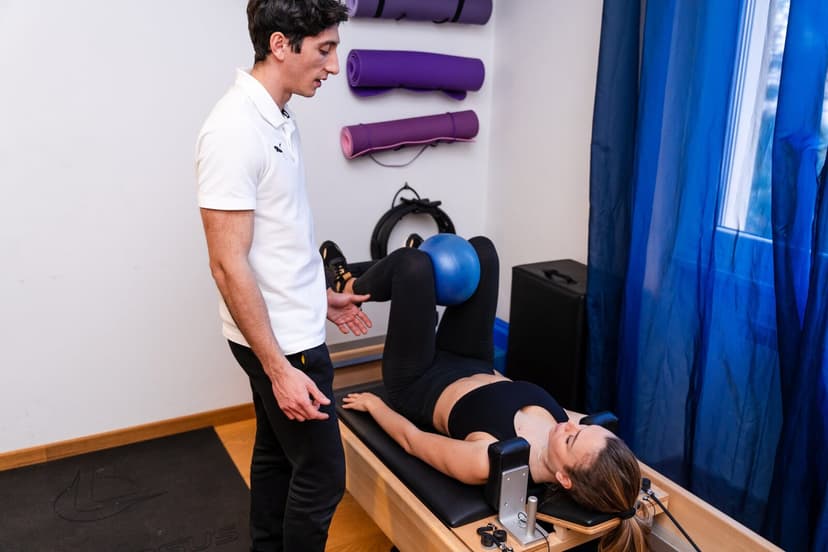
In teleconsultation a physiotherapist can observe posture and movements on video, distinguish what reduces from what is structural, correct the execution and build a progression suited to your history. And in the study of osteoporotic women it was precisely the guidance of the programme that was the decisive variable.
You might also like:
- Desk kyphosis: how to correct it
- Dorsalgia: why the upper back hurts
- Osteoporosis: exercises and prevention at every age
Stay in touch with us
Join our dedicated Facebook group: we answer all patients, give practical advice and clear up the most common doubts. Join the Facebook Group
Among the exercises that really work on the upper back, the row is the most useful and the most often done wrong: how to do it well in Row: complete guide to the horizontal pull.
Need a consultation?
Start from the questionnaire on Ri-Hub. A few questions about your case, you register, and see who will follow you: a physiotherapist registered with the Albo, whom you write to in chat whenever you like. If you prefer to talk it through by voice, the first consultation is free, lasts twenty minutes and commits you to nothing: they arrive having already read what you wrote, and together you decide whether and how to proceed.
If you have been told your back is too arched, it is worth reading what the data really says: Lumbar hyperlordosis: exercises and what the research says.
When rounded shoulders and forward head appear together, there is a name for that picture: Upper cross syndrome: what it is and how to correct it.
Sources
- Ponzano M, Tibert N, Bansal S, Katzman W, Giangregorio L. Exercise for improving age-related hyperkyphosis: a systematic review and meta-analysis with GRADE assessment. Arch Osteoporos. 2021. PMID 34546447
- González-Gálvez N, Gea-García GM, Marcos-Pardo PJ. Effects of exercise programs on kyphosis and lordosis angle: a systematic review and meta-analysis. PLoS One. 2019. PMID 31034509
- Fukuda A, Tsushima E, Wada K, Ishibashi Y. Effects of back extensor strengthening exercises on postural alignment, physical function and performance, self-efficacy, and quality of life in Japanese community-dwelling older adults. Phys Ther Res. 2020. PMID 33489650
- Çergel Y, Topuz O, Alkan H, Sarsan A, Sabir Akkoyunlu N. The effects of short-term back extensor strength training in postmenopausal osteoporotic women with vertebral fractures. Arch Osteoporos. 2019. PMID 31352573
- Kado DM, Prenovost K, Crandall C. Narrative review: hyperkyphosis in older persons. Ann Intern Med. 2007. PMID 17785488
- Sardar ZM, Ames RJ, Lenke L. Scheuermann's kyphosis: diagnosis, management, and selecting fusion levels. J Am Acad Orthop Surg. 2019. PMID 30407981
- Brooke-Wavell K, Skelton DA, Barker KL, et al. Strong, steady and straight: UK consensus statement on physical activity and exercise for osteoporosis. Br J Sports Med. 2022. PMID 35577538
- Sinaki M, Mikkelsen BA. Postmenopausal spinal osteoporosis: flexion versus extension exercises. Arch Phys Med Rehabil. 1984. PMID 6487063
- Giangregorio LM, Papaioannou A, Macintyre NJ, et al. Too Fit To Fracture: exercise recommendations for individuals with osteoporosis or osteoporotic vertebral fracture. Osteoporos Int. 2014. PMID 24281053
- Prost S, Pesenti S, Fuentes S, Tropiano P, Blondel B. Treatment of osteoporotic vertebral fractures. Orthop Traumatol Surg Res. 2021. PMID 33321233
Last source check: August 2026.