


Inner knee pain: a common complaint that can affect both athletes and non-athletes. Whether you call it pain or simply pain on the inner knee, the starting point is the same: understanding which of the structures on that side is suffering. If you suffer from inner knee pain and want to understand the causes and how to treat it, this complete guide is for you. Here you will find everything you need to find your bearings.
The pain on the inner part of the knee has specific causes that differ from outer or front pain. Understanding exactly where it hurts helps identify the cause and the most effective treatment.
⚠ Important: read this before continuing
The exercises and advice in this article are general guidance and may not be suitable for your situation. Every person has a unique clinical history: what works for others could be counterproductive for you.
Want a professional's opinion? Start from the questionnaire: you register and see who will follow you, a physiotherapist registered with the Albo chosen for your case, whom you write to in chat. If you prefer to hear a voice, the first consultation is free and we look at your situation together.
What is inside that side of the knee
To understand inner knee pain, let us get to know the structures of the medial part of the knee.
Medial collateral ligament (MCL): It stabilises the knee by preventing it from opening inwards. An injury to the medial collateral ligament hurts exactly there.
Medial meniscus: The crescent-shaped cartilage on the inner side. Injuries to the medial meniscus cause pain on the inner part of the knee.
Pes anserine: The insertion of three tendons (sartorius, gracilis, semitendinosus) on the tibia. Inflammation of the pes anserine gives pain in the same area, but lower down.
Medial plica: A synovial fold that can become inflamed, causing inner knee pain.
Medial femoral condyle: The bone surface that can be affected by osteoarthritis, in which case the pain is on the inner side.
An important tip: before trying these exercises, make sure you have received a correct diagnosis. People often think they have one problem, but the real cause of the pain is another. Performing the wrong exercises can make things worse instead of better.
The most frequent causes
Here is what most often hides behind this pain.
Medial meniscus injury: one of the most common causes overall, because the inner meniscus is less mobile than the outer one and absorbs more load. In adults over forty, however, the injury is almost always degenerative: it does not arise from a trauma but from years of wear, and here the real question is not "has it torn?" but "does it need surgery?". Reviews comparing a conservative approach with surgery for degenerative injuries do not show the superiority of the procedure one would expect: exercise remains the first route. It should also be said that clinical examination and MRI do not always agree, and finding a tear on MRI does not mean you have found the cause of the pain. The full picture is in the guide to meniscus injury.
Medial collateral ligament injury: a trauma from a blow to the outer side of the knee. It causes acute pain on the medial side, swelling, instability.
Pes anserine tendinopathy: inflammation of the insertion of the tendons on the tibia. It hurts below the joint line, typical in runners and middle-aged women.
On reports and visit letters the same picture is often called pes anserine syndrome, and the term is not a whim: it was proposed precisely because with imaging it is not possible to establish with certainty whether the problem is the bursa, the tendon or both, and the structural lesion responsible remains largely unknown. Two practical consequences. The first: it often coexists with osteoarthritis, in an ultrasound study of 170 knees of people with symptomatic osteoarthritis, pes anserine bursitis was found in 20% of cases, more often in women and with advancing age, and its extent grew with the grade of osteoarthritis. The second: timelines are highly variable, and the literature reports recoveries ranging from ten days to three years. Anyone who promises you a date is guessing.
Medial compartment osteoarthritis: the wear of the cartilage in the inner compartment. The discomfort gets worse with activity and eases at rest.
Medial plica syndrome: inflammation of the synovial plica. It causes discomfort on the anteromedial side, with a sensation of catching.
Valgus knee: knock knees increase the stress on the medial compartment and with it the discomfort on that side.
Stress fracture: it can cause pain in that area in athletes with overload.
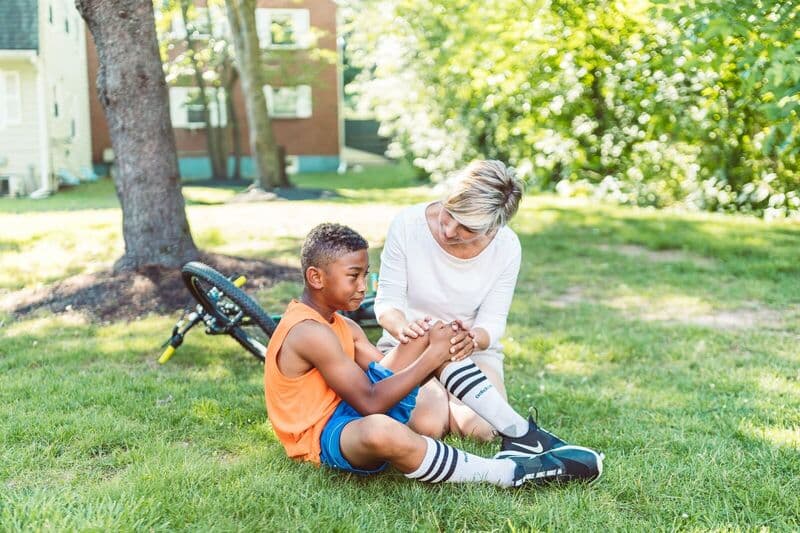
And if there is no swelling?
This is one of the most frequent questions about this pain, and the answer reassures only halfway.
The absence of swelling rules some things out, but not everything. A knee that hurts without swelling makes a major acute injury less likely, a recent ligament rupture, an active joint inflammation, because those fill the joint with fluid within hours. But it does not rule out at all the most common causes of inner pain:
- a degenerative meniscal tear, which in adults over forty develops slowly and often without effusion;
- a pes anserine tendinopathy, which causes pain below the joint line without visible swelling;
- an early osteoarthritis of the inner compartment, which for a long time causes only pain on loading;
- a pure overload, in which the tissue is irritated but there is no structural damage.
What changes in practice: without swelling there is less urgency, but not less need to understand. Pain that lasts beyond two or three weeks, or that limits you on stairs and when squatting, deserves an assessment even if the knee looks normal.
Swelling becomes instead a signal not to postpone when it appears quickly after a trauma, when it is accompanied by heat and redness, or when the knee locks and does not fully straighten.
How it presents
How it manifests, and what changes whether there is swelling or not.
With swelling or without swelling: the first useful distinction
It is the question almost everyone asks, and it is more informative than it seems.
With swelling, especially if it appeared within a few hours of a specific episode, suspicion shifts to something that has been damaged inside the joint: a meniscal injury, a sprain of the collateral ligament, less commonly a cartilage injury. Swelling that comes on straight after a trauma deserves an assessment, not waiting.
Without swelling, the typical picture is different: discomfort that appears with certain movements or after activity, eases at rest and returns the next day. This includes pes anserine tendinopathy, plica syndrome, overload of the medial compartment and early osteoarthritis. It is the most common case, and it is also the one in which work on load and strengthening pays off most.
Watch out for a frequent misunderstanding: absence of swelling does not mean absence of injury. A degenerative meniscus can hurt for months without ever swelling. The distinction serves to orient, not to close the discussion.
Localised pain: The pain is typically located on the medial side.
Meniscal pain: Pain on the inner side of the knee from the meniscus sits on the joint line, often with locking and catching.
MCL pain: Pain from a medial collateral ligament injury is higher up, towards the femur.
Pes anserine pain: Inner knee pain from the pes anserine is below the joint line, on the tibia.
Swelling: Present in several of these causes.
Instability: If the inner knee pain is from the MCL.
Locking: If the cause is meniscal.
Catching: If the inner knee pain is from the plica or the meniscus.
How the diagnosis is reached
How the cause is diagnosed.
Clinical examination: Specific tests point towards the cause of the inner knee pain.
Valgus stress test: Assesses the MCL.
McMurray test: Assesses the meniscus in inner knee pain.
Palpation: Identifies the painful spot.
X-ray: Assesses osteoarthritis in inner knee pain.
MRI: Assesses meniscus, ligaments, cartilage.
The exercises that make sense
Exercises for inner knee pain, varying according to the cause.
Quadriceps strengthening: Essential.
Isometric contractions: Seated, press the knee downwards. 10 seconds, 10 repetitions. For inner knee pain.
Partial leg extension: Last stretch of extension. 15 repetitions..
Partial squat: Do not go too low. 15 repetitions. For inner knee pain.
VMO strengthening: The vastus medialis obliquus is important.
Lateral step down: Step down sideways from a low step. 10 repetitions per side. For inner knee pain.
Hamstring strengthening:.
Bridge: 15 repetitions.
Leg curl: With a band or at the gym. 15 repetitions..
Glute strengthening: To control valgus in inner knee pain.
Clamshell: 20 repetitions per side..
Monster walk: With a band. 20 steps. For inner knee pain.
Stretching:.
Quadriceps stretch: Standing, heel to the glute. 30 seconds. For inner knee pain.
Hamstring stretch: Leg straight, bend forward. 30 seconds..
Treatment, case by case
Specific treatment for the different causes of inner knee pain.
MCL injury: Most MCL injuries heal without surgery. Brace, rest and physiotherapy.
Meniscal injury: Physiotherapy, possibly surgery for severe injuries causing meniscal inner knee pain. Those who do meniscus exercises can improve.
Pes anserine tendinopathy: Strengthening, stretching, ice and possibly an injection.
Osteoarthritis: Exercises, weight loss, possibly injections or surgery for severe osteoarthritic inner knee pain.
Other options
Alongside exercises, other approaches.
Ice: 15-20 minutes after activity for inner knee pain.
Relative rest: Avoid activities that make the pain worse on the inner side.
Medicines: Anti-inflammatories for inner knee pain. Consult your doctor.
Brace: if there is instability from a medial collateral ligament injury.
Injections: Cortisone for pes anserine, hyaluronic acid for osteoarthritis of the inner knee pain.
Surgery: For significant meniscal injuries or severe osteoarthritis with inner pain.
How to reduce the risk of it coming back
How to prevent inner knee pain.
Muscle strengthening: Quadriceps, hamstrings, strong glutes. It prevents inner pain.
Regular stretching: Keep the thigh muscles supple. It prevents inner knee pain.
Control of valgus: Prevent the knee from falling inwards during exercises. It prevents inner pain.
Gradual progression: Do not increase activity too much. It prevents inner knee pain.
Warm-up: Before activity. It prevents inner pain.
In summary
Inner knee pain has specific causes that require an accurate assessment. Meniscus, medial collateral ligament, pes anserine and osteoarthritis are the most common causes. Muscle strengthening is essential for recovery and prevention.
Do not ignore pain that does not go away: with the right treatment you can return to your activities.
If you suffer from inner knee pain and want a personalised programme, the physiotherapists at Ri-Hub can help you with teleconsultation. Targeted exercises for your inner pain, guided progression, all comfortably from your home. Solve your inner knee pain with the professionals.
You might also like:
Sacroiliac Pain: Causes, Symptoms and Exercises for the SI Joint Muscle Wake-Up Exercises: A Morning Routine to Start with Energy Breathing Exercises: Effective Techniques for Relaxation and Well-Being
Stay in touch with us Join our dedicated Facebook group: we answer all patients, give practical advice and clear up the most common doubts.
Sources
Last source check: August 2026.
Need a consultation?
Start from the questionnaire on Ri-Hub. A few questions about your case, you register, and see who will follow you: a physiotherapist registered with the Albo, whom you write to in chat whenever you like. If you prefer to talk it through by voice, the first consultation is free, lasts twenty minutes and commits you to nothing: they arrive having already read what you wrote, and together you decide whether and how to proceed.


