Hazy vision in the afternoon, misty eyes after hours at a screen, a pressure around the eye socket that always arrives together with a stiff neck. The question comes by itself: could it be the neck?
The words change (some say blurred vision, some hazy or distorted, some simply call it strange vision, some talk of misty eyes, and in medical reports you read cervicalgia where we say "neck problems") but the doubt is always the same: how much of all this really depends on the neck.
On this subject there is far more certainty in circulation than the research authorises. This article tries to do the opposite: say what is documented, what is not, and which visual disturbances should never be explained by the neck because they are something else and need to be seen straight away.
First of all: the visual disturbances that cannot wait
Call 112 or go to the emergency department now, without finishing reading, if any of these appears:
- sudden loss of vision, even partial, even in one eye only;
- double vision that appears suddenly, or does not go away;
- a piece of the visual field missing, or a shadow advancing from one side like a curtain;
- severe eye pain, a red and painful eye, blurred vision with nausea and vomiting;
- a violent headache of sudden onset, the worst ever had, reaching its peak within seconds;
- visual disturbances together with difficulty speaking, weakness or tingling on one side of the body, sudden loss of balance.
None of these pictures is explained by the neck, and none of them should be waited out to see if it passes. Severe eye pain with a red eye and reduced visual acuity is the classic presentation of an acute angle-closure glaucoma attack, which raises the pressure inside the eye and damages the retina.
The sudden appearance of flashes of light (the ones many describe as "flashes in the eyes" or as a flickering in the visual field) or of many floaters, followed by a curtain-like shadow in the visual field, is the classic presentation of retinal detachment. Both are ophthalmic emergencies in which time changes the outcome.
And then there is the rule that applies to everything else, that is to mild symptoms, the ones that come and go, the ones that seem only tiredness: any new visual disturbance should be assessed first by an eye doctor. Not attributed to the neck, neither by you nor by me.
If any of these signs applies to you, the emergencies page explains where to go and how fast.
Does cervical spondylosis take away your sight? The most severe test says no
Here is a data point that should settle the question, and that almost nobody cites because it is inconvenient.
There is a very tough way to check whether a symptom really depends on the cervical spine: remove the cervical problem and see what happens to the symptom. This is exactly what decompression surgery does. A narrative review with meta-analysis gathered 27 studies on what happens to the so-called atypical symptoms of cervical spondylosis after the operation.
The result is clear and should be read in two parts. On one side, headache, cervicogenic headache, dizziness, tinnitus and nausea improve in a statistically significant way. On the other, blurred vision does not improve significantly, and along with it memory loss, light-headedness, gastrointestinal complaints, palpitations and hypertension remain unchanged.
Translated: when the cervical problem is removed at the root, the headache goes away and the haziness stays where it was. If cervical osteoarthritis were the cause of the haziness, that symptom should have followed the others. It does not.
It is worth adding the context that concerns osteoarthritis in general: signs of degeneration visible on X-ray become common with age even in people with no symptoms at all, and the degree of wear on the image does not predict how bad you feel. The reasoning is the same as the one we make in the article on cervical osteoarthritis.
So the neck never has anything to do with the eyes? Not exactly. It matters in ways different from the one usually told, and one of them is truly dangerous.
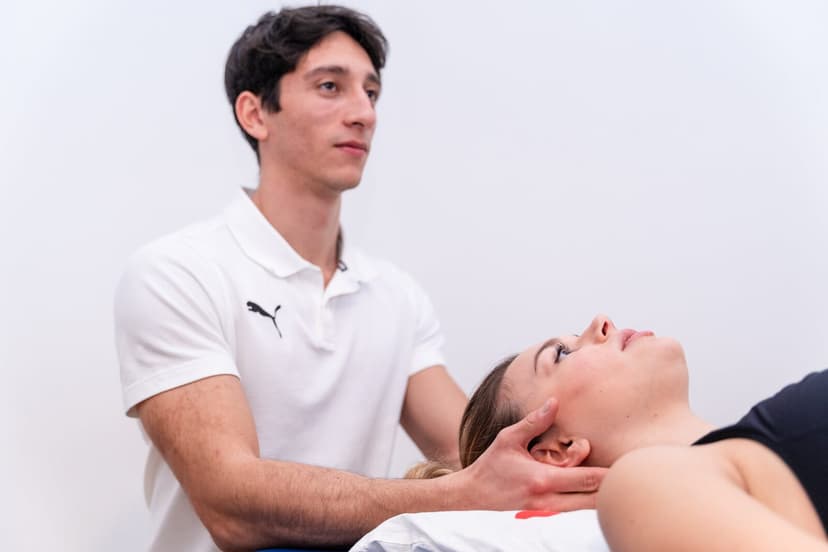
The only truly dangerous link: dissection of the neck arteries
The carotid and vertebral arteries run through the neck and carry blood to the brain and the eye. The wall of these arteries can tear, spontaneously or after even a minor trauma: it is called cervical artery dissection. It is rare, but it is an important cause of stroke in people under 50, so much so that the American Heart Association dedicated a position paper to it in 2024.
Why it matters to anyone searching for "neck and eyesight": because this is the only picture in which neck pain and eye symptoms really arise from the same cause.
In a review of cervical artery dissections, headache and neck pain appear in 65-95% of cases, stroke or transient ischaemic attack in over half, and a partial Horner syndrome in 25%: a drooping eyelid and a smaller pupil on one side only, that is, a sign you can see in the mirror.
The point that matters to you is not the statistic, it is how it presents. A study of 279 people with spontaneous dissection analysed that pain in detail. It was the most frequent symptom of all, present in 4 cases out of 5. In people who already suffered from headaches, in 75.4% of cases the pain was of a new quality, different from the one they knew.
The median intensity was 5 out of 10, so not necessarily dramatic. The thunderclap headache, the violent and sudden one, was uncommon, just 5.5%. And before hospital admission the pain responded to over-the-counter drugs in only 14.7% of cases.
This profile is the reason why dissection has to be named in an article about the neck and the eyes. It does not present as a screaming emergency. It presents as a new neck or head pain, different from usual, that does not pass with painkillers, possibly accompanied by a drooping eyelid, one pupil different from the other, a transient visual disturbance or loss of balance.
Whoever searches the internet at that moment finds a thousand pages about neck problems and none that tell them to go to the emergency department.
Practical rule, and for once without nuance: neck or head pain of a new type, that does not respond to drugs, together with an eye or neurological sign, even a small one, means the emergency department. It is not physiotherapy, and no manipulation should be done on a neck in those conditions.
Cervicogenic dizziness: it concerns balance, not sight
Many pages mix visual disturbances and the feeling of instability as if they were the same thing. They are not, and it is worth separating them.
Cervicogenic dizziness is the feeling of unsteadiness or disorientation associated with neck pain. It concerns balance and orientation in space, not the sharpness of the image: those who experience it do not see worse, they feel unstable while seeing perfectly well.
On its status the literature is more cautious than people believe. It is a diagnosis of exclusion: there is no clinical or laboratory test that confirms it, and to reach it you must first exclude central and peripheral vestibular disorders, vestibular migraine, whiplash-related disorders and cervical arterial dysfunction.
In 2022 the Bárány Society, the international body that classifies balance disorders, took an even clearer position: the evidence supporting a mechanistic link between vertigo and neck pathology or pain is insufficient.
The document adds that migraine is by far the most common cause of the combination of neck pain and vestibular symptoms, and that the committee chose not to propose diagnostic criteria for use outside research.
That same document explicitly names, among the dangerous causes of acute vertigo triggered by head and neck movement, vertebral artery dissection with posterior circulation stroke. Which brings us back to the previous paragraph.
If you want the full picture we covered it in the article on neck problems and dizziness, and it is the same logic of exclusion that applies to the link between neck problems and the ear.
What the neck really changes: movement control, not sight
There is however something measurable, and it is subtler than what is told around.
A 2024 systematic review with meta-analysis gathered 34 studies on sensorimotor tests of the neck: 25 on joint position sense, 4 on the smooth pursuit neck torsion test, 6 on balance. In people with neck pain, compared with healthy subjects, head position sense, oculomotor function and postural stability turn out worse.
The difference grows with pain intensity and with the presence of dizziness.
Pay attention to what this means and what it does not mean. "Worse oculomotor function" means that the eye follows a moving target less precisely when the neck is rotated and painful. It does not mean seeing blurred, it does not mean losing dioptres, it does not mean that the retina or the lens work worse.
The neck takes part in the coordination between head and gaze, and when it hurts that coordination loses precision. It is a matter of motor control, not of visual acuity.
It is a distinction that seems subtle and yet decides everything: it explains why working on the neck can help someone feel less unstable when turning their head, and why it cannot give back sharpness to anyone.
Heavy eyes, puffy eyes, and a stiff neck: why they come together
First a clarification on words, because these are three different sensations that end up under the same search. Heavy eyes and tired eyes describe fatigue of the focusing system, and that is what this section is about. Puffy eyes (eyelids that are actually swollen in the morning) are usually something else: fluid retention, sleep, allergies. The neck has little to do with it, and looking for neck exercises to make them go down is wasted time.
It also happens that you feel it on one side only ("my left eye hurts and my neck on the same side" is the most frequent way we hear it told, and the right one works identically), almost always the side where the stiffness of the neck is greater. It does not mean the neck is pressing on something: more often it is the side you sleep on, or the one towards which you keep your head turned to look at a second screen. If however a visual symptom truly stays confined to one eye and does not go away, the path is the eye doctor, not the physiotherapist.
"Heavy eyes" is the description we hear most often, and it almost always arrives paired with a stiff neck at the end of the day. The temptation is to infer a link: the neck "pulling" on vision. But the most economical explanation is another: the two things have the same cause and do not cause each other.
Spending hours with fixed focus on a near plane reduces blink rate and tires the focusing system: hence the feeling of heavy eyelids, burning, vision that mists up towards evening. At the same time the head stays held forward and up relative to the trunk, and the neck muscles work isometrically for hours. Same workstation, same duration, two symptoms.
The practical test is simple and you can do it yourself: if you change only one of the two things, for example you take real visual breaks but stay in the same position, usually the eyes improve and the neck does not. Those who improve on both fronts are those who change the workstation and the duration, not those who look for the right neck exercise.
"Orbital pain": when the pain is inside the eye socket
There is a more precise description worth distinguishing: orbital pain, that is pain felt inside or behind the eyeball, not on the eyelid and not around it. It is different from tired eye, and the neck explains it even less.
A true orbital pain (deep, worse when moving the eye, perhaps with blurred vision or double vision) concerns the eye and not the neck, and needs to be seen by an eye doctor. The fact that the neck is stiff in the same period is not enough to link them: it is the same trap described above, two true things that happen together.
And back pain with blurred vision?
This question also arrives, usually from those who have both back pain and visual disturbances and look for a single cause. That single cause usually does not exist. The opposite rather holds: blurred vision is not a symptom of back pain, and a sore back does not take away dioptres. If they appear together, the most economical explanation is again a shared one (hours at a screen in the same position) and it is tackled by changing that, not by looking for a link between the two.
An exception worth knowing: if blurred vision arrives suddenly and comes with a violent headache, neck pain never felt before or speech changes, it is not a matter of posture. These are the signs of the first section of this article.
The screen: two symptoms, a single cause
We come to the explanation that concerns most of the people who read this page, and that is neither dramatic nor mysterious.
Tired eyes and a stiff neck arrive together not because one causes the other, but because they have the same cause: hours of static posture in front of a screen.
The interesting thing is that this is written in black and white in the ophthalmology literature, not in the musculoskeletal one. A 2024 review on digital eye strain lists the typical symptoms of the condition, and within that list, next to headache, burning, red eye, photophobia and blurred vision, neck and shoulder pain explicitly appears.
Neck pain is not a consequence of eye strain: it is one of its defining symptoms, because both arise from the same exposure.
The numbers confirm it. In a study of 319 office workers using display screens, with an average of 7.9 hours of screen time a day, the prevalence of computer vision syndrome was 89.4%, and more than 8 participants in 10 reported at least one visual symptom and at least one musculoskeletal symptom.
The most common visual symptoms were tired eye (63.3%), dry eye sensation (57.8%) and headache (56.9%). The associated factors did not concern the neck: using the computer for 8 hours or more, incorrect viewing distance, absence of an anti-glare screen.
On the ocular side the mechanism is known: in front of the screen the blink rate drops, the tear film evaporates and the ocular surface dries out. That is where the burning, the gritty sensation and the red eye at the end of the day come from. None of these symptoms goes away by working on the neck, because the neck plays no part in how they arise.
Association is not causation. Two symptoms that appear together, get worse together and improve together when you reduce screen hours do not prove that one produces the other. They prove that they have a common parent. And it changes everything in practice, because what reduces both is not a neck exercise: it is how and how much you work in front of a monitor.
The explanation almost nobody considers: the wrong glasses
If I had to point to the most frequent and most underrated cause of the symptoms that bring people to this page, it would not be the neck. It would be an uncorrected visual defect.
A study of 90 people described the characteristics of headache from an uncorrected visual defect, what in medicine is called ametropia.
Read this profile thinking of your own symptoms: it was chronic (on average for almost 21 months), progressive in 100% of cases, daily in 90%, concentrated in the second half of the day in 82%, of moderate intensity in 64%, of compressive or pressure type in 64%, and located around the forehead and eye socket in 52% of cases.
Among the risk factors identified: prolonged screen work, astigmatism and moderate hyperopia.
That profile, pressure around the eye that rises in the afternoon when you work a lot at the computer, is precisely the picture that thousands of people attribute to the neck. In the same study, after optical correction and orthoptic treatment, the headache had improved in all patients.
It must be said that this is a small, retrospective, non-blinded study, so that 100% should be taken for what it is, a strong signal and not a precise measure. But the direction is clear, and the stakes are high: the concrete risk is dragging along for months a problem that is solved by one visit and a pair of lenses.
There is one more reason why the order matters. An uncorrected visual defect makes you move closer to the screen, push your neck forward, squint and tense the back of your neck to hold focus. If this is your case, neck exercises work against a cause that keeps acting every day: you can only lose.
Cervicogenic headache and sensitivity to light
A piece of truth in the link between neck and eyes exists, and it is this.
Cervicogenic headache arises from a problem of the cervical spine and shows up as head pain thanks to the convergence between the nerve pathways of the neck and those of the trigeminal nerve: the same nerve station receives the signals from the neck and those from the face, and the brain gets the sender's address wrong.
Typically it is a fixed one-sided pain, that starts in the neck and radiates forward towards the forehead, temple and eye, associated with reduced neck mobility and lower strength in flexion. A history of whiplash is common.
And here the link with the eyes appears: that headache can be accompanied by photophobia, that is discomfort from light, as well as nausea, vomiting, discomfort from noise, autonomic symptoms and dizziness. The same review warns that this similarity to migraine is the main source of diagnostic errors, which should cool the enthusiasm of anyone who self-diagnoses.
Note the difference from everything else in the article: here the neck produces pain and discomfort from light, not a vision problem. You keep seeing exactly as before. The light bothers you, the area around the eye hurts, but the eye as an organ works.
The six symptoms attributed to the neck, one by one
Heavy eyes and fatigue
It is the symptom most compatible with a neck component, because it follows the pattern of postural load and eases after a break.
But it is also the most typical symptom of digital eye strain and of uncorrected refractive error, which remain the most likely hypotheses. If it is already present on waking, look at sleep, allergies and eyesight, not at the neck.
Blurred, misty, "strange" vision
Here the literature is least favourable to the neck: it is precisely the symptom that does not improve after cervical decompression. If you see a veil, the path is through the eye doctor. If the haziness is stable, or gets worse week by week, it is for the eye doctor and urgent.
Pain and pressure around or above the eyes
This one can indeed be cervical, because of the convergence between neck and trigeminal nerve: referred, one-sided pain, that starts from the back of the neck and arrives at the front. But it shares the profile with headache from an uncorrected visual defect, which is also fronto-orbital and also afternoon. The difference is not made by the sensation: it is made by the eye examination.
Sensitivity to light
Plausible as a side feature of a cervicogenic headache, never as an isolated symptom. Marked photophobia without neck pain should be assessed by an eye doctor or neurologist, because it accompanies migraine, eye inflammation and corneal problems.
Difficulty focusing, and fleeting double vision
The neck takes part in the coordination between head and gaze, and this is measurable. But the threshold is precise: a few seconds, at the end of the day, that pass with rest. True double vision, which lasts or appears suddenly, is a neurological symptom and is in the list of emergencies at the beginning of this page.
Dry eye, burning, red eyes
The neck has almost nothing to do with it here: it is the ocular surface, reduced blinking, dry air. It is treated with breaks, conscious blinking, environment and, if the eye doctor deems it appropriate, artificial tears. Red eye with real pain and blurred vision, on the other hand, is an emergency.
Flashes of light and floaters: never neck-related
And this is the seventh, the one that must be removed from the list. They arise inside the eye, from traction of the vitreous on the retina, and can precede a tear or a detachment. No neck mechanism produces them.
What to do, in the right order
The order matters more than the individual steps, and it is this.
- Eye doctor, always first. To rule out uncorrected or changed refractive errors, dry eye, glaucoma and retinal problems. They are the only one who can say with certainty that the eye is fine, and in a good share of cases the story ends here.
- Family doctor or neurologist, if there are recurrent headaches, aura, or neurological signs such as loss of strength, changes in sensation or difficulty speaking.
- ENT specialist, if there is true vertigo, that is the sensation that the environment is spinning, and not simple instability.
- Physiotherapist, only when the previous steps are negative and neck pain, stiffness and headache that starts from the neck remain. The work concerns the neck, and the neck is what can improve.
Visual breaks that make sense, and those that do not help
On breaks, a universal rule circulates, the 20-20-20: every 20 minutes look for 20 seconds at something about 6 metres away. It is repeated everywhere as if it were proven. It is not, and the literature on the point is contradictory.
A study of 30 people doing a 40-minute tablet reading task compared 20-second breaks every 5, 10, 20 minutes and no break: symptoms increased in all four conditions and scheduled breaks had no effect on symptoms, reading speed or accuracy.
Another study, of 29 symptomatic users, with automatic reminders for two weeks, instead observed a reduction in fatigue and dry eye symptoms, but without any change in the objective signs of the ocular surface, and with the benefit gone one week after stopping the reminders.
The honest reading of these two results is that breaks act on the perception of the symptom as long as you take them, correct nothing structural, and must be maintained. They are free and harmless, so it makes sense to take them. They are not a therapy.
What has instead been tested and does not hold up deserves mentioning, because money is spent on it. A systematic review with meta-analysis of 45 randomised trials and 4,497 participants found no high-certainty evidence in favour of any of the therapies analysed for computer-related eye strain.
Lenses that filter blue light did not reduce eye strain symptoms, multifocal lenses did not do better than single-vision ones, supplements based on berry extracts improved neither fatigue nor dryness. The only positive signal, of low certainty, concerned oral omega-3 on dry eye symptoms.
What remains are the boring things that work on load: correct viewing distance, monitor at eye height, lighting without reflections, conscious blinking, and above all fewer consecutive hours. In the study on display screen workers, incorrect viewing distance and 8 or more hours of computer use were among the factors most associated with symptoms.
What physiotherapy can do, and what it cannot
It must be said clearly, because this is the point where this subject is sold badly.
Physiotherapy does not cure eyesight. It does not correct a refractive error, does not treat dry eye, does nothing for the retina. And as we have seen, blurred vision does not go away even when the cervical problem is surgically removed: let alone with exercises.
What it can do is precise and limited. Reduce neck pain and stiffness, and for non-specific neck pain the combination of manual therapy and exercise has reasonable support.
Improve cervicogenic headache, which is the only symptom on this list with a documented link to the neck, photophobia included. And work on the coordination between head and gaze when there is instability, without promising effects on sharpness.
If this is your picture, if the eye doctor has already ruled out the rest and a sore neck, stiffness and headache that starts from the back of the neck remain, you can start here: Start with the questionnaire and talk about it by video call with a physiotherapist registered on the professional register, who will also tell you if your case is outside their competence.
You will find our approach on the page dedicated to neck problems.
In summary
The way this subject is usually told is wrong in the riskiest direction: it attributes to the neck symptoms that belong to the eye and stays silent on the only connection that can truly hurt.
There is no evidence that cervical osteoarthritis causes vision disturbances, and the most severe test available, namely surgical decompression, leaves blurred vision where it was while the headache improves. Cervicogenic dizziness concerns balance, not sharpness, and remains a diagnosis of exclusion with a debated status.
Tired eyes and a stiff neck arrive together because they share the cause, not because one generates the other. Cervicogenic headache can bring with it discomfort from light, and that is true.
And dissection of the neck arteries, rare but serious, is the only picture in which neck pain and eye signs arise from the same problem: it is recognised by a new pain, different from usual, that does not respond to drugs, and it means the emergency department.
Only one sequence comes out of this. Eye doctor first, always. Then, if a sore neck remains, the neck. And if one of the signs in the list at the top of this page appears, the sequence is skipped and you call 112.
If you also have dizzy spells, the dedicated chapter is Vertigo and dizzy spells.
Sources
- Effect of Cervical Decompression on Atypical Symptoms Cervical Spondylosis - A Narrative Review and Meta-Analysis, World Neurosurgery, 2022
- Cervical Artery Dissections: Etiopathogenesis and Management, Vascular Health and Risk Management, 2022
- Head/neck pain characteristics after spontaneous cervical artery dissection in the acute phase and on a long-run, Cephalalgia, 2022
- Treatment and Outcomes of Cervical Artery Dissection in Adults: A Scientific Statement From the American Heart Association, Stroke, 2024
- The Barany Society position on 'Cervical Dizziness', Journal of Vestibular Research, 2022
- How to diagnose cervicogenic dizziness, Archives of Physiotherapy, 2017
- Sensorimotor tests in patients with neck pain and its associated disorders: a systematic review and meta-analysis, Scientific Reports, 2024
- Digital Eye Strain: Updated Perspectives, Clinical Optometry, 2024
- Computer vision syndrome, musculoskeletal, and stress-related problems among visual display terminal users in Nepal, PLoS One, 2022
- Headache associated with refractive errors: Characteristics and risk factors, Revue Neurologique, 2021
- Cervicogenic headache - How to recognize and treat, Best Practice & Research Clinical Rheumatology, 2024
- Adult Eye Conditions: Ophthalmic Emergencies, FP Essentials, 2022
- 20-20-20 Rule: Are These Numbers Justified?, Optometry and Vision Science, 2023
- The effects of breaks on digital eye strain, dry eye and binocular vision: Testing the 20-20-20 rule, Contact Lens and Anterior Eye, 2023
- Interventions for the Management of Computer Vision Syndrome: A Systematic Review and Meta-analysis, Ophthalmology, 2022
- TFOS Lifestyle: Impact of the digital environment on the ocular surface, The Ocular Surface, 2023
- The efficacy of manual therapy and exercise for treating non-specific neck pain: A systematic review, Journal of Back and Musculoskeletal Rehabilitation, 2017
Last source check: August 2026.