

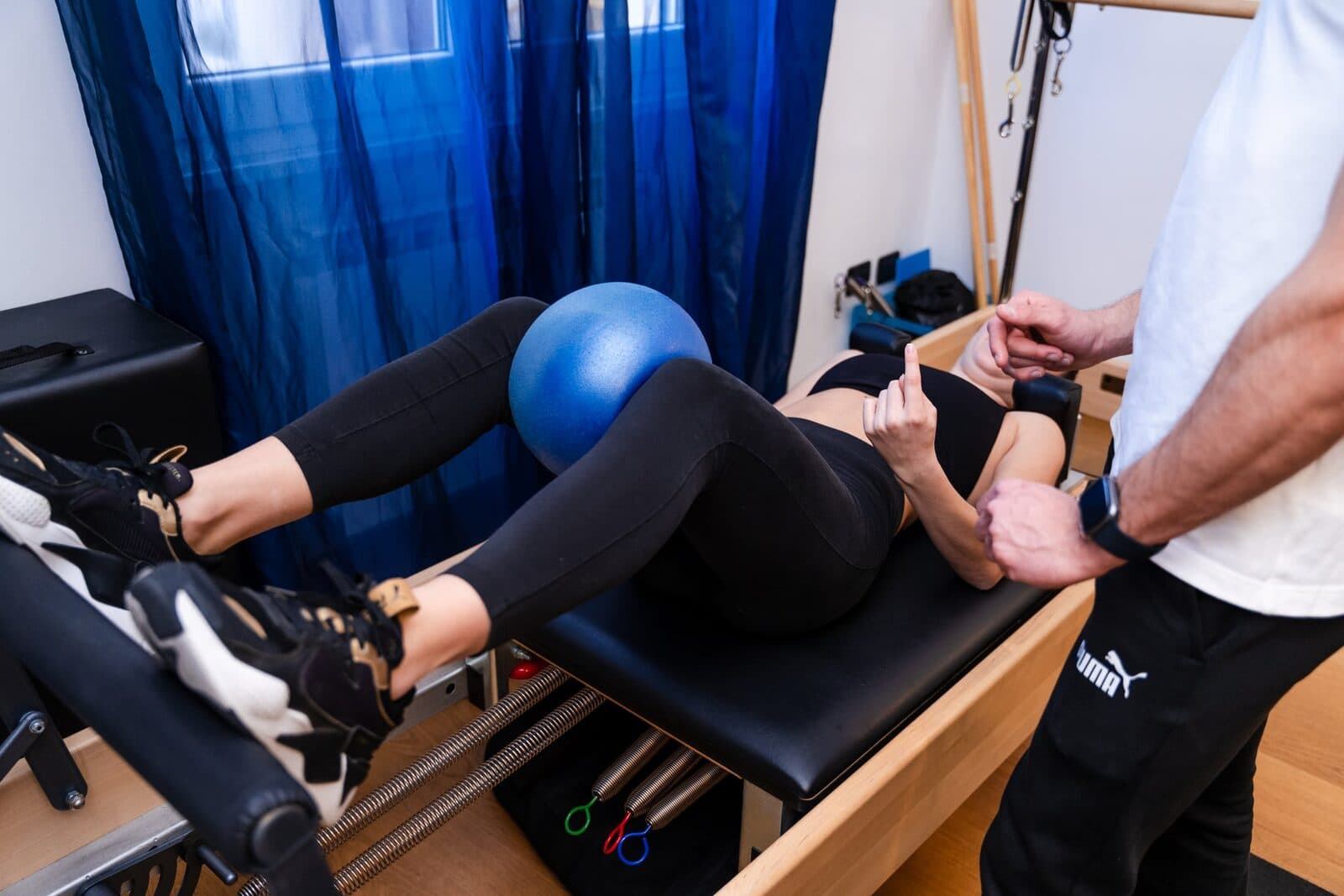
Neck pain and breathing: the neck has been stiff for months and, at the same time, there is a lingering sense of never really being able to fill your lungs. It is one of the combinations our patients describe most often, and it deserves an honest answer rather than a reassuring but wrong explanation.
The research says two very different things, and it is important not to confuse them. The first: people with chronic neck pain have, on average, measurably lower respiratory function than people without it. This is documented by a meta-analysis and it is the most consistent finding we have. The second: that the neck is what spoils breathing, or that retraining breathing makes the neck better, has not been proven. These are two different claims, and almost all the articles you find online treat them as if they were the same. In this guide we look at what holds up and what does not on the subject of neck pain and breathing, and above all what is worth doing with the information we have.
⚠ Important: read this before continuing
The exercises and advice in this article are general guidance and may not suit your situation. Every person has a unique clinical history: what works for others could be counterproductive for you.
Want a professional's opinion? Start with the questionnaire: you sign up and see who will follow you, a physiotherapist registered with the Albo chosen for your case, whom you can write to in chat. If you would rather hear a voice first, the first consultation is free and we look at your situation together.
First of all: when shortness of breath is not a neck problem
This section sits at the top rather than the bottom for a specific reason. "I cannot take a deep breath" is a non-specific symptom: it can come from the heart, the lungs, anaemia, the thyroid or anxiety. Attributing it to the neck should be the last hypothesis on the list, not the first.
See a doctor, or go to the emergency department if the symptoms are acute, when even one of these signs appears:
- chest pain or pressure, especially if it radiates to the arm, jaw, neck or back, or if it comes on with effort and eases at rest;
- breathlessness that comes on suddenly, within minutes or hours;
- shortness of breath that worsens lying down or that wakes you at night, forcing you to sit up;
- swelling or pain in one calf together with shortness of breath;
- blue lips or fingers, fainting, confusion;
- fever, persistent cough, wheezing, or a history of asthma, COPD, smoking;
- rapid worsening over days or weeks, unexplained weight loss, blood when coughing.
None of these pictures has to do with neck pain and breathing, and none is resolved with stretching the scalenes. There is also a technical detail that helps: in people with chronic neck pain, the indices that signal obstruction of the airways, the FEV1/FVC ratio and the FEF25-75 flow, are preserved. If a spirometry shows an obstructive picture, the explanation should be looked for in the lungs, not in the neck.
We have collected all signs of this kind, and what to do for each, in urgent care.
Neck pain and breathing: what the studies really say
Let us start with the strongest finding. A systematic review with meta-analysis published in Disability and Rehabilitation selected 11 studies comparing people with chronic neck pain and asymptomatic people, ten of which entered the pooled analysis. The result: in the group with neck pain, the strength of the respiratory muscles is lower (about 11-12 cmH₂O less both on inspiration and on expiration), and several lung function parameters, vital capacity, maximum voluntary ventilation, forced vital capacity, peak expiratory flow and FEV1, are reduced, with differences from small to moderate.
A later umbrella review, which analysed four systematic reviews together, confirms the picture: the reduction in respiratory muscle strength in chronic pain has moderate quality of evidence, while that of the lung parameters ranges from limited to moderate.
So far the link between neck pain and breathing is documented. But now the part that is usually skipped: these comparisons capture two groups at one precise moment. People who have had pain for some time, measured once and compared with people who are well. The authors of the meta-analysis state this explicitly in their conclusions: longitudinal studies of high methodological quality are needed to strengthen the findings. Until those studies exist, the arrow of cause cannot be drawn in either direction.
What does this mean in practice? That we know the two things travel together, not that one causes the other. And the alternative explanations are far from far-fetched:
- people living with chronic pain move less, and general deconditioning alone lowers respiratory values;
- respiratory strength tests are maximal efforts: pain and fear of hurting yourself can limit the effort during the measurement itself;
- chronic pain, a sedentary lifestyle, stress and disturbed sleep tend to appear as a package in the same people.
This is not a criticism of the studies: it is the physiological limit of that research design. And it is the reason why the sentence "neck pain takes your breath away" is, at present, a reasonable hypothesis rather than a fact.
Neck pain and breathing: does training the breath make the neck pain go away?
Here the answer is more clear-cut, and it runs against what you will read almost everywhere. For honesty it should be said that the authors of the respiratory meta-analysis, at the end of their work, suggest that training the respiratory muscles could be useful for people with neck pain: but this is a research proposal based on their data, not a result they measured. The one who has measured the effects of exercise on the neck is the Cochrane review.
The Cochrane review on exercises for mechanical neck disorders analysed 27 randomised trials involving nearly 2,500 people. In its ranking of what works, breathing exercises appear among the interventions with low evidence that may change neither pain nor function, in the short term. In the same category fall generic fitness training and stretching practised on its own.
What does hold up, with moderate-quality evidence? Strengthening the neck, shoulder girdle and upper limb muscles, endurance training of the scapular muscles, and programmes that combine strengthening and stretching of the neck, shoulders and shoulder blades. These are the ones with the most consistent effect on pain and function.
There is a second clue, even more interesting. A Swiss pilot study had 15 people with chronic neck pain do twenty sessions of respiratory muscle endurance training. The perceived neck disability improved and the respiratory parameters did increase. But the authors note something that is worth more than the result: the respiratory changes and the musculoskeletal changes were not correlated with each other. That is, those who improved most in breathing were not the ones who improved most in the neck. If the mechanism were the one usually told, high breathing overloading the scalenes and therefore better breathing meaning a better neck, we should have seen that correlation. And it was in any case a pilot study without a control group, on 15 people.
The practical translation is this: if your plan for the neck consists only of breathing and stretching, you are betting everything on the two things the evidence supports least. Breathing is a sensible complement, not the pillar.
Why the idea of a neck-and-breathing link is still plausible
Nothing written above cancels the anatomy, which is real and worth knowing.
The scalene muscles are deep neck muscles that lift the first ribs during inspiration. The sternocleidomastoid, besides rotating and flexing the head, takes part in inhalation when breathing becomes demanding. The upper trapezius stabilises the shoulder girdle while the chest expands. These are muscles that belong to both systems: those that move your head and those that help you breathe when more air than usual is needed.
From here comes the clinical hypothesis: if you breathe mainly by lifting the chest instead of letting the abdomen expand, these muscles work many thousands of times a day in a task that, under normal conditions, should be occasional. It is an elegant explanation. It is also, for now, only an explanation: no study has shown that correcting that pattern makes neck pain regress.
The phrenic nerve: a real connection, but a different story
The phrenic nerve, which controls the diaphragm, arises from the cervical roots C3-C5. This anatomical fact is cited endlessly to support the claim that "neck pain blocks the diaphragm". It is worth looking at what really happens when that nerve is involved.
A retrospective study published in Lung examined 334 people with diaphragmatic paralysis, 101 of whom had no known cause. In the available MRI scans, those with idiopathic diaphragmatic paralysis had more severe cervical spondylosis precisely on the side of the paralysed diaphragm, at the levels C3-C4 and C4-C5. The authors conclude that cervical spondylosis is an underestimated cause of diaphragmatic dysfunction and that a scan of the neck should be included in the investigations.
It is an association found in a sample of 32 scans, in a retrospective study: not proof of cause. But above all it should be read for what it describes. We are talking about paralysis of the diaphragm: a rare condition, with real breathlessness, difficulty breathing lying down, abnormalities visible on tests. It is not the stiff neck of a Friday evening after a week at the computer. If you really have that picture, the route is medical diagnosis, not a video of exercises.
Forward head posture: a real association, not a sentence
The other pillar of the story is the head held forward. Here too the evidence is more nuanced than it is said to be.
A systematic review with meta-analysis in Current Reviews in Musculoskeletal Medicine collected 15 cross-sectional studies. In adults, the forward head posture is indeed more pronounced in people with neck pain than in those without, and it correlates with pain intensity and disability. In adolescents, by contrast, the association disappears for almost all the pain measures considered. The authors write that age acts as a confounding factor and that the relationship, despite the widespread claims, remains controversial.
Put simply: if you are forty and your neck hurts and your head sits a little forward, you are not looking at proof that the second causes the first. You are looking at two things that in adults tend to coexist. It is worth working on your workstation and on strength, but without blaming yourself, and without expecting that straightening your head is the switch that turns off the pain.
In children the picture even reverses: in a study of 92 children, among those who breathed through the nose, those with the head a little more forward showed higher respiratory muscle strength, not lower, and the authors read this as a compensation. How much of the story about breathing, face and posture in paediatric age holds up, and how much does not, is covered in a child who breathes through the mouth: what it really entails.
How to tell whether neck pain and breathing are connected in your case
Once medical causes are excluded, there is a simple way to observe yourself. It is not a diagnostic test: it is an observation that helps you describe the problem better to whoever assesses you.
Sit comfortably, one hand on your sternum and one on your navel. Breathe normally for a minute without trying to do it "well", then notice:
- which hand moves first, and which moves more;
- whether your shoulders rise with each inhalation;
- whether you breathe through your mouth even at rest;
- whether sighs or yawns come often;
- whether the neck pain changes when you take three deep breaths.
If the hand on the sternum dominates and the shoulders rise, your pattern is mainly upper-chest breathing. It is useful information. It is not a diagnosis, and it does not automatically mean that this is the cause of your pain.
An important point: before trying these exercises, make sure you have received a correct diagnosis. People often assume they have one problem, but the real cause of the pain is something else. Doing the wrong exercises can make things worse instead of better.
Where to start: strength first
Following the evidence rather than the story, the centre of the programme is not breathing: it is strengthening. These are the exercises that in the Cochrane review have the most solid effect on pain and function.
Deep neck flexors. Lying on your back with your knees bent, make a gentle "double chin" by lightly flattening the back of the neck towards the floor, without lifting your head and without pushing hard. Hold the position for a few seconds while breathing normally, then release. It should be a small, precise movement: if you feel the superficial muscles at the front of the neck working, you are doing too much.
Scapular-thoracic strengthening. Scapular retractions (bringing the shoulder blades together while keeping the shoulders low, not raised), band rows, arm raises against light resistance. It is the family of exercises with the best evidence of all for chronic neck pain, and the one almost all the articles on the neck-and-breathing link forget to mention.
Endurance, not only maximal strength. Long sets with modest loads, repeated consistently through the week. The Cochrane review specifically lists endurance of the scapulothoracic muscles and the upper girdle among the useful interventions.
If you are looking for a structured routine, the article on neck pain exercises goes into the progression in detail.
Breathing work, put in its right place
Having clarified that it is not the pillar, breathing rehabilitation remains a sensible thing to do, especially if the test above has revealed an upper-chest pattern, and if stress and sleep are part of the picture.
Diaphragmatic breathing. Lying with your knees bent, one hand on your chest and one on your abdomen. Breathe in slowly through your nose, letting the hand on the abdomen rise while the one on the chest stays as still as possible. Breathe out slowly and without forcing. It is the foundation of all the work on neck pain and breathing: a few minutes a day, calmly, are worth more than one long session done once a week.
Breathing against resistance. Same position, with a light weight (a thin book will do) resting on the abdomen. Breathe in lifting it, breathe out letting it descend slowly. It serves only to make the diaphragmatic movement noticeable: if the weight forces you to push or to stiffen your neck, it is too heavy.
Lateral rib expansion. Seated, hands resting on the ribs at the sides of the chest. Breathe in trying to push your hands outwards, as if the chest were widening sideways instead of rising. It is the exercise that teaches the chest to expand without recruiting the neck.
Chest opening. Standing in a doorway or a corner, forearms resting on the vertical surfaces, elbows at shoulder height. Shift your weight forward until you feel the front of the shoulders and chest lengthen. It must never hurt.
On the 4-7-8 technique and on slow breathing rhythms in general, one thing needs to be stated clearly: there is no evidence that they change neck pain. They are relaxation routines. If they help you fall asleep, use them for that: it is already a good reason, given how much sleep weighs on chronic pain. But do not expect them to be the cure for your neck.
Stretching: useful, but not on its own
Stretching the scalenes and sternocleidomastoid often gives a pleasant immediate relief. The Cochrane review, however, is explicit: when stretching is used on its own, no benefit should be expected. It should be combined with strengthening, not used as a substitute for it.
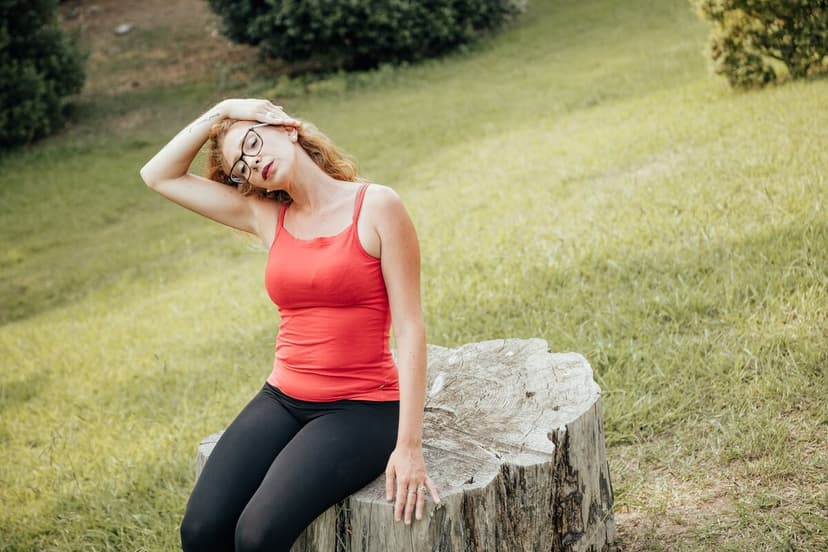
Scalenes. Seated, right shoulder kept low (you can sit on your hand), slowly tilt your head to the left until you feel a stretch on the right side of the neck. Breathe, do not push with the hand in the first weeks, and change sides.
Sternocleidomastoid. Same starting position: after tilting the head, rotate it slightly upwards towards the opposite side. The stretch moves further forward, along the lateral band of the neck.
Stop at once if dizziness, tingling in the arms, ringing in the ears or visual disturbances appear. And for sub-occipital release with a ball: it should be placed at the base of the skull, just below the bone, never on the sides of the neck, where important blood vessels run.
Workstation and habits
Monitor with the top edge at eye level, forearms resting, a backrest that supports the lower back, feet on the floor. These are useful measures, but the factor that in clinical practice makes the most difference is a simple one: changing position often. No posture is wrong; it is holding it for hours that becomes a problem. Getting up often, even just to take a couple of steps, is worth more than an expensive chair.
How long to wait, and when to change course
This is the part that makes everything else useful. If you work consistently for a few weeks, strengthening included and not just breathing, and the pain does not shift by a millimetre, the conclusion to draw is not that you still breathe badly or that you are not training enough.
It is that the cause lies elsewhere, and that the neck-and-breathing chapter has already given what it could give. In chronic neck pain, workload, sleep, stress, sensitisation of the nervous system and, at times, structural problems that deserve investigation all come into play. Persisting for months with the same protocol because "it must be the diaphragm" is the most common way of wasting time.
When to see a professional
Beyond the warning signs listed at the beginning, it makes sense to be assessed when the pain has lasted more than a few weeks without improving, when it radiates to the arm with tingling or loss of strength, when dizziness or balance problems appear, or when you simply do not know where to start and are improvising.
A physiotherapist can distinguish a purely muscular picture from one that requires further investigation, and build a programme that respects the hierarchy of evidence instead of starting from the most fashionable exercise.
Telerehabilitation for neck pain
Neck pain is one of the conditions that lends itself best to remote assessment: the physiotherapist watches in real time how you move, how you sit and how you breathe, which are exactly the two elements of the neck-and-breathing pairing, corrects the technique of the exercises while you perform them, and sets a progression that is updated over time.
With Ri-Hub you can follow the programme from home, with telerehabilitation sessions at 29,90 euro. The value does not lie in the single exercise, which you can find everywhere: it lies in understanding which part of the problem is yours and in not wasting months on the wrong track.
You might also like:
Stress-Related Neck Pain: The Mind-Body Connection Diaphragmatic Breathing: A Complete Guide to Breathing Better Back Pain and Stress: The Connection and How to Resolve It
Stay in touch with us Join our dedicated Facebook group: we answer all patients, give practical advice and clear up the most common doubts.
Need a consultation?
Start the questionnaire on Ri-Hub: a few questions about your case, you sign up, and you see who will follow you: a physiotherapist registered with the Albo, whom you can write to in chat whenever you like. If you would rather talk it through by voice, the first consultation is free, lasts twenty minutes and commits you to nothing: they arrive having already read what you wrote, and together you decide whether and how to go on.
Sources
- Respiratory dysfunction in patients with chronic neck pain: systematic review and meta-analysis, Disability and Rehabilitation, 2023
- Respiratory Function Analysis in Patients with Chronic Pain: An Umbrella Review and Meta-Analysis of Pooled Findings, Healthcare (Basel), 2023
- Exercises for mechanical neck disorders, Cochrane Database of Systematic Reviews, 2015
- The Relationship Between Forward Head Posture and Neck Pain: a Systematic Review and Meta-Analysis, Current Reviews in Musculoskeletal Medicine, 2019
- Respiratory muscle endurance training reduces chronic neck pain: A pilot study, Journal of Back and Musculoskeletal Rehabilitation, 2016
- Association Between Diaphragmatic Paralysis and Ipsilateral Cervical Spondylosis on MRI, Lung, 2019
Last source check: August 2026.



