Neck pain and sport: the question I hear most often in video consultations is whether it is worth stopping training while the neck hurts. The short answer, in the great majority of cases, is no: you do not need to stop, you need to change something. The longer answer is more interesting, because on this subject there are many certainties going round that the literature does not confirm.
In this article I have separated three things that are usually mixed together: what the research really shows, what is reasonable but not proven, and what needs checking with a professional before you touch your training.
⚠ Important: read this before continuing
The exercises and advice in this article are general guidance and may not suit your situation. Every person has a unique clinical history: what works for others could be counterproductive for you.
Want a professional's opinion? Start with the questionnaire: you register and see who will follow you, a physiotherapist on the Italian professional register chosen for your case, whom you can write to in chat. If you would rather hear their voice, the first consultation is free and we look at your situation together.
Before you train: the signs that come before everything else
Neck pain is almost always a benign musculoskeletal problem. "Almost always" does not mean always, and some signs need to be recognised straight away, because they completely change the priority.
Stop and have a doctor check you if you notice:
- Persistent tingling, numbness or weakness in an arm or a hand, especially if they follow a precise path and do not go away when you change position.
- Loss of hand dexterity (buttoning, turning a key, typing on a phone become clumsy) or unsteadiness when walking. These are the two symptoms the literature identifies as characteristic of degenerative cervical myelopathy, a compression of the spinal cord that develops insidiously and whose diagnosis often comes late. It is a condition that is not managed with exercise.
- Pain that appeared after a fall, a tackle, a whiplash or a sports trauma, particularly if accompanied by marked stiffness.
- Night pain that never changes position after position, fever, unexplained weight loss, an oncology history.
- A violent headache unlike your usual ones, that comes on suddenly together with neck pain, visual disturbances, difficulty speaking or co-ordinating movements: in this case you go to the emergency department, not the gym.
None of these pictures is resolved by adjusting the height of the bike handlebars. If you recognise yourself in any of them, the rest of this article can wait.
What the research really says about neck pain and sport
Let us start with the solid point. In chronic neck pain, exercise works: a systematic review of reviews published in 2023 gathered 25 systematic reviews and meta-analyses, for a total of 17,321 participants (without counting overlaps), comparing motor control exercise, Pilates, resistance training, traditional Chinese exercise and yoga. The result: evidence certainty from low to high for positive short-term effects on pain for all these modalities compared with controls without exercise, and for all except resistance training also on disability.
But here comes the part that almost no popular article reports. The authors conclude that it is not possible to recommend one optimal type of exercise, because no relevant differences emerged between the various modalities. And the methodological quality of the included reviews ranged from critically low to low in 13 of the 25 cases.
Translated for someone who trains: the claim that "swimming is ideal for neck pain" or "yoga is better than the weights room" does not have behind it the evidence it seems to have. The reliable finding is simpler and more useful: moving regularly helps, and you can choose the type of movement according to what you tolerate and what you enjoy enough to keep doing for months.
Another recurring claim worth scaling back: "exercise increases blood flow to the tissues and speeds up healing". It is a plausible mechanism, but it is an explanation, not a result measured in studies on neck pain. The benefit of exercise is documented on symptoms; why it happens is still a matter of hypothesis.
On specific strengthening: a systematic review with meta-analysis from 2024 on office workers with chronic neck pain included 8 randomised trials. Seven reported a significant reduction in pain intensity on the VAS scale, and five a reduction in the Neck Disability Index after strengthening exercises for the neck, shoulders and scapular muscles. However, all eight studies had a high risk of bias, and the overall certainty of the evidence was judged low. It is a reasonable direction, not a certainty.
Sports to "avoid": two different risks that are always confused
In the discussion of neck pain and sport, things that have nothing to do with each other are put on the same list.
The first risk is acute trauma. Rugby, contact martial arts, collision sports: here the issue is not the neck ache, it is what can happen to the head and neck in an impact. It is a real risk and must be managed with the levers that have been shown to work, which are regulatory and organisational more than individual. It should be said right away, however, that the most robust prevention research in this field measures concussions and head impacts, not injuries to the cervical spine: they are close outcomes but not interchangeable, and the numbers below should be read for what they are. In the systematic review with meta-analysis in the British Journal of Sports Medicine from 2023 on concussion prevention strategies in sport (192 studies included out of 220 eligible), mouthguards in collision sports were associated with a lower concussion rate (IRR 0.74; 95% CI 0.64-0.89), a ban on body checking in youth and adolescent ice hockey with a concussion rate 58% lower than in leagues that allowed it (IRR 0.42; 95% CI 0.33-0.53), and limiting contact in American football practices with a practice concussion rate 64% lower (IRR 0.36; 95% CI 0.16-0.80).
The second risk is discomfort from holding a position. Road cycling, breaststroke, climbing: the neck stays in extension or rotation for a long time. Here there is no evidence that these sports "harm the neck": none of the sources cited at the end of this article shows it, and I am not aware of any studies that have. What I see in the clinic, and I declare it as a clinical observation, not as data, is that the discomfort appears in people who spend a lot of time in that position. The distinction is not pedantry: it means the solution is not to stop, but to reduce the time spent in the critical position, alternate (on the bike: change grip, stand up periodically; swimming: alternate strokes) and check the set-up of the equipment.
In my clinical experience, and I say this as experience, not as proof, people who arrive with neck pain after a bike ride tend to improve more often by correcting saddle height and setback and the distance to the handlebars than by doing neck exercises. But it is an observation from the clinic, not a controlled study finding.
Neck pain and training in the gym: what to really change
In the weights room there are three exercises worth reviewing when the neck is symptomatic, not because they are "banned" but because they put the cervical spine in extreme positions without any need to:
- Behind-the-neck press (military press behind the head): it forces you to extend the neck to let the barbell pass. The front version trains the same muscles without asking for that extension.
- Pull-ups with a grip behind the neck: same problem, plus the risk of pushing the head forward to compensate. Front pull-downs are the obvious alternative.
- Crunches with hands behind the head: almost everyone ends up pulling the back of the head with their hands. Arms crossed on the chest or hands at the temples without pushing solve it.
The rest of the programme, usually, does not need overhauling. The two most common mistakes I see are: cutting everything (and losing in a few weeks the fitness built over months), or changing nothing and carrying on bringing the symptom back three times a week. The middle path is to regulate the load: reduce the weight while keeping the movement, or keep the weight and reduce the sets, and see how the neck responds over the following 24 to 48 hours.
An important tip: before trying these exercises, make sure you have had a correct diagnosis. People often think they have one problem, but the real cause of the pain is something else. Doing the wrong exercises can make things worse instead of better.
Warm-up and stretching: what they can and cannot do
This is the belief that holds up least under scrutiny. A systematic review of the acute effects of stretching in healthy, active people examined static stretching, dynamic stretching and proprioceptive neuromuscular facilitation. Two findings matter for those who train:
- On injuries: static stretching and proprioceptive facilitation showed no clear effects on either overall injuries or overuse injuries; for dynamic stretching no data were available.
- On performance: measured immediately after stretching (on average 3 to 5 minutes later), performance dropped by 3.7% with static stretching and by 4.4% with proprioceptive facilitation, while dynamic stretching improved it by 1.3%. The drop depended on duration: -4.6% with at least 60 seconds per muscle group against -1.1% under 60 seconds. Gains in mobility typically lasted less than 30 minutes.
The rest also needs to be said in full, which is usually cut because it does not make headlines. First: most studies did not include dynamic activity after stretching, and when that activity was included, no clear effect on performance was observed. The famous -3.7% refers to static stretching on its own, not to a well-made warm-up. Second: static stretching showed a moderate benefit (+2.2%) on performance at greater muscle lengths. Third, and this is the authors' conclusion word for word: they recommend stretching within a warm-up that includes dynamic activity afterwards, precisely to reduce muscle injuries and increase joint mobility, with negligible effects on the subsequent performance.
So the honest reading has two parts. The single finding does not support the slogan: "neck rotations and stretching before training so you don't get hurt" does not have the direct support we attribute to it, because for overall and overuse injuries there is no clear effect. But it does not authorise throwing away the warm-up either, which the authors themselves recommend. The point is the form: arrive at the movement prepared, move the neck and shoulders through the full available range, activate the scapular muscles and increase the load progressively, with the dynamic part after the static one. And if you do static stretching just before a strength or speed performance, keep it short.
A note that makes the picture less clear-cut and more honest, and that applies to the whole topic of neck pain and sport: the concussion review found that neuromuscular warm-up programmes in rugby were associated with concussion rates up to 60% lower (the authors describe the evidence as "partly supportive", not as certain). This is not neck stretching: it is a structured programme of activation, strength and balance, and the measured outcome is concussion, not neck pain. The difference between the two is exactly the point.
Does strengthening the neck protect against blows?
It is one of the most widespread promises in contact sports. To date it has not been demonstrated: the British Journal of Sports Medicine review explicitly places neck strength among the potentially modifiable risk factors on which research is still needed to inform prevention strategies, together with optimal tackling technique, rather than among strategies of proven effectiveness. It is worth repeating: here too, the outcome studied is concussion, not neck injury.
This does not make neck training useless. It means it should be trained for the right reason, which is tolerance to load, control of movement and pain management, and not sold as a biological helmet.
Exercises that make sense to include
Bearing in mind that no type of exercise has proved superior to the others, these are the ones I use most often with people who train and have a symptomatic neck:
- Craniocervical flexion (chin tuck): the small "double chin" movement that activates the deep flexors. It should be done slowly and without pushing the head against anything.
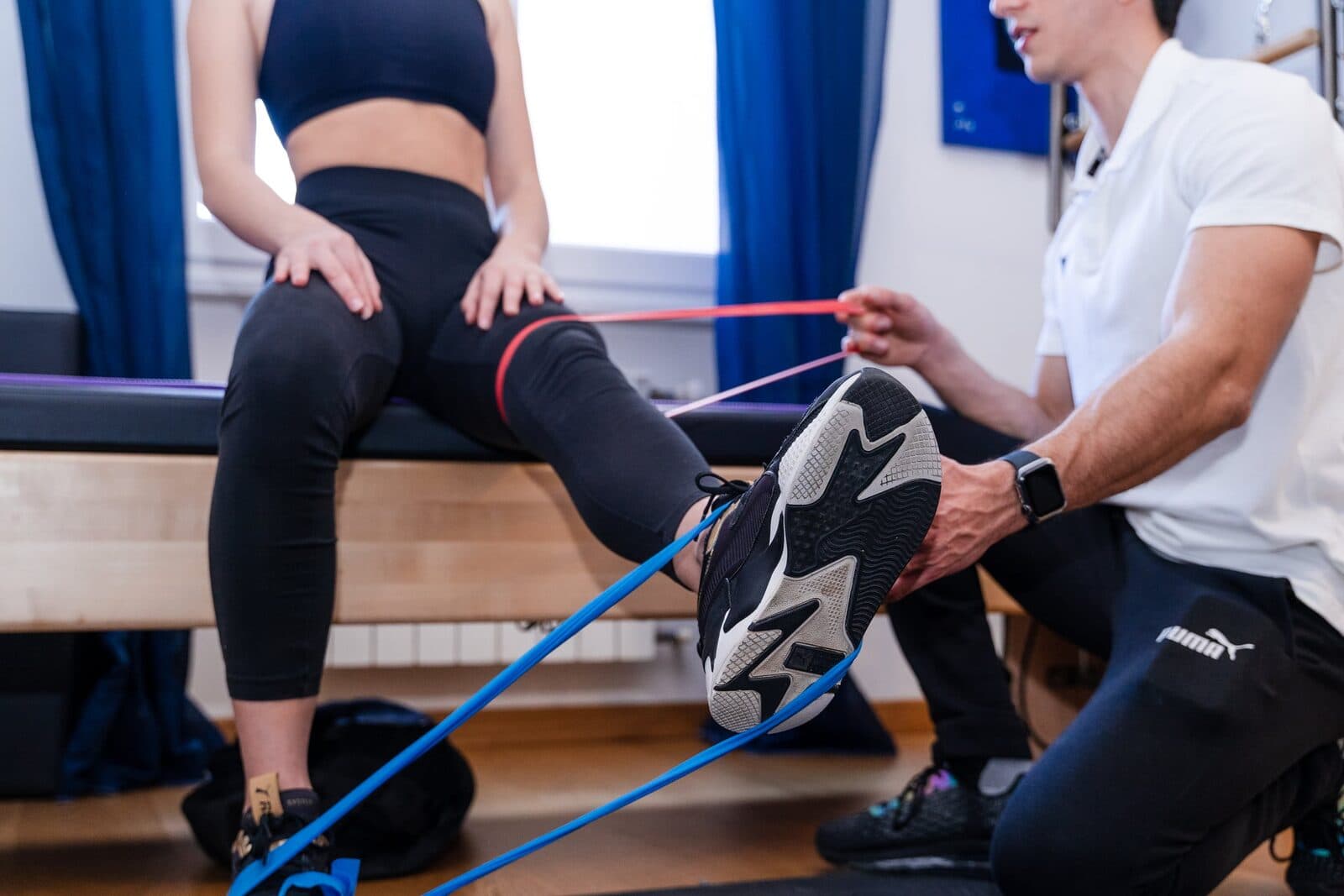
- Scapular control: retractions, external rotations with a band, lifts in the prone position. The scapular girdle is the base on which the neck works.
- Isometric neck strengthening, in all planes, with light manual resistance and without reaching pain.
- Sensorimotor work: this is the most neglected part. A randomised trial of 152 people with neck pain compared four groups (local neck treatment alone, with joint position sense and oculomotor exercises, with balance exercises, or with all of these). All four groups improved, with medium to large effects. The detail matters, however: joint position sense and balance measured during neck rotation improved more when the combined programme (position sense plus oculomotor plus balance) was added, while balance in neutral position improved more when balance exercises alone were added. So there is no single recipe that wins on everything. Adding the sensorimotor work nonetheless kept the improvements in pain and disability better at 6 and 12 months. It should also be said that the study involved 12 sessions over 6 weeks alongside local neck treatment delivered by a professional, not an improvised routine at home.
- Active mobility of the neck and trapezius within the range that does not cause pain, spread across the day rather than concentrated in one session.
If you are looking for a more detailed progression for the neck, you will find it in the guide to Exercises for Neck Pain: The Routine That Works.
How to tell whether a session did you good or harm
The practical rule I give to people I follow in telerehabilitation is not the pain during the effort, but how the neck feels in the 24 to 48 hours after. A discomfort that appears, stays modest and clears by the following day is compatible with carrying on. Pain that increases for hours after training, that wakes you at night or that is worse at the third session than at the first, indicates that the load is beyond what the tissues tolerate at present.
And there are symptoms that require an immediate stop, not an adjustment: sudden acute pain during the movement, tingling or weakness that appears during the effort, dizziness or a sense of unsteadiness. If the neck is involved in episodes of arm tingling, the assessment comes before the programming.
In summary
Neck pain and sport are not incompatible, and the research supports the idea of continuing to move. It supports far less the rigid rules we tell ourselves: there is no sport that is better than the others for the neck, there is no list of banned sports based on evidence, static stretching on its own has not been shown to reduce injuries (although it remains recommended within a warm-up that continues with dynamic work), and neck strengthening is not yet demonstrated as protection against concussion.
What remains, and what matters, is less spectacular: regulate your loads, correct the few exercises that ask the neck for extreme positions, build tolerance progressively and recognise the signs that deserve a doctor. If the pain has been persisting for months, a guided pathway is worth more than any list of exercises. Ri-Hub's physiotherapists can help you build a programme suited to your situation, all through convenient and accessible online consultations.
You might also be interested in:
Knee Bursitis: Causes, Symptoms, Treatment and Remedies Daily Stretching: A Full Routine for a Flexible Body Ankle Sprain Exercises: Complete Step-by-Step Rehabilitation
Stay in touch with us Join our dedicated Facebook group: we answer every patient, give practical advice and clear up the most common doubts.
Need a consultation?
Start with the questionnaire on Ri-Hub: a few questions about your case, you register, and you see who will follow you: a physiotherapist on the Italian professional register, whom you can write to in chat whenever you like. If you prefer to talk it through by voice, the first consultation is free, lasts twenty minutes and commits you to nothing: they arrive having already read what you wrote, and together you decide whether and how to go on.
Before returning to full load it is worth having a solid base: the routine and the criteria are in Exercises for neck pain: what really works.
Sources
- Summarizing the effects of different exercise types in chronic neck pain - a systematic review and meta-analysis of systematic reviews, BMC Musculoskeletal Disorders, 2023
- The influence of exercise on pain, disability and quality of life in office workers with chronic neck pain: A systematic review and meta-analysis, Applied Ergonomics, 2024
- Acute effects of muscle stretching on physical performance, range of motion, and injury incidence in healthy active individuals: a systematic review, Applied Physiology, Nutrition, and Metabolism, 2016
- Prevention strategies and modifiable risk factors for sport-related concussions and head impacts: a systematic review and meta-analysis, British Journal of Sports Medicine, 2023
- Effectiveness of adding rehabilitation of cervical related sensorimotor control to manual therapy and exercise for neck pain: A randomized controlled trial, Musculoskeletal Science and Practice, 2023
- Cervical Spondylotic Myelopathy: A Guide to Diagnosis and Management, Journal of the American Board of Family Medicine, 2020
Last source check: August 2026.