Neck pain is one of those problems where exercise works, but not all exercise works in the same way, and the part that pays off most is also the part almost nobody does.
⚠ Important: read this before continuing
The exercises and advice in this article are general guidance and may not suit your situation. Every person has a unique clinical history: what works for others could be counterproductive for you.
Want a professional's opinion? Start with the questionnaire: you register and see who will follow you, a physiotherapist on the Italian professional register chosen for your case, whom you can write to in chat. If you would rather hear their voice, the first consultation is free and we look at your situation together.
What works, in order of evidence
Strengthening, which is the voice that counts. Working with progressive resistance on the neck, shoulder and shoulder blade for weeks is the intervention with the best evidence. In a study on trapezius myalgia, ten weeks of specific strengthening reduced pain by 42-49%, with the electromyographic activity of the painful trapezius increased by 42-86% and shoulder abduction strength by 18-53%.
Motor control exercise. Learning to move the neck in a graded way, without recruiting the whole scapular girdle with every gesture, has a recognised role in chronic neck pain.
Mobility. It is needed, but for a different reason from the one usually given to it: it reduces perceived stiffness and puts you in a position to do the rest. On its own, according to the Cochrane review on chronic neck pain, the evidence for stretching in isolation is low and it may not change pain or function.
Put simply: mobility is the trailblazer, strengthening is the work.
The routine, in three blocks
An important tip: before trying these exercises, make sure you have had a correct diagnosis. People often think they have one problem, but the real cause of the pain is something else. Doing the wrong exercises can make things worse instead of better.
1. Mobility: every day, five minutes
Chin tuck. Seated, draw your chin back as if making a double chin, keeping your gaze horizontal. Five seconds, ten repetitions. It is the movement that reactivates the deep flexors, the ones that switch off first.
Rotations. Slowly turn your head to one side, stop where the movement ends without forcing it, and come back. Ten per side.
Side bends. Bring your ear towards your shoulder while keeping the other shoulder low. Twenty seconds per side, without pulling with your hand: just gravity.
Thoracic extension. Seated, hands behind your head, open your elbows and look up, extending the upper back, not the lower back. Ten slow repetitions. The neck also pays for a back that does not extend.
2. Strengthening: two or three times a week
Isometrics in four directions. Hand on your forehead, push your head against the hand without letting it move. Five seconds, five repetitions. Then to the sides and to the back.
Band scapular retraction. Pull the band bringing your shoulder blades back and down, elbows close to your sides. Twelve repetitions, three sets.
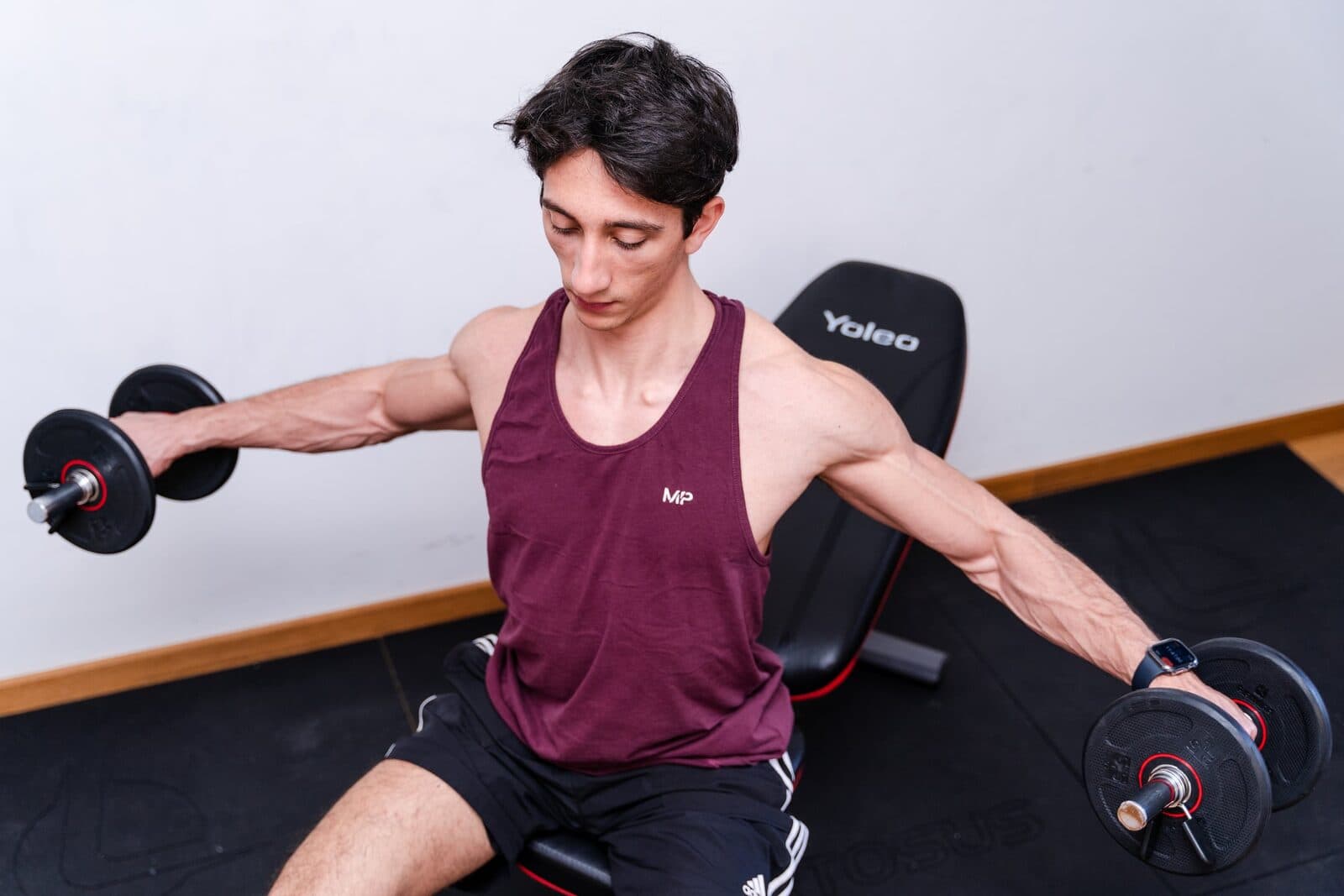
Light lateral raises. Low loads, controlled movement, twelve repetitions. It seems far from the neck and it is not.
Prone Y-T-I. Lying face down, arms forming the letters Y, T and I. Ten per position. It works the scapular muscles, which in the painful neck are almost always the weak ones.
3. Control: when the pain allows it
Slow, wide movements following with your eyes a point that moves, or writing imaginary letters with your nose. It seems like a game: it serves to bring precision back where the pain has made everything stiff.
If you work at a computer
Here the problem is not the position, it is the duration.
Active micro-breaks. Every 30-45 minutes: five chin tucks and five rotations per side. Thirty seconds is enough, and it is the thing that changes the most in the day of someone sitting at a desk.
Stretching seated. A side bend held for twenty seconds per side, which you can do during a phone call without anyone noticing.
Chest opening. Hands interlaced behind your head, elbows open, gaze upwards. It counteracts the hours spent hunched forward.
The timer matters more than the chair: a perfect workstation where you stay motionless for three hours still produces a stiff neck.
Ones to avoid
Full, fast circles, especially the backward part: they load the facet joints without giving back anything you cannot get with separate movements.
Any movement that produces dizziness, nausea or tingling in the arms. Stop these and report them.
Exercises that make the pain travel down the arm. The direction of the symptom is the most useful information you have: if it travels down, that movement is not for you right now.
How long it takes
A few days for the feeling of stiffness. Four to eight weeks for a stable change in pain, which is the order of magnitude that recurs in the studies on strengthening.
It is also the reason why many people conclude that "exercise does not work": they stop in the second week, that is, before strengthening has had time to produce anything.
When these are not exercises to do on your own
Pain that appeared after a trauma, real weakness in an arm, persistent sensory disturbances, fever with neck stiffness, or pain that does not change in any position: these are situations to be assessed before any routine.
Ri-Hub offers online physiotherapy sessions of 30 minutes for 29,90 €, and the first 20-minute consultation is free.
Sources
- Exercises for mechanical neck disorders, Cochrane Database of Systematic Reviews, 2015
- Effects of Stretching or Strengthening Exercise on Spinal and Lumbopelvic Posture: A Systematic Review with Meta-Analysis, Sports Medicine - Open, 2024
- Effect of physical training on function of chronically painful muscles: a randomized controlled trial, Journal of Applied Physiology, 2008
- The Relationship Between Forward Head Posture and Neck Pain: a Systematic Review and Meta-Analysis, Current Reviews in Musculoskeletal Medicine, 2019
Last source check: September 2026.
You might also be interested in:
Chin Tuck: The Complete Guide to Healthy Neck Posture Neck Exercises: The Complete Routine for the Neck Stress-Related Neck Pain: The Mind-Body Connection
Stay in touch with us Join our dedicated Facebook group: we answer every patient, give practical advice and clear up the most common doubts.
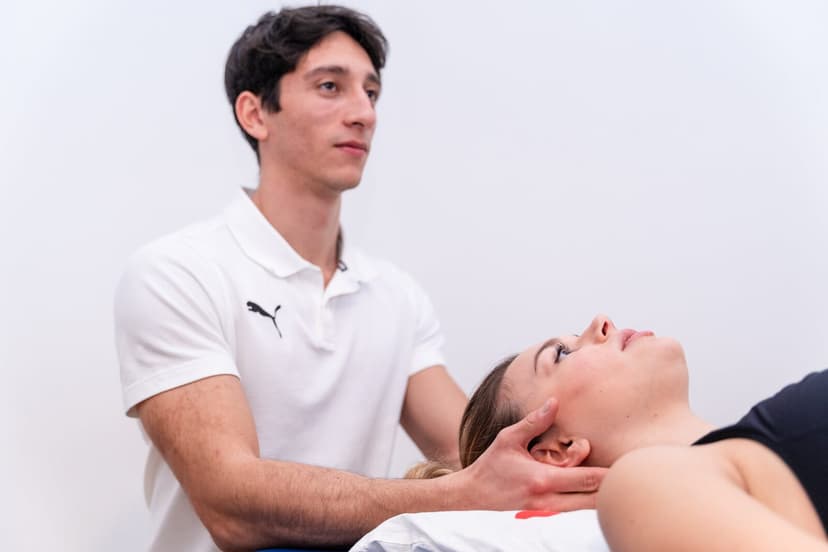
Manual techniques you will be offered
Many manual techniques circulate for the neck, and the right question is not which is the best: it is whether they stand alone or sit within a pathway in which you move. On this the research is clear: manual therapy combined with exercise beats either taken alone. The case of cervical pompage explains it best, because it is very widespread and has never been studied on the neck.
Need a consultation?
Start with the questionnaire on Ri-Hub: a few questions about your case, you register, and you see who will follow you: a physiotherapist on the Italian professional register, whom you can write to in chat whenever you like. If you prefer to talk it through by voice, the first consultation is free, lasts twenty minutes and commits you to nothing: they arrive having already read what you wrote, and together you decide whether and how to go on.