The front of your knee has swollen up. Not inside the joint: right above the kneecap, a soft swelling that moves under your fingers, appearing after days spent kneeling to lay tiles, to garden, or after a direct knock.
Most often it is a prepatellar bursitis. And the first thing to establish is not how to treat it: it is whether it is infected or not, because the two paths diverge completely.
What a bursa is, and why it becomes inflamed
Synovial bursae are small sacs filled with fluid that act as a cushion between a bone and the tissues that slide over it: tendons, muscles, skin. Around the knee there are several; the one that most often becomes inflamed is the prepatellar bursa, which sits between the kneecap and the skin and absorbs the pressure when you rest on your knees.
When that pressure is repeated for hours, or when a direct blow arrives, the bursa reacts by producing more fluid. The result is the visible swelling that brought you here.
It is not a rare condition: the literature reports a minimum incidence of 10 cases per 100,000 people a year for prepatellar and olecranon bursitis combined, with a clear male predominance, consistent with work that involves kneeling.
The types seen at the knee
- Prepatellar, the most common: swelling in front of the kneecap, typical of people who work on their knees.
- Superficial infrapatellar, just below the kneecap, with the same mechanism.
- Pes anserine, on the inner side of the knee a few centimetres below the joint: here the swelling is less obvious and the pain is felt going up stairs or getting up from a chair.

The distinction that changes everything: infected or not
This is the part worth reading carefully, because it decides whether the problem can be handled with rest and protection or whether you need a doctor today.
A bursitis can be septic (infected) or non-septic. The vast majority of cases are not infected, but those that are require antibiotics, and the skin in front of the knee is a place where bacteria easily enter through a small wound.
The clinical signs that point towards infection, according to the review that built the most widely cited treatment algorithm, are three:
- fever above 37.8 °C;
- a skin temperature difference over the bursa greater than 2.2 °C compared with the healthy side;
- the presence of skin lesions over or near the bursa.
Confirmation, however, does not come from the physical examination: it comes from the analysis of the aspirated fluid. Signs pointing to infection include purulent aspirate, a fluid-to-blood glucose ratio below 50%, white blood cells above 3,000 per microlitre, polymorphonuclear cells above 50%, a Gram-positive stain or a positive culture.
What to do, in practice: if you have a fever, the skin over the swelling is hot and red compared with the other knee, or there is a wound, even a small one, in that area, do not wait and do not treat it on your own. In other cases the picture is almost always non-infectious and is managed as described below.
How long recovery takes
This is the question that brings most people to this page, and it deserves an honest answer: the literature does not give a single number, and the "two to eight weeks" you read around the web is not backed by any study that measures it.
What can be said with more confidence is this:
- in non-infected forms caused by overuse, the swelling goes down over a matter of weeks provided the cause is removed. If you keep kneeling as before, the bursa keeps filling: time does not pass on its own;
- recurring forms, the ones that go down and come back, take longer, and these are exactly the cases where protecting the area matters more than any therapy;
- for cases that reached surgery the data is precise: in the largest systematic review available, 80% of patients operated endoscopically were pain-free at one year.
The variable that governs timing, then, is not the therapy: it is whether the movement that caused the bursitis is stopped or not.
What is done, in order
The general measures indicated in the literature, valid for both septic and non-septic forms, are three and they are simple: aspiration of the bursa, anti-inflammatories and protection of the area: relative rest, ice, compression, leg elevated.
Aspiration does not only relieve pressure: above all it gives you fluid to analyse, which is why it comes before any therapeutic decision.
Cortisone injections have a precise and narrow place: the literature indicates them for patients with confirmed non-septic bursitis and high sporting or work demands. They are not routine treatment, and on an infected bursa they would make things worse. This is why the distinction in the previous paragraph comes first.
Antibiotics apply only to septic forms. One interesting finding from the review of 702 patients: those who received antibiotics for fewer than 8 days showed no more recurrences than those who took them for eight days or more. This is not an invitation to stop a treatment, which is the doctor's decision, but it does put into perspective the idea that a long course is always needed.
When surgery comes into play (and how much the technique matters)
Surgery (incision, drainage or removal of the bursa) is reserved for severe cases that do not respond to treatment, or for chronic and recurring cases. It is not the first step, and on this point the review is explicit: the available evidence does not support immediate removal of the bursa, not even in infected forms, where a conservative approach comes first.
If surgery does happen, the choice between endoscopic and open technique is not a choice between better and worse: across the 702 patients, the two did not show significant differences either in recurrences at one year or in surgical complications.
What physiotherapy can do
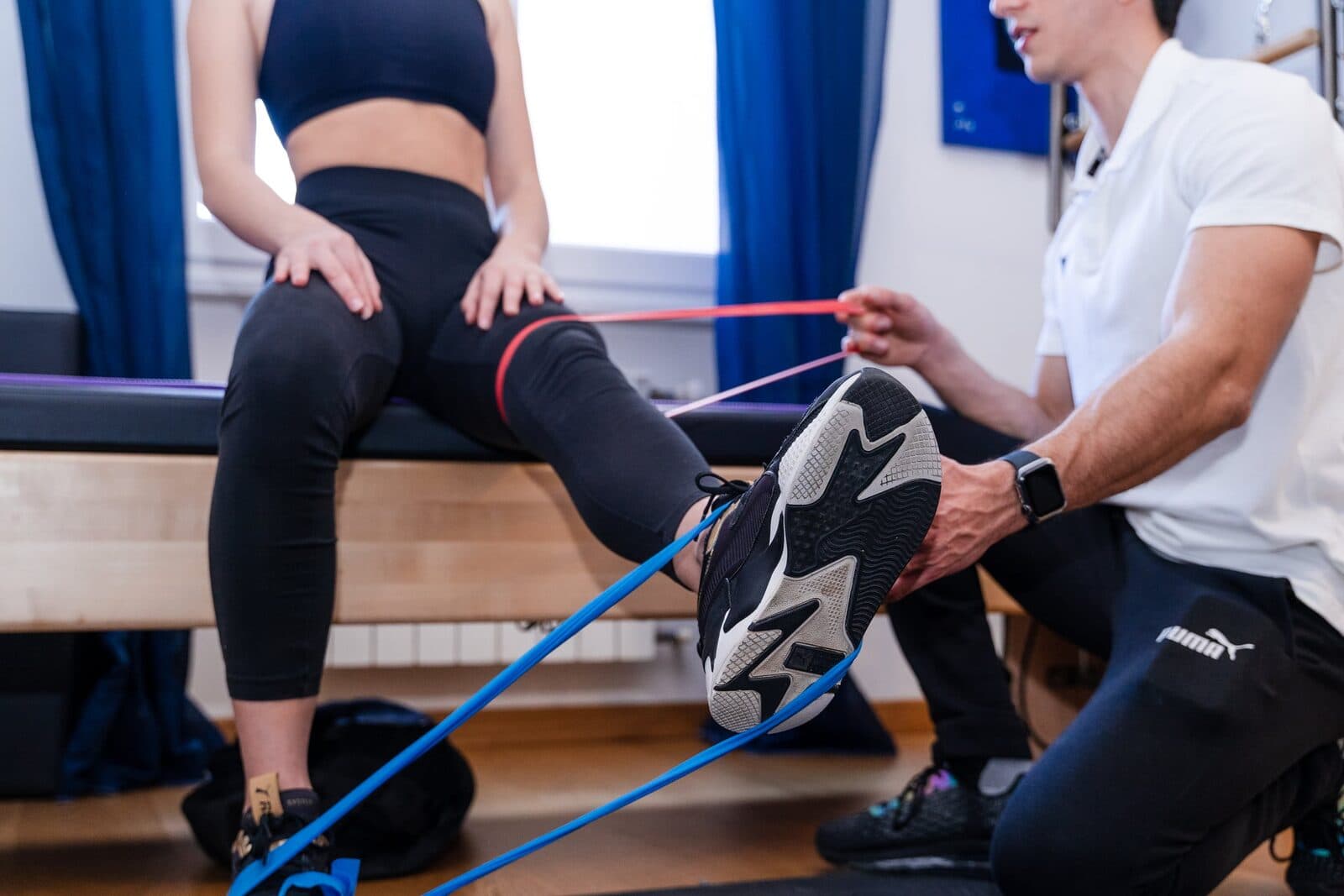
Prepatellar bursitis is not "rehabilitated" in the way a shoulder is rehabilitated after surgery: the bursa goes down on its own once you stop compressing it. The useful work is something else, and it concerns the after:
- Removing the load that caused it. If your job requires kneeling, the padded knee pad is not an accessory: it is the measure that decides whether it comes back. Alternating positions and building in pauses where the knee is not resting on the ground is worth more than any device-based therapy.
- Restoring full movement, which is often lost because of pain and swelling, before stiffness becomes the next problem.
- Strengthening the quadriceps, which weakens quickly when the knee hurts and stays behind even after the swelling has gone.
- Reviewing the movement pattern: in pes anserine bursitis, for example, hip control and gluteal strength matter a great deal, because that bursa becomes irritated when the knee gives way inwards.
How to stop it coming back
Recurrence is the real problem with this condition, and prevention is almost entirely mechanical: knee pads with adequate padding for people who work on their knees, scheduled breaks, a mat to kneel on, and immediate attention to any skin wound in that area, since it is the entry point for infected forms.
Signs not to manage on your own
See a doctor without waiting if you develop a fever, if the skin over the swelling is hot and red compared with the other knee, if there is a wound in the area, if the pain is intense and stops you bending the knee, or if the swelling returns every time you resume activity.
Getting checked
The swelling in front of the knee can have more than one explanation: prepatellar bursitis, fluid inside the joint, problems with the patellar tendon. They are told apart by looking at exactly where it sits and how it behaves.
With Ri-Hub the first consultation is free: a physiotherapist on the Italian professional register takes your history, works out which movement is feeding the problem and tells you whether the picture first needs a medical check, which with a swollen knee has to be ruled out first. Follow-up sessions cost 29,90€.
Sources
- Prepatellar and olecranon bursitis: literature review and development of a treatment algorithm, Archives of orthopaedic and trauma surgery, 2014
- Management of septic and aseptic prepatellar bursitis: a systematic review, Archives of orthopaedic and trauma surgery, 2022
Sources last checked: September 2026.