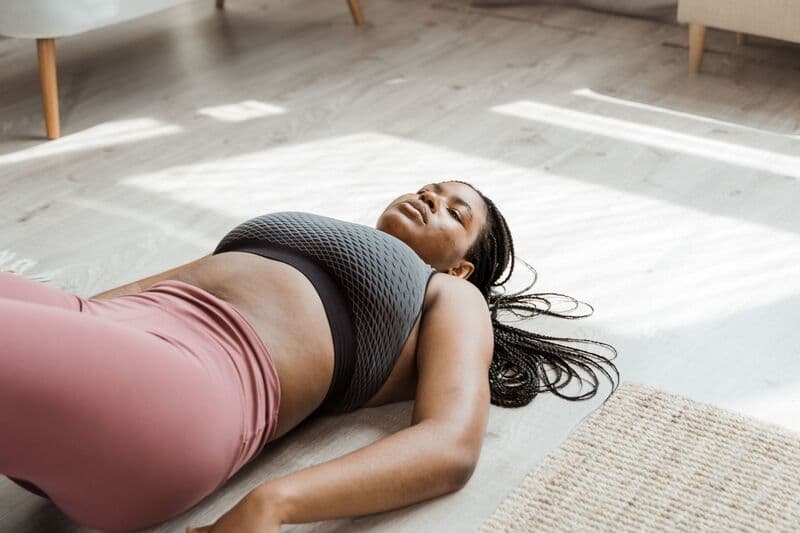
After a knee sprain with pain on the inner side, the question almost always comes in the same form: which exercises are needed for the collateral ligament? The honest answer is less straightforward than what you usually find, and it is worth reading before you start doing heel slides on the mat.
⚠ Important: read this before continuing
The exercises and advice in this article are general guidance and may not suit your situation. Every person has a unique clinical history: what works for others could be counterproductive for you.
Want a professional's opinion? Start with the questionnaire: you sign up and see who will follow you, a physiotherapist registered with the Albo chosen for your case, whom you can write to in chat. If you would rather hear a voice first, the first consultation is free and we look at your situation together.
First of all: the signs that call for a visit
A knee that has taken a twist or a blow to the side can have a much more serious problem than a ligament sprain, and some of these situations cannot wait.
Go to the emergency department or to a doctor, not to the gym, if:
- you cannot bear weight on the leg, or cannot take four steps putting weight on it;
- you cannot bend the knee to ninety degrees, or cannot straighten it fully;
- the knee locks in one position and does not unlock, or gives way suddenly while you walk;
- the joint is hot, swollen and red, especially with fever or general malaise: a hot, swollen knee always needs to be assessed, because one of the causes is joint infection;
- the swelling appeared very quickly after the injury, not the next day: an immediate effusion suggests blood in the joint, and therefore a cruciate ligament injury or a fracture;
- the pain is on the outer side of the knee, or you feel that the leg "goes out of line";
- you had a high-energy injury (a car accident, a fall from a bike at speed, a violent sports collision);
- you are a growing adolescent: at your age a blow causing the knee to fold inwards can affect the growth plate rather than the ligament, and the management changes completely.
These indications are not bureaucratic formalities. The Ottawa knee rules, created precisely to decide who should be sent for an X-ray, are a validated screening tool for ruling out fractures, with a negative likelihood ratio of 0.05: if the criteria are negative, a fracture is very unlikely. The same review, however, shows a finding worth keeping in mind: taken individually, clinical tests of the knee rarely suffice on their own to confirm or rule out a diagnosis, with the exception of the Lachman test for the anterior cruciate ligament. There is also the other side of the coin: a complete physical examination, performed by a trained professional, has instead proven valid for injuries to the cruciate and meniscal structures. So it is not the visit that is unreliable: it is an isolated single test, and even more so self-diagnosis online of a traumatised knee.
Which ligaments we are dealing with (they are not the same thing)
The knee has two collateral ligaments, and the literature treats them in radically different ways.
The medial collateral ligament (MCL) sits on the inner side and resists the force that pushes the knee "inwards". It is the ligament most often injured in the knee, and most isolated injuries are treated without surgery. Partial injuries in particular have excellent outcomes with conservative treatment; complete tears can be managed without an operation, but some of them still end up in the operating theatre.
The lateral collateral ligament (LCL) sits on the outer side and is part of a complex of structures called the posterolateral corner. Here the picture changes: the long-standing limited knowledge of the anatomy and biomechanics of this area, together with the poor results of non-surgical treatment, has earned it the nickname "the dark side of the knee" in the orthopaedic literature. Over the last twenty years research has improved surgical reconstructions and outcomes, but there is still no standardised algorithm for diagnosis and treatment: decisions are made case by case. Lateral pain after an injury is not the mirror image of medial pain, and it should not be managed with the same scheme of exercises found online.
There is also the chapter on combined injuries. Associated damage to the anterior or posterior cruciate ligament is a frequent indication to treat a high-grade medial collateral ligament injury surgically, although, for multiligament injuries, the role of repairing or reconstructing the collateral remains debated, with data supporting both conservative and surgical management. This is one of the reasons why the first step is not choosing exercises: it is understanding what has really been torn, and how much.

What the studies really say about exercises
Here we reach the part that is rarely written. The prevailing message is that recovery of the collateral ligament depends almost entirely on the rehabilitation programme. The documented reality is more nuanced.
A systematic review from 2024 gathered all the available literature on non-surgical treatment of isolated MCL injuries: 26 studies with a total of 1,912 patients. The conclusions are clear and uncomfortable. Between grade I and grade II there are no differences in treatment; immediate loading and walking are tolerated; rehabilitation consists of "different types of strengthening exercises with poorly reported details". The use of a brace and its duration are reported inconsistently from one study to another. The authors' verdict is that there is substantial heterogeneity and a lack of detail, and that high-quality studies are needed. It is worth noting that eighteen of those twenty-six papers were published before 2000.
A review on return to sport after a medial collateral ligament injury is even more explicit: a complete rehabilitation programme is considered decisive for the outcome, but a standardised programme valid for all injuries does not exist, the literature is made up mostly of observational studies and clinical cases, and no level I studies have been published comparing rehabilitation protocols with each other.
What do we take from this, in practice?
- The good outcome of isolated MCL injuries is real, and it is documented: the authors of the review speak of non-surgical treatment as "promising". What is missing is not the result, it is the proof that a specific list of exercises works better than another.
- Nobody can tell you that "these twelve exercises" are the best. Anyone who does is selling, not citing.
- Progression by phases remains the sensible approach, because it helps avoid overloading a tissue that is repairing and avoids leaving strength and control behind. But it is clinical reasoning, not first-level evidence.
This distinction does not take away the value of exercises: it changes how you use them. Instead of chasing a list, you reason in terms of goals and of criteria for moving from one phase to the next.
Phase 1: Protection, movement and activation
In the first days the aim is to protect the tissue that is repairing, control swelling and pain, and not lose movement. The systematic review notes that, in grade I and II injuries, loading and walking are tolerated from the outset: staying still out of generic caution is not the default choice.
Movement is recovered with flexion and extension within the limit of pain. Heel slides, lying down, with the heel sliding towards the buttock and back, are the simplest way to regain degrees without forcing. The criterion is not "how far do I bend", it is "I bend without the pain increasing afterwards".
In parallel the quadriceps is kept active with quad sets: with the knee straight, you press the back of the knee towards the bed by contracting the thigh, hold for a few seconds, and release. It seems little, and it is the way clinicians try to limit the loss of strength that follows a knee injury: it is shared clinical reasoning, not a protocol proven superior to others in high-quality studies. From there you move to the straight leg raise, lifting the straight leg, which demands the same contraction against the weight of the limb.
An important point: before trying these exercises, make sure you have received a correct diagnosis. People often assume they have one problem, when the real cause of the pain is something else. Doing the wrong exercises can make the situation worse rather than better.
Phase 2: Strengthening, and not just of the quadriceps
When movement is acceptable again and the swelling is under control, you start loading. Mini squats, short lunges, step-ups, leg press with moderate loads: the principle is to increase the load a little at a time, keeping the pain below a threshold that stays low and does not carry over into the following hours.
The most common mistake is to concentrate everything on the quadriceps. The hamstrings, the muscles at the back of the thigh, and above all the glutes deserve equal attention: they govern the orientation of the femur and reduce the knee's collapse inwards, which is precisely the direction that stressed the medial collateral. If you want an overview of strength work for the joint, the knee exercises are a good starting point to adapt to your case.
One detail that applies throughout this phase: avoid the movements that reproduce the mechanism of the injury until strength has returned, that is, forced valgus openings and twisting with a fixed foot.
Phase 3: Single-leg control
Here you train the ability to manage the knee when the body moves: standing on one leg, first with eyes open on stable ground, then with perturbations, then on unstable surfaces such as cushions or wobble boards. Load transitions, decelerations and controlled landings are added.
On this phase there is a claim that needs toning down: that proprioceptive work is "essential to prevent recurrences". The data are more cautious, and it is worth being precise about what was measured. A systematic review with meta-analysis (25 included studies, meta-analysis restricted to randomised studies) evaluated neuromuscular training programmes (not just the proprioceptive board, but broader packages of exercises) as prevention of injuries in youth sport. The outcome measured was injuries during sports practice, not recurrences after an injury had already occurred. The result: a reduction in the risk of lower-limb injury, with an incidence rate ratio of 0.64 (95% confidence interval 0.49-0.84); for knee-specific injuries, on the other hand, the point estimate suggests a protective effect but does not reach statistical significance (0.74; 0.51-1.07).
In other words: training control and balance is a good idea, and across the lower limb as a whole it pays off, at least in primary prevention. But promising that it will prevent a new collateral ligament injury is a promise the data do not cover: that meta-analysis did not measure recurrences of collateral injuries in people who had already injured it, and for the knee in particular the confidence interval still includes the absence of effect. Knowing that the knee can still give way suddenly and recognising it as a sign to be assessed is more useful than relying on a wobble board as an insurance policy.
Phase 4: Return to activity
The last phase is the most specific: progressive running, controlled changes of direction, the movements of the sport you practise. The move from one phase to the next is decided on criteria (absence of pain and reactive swelling, symmetry of strength with the other leg, quality of control in single-leg tests), not on a number of weeks read in an article.
On timescales it is worth being explicit: anyone who promises you a precise date is extrapolating. The 2024 review found descriptions too heterogeneous to build reliable standardised timescales, and combined injuries follow completely different paths from isolated ones. A grade I in a sedentary person and a grade II in a contact-sport athlete do not have the same timetable, and neither of them will find it on the internet.
Telerehabilitation is particularly suited to this part of the pathway: most of the work consists of performing exercises correctly and progressing at the right moment, and both can be checked well on a video call, with the option of adjusting the programme week by week.
In short
Isolated injuries of the medial collateral ligament have a good prognosis, and this is documented. The exercises for the collateral ligament serve to protect the repair, not to lose strength, and to return without skipping steps. But no protocol has proven superior to the others in high-quality studies, and balance work is not the anti-recurrence guarantee that is often described.
What really makes the difference is two things: a correct diagnosis at the start, which ligament, which grade, what else is involved, and progression decided on criteria rather than on the calendar. If you have doubts about either of these two points, that is the moment to get assessed, not to look for another list of exercises.
You might also like:
Lifting Weights with Your Back: How to Do It Without Hurting Yourself Warm-Up Before Training: A Complete Guide to Preparing at Your Best Exercise with Joint Hypermobility: A Complete and Safe Guide
Stay in touch with us
Join our dedicated Facebook group: we answer all patients, give practical advice and clear up the most common doubts.
Sources
- Shedding light on the non-operative treatment of the forgotten side of the knee: rehabilitation of medial collateral ligament injuries - a systematic review - BMJ Open Sport & Exercise Medicine, 2024
- Return to Play After Medial Collateral Ligament Injury - Clinics in Sports Medicine, 2016
- Treatment of medial collateral ligament injuries - Journal of the American Academy of Orthopaedic Surgeons, 2009
- Posterolateral corner knee injuries: a narrative review - EFORT Open Reviews, 2021
- Diagnostic validity of physical examination tests for common knee disorders: an overview of systematic reviews and meta-analysis - Physical Therapy in Sport, 2017
- Neuromuscular training injury prevention strategies in youth sport: a systematic review and meta-analysis - British Journal of Sports Medicine, 2015
Last check of the sources: August 2026.
Also read: Cruciate Ligament Injury: Symptoms and Recovery Pathway.
Need a consultation?
Start with the Ri-Hub questionnaire, a few questions about your case, you sign up, and you see who will follow you: a physiotherapist registered with the Albo, whom you can write to in chat whenever you like. If you prefer to talk it through, the first consultation is free, lasts 20 minutes and commits you to nothing: they arrive having already read what you wrote, and together you decide whether and how to go on.