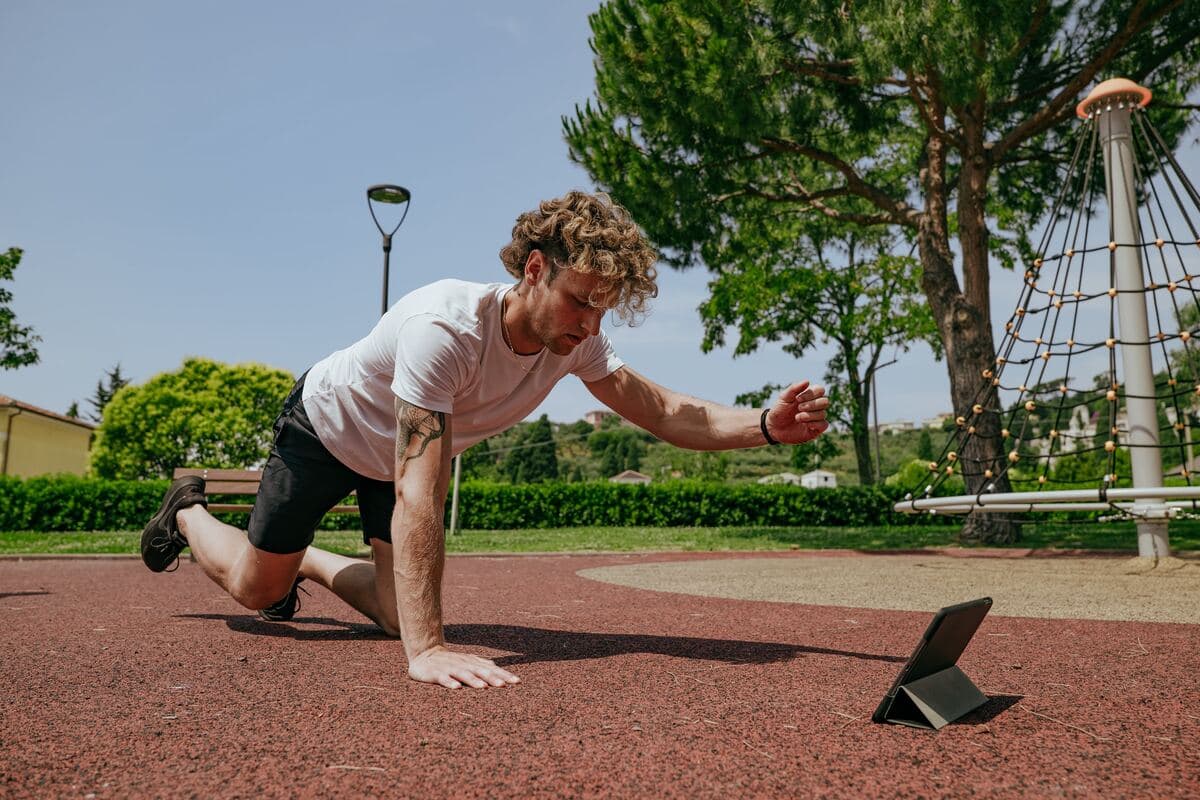
Isometric exercises are contractions in which the muscle produces tension without the joint moving: you push against a wall that does not give, or hold a position against gravity. From the outside it looks as if nothing is happening.
They are the most talked about and least understood type of exercise in rehabilitation. They are presented as an immediate painkiller for tendons and as a remedy for high blood pressure. One of these two claims has stronger evidence than people think, the other much less than it is sold for.
Important: read before continuing. The exercises below are general indications and may not suit you: what works for others can be counterproductive.
Want a professional's opinion? Start with the questionnaire: you register and see who will follow you, a physiotherapist registered with the Albo chosen for your case, whom you write to in chat. If you would rather hear their voice, the first consultation is free.
What changes compared with dynamic work
An isometric contraction is one in which the muscle generates tension without changing length: you push against a wall, the wall does not move, nor do you, but the muscle is working hard.
In dynamic work the muscle shortens or brakes as it lengthens, and the joint travels through a range of movement. In the isometric there is no range. From this difference everything else follows.
First consequence: you can produce high tension without passing through the part of the movement that hurts. If it is the last degrees of knee flexion that block you, you load the quadriceps while staying outside that degree.
Second consequence: it causes less fatigue. A review of isometric strength in sport notes that this work induces less fatigue than dynamic work and produces strength gains specific to the trained angle (Lum and Barbosa, 2019).
Third consequence, the least discussed: what you gain largely stays where you built it.
It is also called isometric gymnastics, and it is the same thing: contraction without joint movement. On the knee it is the most widespread application, because it allows you to load the quadriceps when bending hurts or when the joint needs protecting: after surgery, in an acute phase, with patellofemoral pain that does not tolerate bending.
Angle specificity: the concept almost nobody explains
This is what separates a well-designed programme from a list of positions to hold.
A 1989 study had six women train with maximal contractions of the plantar flexors at a single ankle angle, three times a week for six weeks, then measured strength at five-degree intervals in both directions.
Strength increased at the trained angle and at the two immediately adjacent angles, and at no others. The authors concluded that the mechanism is neural (Kitai and Sale, 1989).
An earlier study on the elbow found the same thing with one extra detail: training different groups at 25, 80 and 120 degrees of flexion, the gain was always greatest at the trained angle, and the shorter the muscle was during training, the more the gain stayed confined there (Thépaut-Mathieu and colleagues, 1988).
These are small, old studies, and it is right to say so. But the direction is confirmed: a review of twenty-six works found that training at longer muscle lengths produces more hypertrophy and transfers better to dynamic work, and that to affect the tendon intensities of 70% and above are needed (Oranchuk and colleagues, 2019).
In practice:
- If you have a specific weak point, isometrics are the most direct tool: train it there.
- If the goal is strength across the whole range, one angle is not enough.
- All else being equal, it is better to favour positions with the muscle long rather than comfortable positions with the muscle short.
The quadriceps held with the knee almost fully extended and the same quadriceps held at sixty degrees of flexion are not the same exercise.

Isometrics and blood pressure: the most solid finding in the field
Here is the surprise. In recent years isometric training has found its way among the forms of exercise with the most consistent effect on resting blood pressure.
A 2023 network meta-analysis pooled 270 randomised trials and 15,827 participants, comparing all forms of exercise. Isometric training showed a reduction of 8.24 mmHg systolic and 4.00 diastolic, the largest among the modalities examined, and the most effective sub-modality for systolic pressure was holding a wall squat (Edwards and colleagues, 2023).
A 2014 meta-analysis had already found 6.77 mmHg systolic and 3.96 diastolic, but across nine studies and 223 participants in total, most of them with normal blood pressure (Carlson and colleagues, 2014).
How much trust these numbers deserve
This is the part that is usually cut, and yet it is the part that matters.
A panel of experts assessed the whole body of evidence in 2024 using the GRADE approach, declaring moderate certainty, downgraded for serious risk of bias: many studies do not explain how allocation to groups was concealed, blinding of assessors is often not reported, and about 30% of the works have a high risk of bias.
The panel's estimate is 8.1 mmHg systolic and 3.7 diastolic across 1,424 participants in 28 studies (Edwards and colleagues, 2024).
An independent review from 2021, limited to adults with already raised blood pressure, was more severe: 24 studies, 1,143 participants, clinic systolic reduced by 6.97 mmHg, but certainty judged very low to low with high heterogeneity.
And above all, for blood pressure monitored over 24 hours the reduction in systolic did not reach significance (Hansford and colleagues, 2021).
The correct formulation is therefore: the effect exists, it is replicated across many small studies, it is more visible in the clinic than over 24 hours, and no guideline has promoted it to first-choice treatment.
The European consensus document of 2022 examined isometrics alongside the other modalities and proposed choosing the type of exercise according to the starting value, declaring that considerable research gaps remain (Hanssen and colleagues, 2022).
An isometric exercise does not replace a medicine your doctor has prescribed you.
The double edge: during the hold, pressure rises
The effect has two phases, and this changes the indications.
In a study of forty sedentary women, during a single session of isometric wall squats significant increases in heart rate and in systolic, mean and diastolic pressure were measured, with a reduction in baroreflex sensitivity.
In recovery, peripheral resistance fell below the starting value, and with it blood pressure, by around 17 mmHg (O'Driscoll and colleagues, 2021).
Put simply: pressure falls afterwards, but during the hold it rises. And it rises more if you hold your breath, because forced exhalation with a closed glottis produces pressure spikes on its own. The technical rule is not negotiable: continuous breathing for the whole duration of the hold.
On the link between the neck and blood pressure we have written about it in neck pain and high blood pressure: claims circulate on that connection that do not hold up.
Who should be assessed before starting
The 2024 review reports isometric training as strongly contraindicated in connective tissue diseases, such as Marfan syndrome, and in disorders of the thoracic aorta, although on low-quality evidence. It advises caution in coronary artery disease, because the rapid drop in diastolic pressure after a hold involving a lot of muscle mass can reduce blood flow to the heart muscle.
The same work states, however, that contraindicating isometrics for all hypertensive people who are otherwise healthy has no foundation and creates confusion. On safety, the 2021 review found no significant increase in risk: one adverse event every 38,444 holds performed.
Speak to a doctor before setting up a programme if:
- you have uncontrolled hypertension, or you do not know what your values are;
- you have known heart disease, particularly coronary;
- you have a diagnosis involving connective tissue or the aorta;
- you are pregnant: the haemodynamic reasoning is the same, and long breath-holding holds should be avoided. This is clinical caution, not experimental data.
A special case is glaucoma. A study of twenty adults measured intraocular pressure during one-minute isometric efforts with three breathing patterns: it rose progressively during the hold, and rose more the longer the breath was held.
The authors conclude that anyone with glaucoma or at risk should avoid activities in which the breath is held, especially when combined with isometric contractions (Vera and colleagues, 2021). It is not isometrics that should be avoided: it is breath-holding.
Isometrics and tendon pain: more uncertain than it is portrayed
Here honesty costs something, because it is the reason most people look for these exercises.
In 2015 a crossover study of volleyball players with patellar tendinopathy compared isometric and isotonic contractions. Pain during the single-leg decline squat fell on average by 6.8 points out of 10 after the isometric exercises, against 2.6 after the isotonic ones, with the advantage still present at 45 minutes (Rio and colleagues, 2015). That result went around the world. It had six participants.
Then came the checks. A randomised crossover study of 21 people with patellar tendinopathy compared high-load isometrics with dynamic work: pain fell by 0.9 points out of 10, the effect did not last to 45 minutes, and no difference emerged between the two modalities.
The authors write that the type of contraction may not be the most important factor (Holden and colleagues, 2020).
On the Achilles tendon the result was worse. In sixteen patients given the 45-second heavy hold recommended by the protocols, neither pain during a functional task nor mechanical sensitivity improved appreciably. The authors' conclusion is explicit: on this basis those holds cannot be recommended for immediate relief (O'Neill and colleagues, 2019).
On the shoulder the result is the opposite of what was expected. In 35 people with rotator cuff-related pain, both painful and non-painful isometrics produced a moderate increase in pain right after the exercise compared with rest, which subsided after 45 minutes (Balasch-Bernat and colleagues, 2021).
The summary picture is given by a network meta-analysis on patellar tendinopathy: pooling three randomised trials, isometrics are equivalent to isotonic exercise for immediate relief, with a mean difference of 1.03 points and a confidence interval that crosses zero.
The authors place isometrics among promising interventions with inadequate evidence, and indicate eccentric loading as first-line treatment (Challoumas and colleagues, 2021).
An earlier systematic review offers the most useful clinical synthesis: isometrics seem better suited to short-term relief, for example during a competitive season, while for long-term pain slow, heavy loading or eccentric work is needed (Lim and Wong, 2018).
Isometrics are worth testing on the individual case: when they work they cost little. But they are not a rule and they are not the treatment, which remains progressive loading over time; eccentric exercises are the reference point to measure yourself against.
That a step is not the destination is shown by a 2025 trial on insertional Achilles tendinopathy: both groups followed a four-stage loading programme that began with isometrics and went on to isotonic work, energy storage and sport-specific movement (Pringels and colleagues, 2025). Nobody stops at the first stage.
When they are truly needed in rehabilitation
Beyond the question of pain relief, there are situations in which isometrics are not one option among many: they are what can be done.
- Acute phase and irritable pain. When movement sets off the symptom, holding moderate tension in a tolerated position avoids reducing the load to zero.
- Post-operative with movement restricted. After many operations the range is limited by protocol: contraction without movement keeps the muscle active within those constraints.
- Immobilisation. With a brace or cast, it is often the only voluntary contraction possible in that segment.
- Partial range of movement. When only part of the movement is painless, angle specificity becomes an advantage.
- Identified weak point. If the assessment shows a give-way in a precise position, that position is the target.
In all these cases the isometric is a bridge: it keeps something going while you wait to be able to do more. Programming it as the final destination is the most common mistake I see.
How to dose them: what comes from studies and what from practice
Distinguishing the two is the only way not to pass off conventions as evidence.
Maximal strength and hypertrophy (from studied protocols). The Lum and Barbosa review indicates, for maximal strength, contractions at 80-100% of maximal voluntary contraction held for 1-5 seconds, for 30-90 seconds in total per session, across several angles or on the target angle. For hypertrophy, intensity of 70-75% with holds of 3-30 seconds and a total of 80-150 seconds per session, for more than 36 sessions.
Tendon (from studied protocols). Oranchuk adds the constraint on intensity: to change the structure and function of the tendon, contractions at 70% or more are needed.
Blood pressure (from studied protocols). The schemes used in studies on hypertension are uniform: four holds of two minutes, with one or two minutes of rest, three times a week. The intensity is low and depends on the modality, around 30% of maximum in manual grip. The 2024 review notes that this scheme has rarely been questioned.
Tendon pain (studied protocol, uncertain effect). Five holds of 45 seconds at around 70% of maximum, with two minutes of rest: it comes from the 2015 study and is legitimate to try, keeping in mind what was said above about reproducibility.
Stability and control (clinical practice). Holds of 20-60 seconds at moderate intensity, two or three sets. It does not come from a validated protocol: it comes from use. The same goes for frequency: light isometrics are tolerated even daily, but that is clinical experience, not a demonstrated dose.
Practical exercises, divided by area
These are a generic starting point: the right angle for you depends on where you are weak and where you hurt, and it is established by looking, not by reading.
Upper body
- External shoulder rotation: elbow at your side at 90 degrees, press the back of your hand against a door frame. Three sets of 15-30 seconds per side.
- Shoulder abduction: standing next to the wall, press your arm sideways against the wall.
- Wall push: both hands on the wall, elbows nearly straight. Three sets of 20-30 seconds.
- Biceps and triceps: elbow at 90 degrees, press your palm upwards against a table, then downwards. Three sets of 15-30 seconds.
Remember the 2021 finding: if the hold increases pain, you are not unlocking anything. Change angle or reduce intensity.
Core
- Plank: body in a straight line on the forearms, pelvis neither high nor sagging. Three sets of 20-45 seconds.
- Side plank: shoulder, pelvis and ankle aligned. Three sets of 15-30 seconds per side.
- Dead bug hold: lying on your back, arms towards the ceiling and hips at 90 degrees, lower back in contact with the floor.
- Glute bridge hold: pelvis lifted, ribs low. Three sets of 20-30 seconds.
Legs
- Wall squat: back against the wall, knees at 90 degrees. Three sets of 30-60 seconds. It is the mode that emerged as most effective on pressure, so the caveats about precautions apply.
- Spanish squat: a band behind the knees anchored to a low support, hold the half squat. It is the version used in patellar tendon work.
- Quadriceps with the knee extended: seated or lying, leg straight, contract by pushing the knee towards the floor. Ten holds of 10 seconds. It is the exercise for post-operative and immobilisation phases.
- Calf hold on the toes: for the Achilles tendon it is used mid-range or at the top. Three sets of 20-30 seconds.
- Hamstrings: lying on your back, heel on a raised support, press the heel downwards.
If the problem is pain under the kneecap, angles and progressions are covered in the guide on patellar tendinitis.
Neck
Hand on the forehead, push your head forwards while the hand resists; then hands behind the head pushing backwards; then hand on the side of the head pushing sideways. Five repetitions of 5-10 seconds per direction, at low intensity. On the neck maximal intensity is not needed and often makes everything worse.
Common mistakes
- Holding your breath. The first by frequency and by importance: it raises both blood pressure and intraocular pressure.
- Raising the intensity thinking it is better. For rehabilitation purposes moderate intensity is often sufficient and more tolerable.
- Training one angle and expecting strength across the whole range. Angle specificity says it does not work that way.
- Staying on isometrics forever. If after weeks you are still there, the programme has stalled.
- Using them to silence a pain you have not understood. A symptom that disappears for 45 minutes is not a symptom that has been explained.
Signs that mean you should not train but get assessed
Stop and ask for an opinion if:
- the pain increases during the hold instead of staying stable or falling;
- the pain increases in the 24 hours afterwards and does not return to its previous level;
- dizziness, chest pain, breathlessness or visual disturbances appear during the exercise;
- there has been a recent trauma, or you have swelling, fever, or a sudden loss of strength;
- the pain wakes you at night or is not linked to any movement.
The general principle is this: a pain that has not been understood is not trained, it is assessed. First establish what hurts and why, then choose angles and doses. The reverse order is the most effective way to lose months.
Stay in touch with us
Join our dedicated Facebook group: we answer patients and clear up the most common doubts.
If the muscle struggles to activate even when you try, for example after an operation, see Muscle electrostimulation: does it really help?.
This exercise is part of the exercise library: eighty-three guides like this one, with execution, common mistakes and variations, written by our physiotherapists.
Sources
- Specificity of joint angle in isometric training, European Journal of Applied Physiology, 1989
- Myoelectrical and mechanical changes linked to length specificity during isometric training, Journal of Applied Physiology, 1988
- Isometric training and long-term adaptations: effects of muscle length, intensity and intent: a systematic review, Scandinavian Journal of Medicine and Science in Sports, 2019
- Brief review: effects of isometric strength training on strength and dynamic performance, International Journal of Sports Medicine, 2019
- Exercise training and resting blood pressure: a large-scale pairwise and network meta-analysis of randomised controlled trials, British Journal of Sports Medicine, 2023
- Isometric exercise training for blood pressure management: a systematic review and meta-analysis, Mayo Clinic Proceedings, 2014
- Isometric exercise training and arterial hypertension: an updated review, Sports Medicine, 2024
- The effectiveness and safety of isometric resistance training for adults with high blood pressure: a systematic review and meta-analysis, Hypertension Research, 2021
- Continuous cardiac autonomic and haemodynamic responses to isometric exercise in females, European Journal of Applied Physiology, 2021
- Personalized exercise prescription in the prevention and treatment of arterial hypertension: EAPC and ESC Council on Hypertension consensus document, European Journal of Preventive Cardiology, 2022
- The intraocular pressure response to lower-body and upper-body isometric exercises is affected by the breathing pattern, European Journal of Sport Science, 2021
- Isometric exercise induces analgesia and reduces inhibition in patellar tendinopathy, British Journal of Sports Medicine, 2015
- Isometric exercise and pain in patellar tendinopathy: a randomized crossover trial, Journal of Science and Medicine in Sport, 2020
- Acute sensory and motor response to 45-s heavy isometric holds for the plantar flexors in patients with Achilles tendinopathy, Knee Surgery, Sports Traumatology, Arthroscopy, 2019
- Should exercises be painful or not? Effects on clinical and experimental pain in individuals with shoulder pain, The Journal of Pain, 2021
- Management of patellar tendinopathy: a systematic review and network meta-analysis of randomised studies, BMJ Open Sport and Exercise Medicine, 2021
- Effects of isometric, eccentric, or heavy slow resistance exercises on pain and function in individuals with patellar tendinopathy: a systematic review, Physiotherapy Research International, 2018
- Effectiveness of reducing tendon compression in the rehabilitation of insertional Achilles tendinopathy: a randomised clinical trial, British Journal of Sports Medicine, 2025
Last source check: August 2026.
Need a consultation?
Start with the questionnaire on Ri-Hub: a few questions about your case, you register, and you see who will follow you: a physiotherapist registered with the Albo, whom you write to in chat whenever you like. If you prefer to talk it through by voice, the first consultation is free, lasts 20 minutes and commits you to nothing: they arrive having already read what you wrote, and together you decide whether and how to go on.