


Abdominal diastasis: after pregnancy you notice that a sort of ridge forms along the centre of your belly when you lift yourself up from the bed, you search online and find two messages repeated everywhere: "it closes with the right exercises" and "never do crunches". Neither holds up as it is usually told. It is worth saying this straight away, because it completely changes what you can reasonably expect from a training programme and how to tell whether it is working.
⚠ Important: read this before continuing
The exercises and advice in this article are general guidance and may not suit your situation. Every person has a unique clinical history: what works for others could be counterproductive for you.
Thinking about starting a programme? Answer a few questions: you sign up and see who will follow you, a physiotherapist registered with the Albo chosen for your case, whom you can write to in chat. If you would rather hear a voice first, the first consultation is free and we look at your situation together.
First of all: when it is not (only) a diastasis
A soft groove along the midline that becomes more pronounced when you lift up is the typical and benign presentation. There are, however, pictures that a doctor should look at before you start any exercise, because hernias of the abdominal wall, umbilical or epigastric, can appear along the same line. They often coexist with separation of the recti and completely change how the case is managed.
Go to a doctor, and to the emergency department in case of acute pain, if you notice:
- a hard, localised and painful bulge, different from the soft groove, that does not go back in when you lie down;
- sudden, severe abdominal pain over that bulge, even more so if accompanied by nausea, vomiting or a bowel blockage: this is the presentation of a hernia that has become trapped and needs to be assessed immediately;
- a red or warm mass on the navel or along the midline;
- a rapid increase in abdominal size without pregnancy, which should be explained before it is trained;
- after childbirth: fever, heavy bleeding or pain that is getting worse instead of easing.
Outside of emergencies, there are two symptoms that often accompany abdominal diastasis and deserve their own assessment, because they follow their own paths: urine leakage on effort and a feeling of heaviness or bulging in the vagina. They are not "things that go away by strengthening the belly".
And it is not only a postpartum condition: in 1,575 men the measured prevalence is 29.8% beyond 2 cm. If this is your case, the causes and the path are different: abdominal diastasis in men.
What abdominal diastasis is and how it is measured
The two rectus abdominis muscles run on either side of the midline and are joined by a sheet of connective tissue, the linea alba. During pregnancy the growing uterus stretches and thins this sheet: the two muscle bellies move apart. The European Hernia Society guidelines define abdominal diastasis as a separation between the recti greater than 2 cm, and propose classifying it according to width, postpartum status and whether an associated hernia is present.
For a rough idea you can feel it yourself: lying on your back with your knees bent, lift your head slightly and search with your fingertips for the gap between the two muscle edges, above, at the level of and below the navel. Two fingers or more of space is the threshold used in many studies. Keep in mind the limit of the method: finger palpation is a rough measure, and that is one of the reasons why the numbers from different studies do not always match.
The figure that helps most to frame the issue is how common it is. In a prospective cohort of 300 women having their first child, followed from pregnancy to one year after delivery, diastasis was present in 33.1% at 21 weeks of gestation, in 60.0% at 6 weeks after delivery, in 45.4% at 6 months and in 32.6% at 12 months. Put another way: right after delivery it is the norm, not the exception, and in a large part of women the separation reduces anyway over the following months. In the same cohort, comparing women with and without diastasis, the authors found no differences in the risk factors examined. The only association that emerged concerned lifting weights at least 20 times a week (OR 2.18; 95% CI 1.05-4.52).
What the evidence really says
Here comes the uncomfortable part, and it is also the reason this article exists in this form.
Exercises do not "close" the gap, or at least not reliably
The reference systematic review with meta-analysis on conservative treatment included 7 randomised trials for a total of 381 women. The number that circulates everywhere, however, comes from a narrow portion of that material: only 2 of the 7 studies provided pooled data, and it is from those two that the average reduction of 0.63 cm in the distance between the recti comes, with transversus abdominis training compared with minimal intervention (95% CI from -1.25 to -0.01), with very low quality evidence. In the same review, based on single studies, pelvic floor training was not found to be more effective than minimal intervention for treating diastasis, while for curl-ups there is evidence (also very low, from single studies at high risk of bias) that they are more effective than minimal intervention. The authors' conclusion is clear: at present there is no evidence of sufficient quality to recommend specific exercise programmes.
A more recent meta-analysis on exercise in the first year after childbirth (65 studies, 21,334 participants in total) reaches a similar position, but a slightly more favourable one: evidence of low certainty of a greater reduction in the distance between the recti, measured at rest and while lifting the head, after training the abdominal muscles compared with no exercise. To be accurate, the conclusions of that work explicitly support the effectiveness of postpartum abdominal training in reducing the distance between the recti: the reservation concerns confidence in the estimate, not its direction. In the same work, however, the evidence on the effect of exercise on the risk of abdominal diastasis is described as limited, while for urinary incontinence the certainty rises to moderate, with a 37% reduction in the odds thanks to pelvic floor training. That 37%, to be clear, is not calculated on the 21,334 participants of the review but on the 7 randomised trials (1,930 women) that measured that outcome.
In short: abdominal training shifts the distance between the recti by some amount, the direction of the effect is favourable, but the size is modest and the confidence we can place in that number is low. Anyone who promises you closure of the gap is promising more than the literature supports.
"No crunches": a rule born from reasoning, not from a study
It is the most widespread recommendation of all about abdominal diastasis, and it does not have behind it the evidence it should have.
A randomised controlled trial assigned 70 women between 6 and 12 months after childbirth, with abdominal diastasis confirmed by ultrasound (distance greater than 28 mm at rest or 25 mm during a crunch), to 12 weeks of a home programme made up of head lifts, abdominal crunches and crunches with rotation, 5 days a week, or to no intervention. The result: the programme did not worsen the distance between the recti (average difference 1 mm at rest, 2 cm above the navel; 95% CI from -1 to 4), did not worsen pelvic floor symptoms or lumbar, pelvic or abdominal pain, and it increased the thickness of the rectus abdominis (0.7 mm; 95% CI 0.1-1.3) and the strength measured at 10 degrees (9 Nm; 95% CI 3-16). On the other secondary outcomes, the authors described the effects as negligible or unclear. Put simply: the distance between the recti was neither improved nor worsened, while strength and thickness increased.
And the technical argument usually cited in support of the ban? It comes from an observational study that used ultrasound to look at what happens to the linea alba during a crunch in 26 women with diastasis and 17 controls. A crunch performed spontaneously narrows the distance between the recti (on average 1.19 cm above the navel), it does not widen it; but it increases the distortion of the linea alba, that is, the deformation of the tissue compared with the shortest path between the two muscles. When the transversus was pre-activated before lifting, the distance narrowed less but the linea alba deformed less. The authors themselves write that the distortion index they built needs further validation, and that the clinical implication is almost the opposite of common sense: reducing the distance less, thanks to the contraction of the transversus, could be better for the mechanics of the wall.
So: the separation that widens under a crunch is not what you see on the ultrasound, and the programme that used crunches for three months did no measurable harm. There remain good practical reasons not to start with crunches if your belly loses control under effort (you will find them in the paragraph on doming), but they are reasons of dosage and progression, not a ban supported by the evidence.
Diastasis and back pain: the link is not proven
The idea that abdominal diastasis weakens the core and therefore causes back pain is intuitive but has not held up under testing. A systematic review of 13 studies and 2,820 patients found no association between diastasis and low back pain in 61.5% of the included studies, and a positive association in the remaining 38.5%; the authors conclude that better-quality research is needed to understand it. In the cohort of 300 women mentioned above, at 12 months after childbirth the lumbopelvic pain reported was the same in those who had diastasis and in those who did not.
If you have back pain after childbirth, this does not mean it should be ignored: it means it deserves its own assessment, and attributing it automatically to abdominal diastasis risks sending you looking for the solution in the wrong place for months.
So what makes sense to do
Change the target. If the goal is "closing the gap", the programme is very likely to feel like a failure even when it is working. If the goal is to load your belly again with control (lifting your child, coughing, carrying the shopping, getting back to the gym or running without feeling a collapse at your centre), then there is a sensible path, and there is evidence at least that it makes the wall stronger and thicker.
The European surgical guidelines point in the same direction: they identify the altered body image and the perceived instability of the centre as the most relevant symptoms, and they suggest considering physiotherapy before the surgical option.
The operating principle of everything that follows is just one: progressively increase the demand on the abdomen while keeping a pressure that the abdomen can manage. Not "activating the magic muscle".
An important point: before trying these exercises, make sure you have received a correct diagnosis. People often assume they have one problem, but the real cause of the pain is something else. Doing the wrong exercises can make things worse instead of better.
The exercises, from the first to the last
There are seven, in order of increasing difficulty. You do not need all of them together: you move to the next one when the previous one can be performed without the centre of the abdomen bulging or giving way, and without holding your breath.
1. Diaphragmatic breathing. Lying on your back, knees bent, one hand on the chest and one on the belly. Breathe in letting the abdomen expand, breathe out letting it come back in without pushing. This is the foundation: if you breathe only with the chest and with the abdomen locked in tension, everything else starts off badly.
2. Activating the transversus abdominis. From the same position, as you breathe out, gently draw the navel towards the spine, as if you were tightening a belt by one notch. The pelvis does not move, the breathing continues. Hold it for 5-10 seconds while breathing, then release. This is the exercise with the best data, though weak, on reducing the distance between the recti.
3. Coordination with the pelvic floor. During the same activation, add a gentle contraction of the pelvic floor as you breathe out. On the diastasis itself it is not more effective than minimal intervention, but for postpartum urinary incontinence it is the treatment with the highest certainty of evidence of all those discussed here: if you also have that symptom, that is the reason to do it.
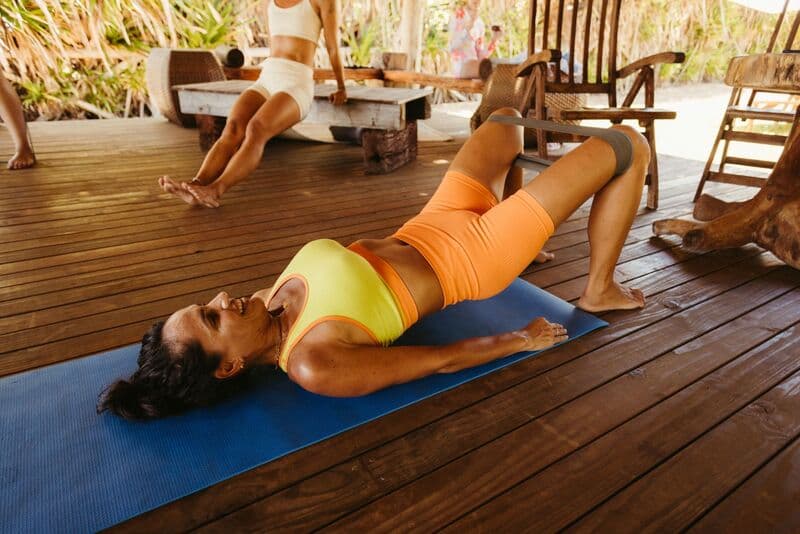
4. Glute bridge. Lying on your back, feet on the floor: activate the transversus, then lift your pelvis, hold for two or three breaths and lower down vertebra by vertebra. It adds load to the posterior chain without asking the trunk to flex.
5. Modified dead bug (or toe tap). Lying on your back with knees at 90 degrees, maintain the activation and slowly lower one foot towards the floor until it just touches it, then return. Alternate. Here the difficulty is not the leg: it is keeping the lower back and abdomen still while the leg moves.
6. Bird dog. On hands and knees, extend one arm and the opposite leg at the same time without rotating the pelvis and without arching the back. It moves the work into an anti-gravity position.
7. Plank, first on the knees then full, and squat. These are the finish line, not the starting point: they come in when you can hold the position while breathing normally and without the centre bulging. The squat with a controlled trunk is what brings the work back into everyday life.
On the overall dosage, the only reference we can give with a number taken from a study and not invented is that of the crunch programme: 5 days a week for 12 weeks. The holding times indicated above, on the other hand, are practical execution cues, not thresholds drawn from the literature. For activation exercises, a short daily practice is more realistic than long, sporadic sessions.
Doming: what it really means
Doming is the dome that forms along the midline when you come up. On social media it is described as the sign that you are hurting yourself. It is more accurate to read it as a dosage signal: at that moment the exercise is asking your wall for more than it can distribute, and the linea alba deforms instead of transmitting force from one side to the other. Whether this deformation causes damage over time is not proven today: the index used to measure it, the same authors who proposed it say, still needs to be validated.
The practical consequence is still useful: when doming appears, you do not need to stop for good, you need to step back one level in the progression, reduce the range of movement, pre-activate the transversus before you come up. This is exactly what reduced the distortion in the ultrasound study.
How long it takes
There is no honest number to give you, and the rule that circulates, "nine months to form it, nine months to fix it", is a saying, not a fact.
What we know is that part of the reduction happens on its own: from 60.0% at six weeks after delivery it drops to 32.6% at twelve months even in natural observation. And we know that the most solid randomised study on this topic used a 12-week programme, obtaining measurable effects on strength and muscle thickness and no change in the distance between the recti.
The most useful way to measure your progress, therefore, is not the width of the gap but what you can do: how many steps of progression you have climbed without doming, whether coughing or lifting your child still gives you that sense of collapse at the centre, whether you have got back to the activity that matters to you.
If you are in the first months and do not know where to start, the sequence for beginning from the start is in postnatal exercise: where to really begin. And if the real question is the belly that stays, we cover it in full in belly after childbirth.
When surgery comes up
The European Hernia Society guidelines suggest considering physiotherapy before the surgical route. Surgery remains an option to discuss with a specialist, especially when there is an associated midline hernia: in that case the guidelines suggest repair with mesh, while in abdominal diastasis without a hernia the proposal is plication of the linea alba. It should be said honestly that the same guidelines point to limited quality literature, which has led to weak recommendations on most questions.
There is no threshold of months of exercise beyond which "it is time to operate": the decision is taken on symptoms, on the presence of a hernia and on what you have not managed to recover, not on the calendar.
Why get watched while you do them
The difference between these exercises done well and done badly does not lie in the list: the list is public and you will find it everywhere. It lies in recognising doming when it appears, in not holding your breath, in understanding when you are ready for the next step and when you have got there too early. These are things that are seen by watching, and that are hard to judge on your own.
With Ri-Hub you can be followed by a physiotherapist by video call: they assess your situation, watch you while you perform the exercises, correct the progression and distinguish what concerns abdominal diastasis from what concerns the pelvic floor or the back, which, as you have read, does not necessarily have the same cause. If the picture calls for a medical or surgical assessment, they will tell you.
You might also like:
Posture Exercises: A Daily Routine for a Healthy Back Hip Osteoarthritis: Symptoms, Causes and How to Manage It with Exercise Multifidus Exercises: Strengthening the Back's Stabilising Muscle
Stay in touch with us Join our dedicated Facebook group: we answer all patients, give practical advice and clear up the most common doubts.
The pelvic floor works together with the abdominal wall: how to train it without using the wrong muscle is covered in Kegel exercises: how to do them properly (and when not to).
Sources
- Impact of postpartum exercise on pelvic floor disorders and diastasis recti abdominis: a systematic review and meta-analysis, British Journal of Sports Medicine, 2025
- What is the evidence for abdominal and pelvic floor muscle training to treat diastasis recti abdominis postpartum? A systematic review with meta-analysis, Brazilian Journal of Physical Therapy, 2021
- Curl-up exercises improve abdominal muscle strength without worsening inter-recti distance in women with diastasis recti abdominis postpartum: a randomised controlled trial, Journal of Physiotherapy, 2023
- Behavior of the Linea Alba During a Curl-up Task in Diastasis Rectus Abdominis: An Observational Study, Journal of Orthopaedic & Sports Physical Therapy, 2016
- Diastasis recti abdominis during pregnancy and 12 months after childbirth: prevalence, risk factors and report of lumbopelvic pain, British Journal of Sports Medicine, 2016
- Is Diastasis Recti Abdominis Associated With Low Back Pain? A Systematic Review, World Neurosurgery, 2023
- European Hernia Society guidelines on management of rectus diastasis, British Journal of Surgery, 2021
Last source check: August 2026.
Need a consultation?
Let's see whether a programme makes sense for you: a few questions about your case, you sign up, and you see who will follow you: a physiotherapist registered with the Albo, whom you can write to in chat whenever you like. If you would rather talk it through by voice, the first consultation is free, lasts twenty minutes and commits you to nothing: they arrive having already read what you wrote, and together you decide whether and how to go on.