Muscle strain: the muscle feels locked, it is hard to the touch like a rope, and every movement in that direction pulls. It is one of the most common diagnoses in changing rooms and in Italian clinics, and it is also one of those where the international literature has much less to say than we would expect.
It is worth making this clear at the outset, because it changes how you read everything else: none of the popular remedies for muscle strain has solid evidence of "releasing" anything. Heat has small and short-lived evidence, massage has little of low quality, the foam roller does not change the stiffness of the tissue in meta-analyses, and stretching does not reduce soreness in a clinically relevant way. This does not mean throwing everything away. It means knowing what you are buying when you spend twenty minutes on a remedy, and recognising the moment when that "tight muscle" is not a tight muscle at all.
⚠ Important: read this first
The exercises and advice in this article are general information and may not suit your situation. Every person has a unique clinical history: what works for others could be counterproductive for you.
Want a professional's opinion? Start with the questionnaire: you register and see who will follow you, a physiotherapist on the Italian professional register chosen for your case, to whom you write in chat. If you would rather hear their voice, the first consultation is free and we look at your situation together.
First of all: when it is not a strain
The problem with a reassuring label like "muscle strain" is that it also covers things that are not reassuring. A hard, painful muscle can be the symptom of something different, and some of those things do not wait. If you recognise one of these situations, do not apply heat and do not massage: get it checked.
- Calf swollen, warm and painful on one side only, perhaps after a long journey, immobilisation or surgery. This is the picture that raises suspicion of deep vein thrombosis, and massage is contraindicated. Urgent assessment.
- Dark, cola-coloured urine, marked weakness and widespread muscle pain after unusually intense effort, after a heat stroke or after starting a medicine (statins are the best known). An acute muscle injury needs to be ruled out.
- Fever, general malaise, red and hot skin over the painful area: an infection is not treated with a hot water bottle.
- Tingling, numbness, loss of strength, or pain that runs down the limb in a defined way. Here the source is more often nerve than muscle, and the stiff muscle is a consequence.
- Pain that came on with a clear snap during a movement, with inability to bear load or a palpable gap: this is a picture of structural injury, not tension.
- Swelling that increases quickly in a tense, hard segment after a trauma or a cast, with pain out of proportion: this is an emergency.
- Pain that never changes, neither with position, nor with movement, nor at night, especially if it comes with weight loss or an oncological history.
Outside these cases, the typical picture of a muscle strain is mundane: the discomfort is linked to a specific direction, it gets worse when you use that muscle, it improves at least a little with light movement, and within days it changes. If the painful spot is always the same one (the neck, the lower back, the calf), it is worth also reading the guides for that area, for example the one on trapezius strain or the one on the back. If it does not change within two or three weeks, the label needs to be questioned.
What a muscle strain is (and what we do not know)
In Italian we call muscle strain an involuntary and persistent contraction of a muscle, which stays shortened and painful without the fibres having torn. It is a sensible clinical description, and it is what the patient feels. The point is that it does not correspond to an entity with an objective test that confirms it.
The same words, used for a small child, mean something else: "stiff" or "tight" there do not describe a shortened muscle but the tone, that is the resistance you feel when you move the child's arm while they stay still. What a high tone in the first months means.
The most cited international consensus on terminology for muscle injuries, the Munich consensus statement published in the British Journal of Sports Medicine, arose precisely from this problem: the preliminary questionnaire sent to 30 scientists and doctors of professional teams with English as their first language (63% responded) confirmed considerable variability in the use of the terms, with the most obvious inconsistencies concerning strain. The classification that came out distinguishes functional muscle disorders (type 1, linked to overload, and type 2, neuromuscular) which by definition have no macroscopic evidence of fibre rupture, from structural injuries (types 3 and 4), which do. Our "strain" lives in the first family. However, it is worth reading the last line of that document: level of evidence V, expert opinion. It is the best agreement available, not a demonstration.
There is a second, more uncomfortable limit. The gesture on which all the practice is based, palpating and finding the "knot", is not very reproducible. A meta-analysis on inter-rater agreement in manual palpation of myofascial trigger points, across 6 studies and 363 patients, estimated a κ of 0.452 (95% CI 0.364-0.540). The most reliable criterion was simple localised tenderness (κ = 0.676). The authors' conclusion is clear: manual palpation to identify trigger points is unreliable. Put simply: two professionals who examine you may find "the knot" in two different places.
This does not cancel your pain, which is real and measurable. It does, however, shift the target: the useful work is not chasing a hard spot, it is understanding which movement and which load produced the symptom.

Heat: the remedy with the best evidence (which remains small)
If you have to choose one thing to do at home, heat is the one with the most literature behind it. The Cochrane review on superficial heat or cold for back pain included 9 studies and 1,117 participants. In two studies of 258 people with acute and subacute low back pain, heat wrap therapy reduced pain at five days compared with an oral placebo (weighted mean difference 1.06, 95% CI 0.68-1.45, on a 0-5 scale). One study of 90 people with acute low back pain found an immediate reduction in pain with a heated blanket.
Two clarifications, because they matter. The first: that review concerns back pain, not muscle strain in general; extending it to other areas is reasonable but remains an extrapolation. The second, and more useful: the authors themselves define the base of evidence as limited, and speak of moderate-quality evidence of a small reduction in the short term in pain and disability. Heat does not repair anything and does not release a muscle strain. It makes an area more tolerable for a while.
The most interesting finding of that same review is another. One study of 100 people added exercise to the heat wrap, and pain at seven days fell further. This is the first practical clue in this guide: heat is worth above all as a window, that is as a way to make movement possible, not as a substitute for it.
Practical use, without invented numbers: apply a heat source to the area while it stays pleasant and the skin does not redden abnormally, then, while the benefit lasts, move that segment. A warm shower, a hot water bottle or a self-heating patch differ little from one another; choose the one that lets you move straight afterwards.
An important point: before trying these exercises, make sure you have received a correct diagnosis. People often think they have one problem, but the real cause of the pain is something else. Doing the wrong exercises can make things worse instead of better.
Movement: the less spectacular and more solid part
The instinct when a muscle hurts is to protect it. The result is that the muscle loses tolerance to load, and every time you use it the symptom returns in the same way, feeding the idea that there is a knot to release.
In common musculoskeletal pain, muscle strain included, the direction is the opposite: getting back to loading gradually. Nothing heroic is needed. Walking, swimming, cycling, getting back to everyday movements in measured doses, and accepting mild discomfort during the activity, as long as the next day the situation has not got worse. It is a different logic from that of post-workout soreness, which follows its own rules and passes on its own. This rule of "acceptable discomfort that leaves no aftermath" is the practical criterion I use with patients to decide how hard to push.
It is also the only strategy, among those in this article, that builds something. The others manage the symptom for a few hours.
Stretching: useful, but not for the reason you were told
Stretching is proposed as the gesture that "lengthens" the tight muscle. On this, the most solid evidence we have is disappointing. The Cochrane review Stretching to prevent or reduce muscle soreness after exercise, updated in 2011 across 12 studies, measured the effect on delayed-onset muscle soreness: stretching before activity reduced soreness by half a point on a scale of 100 (mean difference -0.52, 95% CI -11.30 to 10.26; 3 studies); after activity by about one point out of 100 (-1.04, 95% CI -6.88 to 4.79; 4 studies). It is worth looking at those confidence intervals: they are very wide and include zero, meaning those two results are not even statistically significant. The large study of 2,377 participants, with stretching both before and after, found a reduction in peak soreness over a week of four points out of 100: statistically significant, and described by the authors themselves as very small. The conclusion of the review is that stretching does not produce clinically important reductions in soreness in healthy adults.
Be careful about what this means and what it does not. It means that using stretching as a cure for a muscle strain or for muscle pain in general is a losing bet. It does not mean that stretching is useless: if your real limit is range of movement, for instance you cannot reach your shoelaces or turn your neck, then stretching works on that, and it is the right thing to do. It is a mistake of target, not of tool.
How to do it, if you do it: stretch slowly to a tolerable, non-painful tension, breathe, and do not bounce. If a stretch exactly reproduces your acute pain, stop: you are stressing a tissue that is not ready.
Self-massage, foam roller and tennis ball
Here a distinction that is usually missing needs to be made, and it changes the verdict.
Massage performed by a therapist has its own literature. The Cochrane review on massage for low back pain (25 studies, 3,096 participants) reports improvements in pain compared with inactive controls, but only in the short term and not in the long term. For fairness, the more favourable finding should also be stated: in comparison with active controls, such as other therapies, exercise or education, massage was better for pain both in the short and the long term, although without differences in function. The overall judgement of the authors remains: they write that they have "very little confidence" that massage is an effective treatment for low back pain, with evidence quality rated from low to very low. No serious adverse events, but an increase in reported pain by a share of participants ranging from 1.5% to 25%.
The foam roller and the ball, that is the do-it-yourself version, are a different thing and should be judged on their own studies, not on those of manual massage. It is a frequent mistake: a technique performed by a therapist does not prove the effectiveness of its home version. A meta-analysis of 20 studies evaluated the acute effects of foam rolling during warm-up: no effect on the stiffness of the myofascial tissue and no effect on isometric strength, with an increase in concentric torque of the knee extensors only; the authors specify that the certainty of the evidence is low. One detail in the opposite direction, which it is right to report: in the qualitative analysis some individual studies had found a reduction in stiffness (2 on fascia, 5 on the muscle), but when pooled in the meta-analysis the effect disappears. Put another way: the feeling of "loosened" that you get after rolling does not correspond, in the measuring instruments, to a less rigid tissue.
There is, however, a use that holds up. A second meta-analysis, of 11 studies and 290 healthy participants with a mean age of 24 years, so not people with a painful muscle, keep that in mind, found a moderate effect of foam rolling as training on range of motion (ES = 0.823, 95% CI 0.325-1.322), with a significant difference in favour of programmes lasting over 4 weeks compared with shorter ones, and muscle-specific responses: gains for the hamstrings and quadriceps, and no improvement in ankle dorsiflexion when rolling the calf. So: the roller is not a first-aid tool for muscle strain, it is a routine tool to keep for weeks if your goal is mobility.
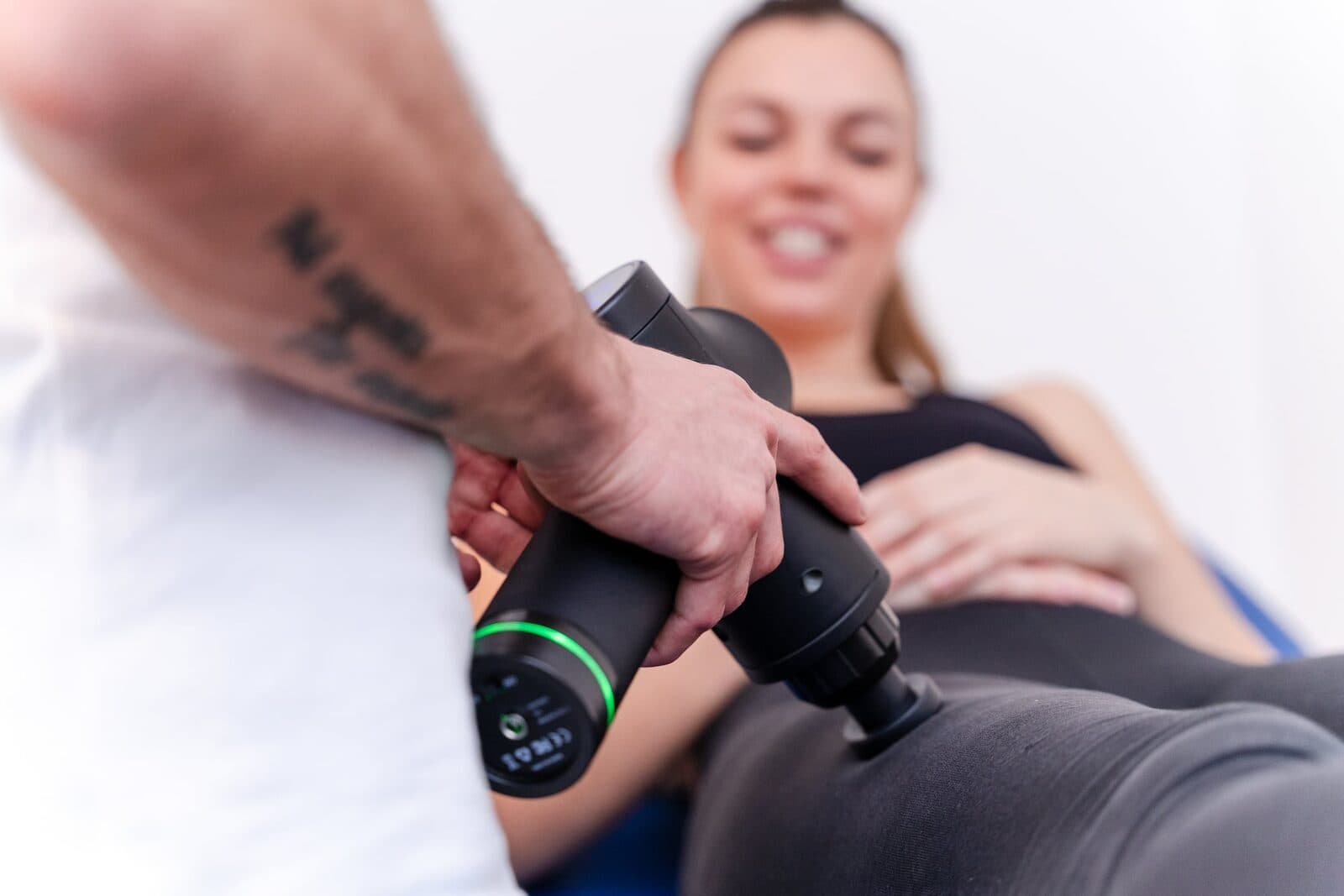
In the meantime, if rolling or pressing with a ball gives you relief for an hour and lets you move better, use it. Just know that you are buying that hour, not a change in the tissue.
Medicines: what to realistically expect
Over-the-counter anti-inflammatories are the first thing many people take. They can reduce pain, they are not free of side effects (stomach, kidneys, blood pressure), and they should not be used indefinitely for weeks without speaking to your doctor or pharmacist.
On muscle relaxants, the medicine everyone associates with muscle strain, it is worth being precise: common perception is much more optimistic than the data. A systematic review with meta-analysis published in the BMJ in 2021 included 49 studies, of which 31 were analysed quantitatively with 6,505 participants, in non-specific low back pain. For acute low back pain, with evidence of very low certainty, non-benzodiazepine antispasmodics for two weeks or less reduced pain intensity compared with control by 7.7 points on a 0-100 scale (95% CI -12.1 to -3.3), without any reduction in disability (-3.3, -7.3 to 0.7). According to the same review, they could increase the risk of adverse events (relative risk 1.6, 95% CI 1.2-2.0). The authors define these reductions as small and not clinically important and conclude that considerable uncertainty remains about efficacy and safety.
Seven points out of a hundred, without a functional gain, with more unwanted effects: this is not a reason to refuse a prescription, it is a reason not to expect a miracle and to leave the decision to the doctor.
Prevention: what holds up and what is folklore
The most repeated saying is that dehydrated muscles contract more easily. The evidence does not support it. The review in the British Journal of Sports Medicine on exercise-associated muscle cramps examined the "dehydration and electrolytes" hypothesis and found that it rests on anecdotal clinical observations, case series totalling 18 cases and a small case-control study of 10 subjects, while four prospective cohort studies do not support it; the hypothesis best supported today is that of altered neuromuscular control. A later review in the Journal of Electromyography and Kinesiology reaches the same conclusion, pointing to spinal involvement rather than peripheral motor neuron excitation.
Note: cramps are not the same thing as a muscle strain, and I am not transferring a finding from one to the other. What I am saying is that the belief "drink more and your muscle won't contract" has no basis even in the phenomenon for which it is cited most often. Drink because it is sensible, not as a remedy against tension.
On warm-up I am more cautious about promising, and I prefer to say so openly: preparing before an intense effort is standard practice and clinically reasonable, but here I do not have a review to cite on the prevention of strains, so take it as sensible habit and not as data. The lever on which I have seen concrete results in my practice is another, and it is dull: increasing load in stages. The vast majority of muscle strain cases I see come from a jump: the first long run after months, the move, the week of work spent on a different chair from usual. In my experience periods of psychological tension also count: I have written about this separately, discussing the link between stress and muscle pain.
A practical four-point plan
- Rule out the red flags in the list at the start. If there is one, self-treatment stops.
- Use heat to open a window, and move within that window. Heat alone is a relief; in the Cochrane review the only comparison that added something to heat alone was precisely the addition of exercise, with less pain at seven days, a single study of 100 people, so a clue, not a robust proof.
- Get back to loading in stages, tolerating mild discomfort that does not worsen the next day. This is the part that builds something.
- Keep massage, ball and roller as comfort tools, not as a cure. If they help you move better, excellent. If they replace movement, you are going round in circles.
And a time limit: if a muscle strain does not change in two or three weeks of reasonable management, you do not need one more remedy. You need to question the diagnosis.
When an assessment makes sense
An assessment is useful when the muscle strain keeps returning to the same spot (usually there is a gesture or a posture that loads it again each time), when it limits work or sport, when neurological symptoms appear, or when you simply do not know how hard you can push and so you do not push at all. The same applies if the pain runs through a whole limb: in that case it is better to start from what can cause muscle pain in the legs.
In everyday practice in telerehabilitation, the part that changes the results is almost never the remedy chosen: it is understanding which load exceeded your tolerance and rebuilding it with a progressive programme. A physiotherapist can guide you on this even at a distance, because what is needed is an eye on the movement and a plan, not hands-on work.
If the muscle pain began when you started taking a statin, the picture should be read differently: we discuss it in Statins and muscle pain: what the studies really say.
Sources
- Terminology and classification of muscle injuries in sport: the Munich consensus statement (British Journal of Sports Medicine, 2013)
- Interrater Agreement of Manual Palpation for Identification of Myofascial Trigger Points: A Systematic Review and Meta-Analysis (The Clinical Journal of Pain, 2017)
- Superficial heat or cold for low back pain (Cochrane Database of Systematic Reviews, 2006)
- Stretching to prevent or reduce muscle soreness after exercise (Cochrane Database of Systematic Reviews, 2011)
- Massage for low-back pain (Cochrane Database of Systematic Reviews, 2015)
- Foam Rolling Acute Effects on Myofascial Tissue Stiffness and Muscle Strength: A Systematic Review and Meta-Analysis (Journal of Strength and Conditioning Research, 2023)
- Foam Rolling Training Effects on Range of Motion: A Systematic Review and Meta-Analysis (Sports Medicine, 2022)
- Efficacy, acceptability, and safety of muscle relaxants for adults with non-specific low back pain: systematic review and meta-analysis (BMJ, 2021)
- Cause of exercise associated muscle cramps (EAMC): altered neuromuscular control, dehydration or electrolyte depletion? (British Journal of Sports Medicine, 2009)
- Muscle cramps: A comparison of the two-leading hypothesis (Journal of Electromyography and Kinesiology, 2018)
Last source check: August 2026.
You might also like:
Correcting Posture: Exercises and Strategies to Straighten Your Back Hip Replacement Rehabilitation: Complete Guide to Recovery Sciatica Exercises: The Best Movements to Free You from Pain
Stay in touch with us Join our dedicated Facebook group: we reply to all patients, give practical advice and clear up the most common doubts.
Need a consultation?
Start from the Ri-Hub questionnaire: a few questions about your case, you register, and see who will follow you: a physiotherapist on the Italian professional register, to whom you write in chat whenever you like. If you prefer to talk it through by voice, the first consultation is free, lasts twenty minutes and commits you to nothing: they arrive having already read what you wrote, and together you decide whether and how to continue.