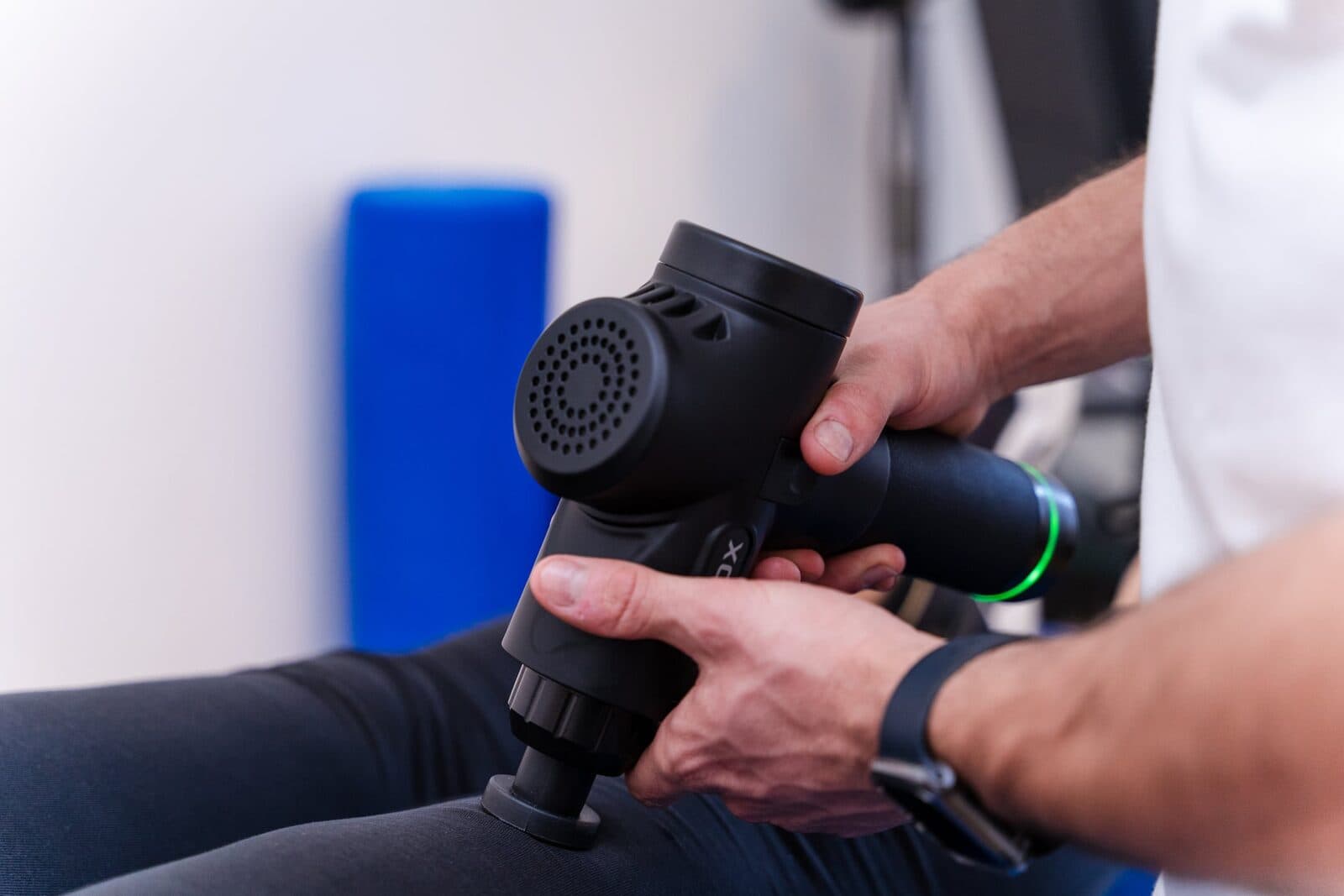
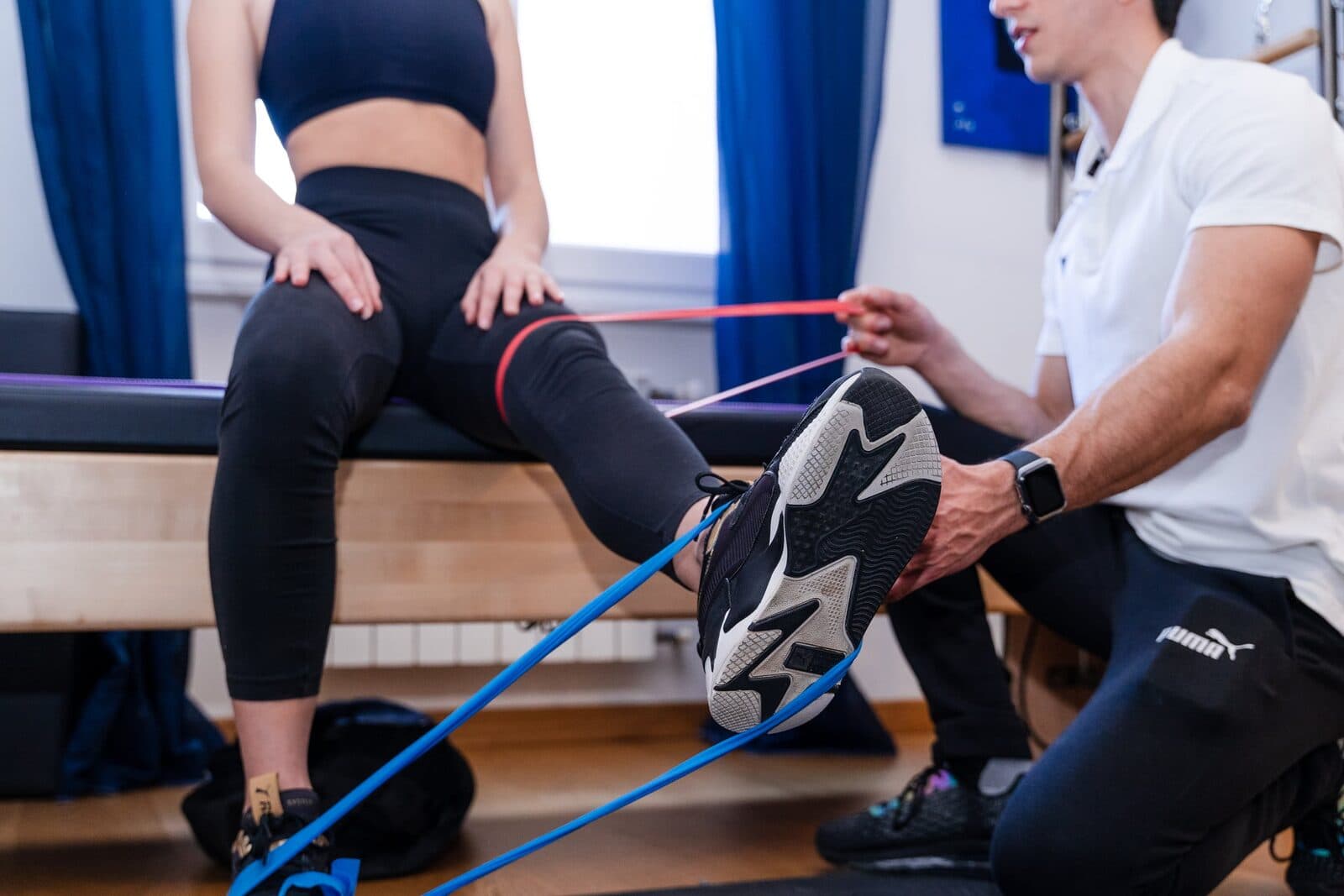
If you have been given a report that says "patellar chondropathy", the first question is almost always the same: the cartilage has worn, so what can I still do?
The short answer is that the word on the paper says much less than it seems, and that therapeutic exercise remains the intervention with the best evidence for pain in front of the knee. How you set it up matters more than the diagnosis written on the report.
In this guide you will find the distinction that almost no article makes (patellofemoral pain versus cartilage lesion), what works with the real numbers, what has not been shown, and realistic timings. These are general indications: your situation may require something else.
First of all: the signs that have nothing to do with exercises
Some pictures are not "chondropathy to rehabilitate" and need to be seen by a doctor before starting any programme. If you recognise yourself in one of these points, stop reading the exercises and get the knee assessed.
- A knee that does not fully straighten, with a sensation of mechanical locking: it can be a meniscal lesion caught in the joint, and it needs assessing (we discuss it in the guide to a locked knee).
- Significant and rapid swelling, appearing within a few hours of a trauma or a sprain.
- Real giving way, that is the knee buckling under your weight and making you lose your footing, not simple insecurity.
- A warm, red and very painful knee, especially with fever or general unwellness: it is a picture to be assessed urgently.
- Pain at rest at night, which wakes you and does not depend on position or on the previous day's activity.
None of these signs is managed with quadriceps strengthening, and putting off the assessment to "try the exercises first" is the quickest way to lose valuable time. The rest of this guide assumes these signs are absent.
Want a professional's opinion on your case? Start with the questionnaire: you sign up and see who will follow you, a physiotherapist on the Italian professional register chosen for your case, whom you can write to in chat. If you would rather hear their voice, the first consultation is free.
Patellar chondropathy: two different things under the same label
Here lies the whole understanding of the problem. "Patellar chondropathy" is used to indicate two things that do not coincide, and confusing them leads to the wrong choices.
The first is patellofemoral pain: pain around or behind the kneecap that flares on stairs, squats, jumps and prolonged sitting. It is a clinical diagnosis, made through examination and the history of symptoms, and it does not require any cartilage damage to exist.
The second is chondromalacia or cartilage lesion: a visible alteration of the cartilage behind the kneecap. It is a finding, meaning something seen on MRI or arthroscopy. It describes a tissue; it does not automatically explain a symptom. If this is the word you were given, the full picture, including the uncomfortable point about why worn cartilage is not enough to explain the pain, is in patellar chondromalacia.
The 2016 international consensus on patellofemoral pain devoted an entire document to terminology, definitions, clinical examination and natural history, precisely because this confusion had become a clinical problem before it was a linguistic one.
There is also a third label that sometimes overlaps: patellar tendinopathy, that is, well-localised pain at one point on the lower pole of the kneecap, typical of those who jump. If your pain is pinpoint and flares when you jump, the load progression to follow is a different one.
What is seen in knees that do not hurt
This is the finding that changes how the report should be read. A systematic review with meta-analysis published in the British Journal of Sports Medicine gathered the prevalence of signs of osteoarthritis on MRI in adults with no pain and no injuries: 63 studies, 5,397 knees from 4,751 people.
Cartilage defects were present in 24% (95% confidence interval from 15% to 34%) of those asymptomatic knees. The share rises with age: 11% under 40 and 43% from 40 upwards. Meniscal lesions were present in 10%, and they too increased with age.
The authors conclude with a sentence worth re-reading: these findings must be interpreted in the context of the clinical picture. Put simply: imperfect cartilage is common even in people who are doing very well, and on its own it is not the explanation for your pain.
The reverse is equally true: there are people with intense pain and almost intact cartilage. The report and the symptom are two parallel pieces of information, not cause and effect.
What changes in practice
The first consequence is that the report does not determine how much you will be able to move. It is not a report card and it is not a sentence: at best it tells you what the tissue looks like today.
The second is that the rehabilitation pathway, if your symptoms are the typical ones (stairs, squats, chair), is that of anterior knee pain, whether or not there is a report of chondropathy above it.
The third is the most important: the aim of exercise is not to change the image, but to change how much load the knee tolerates and how that load is distributed. And it is precisely on this that exercise has evidence in its favour.

What works: therapeutic exercise, with the stated certainty
The Cochrane review on exercise for patellofemoral pain included 31 studies with 1,690 participants. In the comparison with no treatment, exercise reduced pain during activity in the short term by 1.46 points on a 0-10 scale, with an interval that includes the clinical relevance threshold of 1.3 points.
On function the result points in the same direction: an improvement that, expressed on the Anterior Knee Pain scale (0-100), is worth around 12 points, above the clinical relevance threshold of 10. And at 12 months the estimate is about 88 more people recovered for every 1,000 treated.
It is important to say with what certainty. The authors rate the evidence as very low quality for all seven main outcomes, due to design limitations and small samples, and they explicitly state that they are very uncertain about the estimates. They are consistent with one another, but they are not solid.
The same review adds something that matters to anyone looking for "the right sheet of exercises": there is not enough evidence to establish which form of exercise is best. This means the programme is built around the person, not copied.
Hip and knee together, not only the quadriceps
Here is the most useful finding in the rehabilitation of patellar chondropathy. A systematic review with meta-analysis published in the Journal of Orthopaedic & Sports Physical Therapy included 14 studies with 673 participants with patellofemoral pain.
Strengthening hip and knee together proved superior to strengthening the knee alone, both for pain (mean difference -1.5 points, interval from -2.3 to -0.8) and for activity, and the advantage held even after the end of the programme. The Cochrane review points in the same direction, again with evidence of very low quality.
One detail needs reporting in the interests of honesty, because it overturns the most widespread explanation: in that meta-analysis the benefits arrived without significant changes in measured strength. So why it works is not as well established as the fact that it works.
For those who have to train, little changes: the programme that includes the hip does better. But the next time you read "your glute is weak, that is why you hurt", know that it is a plausible mechanical hypothesis, not an established fact.
Load management is not the accessory part
A randomised study of 69 runners with patellofemoral pain compared three 8-week programmes: education alone on managing symptoms and training loads; education plus exercises; education plus gait retraining.
All three groups improved in a similar way on pain and functional limitations, at 4, 8 and 20 weeks. The exercise group was the only one to increase knee extension strength, and the gait retraining group the only one to change cadence and vertical load.
It is a single study and on runners, so it does not cancel the meta-analysis on the hip. The authors' conclusion is, however, the right one to take home: education on managing symptoms and loads should be considered a primary component of treatment, not a side dish.
What has not been shown
Cartilage supplements. A network meta-analysis published in the BMJ gathered 10 studies on 3,803 patients with knee or hip osteoarthritis. Glucosamine, chondroitin and their combination did not reduce pain in a clinically relevant way, nor did they change the reduction in joint space.
In the same analysis, the studies independent of industry showed smaller effects than those funded commercially.
A more recent systematic review with network meta-analysis of 28 studies and 11,890 patients reaches the same practical conclusion: glucosamine and chondroitin give statistically detectable effects of doubtful clinical relevance, and none of the 12 classes of drugs examined shows a clinically significant long-term benefit.
Note a limitation that concerns you directly: these studies are on knee and hip osteoarthritis, not on patellofemoral pain or chondropathy of the kneecap. For the latter there is not even that level of evidence. Nobody has shown that a supplement rebuilds your cartilage.
"Regenerating" the cartilage with exercise. This is not what exercise does, and no serious professional will promise it to you. A meta-analysis of 24 studies measured the cartilage on MRI before and after running.
Immediate decreases in thickness and volume ranged from 3.3% to 4.9% depending on the area, and the values in the femorotibial compartment returned to baseline within about 91 minutes.
Above all: the cartilage defects already present were unchanged in the 48 hours after running. The certainty of the evidence is very low, but the useful reading is twofold. The load was not destroying the cartilage, and it was not rebuilding it either. Exercise works on tolerance, not on the image.
Prolonged rest. It is not a treatment for patellofemoral pain. The pain eases while you are still and returns as soon as you resume, because in the meantime the tolerance to load has fallen further. Temporarily reducing the movements that irritate makes sense; stopping loading the knee for weeks does not.
Passive therapies alone. A course of machines or of manipulation alone, without a progressive exercise programme, is not the treatment that the evidence supports. They may have a place as an accompaniment in the most painful phase, never as a substitute for graduated loading.
Patellar chondropathy: the exercises to avoid
The question almost always arrives in this form, which exercises should I avoid?, and the honest answer is that the list of forbidden movements does not exist. There is a list of movements to be dosed, because they compress the patellofemoral joint more, and in the irritable phase you reduce them rather than eliminate them:
- heavy leg extensions, which concentrate all the compression on the joint at the worst point of the range;
- deep squats, full squats, low lunges, leg press with the knee very flexed, because compression grows with the degree of flexion;
- repeated impacts: running downhill, jumping, changes of direction;
- going down many stairs in a row, which is the movement that loads the most.
The real mistake is not choosing the wrong exercise, it is choosing the wrong criterion for deciding. The useful one is below.
Managing load and symptoms: the 24-hour criterion
The principle is simple: during exercise a mild pain is acceptable, provided it dies down shortly afterwards and the following day the knee is no more painful than usual. If the next morning it is worse, you have done too much. You have not broken anything: you step back one rung.
This criterion does not come from a study that validated its exact threshold: it is clinical practice, consistent with the sources that indicate exercise as the first line without establishing the optimal dose. It serves to give you your own measure, one you can take at home, rather than guessing.
Three movements typically irritate the patellofemoral joint, and the strategy is not to eliminate them but to dose them.
- Going down stairs. It is the movement that loads the most: the quadriceps brakes your body weight with the knee bent. Do not avoid stairs, reduce their number, go down more slowly and place the whole foot well. If this is your main symptom, you will find more on knee pain when going down stairs.
- Deep squats. Compression between kneecap and femur grows with the degree of flexion, so in the irritable phase you work in partial flexion and increase the range a few degrees at a time, you do not stop squatting.
- Sitting for long periods with the knees bent. Chair pain does not resolve by standing all day: it eases by getting up every 30 to 40 minutes, extending the knee under the table, changing position before the discomfort flares.
The same applies to heavy leg extensions and repeated impacts: they are not banned for ever, they are reduced while the knee is irritable and reintroduced while watching how it reacts over the following 24 hours.
The exercises: quadriceps
Isometric quad set. Seated or lying with the leg straight, contract the quadriceps by pressing the knee downwards, as if flattening a rolled-up towel under the back of the knee. Hold for 5 to 10 seconds and release. Three sets of 15 repetitions. It activates the muscle with almost no movement of the kneecap in the groove, so with minimal compression.
Straight leg raise. Lying on your back, the other knee bent with the foot on the floor, lift the straight leg 30 to 40 cm, hold for 5 seconds and lower slowly. Three sets of 15. The knee stays straight throughout the movement. The part that counts is the slow lowering, not the lift.
Controlled mini squat. Standing, feet hip-width apart, bend the knees to 30 to 45 degrees keeping the weight evenly distributed and the knees aligned with the feet. Three sets of 15. The range limit is not a generic precaution: it keeps you below the level of compression that in this phase rekindles the pain.
The comparison between open and closed chain exercise has been studied precisely in patellar chondromalacia. In a randomised study of 32 female students, after three weeks the half-squat produced quadriceps strength gains greater than the straight leg raise, but pain fell significantly in both groups.
It is a small, brief study on a very specific sample: no rule should be built on it. The useful reading is that if the mini squat bothers you, working in open chain does not cost you the pain benefit, and that when the knee tolerates it the half-squat does more for strength.
If you want to go deeper into this chapter, there is a dedicated guide to quadriceps strengthening.
The exercises: hip
Clamshell. Lying on your side, hips and knees bent to about 45 degrees, open the knees like a book keeping the feet together and the pelvis still, without rotating it backwards to gain range. Three sets of 20. It works on the external hip rotators.
Bridge. Lying on your back, feet on the floor, lift the pelvis by contracting the glutes until shoulders, hips and knees are aligned. Three sets of 15. It rebuilds glute strength in the extension chain and works on pelvic stability.
Side-lying hip abduction. On your side, top leg straight, lift it slowly keeping the pelvis perpendicular to the couch. Three sets of 15 per side. If you feel the outer thigh burning instead of the glute, you have probably rotated the pelvis backwards.
On stretching, a note of proportion: stretching the quadriceps, hamstrings and outer thigh for 30 seconds per side is a reasonable complement, but no source indicates it as the main treatment. If you have twenty minutes, spend fifteen on strengthening.
Progression: gates, not deadlines
The phases are not dates on the calendar: you move to the next when the previous one no longer hurts by the 24-hour criterion. The durations below are only an order of magnitude.
- Phase 1, about 2 to 3 weeks. Isometrics and open chain: quad sets and straight leg raise, plus the hip work, which can start straight away because it does not compress the kneecap. You stay in this phase if the pain is present even at rest or after sitting, and going down stairs is very painful.
- Phase 2, about 3 to 4 weeks. Mini squats, low step-ups, gradual increase in flexion. You enter here when going down stairs is uncomfortable but manageable and the pain dies down within a few minutes.
- Phase 3, onwards. Real movements: controlled lunges, higher step-ups, stairs done with control and, for those who play sport, a gradual return to running or the pitch. You enter here when going down stairs no longer hurts and the discomfort only arrives after long activity.
The most common mistake we see is starting in the wrong phase: someone with pain at rest who begins with lunges stops after three days and concludes that "exercises do not work".
Realistic timings: it is months, and it is worth knowing
This is the part that is usually missing, and it needs stating clearly. An observational analysis of 310 people with patellofemoral pain, built on data from two randomised studies, measured how many had an unsatisfactory recovery: 55% at 3 months and 40% at 12 months, regardless of the intervention received.
The most consistent prognostic factor was the duration of symptoms: a duration longer than 2 months at the initial assessment was associated with a worse recovery at 3 and at 12 months. The authors recommend early intervention for exactly this reason. If you have been putting it off for a year, that is the figure that concerns you.
A longer follow-up of the same cohorts traced some of the participants at 5 to 8 years: 57% reported an unsatisfactory recovery. This figure should be read with caution, because only 19.3% of the original participants responded, so the estimate is fragile.
In the same follow-up, however, there is good and solid news: 48 of 50 participants (98%) had no radiographic signs of knee osteoarthritis. Patellofemoral pain is more stubborn than it was once said to be, but in the medium term it has not turned into osteoarthritis.
What to do with this, in practice. Expecting weeks for the first changes and months for a stable change is realistic. It is worth choosing two or three reference movements (a flight of stairs, the first minute after getting up from a chair, the first ten minutes of walking) and using them as your measure, rather than asking yourself every morning whether things are better "in general".
And if after a few weeks nothing changes, the right move is not to increase the repetitions: it is to have the choice of exercises and the progression reassessed. A written sheet cannot see how you perform the movement.
Do you need a consultation?
Start the Ri-Hub questionnaire: a few questions about your case, you sign up, and you see who will follow you: a physiotherapist on the Italian professional register, whom you can write to in chat whenever you like. If you would rather talk it through by voice, the first consultation is free, lasts twenty minutes and commits you to nothing: they arrive having already read what you wrote, and together you decide whether and how to go on.
Sources
- Patellofemoral Pain: Clinical Practice Guidelines, Journal of Orthopaedic & Sports Physical Therapy, 2019
- 2018 Consensus statement on exercise therapy and physical interventions to treat patellofemoral pain, British Journal of Sports Medicine, 2018
- 2016 Patellofemoral pain consensus statement, Manchester. Part 1: terminology, definitions, clinical examination and natural history, British Journal of Sports Medicine, 2016
- Prevalence of knee osteoarthritis features on MRI in asymptomatic uninjured adults: systematic review and meta-analysis, British Journal of Sports Medicine, 2019
- Exercise for treating patellofemoral pain syndrome, Cochrane Database of Systematic Reviews, 2015
- Hip and Knee Strengthening Is More Effective Than Knee Strengthening Alone for Patellofemoral Pain: Systematic Review With Meta-analysis, Journal of Orthopaedic & Sports Physical Therapy, 2018
- Is combining gait retraining or an exercise programme with education better than education alone in treating runners with patellofemoral pain? A randomised clinical trial, British Journal of Sports Medicine, 2018
- Open versus closed kinetic chain exercises for patellar chondromalacia, British Journal of Sports Medicine, 2008
- Prognostic factors for patellofemoral pain: a multicentre observational analysis, British Journal of Sports Medicine, 2013
- Factors that predict a poor outcome 5-8 years after the diagnosis of patellofemoral pain: a multicentre observational analysis, British Journal of Sports Medicine, 2016
- Effects of glucosamine, chondroitin, or placebo in patients with osteoarthritis of hip or knee: network meta-analysis, BMJ, 2010
- The Efficacy and Safety of Disease-Modifying Osteoarthritis Drugs for Knee and Hip Osteoarthritis: Systematic Review and Network Meta-Analysis, Journal of General Internal Medicine, 2021
- Is running good or bad for your knees? Systematic review and meta-analysis of cartilage morphology and composition changes, Osteoarthritis and Cartilage, 2023
Last source check: August 2026.