Trochanteric pain, or trochanteric bursitis: two names for the same thing. If you have pain on the outer side of the hip, the kind that wakes you when you sleep on that side and hurts even when you press a finger on the bony prominence, you have almost certainly been given this name. It is one of the conditions I see most often over video calls, and also one where Italian popular information has been behind for twenty years.
It is worth saying straight away, because it changes everything else: in most cases it is not a bursitis. The structure generating the pain is almost always the gluteal tendon, not the bursa. This is not a textbook nitpick. If the problem is a tendon that has lost its capacity to handle load, the plan of care is to rebuild that capacity through exercise, not to put out an inflammation with ice, rest and stretching.
⚠ Important: read this before continuing
The exercises and advice in this article are general guidelines and may not suit your situation. Every person has a unique clinical history: what works for others could be counterproductive for you.
Want a professional's opinion? Start with the questionnaire: you register and see who will follow you, a physiotherapist on the Italian professional register chosen for your case, whom you write to in chat. If you would rather hear a voice, the first consultation is free and we look at your situation together.
First of all: when lateral hip pain needs a doctor
The name that is gaining ground is greater trochanteric pain syndrome, because the bursa is often the least interesting part of the problem: in most cases the main player is the tendon.
Pain on the side of the hip is, in the great majority of cases, a mechanical problem: very annoying but benign and reversible. Some pictures, however, have nothing to do with the tendons, and recognising them matters more than any exercise. An orthopaedic review dedicated to the most common bursitides puts this as the first step: bursitis must be distinguished from arthritis, fracture, tendinopathy and nerve disease, because the treatment is completely different.
See a doctor, not an article, if:
- you have a fever and the area is warm, red, swollen and painful even at rest: this is the picture of septic bursitis, which is treated with antibiotics and must be recognised quickly;
- the pain appeared after a fall or trauma and you struggle to put weight on the leg, especially if you are over 65 or have known osteoporosis;
- the bone pain is constant, present even at rest, wakes you at night and comes with unexplained weight loss, night sweats or a history of cancer;
- you have greatly increased your running load and feel a pinpoint, progressive bone pain that now also appears when walking: a picture compatible with a stress fracture of the bone, which gets worse if you keep loading it;
- tingling, numbness or loss of strength runs down the leg, which shifts suspicion towards the lumbar spine;
- the pain is mainly in the groin, with stiffness in the hip and loss of rotation, rather than on the side: this is more typical of hip osteoarthritis and is managed differently.
None of these points automatically means you have something serious. They mean that a clinical eye is needed before starting any programme. If none of this applies to you, we can reason about the rest.
Why the name "bursitis" is wrong, and why it matters
The trochanteric bursa is a gliding cushion between the bony prominence on the side of the hip, the greater trochanter, and the tissues that pass over it. The classic idea was that it became inflamed, hence the name.
The picture changed when people looked more closely. A clinical review published in the Journal of Orthopaedic & Sports Physical Therapy summarises the state of the art: gluteal tendinopathy is now considered the main local source of lateral hip pain, what was previously called trochanteric bursitis. The protocol of the most important randomised study on the subject puts it even more directly: the condition is often diagnosed as trochanteric bursitis, but radiological and surgical studies have revealed that the most common pathology is a tendinopathy of the gluteus medius and minimus.
There is more, and this is the part that should make you cautious about diagnoses from a report. In a study of 40 people with lateral hip pain who underwent MRI, changes to the gluteus medius tendon, bursitis, osteoarthritis and muscle atrophy were found; but the same changes also appeared in hips without symptoms, particularly precisely those labelled as bursitis. The authors also noted that agreement between the physiotherapy diagnosis and the radiological one was poor, and concluded that using MRI as the reference standard is problematic.
Put simply: if your report says "trochanteric bursitis", that word describes an image, not necessarily the source of your pain. This is why the literature has adopted a more honest label, greater trochanteric pain syndrome, which says where it hurts without claiming to know which tissue is suffering.
This does not mean your pain is imaginary or that there is nothing to be done. It means the target of treatment is a tendon that needs gradual load, not a flare to be put out.

Who suffers from it, and what the mechanism is
What we call trochanteric bursitis is far from rare: the 2024 meta-analysis on shockwave therapy, which I discuss further on, reports in its introduction that greater trochanteric pain syndrome affects 17.6% of adults between 50 and 79 years old, with a clear female predominance. In the main randomised study on this topic, of the 204 participants 167 were women, with a mean age of 54.8 years (standard deviation 8.8). The literature describes it as particularly frequent in postmenopausal women.
On the mechanism, the most widely accepted reconstruction is that the combination of excessive compression and high tensile loads damages these tendons. Compression depends above all on the position of the hip: when the thigh comes closer to the midline of the body, that is in adduction, the gluteal tendons are squeezed against the greater trochanter. Along with muscular and bony elements, joint position is identified as the key factor.
From this follows all the practical part of this article, and it is worth keeping in mind because it is the thread that connects apparently unrelated advice: almost everything that helps serves to reduce hip adduction, and almost everything that makes it worse brings it on.
It should be said honestly that this is a model, consistent with anatomy and with clinical practice, not a proven law. The same authors who propose it note that high-quality studies on this condition are still lacking, and that there is no consensus on which clinical tests are the most reliable for diagnosing it.
Treating trochanteric bursitis: what the studies say
Here the news is good, and it is the part with the strongest evidence in the whole article.
The reference study is a randomised trial published in the BMJ in 2018. It enrolled 204 people aged 35 to 70, with lateral hip pain for more than three months, intensity at least 4 out of 10, and gluteal tendinopathy confirmed both clinically and by MRI. They were divided into three groups: an education programme on managing load plus exercise, delivered by physiotherapists in 14 sessions over eight weeks (69 people); a single ultrasound-guided cortisone injection (66 people); a wait-and-see approach with reassurance alone (69 people). At 52 weeks, 92.6% of participants completed follow-up.
At eight weeks, the number of people reporting a significant overall improvement was 51 out of 66 in the education and exercise group, 38 out of 65 with the injection, and 20 out of 68 in those who did nothing. Average pain in the last week was 1.5 (standard deviation 1.5) with exercise, 2.7 (2.4) with the injection, and 3.8 (2.0) without treatment. The advantage of exercise over the injection was 19.9 percentage points on overall improvement (95% confidence interval 4.7 to 35.0) and a little over one point on the pain scale.
At 52 weeks, success was reported by 51 out of 65 in the exercise group, 36 out of 63 with the injection, and 31 out of 60 on waiting. (If you have just had an injection, what to expect in the following days is covered in after the injection: what to do.) Exercise remained superior to the injection on overall improvement (20.4 percentage points, from 4.9 to 35.9), but on pain intensity the difference between the two had disappeared. This needs saying in full: at one year, those who had the injection had on average the same pain as those who had physiotherapy, while being less satisfied with the overall result.
A 2024 meta-analysis then pooled six randomised studies covering 733 patients and concluded that the current evidence supports a strong recommendation for exercise as first-line treatment, and that compared with injection, exercise increases the probability of an overall improvement perceived as relevant. Here too the nuance matters: the authors use the word "slightly" to describe the effect of exercise on pain and function compared with a control group, and note that the result rests on few studies and a moderate number of patients. No serious adverse events were reported.
Two caveats before translating all this into practice. The first: the population studied is chronic, with pain lasting more than three months. We do not know whether pain that appeared last week behaves in the same way. The second: in the trial the programme was guided by a physiotherapist over fourteen sessions across eight weeks. Exercises were also done at home, as the study protocol states explicitly, but progression was decided and corrected session by session, not handed over on a sheet. This is not a minor detail, as you will see shortly.
An important tip: before trying these exercises, make sure you have a correct diagnosis. People often assume they have one problem when the real source of the pain is something else. Doing the wrong exercises can make things worse instead of better.
"Weak glute medius": a hypothesis, not a proven cause
The idea that a weak gluteus medius causes trochanteric pain is presented everywhere as a fact. What we have is more modest.
One study compared 40 sedentary women over 45, half with the condition and half without. MRI did not distinguish the two groups by frequency of tendinopathy, peritendinitis, bursitis or enthesopathy (the only difference, borderline significant, concerned lesions of the gluteus medius tendon), and pelvic sagittal alignment parameters did not differ either. What distinguished the two groups was strength: those with the condition were weaker in all hip muscle groups, abductors but also adductors, flexors, extensors and rotators, and held less well in the endurance tests of supine and prone bridging.
Two practical consequences. First: being a comparison taken at a single moment, it cannot say whether the weakness comes before the pain or is the result of months in which you avoided loading that leg. Second: if the weakness is spread across the whole hip, insisting only on abduction makes little sense.
The awkward point: we do not know which programme is best
This is the part you usually do not find in articles on trochanteric pain, and yet it changes how one works.
A randomised study compared, in 94 postmenopausal women with greater trochanteric pain syndrome, a targeted 12-week gluteal loading programme against a sham exercise programme. Note what this means: the control group was not sitting still, it also did exercises, simply not designed to load the glutes. And all participants, in both groups, received the same education: how to avoid compressing the tendon and how to modify daily activities. In the intention-to-treat analysis, no difference emerged between the two programmes. Both groups, however, improved significantly at 12 and at 52 weeks. Only when looking at the subjects who had responded to treatment did the targeted programme come out ahead, which suggests a subgroup that benefits, not that the specific exercise works for everyone.
The most honest reading is this: which exercise you choose matters less than is often claimed. From here comes the hypothesis that what weighs most is the element common to both groups, namely education in managing load, but it remains a hypothesis, because in none of the studies cited here has education alone been tested against the complete package, and the package that beat waiting in the LEAP trial also included exercise. What follows in practice is that managing load should not be treated as a side dish: it is also the part you can correct straight away, every day, without equipment.
The first intervention: removing compression
Before strengthening, you stop compressing. This part has no dedicated study that validates it on its own, but it follows directly from the mechanical model, and in my experience it is what gives the quickest relief for sleep.
At night. This is the part that weighs most, and I cover it in full below.
Standing. Standing still with all your weight on one hip, with the pelvis sliding sideways, is a held adduction position. It also applies to people who work standing: alternate, keep your feet at hip width.
Sitting. Do not cross your legs or hold them tightly one on top of the other. Chairs that are too low and soft sofas that let the hips sink below knee level make the picture worse.
In movement. Temporarily reduce what reproduces the pain: running, repeated stairs, downhill walks, deep lunges. Relative rest, not absolute: keep moving with what does not hurt.
How to sleep with trochanteric bursitis
For almost everyone this is the symptom that decides the day: the pain that wakes you as soon as you turn onto that side. The logic is the same as in the section above, any position that brings the thigh towards the midline compresses the tendon, applied to the hours in which you cannot control how you move.
Not on the painful side. This is the main rule and the simplest. Sleeping on the side that hurts crushes the tendon between bone and mattress for hours.
On the other side, but with a pillow. This is the most common mistake: you turn to the healthy side and sleep just as badly. The reason is that the top leg, the painful one, falls forward and downwards, which is exactly adduction, and recreates the compression you wanted to avoid. You need a pillow thick enough to keep thigh and ankle aligned with the hip, not just wedged between the knees: if the ankles stay crossed the job is only half done.
On your back, if you can. It is the position that unloads the most. A pillow under the knees relieves tension in the lower back and helps you stay there.
The mattress matters less than people say. A mattress that is too hard increases pressure on the greater trochanter and worsens the symptom, but changing it rarely solves the problem on its own: position and pillow come first, and they cost nothing.
If you wake up anyway. In acute phases it happens, and it does not mean you are getting worse. It makes sense not to lie in bed turning over for hours: get up, walk for a minute and lie down again on the other side, which breaks the cycle better than insisting.
If night-time hip pain is your main symptom, we have covered it in full in hip pain at night.
The exercises
The core of the programme is progressive strengthening of the hip abductors, the gluteus medius and minimus. It is the ingredient that recurs in the studies. The individual exercises used to train them are, however, current clinical practice, not a list copied from a piece of research, and they must be adapted to how irritable the tendon is.
Initial phase: isometrics. Contractions held without movement, in neutral hip positions, are the usual way to start when the tendon is sensitive: they allow loading without passing through compressive ranges. A simple example is pushing the side of the leg against a wall while standing, or against a cushion when lying on your back.
Glute bridge. Lying on your back, knees bent and feet at hip width, lift the pelvis by contracting the glutes without arching the back. It is well tolerated because the hip never goes into adduction.
Side-lying abduction. Lying on the healthy side, lift the top leg while staying aligned. The practical rule: do not let the leg drop below the line of the body at the end of the movement, because that is the point where compression occurs. The clamshell, with the hips stacked and the feet together while the upper knee opens, is the variant most often used as a first step.
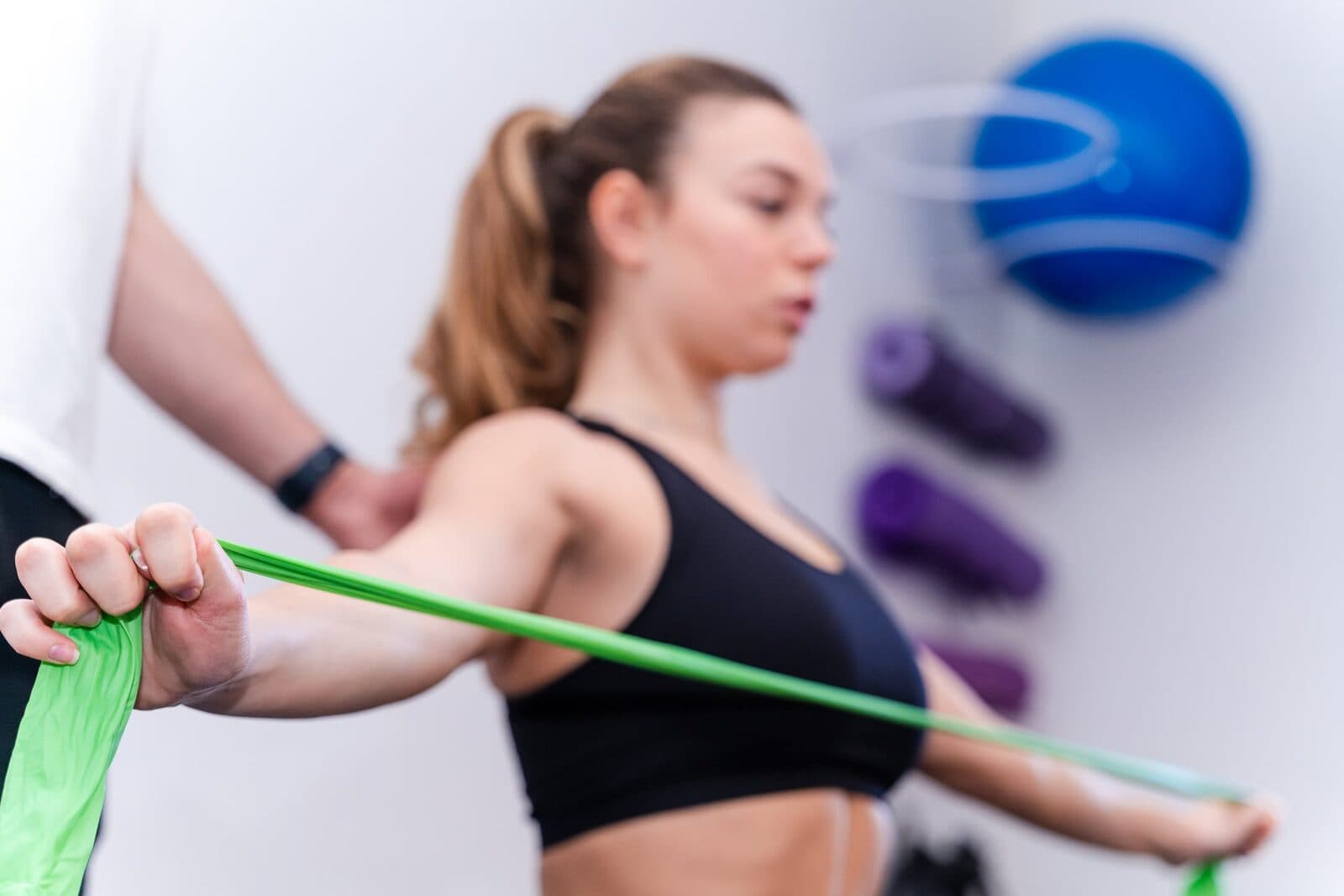
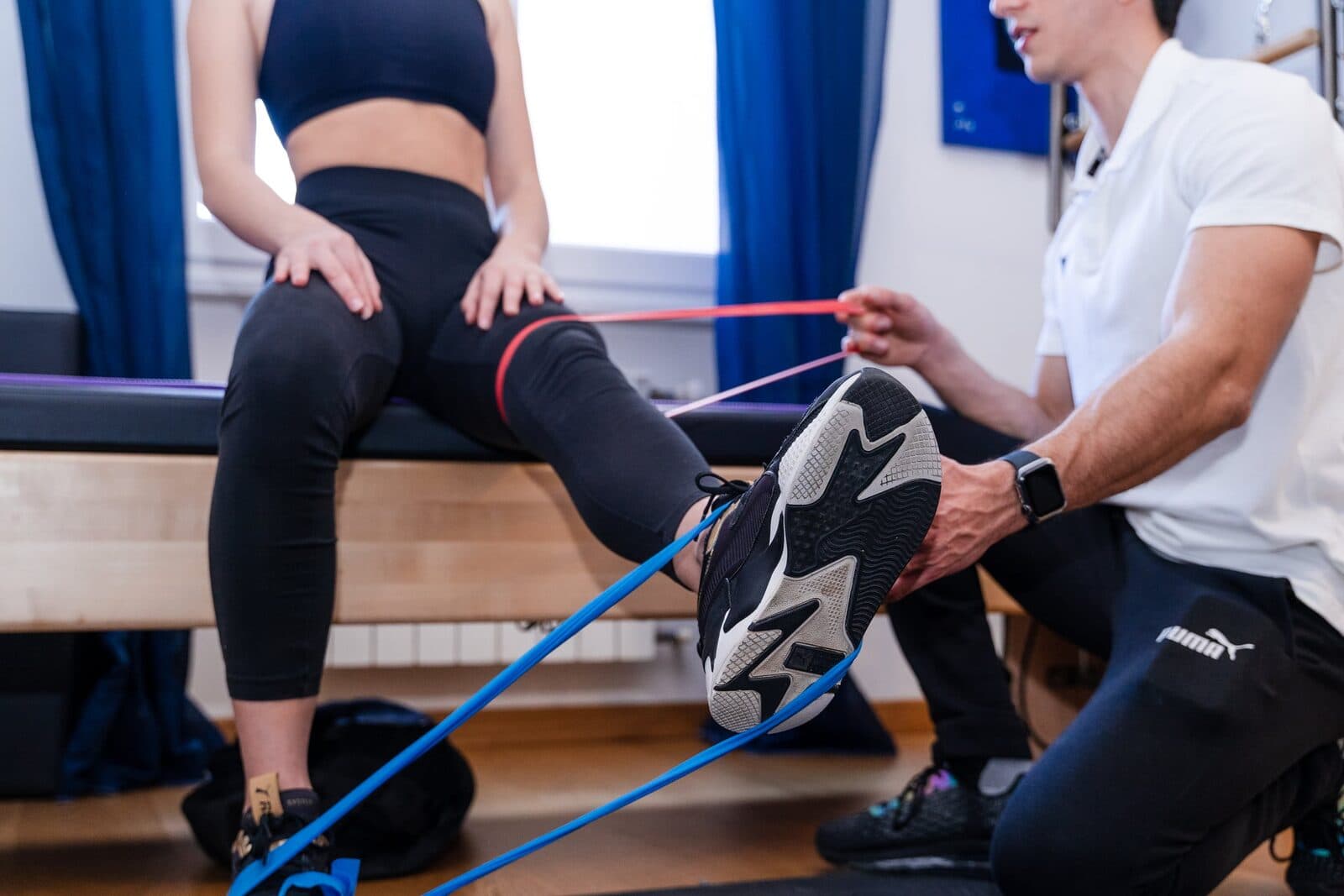
Lateral band walks. Band above the knees or around the ankles, side steps keeping the pelvis stable and without letting the knee collapse inwards. They add a loaded component.
Single-leg work. Partial squats, step-ups onto a low step, controlled step-downs: here the quality matters more than the number of repetitions, meaning the pelvis does not drop sideways and the knee does not fall inwards. It is the movement you repeat thousands of times walking, so it is the one worth training well.
The progression criterion, when working on a tendon, is the behaviour of the pain: a mild discomfort during the exercise that settles within the following hours is acceptable; pain that increases the next day says the load was too much. If you want the general reasoning on how tendons are loaded, I explained it in the article on tendinopathy and evidence-based treatment; if you are looking for the specific picture of the tendon most involved, there is the article on gluteus medius tendinitis.
Trochanteric bursitis: exercises to avoid
There is one thread that holds the whole list together, and it is only one: hip adduction, that is bringing the thigh towards the other leg or past it. It is the position in which the gluteal tendons are compressed against the trochanter, and it is exactly the one that most fitness sheets recommend.
So set aside:
- the iliotibial band stretch with the painful leg crossed behind the other and the pelvis pushed sideways;
- the piriformis stretch with the knee brought towards the opposite shoulder;
- side-lying abduction done letting the leg drop below the line of the body at the end of the movement: that is the compressive moment, and it is enough to stop before it;
- lateral band walks with a band that is too stiff, where the pelvis gives way sideways at every step;
- standing with your weight on one leg, crossing your legs while seated, sleeping on the painful side.
None of these has been studied as a worsening factor, which I say below, with the asterisk it deserves. But they are all movements that bring the hip into the position the mechanical model identifies as compressive, and for none of them is there evidence of benefit: sufficient reason not to place them at the centre of the programme.
Stretching: here the classic advice goes wrong
Practically every sheet you will find online on trochanteric bursitis recommends stretching the iliotibial band and the piriformis. And it is, most likely, the least defensible advice of all.
The reason is internal consistency. The classic band stretch is done by crossing the painful leg behind the other and pushing the pelvis sideways; the classic piriformis stretch is done by bringing the knee towards the opposite shoulder. These are both hip adduction positions, exactly what the mechanical model identifies as the position that compresses the gluteal tendons against the trochanter. The same article that tells you not to cross your legs then asks you to hold the hip crossed for thirty seconds in the name of stretching.
I am honest about the level of evidence: there is no study showing these stretches make greater trochanteric pain syndrome worse. But neither is there one showing they improve it, and in the reviews of conservative treatments stretching does not appear among the interventions that have been tested. We therefore have an intervention without evidence in its favour and with a theoretical reason to suspect the opposite.
How to use this information: do not place stretching at the centre of the programme, and above all do not push if it causes pain at the exact point where it hurts. If your hip feels stiff, work on active mobility through non-compressive ranges and on the muscles, rather than pulling the thigh across the midline. The work that counts here is progressive loading.
Ice and anti-inflammatories
Ice appears in every sheet on trochanteric bursitis, consistent with the idea that there is an inflammation of the bursa to put out. In the reviews of conservative treatments for this condition, however, the interventions actually studied are injections, shockwaves, home exercise and insoles: ice and oral anti-inflammatories have no specific evidence.
The other side of the coin, which it is right to report: the orthopaedic review on the most common bursitides states that most patients respond to non-surgical treatment made up of ice, modification of activities and anti-inflammatories. This is a clinical practice recommendation in a summary article, not the result of a controlled study on trochanteric bursitis, and it should be weighed for what it is: it says these remedies are in common use and reasonable, not that they have been measured and found effective in this condition.
The sensible way to read this is not to throw away the ice pack. It is to understand what you should expect from it: if after twenty minutes of ice you feel less pain and sleep better, it is an analgesic, and that is perfectly fine. It is not the cure, and above all it is not what is changing the state of the tendon. The same goes for an anti-inflammatory taken for a few days in the most acute phase, which is in any case a decision to make with your doctor, not open-ended self-medication.
Cortisone injection
It works, in the short term, and it would be dishonest to deny it. A systematic review of conservative treatments for greater trochanteric pain syndrome, which included eight studies covering 696 patients, found that cortisone injection showed superior results on pain up to three months compared with home exercise, radial shockwaves and usual care. In the same review, the only study at low risk of bias showed that guiding the injection with fluoroscopy adds no benefit.
But watch how the two sets of evidence fit together, because it is the most interesting point of the whole question. In the review the losing comparison was home exercise, a single study, of which the authors themselves say the evidence is limited. In the BMJ trial, where exercise was guided by a physiotherapist over fourteen sessions, the result reverses and exercise beats the injection already at eight weeks. This is not a direct comparison: these are different studies, with different patients, and nobody has pitted supervised exercise against home exercise in the same population. The most reasonable hypothesis to explain the reversal is that what makes the difference is not exercise itself but supervision and progression of load; it remains a hypothesis, not a measured result.
The injection therefore has a role, but it is that of opening a window of less pain in which it becomes possible to work. It is not a causal treatment: it acts on the symptom, not on the tendon's capacity to bear load. It should also be remembered that among the recognised limits of injections is possible weakening of the tendon: it is one of the reasons the shockwave meta-analysis looks for alternatives. Here, however, one must be precise about what is documented and what is not: the observation cited by the orthopaedic review on bursitides concerns another site, namely steroid injection into the retrocalcaneal bursa, which can alter the biomechanical properties of the Achilles tendon. It is not evidence gathered on the gluteal tendons, and it should not be passed off as such, but it is a sufficient reason not to take repeated injections lightly.
Shockwave therapy
A 2024 meta-analysis pooled eight randomised studies covering 754 patients on extracorporeal shockwave therapy in this condition. The result: a significant advantage on pain over other treatments between two and four months (standardised mean difference −0.431, 95% confidence interval −0.82 to −0.039), with very high heterogeneity between studies. On function, improvement at six months was statistically significant but did not exceed the minimum clinically important threshold. Focused shockwaves proved more effective than radial ones.
It should be read with the caution the authors themselves recommend: seven of the eight included studies were judged to be at high risk of bias. The reasonable conclusion is that a course of three sessions, one a week, can give short-term relief and support the pathway, not replace it.
How long it takes
I do not have a reliable number to give you, and I would be wary of anyone who gives you one with decimal precision. What can be said is what the studies measured: the programme in the main trial lasted eight weeks, with measurements at eight and at fifty-two weeks, and already at eight weeks most people in the exercise group reported a relevant improvement.
Two figures need holding together, though, because they temper both pessimism and promises. The first: at one year, in the exercise group, 78% of those who reached the end of the study reported success (51 out of 65), which means about one person in five had not improved satisfactorily even with the best treatment available. The second: in the group that had done nothing, at 52 weeks just over half of those who reached the end reported improvement (31 out of 60). Time, on its own, does part of the work; but it does it more slowly and less well.
The practical criterion remains how the pain behaves over the weeks, not the calendar.
And surgery
In trochanteric bursitis surgery remains reserved for cases that do not respond to conservative treatment, and it is a rare eventuality. You will not find here a threshold in months beyond which to operate, because that threshold is not established by studies: the reviews describe surgery as an option for refractory cases, without indicating a precise time. It is a decision to make with the specialist after a conservative pathway carried out seriously, meaning supervised and progressive, not after a few weeks of haphazard exercises.
Online physiotherapy
This condition lends itself well to remote management, and that is not a polite phrase: what worked in the BMJ trial was education in managing load plus supervised exercise, and both are things that can be done very well over a video call. The educational part, understanding which positions compress, how to sleep, how to set up your workstation, what to expect from the pain during exercises, accounts for half the work. The other half is watching you while you perform, correcting your single-leg stance, and raising the load when the time is right rather than when you remember.
What really matters is continuity: being followed in the weeks when the progression needs adjusting, which is exactly the variable that separates the results of supervised exercise from those of an exercise sheet handed over and forgotten. Online physiotherapy sessions with Ri-Hub cost 29,90 euro.
In summary
So-called trochanteric bursitis is almost never a bursitis: it is a tendinopathy of the glutes, and the correct name is greater trochanteric pain syndrome. Everything follows from this change of perspective.
What has the best evidence is less spectacular than the list of remedies found online: reducing the positions that compress the tendon, such as sleeping on the painful side, crossing the legs or putting weight on one hip, and progressively strengthening the hip abductors under genuine supervision. The injection helps for a few months but does not change the capacity to bear load. Shockwaves give short-term relief on fragile evidence. Ice and anti-inflammatories are analgesics. The band and piriformis stretches, which almost everyone recommends, have no evidence in their favour and put the hip exactly where you are trying to avoid it.
If for months you have been doing the wrong thing with great consistency, you do not lack discipline: you lack the right lever.
You might also be interested in:
Ankle Proprioception: Exercises for Stability and Sprain Prevention Pain Behind the Knee: Causes, Diagnosis and Treatment Gonalgia: Causes of Knee Pain and How to Treat It
Stay in touch with us Join our dedicated Facebook group: we reply to all patients, give practical advice and clear up the most common questions.
Deep forms like this one are the hardest to pin down and are often recognised late: the overall picture is in Bursitis: causes, symptoms and remedies.
Sources
- Education plus exercise versus corticosteroid injection use versus a wait and see approach on global outcome and pain from gluteal tendinopathy: prospective, single blinded, randomised clinical trial, BMJ, 2018
- Exercise compared to a control condition or other conservative treatment options in patients with Greater Trochanteric Pain Syndrome: a systematic review and meta-analysis of randomized controlled trials, Physiotherapy, 2024
- Gluteal Tendinopathy: Integrating Pathomechanics and Clinical Features in Its Management, Journal of Orthopaedic & Sports Physical Therapy, 2015
- Gluteal Tendinopathy: A Review of Mechanisms, Assessment and Management, Sports Medicine, 2015
- Conservative treatments for greater trochanteric pain syndrome: a systematic review, British Journal of Sports Medicine, 2017
- Extracorporeal Shockwave Therapy for Greater Trochanteric Pain Syndrome: A Systematic Review with Meta-Analysis of Randomized Clinical Trials, JBJS Reviews, 2024
- Lateral hip pain: findings from magnetic resonance imaging and clinical examination, Journal of Orthopaedic & Sports Physical Therapy, 2008
- Four common types of bursitis: diagnosis and management, Journal of the American Academy of Orthopaedic Surgeons, 2011
- Exercise and load modification versus corticosteroid injection versus 'wait and see' for persistent gluteus medius/minimus tendinopathy (the LEAP trial): a protocol for a randomised clinical trial, BMC Musculoskeletal Disorders, 2016
Sources last checked: August 2026.
Need a consultation?
Start the questionnaire on Ri-Hub: a few questions about your case, you register, and you see who will follow you: a physiotherapist on the Italian professional register, whom you write to in chat whenever you like. If you would rather talk it through by voice, the first consultation is free, lasts twenty minutes and commits you to nothing: they arrive having already read what you wrote, and together you decide whether and how to go on.