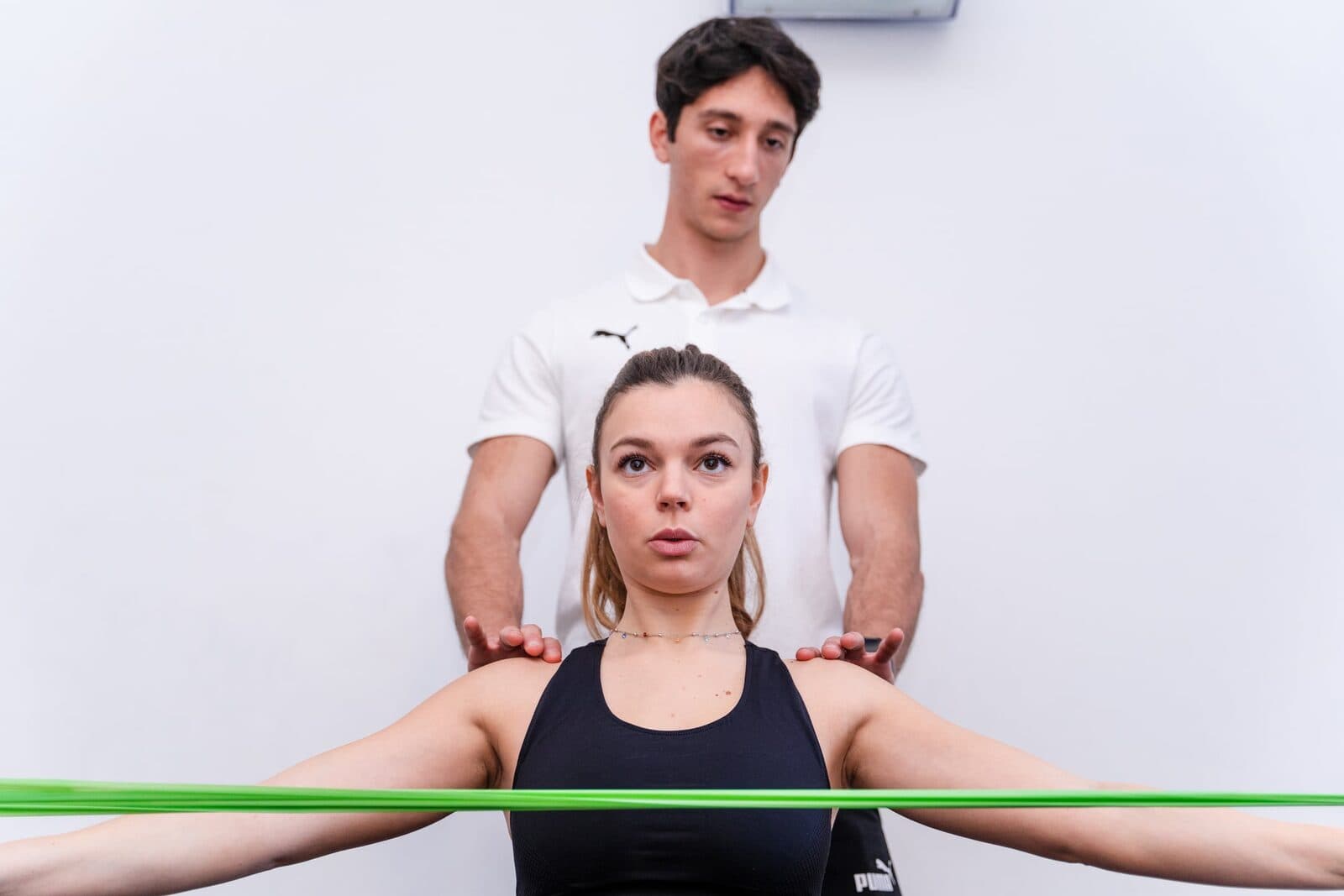
Band pull apart: all you need is a resistance band and two square metres of space. It is one of the exercises I suggest most often in the clinic, and at the same time one of those surrounded by the most inflated promises. You will read that it straightens rounded shoulders, that it corrects desk posture, that it prevents shoulder injuries. None of these three claims holds up against the research.
What holds up is more modest, and it is still enough to earn it a place in your week: it is a very low-load exercise, easy to dose, which lets you accumulate volume on the muscles at the back of the shoulder and on the muscles that control the shoulder blade without stressing the joint. In this guide we look at the technique, the typical mistakes, the dosage and, above all, what we can honestly expect.
Before you continue
The exercises and advice in this article are general indications and may not suit your situation. Every person has a different clinical history: what works for others can be useless or counterproductive for you. If you already have pain, the first step is not the exercise, it is understanding where it comes from.
Want a professional's opinion? Start with the questionnaire: you register and see who will follow you, a physiotherapist registered with the Register chosen for your case, to whom you write in chat. If you would rather hear their voice, the first consultation is free and we look at your situation together.
The full list of signs that need a doctor before a physiotherapist is in emergencies.
What the band pull apart is
You hold a band with your arms straight in front of your body, at shoulder height, and open it by moving your hands outwards until the band reaches your chest. The movement is a horizontal abduction of the arms with the shoulder blades coming together.
The gesture looks trivial, and that is exactly its clinical value: no equipment is needed, it takes a few minutes to learn, it can be repeated anywhere, and the resistance is adjusted continuously by changing how wide you grip the band. In shoulder rehabilitation this matters more than it seems, because the practical problem is not finding the perfect exercise: it is finding one that the person can do every day for weeks without waking up the pain.

Which muscles really work
When you open the band, the posterior deltoid, the rhomboids, the middle and lower trapezius and, to a variable extent, the external rotators such as the infraspinatus come into play. These are the muscles that keep the shoulder blade pressed against the rib cage and guide it when you raise your arm.
The band pull apart has been measured with surface electromyography in a study of 36 people, half with forward head posture and half without. The researchers compared the same exercise performed in five different positions: standing, standing on one leg, in a squat, in a single-leg squat and in a Bulgarian split squat. The exercise performed in a squat produced more activity in the middle and lower trapezius, and less activity in the sternocleidomastoid, than in the standing position, with lower upper-to-middle and upper-to-lower trapezius ratios.
People with forward head posture and those without showed different levels of activation, but the ratios between the muscles were similar in the two groups. Put simply: someone with their head forward does not have an "unbalanced" activation pattern during this exercise.
Why EMG activation is not a clinical benefit
Here a clarification is needed that popular articles almost always skip. Electromyography measures the electrical activity of a muscle during a single laboratory session, usually on twenty or thirty healthy volunteers. It does not measure the strength gained, it does not measure pain, it does not measure function weeks later.
Knowing that one variant activates the lower trapezius 9% more does not allow you to conclude that this variant will make your shoulder feel better. It is useful information for choosing between two exercises when everything else is equal, and nothing more. Every time you read "this exercise activates muscle X more, so it is better", you are reading a logical leap.
The posture myth
The common reasoning goes like this: hours at the computer shorten the chest muscles and weaken the muscles between the shoulder blades, so strengthening the back pulls the shoulders back and removes the pain. It sounds convincing. Research dismantles it at two different points.
The angles do move, yes
Strengthening can indeed change posture measurements. A systematic review with meta-analysis of 23 studies and 969 healthy people found that strengthening programmes carried out over time improve measured posture, with a large effect in the thoracic and cervical region, while stretching the "shortened" muscles produced no change at all. A second meta-analysis, focused on people with the so-called upper crossed syndrome, reports improvements in the angles of forward head posture, forward shoulders and thoracic kyphosis.
Pay attention to what was measured: degrees on a goniometer or on a photograph, in people who were generally healthy, in studies that were often small. These are real variations, not transformations of body shape, and neither of the two works measures pain as its main outcome.
But posture does not predict pain well
And this is where the reasoning breaks down. A systematic review of ten studies concluded that there is moderate-level evidence of no difference in thoracic kyphosis between people with shoulder pain and people without. The same review, on the other hand, finds solid evidence that maximum shoulder range of motion is greater in the standing position than in a slumped position, but these are measurements taken in a single session, whose long-term meaning remains unknown.
A prospective study points in the same direction: 113 amateur athletes doing overhead movements were followed for two years. 22% developed shoulder pain, and none of the scapular features assessed at the start (observed dyskinesis, protraction, rotation, dynamic control) predicted who would get hurt. The authors note that those who later had pain showed less upward rotation of the shoulder blade at the start, but this is a secondary observation, not a predictive ability. Even in a cross-sectional study of 56 volleyball players, a forward-shoulder position did not distinguish those with pain from those without.
For the other side of the argument, one point of honesty: scapular dyskinesis, meaning an altered movement of the shoulder blade rather than a fixed posture, seems to matter. A meta-analysis of five prospective studies and 419 asymptomatic athletes estimated a 43% higher risk of future pain in those who showed it. But this is an increased risk for a movement, not for a resting shape, and nobody has ever shown that an exercise with a band cancels it out.
The practical conclusion is simple. If you do the band pull apart to feel stronger and to tolerate overhead work better, you have a sensible goal. If you do it because you were told your shoulders are "closed" and that this will hurt you, you are chasing a target that the research does not confirm.
"It prevents injuries": here the literature does not exist
To say it plainly: no study has tested the band pull apart as a preventive intervention. No randomised trial, no cohort. Anyone who writes that it "prevents shoulder injuries" is not reporting a result, they are extending a hypothesis.
What we know concerns much broader programmes, which the pull apart could at most be part of. A systematic review with meta-analysis of shoulder prevention programmes in handball included five randomised studies and 1,872 players: all the programmes included strengthening, some also mobility, scapular work, trunk work and neuromuscular control. In the three studies that entered the meta-analysis, the incidence of shoulder injuries was not significantly different from usual warm-up.
On the single physical quality front, a randomised study of 92 adolescent players added two band exercises for the external rotators for eight weeks, five to ten minutes three times a week after training. In the end, neither external rotation strength nor the ratio between external and internal rotators had improved compared with usual training alone.
The lesson is not that the exercise is useless. It is that a few minutes of band tacked on at the end of a session is too low a dose to change anything measurable, and that the word "prevention" applied to a single exercise has, at present, no support.
Signs that come before the exercise
Before you open a band, there are situations in which the right thing to do is get assessed. If you recognise any of these pictures, stop and see a doctor or a physiotherapist:
- Loss of strength after an injury: after a fall or a tear, you cannot lift or rotate your arm against resistance. This may indicate a rotator cuff tear.
- Hot, swollen and red shoulder, with fever or general malaise: this needs an urgent medical assessment, not exercise.
- Night pain that gets progressively worse, especially with a history of cancer, unexplained weight loss or night sweats.
- Tingling, numbness or weakness running down the arm to the hand: the problem may start in the neck, not the shoulder.
To find your way among the most common pictures and understand when it is worth looking further, the guide on when shoulder pain should worry you may help.
How to do the band pull apart
The quality of the movement matters more than the strength of the band. The sequence:
- Standing, feet hip-width apart, band held with your arms straight in front of you at shoulder height, palms facing down.
- Choose your grip width: this is what sets the intensity. Hands closer together, band more stretched, movement harder.
- Draw the shoulder blades back and down, then open your arms until the band reaches your chest.
- Keep your arms straight throughout the range: the movement comes from the shoulders and shoulder blades, not from the elbows.
- Return slowly to the starting point, resisting the band instead of letting it snap you back.
- Breathe normally: if you hold your breath, the resistance is almost always too high.
A useful reference: if you can talk while doing it and feel the area between the shoulder blades and the back of the shoulders working, you are on the right track. If you feel the top of the neck pulling, you are almost certainly shrugging your shoulders towards your ears.
The three most common mistakes
Using momentum. The movement should be slow and controlled, with the return braked. If the arms snap and bounce, the band is doing the work instead of you and the real dose of exercise collapses.
Shrugging the shoulders towards the ears. The shoulder blades should go down and come together, not up. If you feel it in the neck, stop, deliberately lower your shoulders and start again from there. It is worth remembering that in the electromyography study cited above, body position was changing exactly the balance between the upper and the middle and lower trapezius: position matters.
Bending the elbows. The arms stay straight. An elbow that bends is almost always a sign that the band is too stiff or the grip is too narrow for the strength you have.
Variants and what really changes
The basic variant, with arms at shoulder height and palms down, mainly loads the posterior deltoid, the rhomboids and the middle trapezius. Bringing the arms higher shifts some of the work towards the lower trapezius; rotating the humerus outwards during the opening involves the external rotators more; changing the rotation of the palms slightly shifts the emphasis between the back muscles.
It should be said that these distinctions come from laboratory studies of similar, not identical, movements. For example, in a study of 21 university baseball players, an external rotation exercise with the arm at 90 degrees performed with two bands increased the activity of the teres minor and the lower trapezius in the frontal plane, while containing the upper trapezius. In another study of 13 healthy men, maintaining an opening push against a band during arm elevation increased the activity of the middle deltoid, posterior deltoid, infraspinatus and teres minor by two to seven times, while reducing that of the anterior deltoid and pectoralis major. The authors suggest a use in people with large rotator cuff tears or who have had surgery, but this is a laboratory hypothesis, not a clinical result.
In practice: alternating the variants over time is reasonable, because it varies the working angles and keeps the movement from becoming mechanical. Anyone who already has shoulder pain would do well to stay with the basic variant on a light band, and add rotations or high arms only when that one causes no discomfort. For more complete work on the rotators, there is a dedicated guide to rotator cuff exercises.
How much and how often: the dosage
What follows is clinical practice, not a validated protocol: there are no studies comparing different doses of the band pull apart.
- As a warm-up before sessions with pushing or overhead work: 2-3 sets of 15-20 repetitions with a light band, to wake up the back muscles without tiring them.
- As a dedicated exercise: 3-4 sets of 12-20 repetitions, 2-3 times a week, with a resistance that becomes demanding in the last repetitions but does not alter your technique.
- As a micro-break during the day: one or two short sets, a few times a day, without chasing fatigue.
An interesting data point on volume comes from rehabilitation. A meta-analysis of eight randomised studies in people with shoulder pain found that specific scapular exercises improve function more than the comparisons, with benefits when the programme lasts at least six weeks and when the repetitions per exercise per session stay within thirty. In the same set of studies, pain reduction was not superior to the comparisons. These are subgroup analyses, so they are exploratory, but they suggest that accumulating hundreds of repetitions a day is not the way.
On micro-breaks at work there is a signal, although for a different exercise: in a small randomised study of 30 office workers with chronic neck and shoulder pain, two minutes a day of high-intensity band work for ten weeks reduced pain intensity by 40% and increased isometric strength by 6%. The exercise used was lateral arm raise, not the pull apart, and the sample was very small: take it as a hint that minimal but daily doses can be worth something, not as proof for this exercise.
Which band to choose
Start with a light band and master the movement. Move to a higher resistance when you complete more than twenty controlled repetitions without losing form, without compensating with your neck and without bending your elbows.
Having two or three different resistances is the best investment, because it lets you vary the intensity between warm-up and dedicated work without changing exercise. As for band versus weights, there is no absolute winner: a study of twenty competitive swimmers measured the muscle activity of the same five exercises performed with the two tools and found great variability between them: the 90-degree rotation was more active with the band, the scapular presses more active with weights. It depends on the exercise, and for a horizontal opening movement the band is the more practical choice.
The band pull apart in shoulder rehabilitation
When pain is already present, work on the scapular muscles has its best evidence, which remains modest. A meta-analysis of 14 studies and 666 people with subacromial pain found that adding scapular stabilisation exercises to the general programme reduces pain by about 0.8 cm on a 10-point scale and improves function, but the authors rate the certainty of the evidence as low to very low: these are small numbers, from small studies, to be read with caution.
It is also worth remembering how hard it is to beat the minimum. In the GRASP trial, published in the Lancet and conducted on 708 people with rotator cuff disorders, a progressive exercise programme with up to six physiotherapy sessions was not superior to a single session of best-practice advice, over a twelve-month period. The 2025 international guidelines on rotator cuff tendinopathy nonetheless place exercise-based rehabilitation within the reference non-surgical pathway.
How does all of this translate? In a rehabilitation pathway, the band pull apart is one of the most useful tools I have, but not for a specific effect on the shoulder blade: it is because it can be graded down almost to zero, because almost nobody finds it painful, because it can be done at home every day, and because it builds confidence in movement in the phases when everything else hurts. In a painful shoulder these four requirements are worth more than any activation percentage.
If your problem starts under the barbell, you may also be interested in the article on shoulder pain in the gym.
What to expect, in concrete terms
With eight to twelve weeks of regular work you can expect to handle the band and the loads in opening more easily, to feel less fatigue in the area between the shoulder blades on sedentary days and, if you train, to tolerate volume on pushing and overhead movements better.
You cannot expect your body shape to change, your shoulders to "stay back" on their own, your neck to stop bothering you if the problem lies elsewhere, or a proven protection against injury. It is a cheap, safe, easy-to-maintain exercise. Its value lies exactly in those three words, not in some hidden virtue.
Online physiotherapy
A physiotherapist can watch you do the movement, correct the position of the shoulder blades, choose the resistance, decide whether the pull apart makes sense for you at this moment and fit it into a complete programme. That is the real point: on its own an exercise does little, within a reasoned pathway it does a lot. Ri-Hub's sessions are there to build and follow that pathway at a distance.
Stay in touch with us: join our dedicated Facebook group, where we answer patients, give practical advice and clear up the most common doubts.
Need a consultation?
If you feel something wrong while doing it: a twinge, a discomfort that stays the next day, one side behaving differently from the other, that is the moment to ask, not to keep pushing by switching videos. A physiotherapist will look at how you perform it and tell you whether it is technique, load or something to assess first: 20 minutes on a video call, free and with no credit card. You do not need a credit card: the first consultation does not commit you to anything.
For bodyweight pulling work, see Inverted row: the perfect alternative to pull-ups.
You will find this and eighty-two other exercises, each with execution, common mistakes and variants, in the exercise library.
Sources
- Investigation of muscle activation during kinetic chain based exercises in individuals with and without forward head posture, Journal of Back and Musculoskeletal Rehabilitation, 2024
- Is thoracic spine posture associated with shoulder pain, range of motion and function? A systematic review, Manual Therapy, 2016
- Does scapular positioning predict shoulder pain in recreational overhead athletes?, International Journal of Sports Medicine, 2014
- Mechanical Hyperalgesia but Not Forward Shoulder Posture Is Associated with Shoulder Pain in Volleyball Players, Journal of Clinical Medicine, 2022
- Scapular dyskinesis increases the risk of future shoulder pain by 43% in asymptomatic athletes: a systematic review and meta-analysis, British Journal of Sports Medicine, 2018
- Effects of Stretching or Strengthening Exercise on Spinal and Lumbopelvic Posture: A Systematic Review with Meta-Analysis, Sports Medicine Open, 2024
- The effect of various therapeutic exercises on forward head posture, rounded shoulder, and hyperkyphosis among people with upper crossed syndrome, BMC Musculoskeletal Disorders, 2024
- Shoulder injuries prevention programmes in handball: a systematic review with meta-analysis, BMJ Open Sport & Exercise Medicine, 2025
- No Added Benefit of 8 Weeks of Shoulder External Rotation Strength Training for Youth Handball Players Over Usual Handball Training Alone: A Randomized Controlled Trial, Journal of Orthopaedic & Sports Physical Therapy, 2021
- Effectiveness of specific scapular therapeutic exercises in patients with shoulder pain: a systematic review with meta-analysis, JSES Reviews, Reports & Techniques, 2024
- Scapular stabilization exercise on pain and functional recovery in people with shoulder impingement syndrome: a systematic review and meta-analysis, The Physician and Sportsmedicine, 2025
- Progressive exercise compared with best practice advice, with or without corticosteroid injection, for the treatment of patients with rotator cuff disorders (GRASP), Lancet, 2021
- Rotator Cuff Tendinopathy Diagnosis, Nonsurgical Medical Care, and Rehabilitation: A Clinical Practice Guideline, Journal of Orthopaedic & Sports Physical Therapy, 2025
- The Application of Double Elastic Band Exercise in the 90/90 Arm Position for Overhead Athletes, Sports Health, 2020
- Electromyographic activities of glenohumeral joint muscles during shoulder forward flexion with isometric horizontal abduction loading, Journal of Shoulder and Elbow Surgery, 2023
- Electromyographic activity of shoulder muscles on two preventive exercise programmes for swimmer's shoulder: elastic band versus weight, Sports Biomechanics, 2025
- Effect of brief daily resistance training on occupational neck/shoulder muscle activity in office workers with chronic pain: randomized controlled trial, BioMed Research International, 2013
Last source check: August 2026.