30 minutes of exercise a day is the formula we have all heard. It is a good practical rule, but it is not what the guidelines say, and the difference changes how it makes sense to organise yourself.
The 2020 recommendations of the World Health Organization speak of 150-300 minutes a week of moderate aerobic activity, or 75-150 minutes of vigorous activity, plus muscle-strengthening work. 30 minutes a day is simply a convenient way of dividing that total over five days. It is not a threshold below which movement stops working, and the same guidelines repeat that some activity is better than none.
This distinction is not a technicality. Someone who thinks "I don't have half an hour, so I might as well not move at all" is giving up the most profitable part of the curve.
⚠ Important: read this before continuing
The exercises and advice in this article are general guidance and may not suit your situation. Every person has a unique clinical history: what works for others could be counterproductive for you.
Want a professional's opinion? Start from the questionnaire: you sign up and see who will follow you, a physiotherapist registered with the Register chosen for your case, whom you can write to in chat. If you would rather hear their voice, the first consultation is free and we look at your situation together.
First of all: when to stop and see a doctor
Moderate physical activity is safe for the great majority of people, but some signs must be taken seriously right away, not "after a few weeks of seeing how it goes":
- pain, pressure or burning in the chest during effort, even if it goes away when you stop;
- breathlessness clearly out of proportion to what you are doing, or that has appeared recently for the same effort;
- fainting, near-fainting or dizziness during or right after activity;
- sudden palpitations, an irregular heartbeat, a feeling of "heart in the throat" at rest;
- pain in one calf with swelling, warmth or redness;
- new ankle swelling, or difficulty breathing when lying flat.
These are situations where the medical assessment comes before the training programme. The same applies if you have known heart disease, uncontrolled hypertension, poorly controlled diabetes, or have recently had a cardiovascular event: in these cases it is not a matter of giving up movement, but of dosing it together with the person following you. We have written an article on how to move safely with heart disease.
Musculoskeletal pain deserves separate attention: a discomfort that appears at the start and warms up after a few minutes is usually not a problem; pain that increases during activity, makes you limp, or stays active the next day should be assessed.
What you really gain (and where the gain is greatest)
Here is the data point worth keeping in mind above all others. A dose-response meta-analysis published in the British Journal of Sports Medicine in 2023, which pooled 196 articles, 94 cohorts and over 30 million participants, showed that the relationship between physical activity and risk is not a straight line: the most marked difference in risk is found between 0 and about 8.75 mMET-hours a week (the equivalent of the recommended 150 minutes). Between 8.75 and 17.5 mMET-hours the additional differences are already smaller, and beyond that level they become small and uncertain.
In numbers: at 8.75 mMET-hours a week the relative risk of all-cause mortality was 0.69 (95% CI 0.65-0.73) and that of cardiovascular mortality 0.71 (95% CI 0.66-0.77). The authors estimate that if all insufficiently active people had reached that level, 15.7% of premature deaths would have been avoided.
A 2019 study in the BMJ, which harmonised individual data from eight cohorts measured with accelerometers (36,383 people, mean age 62.6 years, 72.8% women, followed for a median of 5.8 years), reached a consistent and in some ways more encouraging conclusion: any activity, at any intensity, was associated with lower mortality, again with a non-linear pattern. Compared with the least active quarter, the risk was already halved in the second quarter (HR 0.48, 95% CI 0.43-0.54). Even light activity, such as walking around the house, climbing stairs or doing the shopping on foot, showed this association (HR 0.60 in the second quarter). It is worth remembering that these were middle-aged and older adults, mostly women: the exact figures cannot automatically be transferred to sedentary people in their twenties.
These are observational studies: they show associations and do not, on their own, prove cause and effect, and people who move more often differ in other ways too. But the direction is so consistent, across such large populations, that the practical message is solid: the most valuable step is from "inactive" to "a little active", not from 25 to 30 minutes.
This matters even more when time is not entirely yours. In the months after giving birth, with another child at home, the dose measured to have an effect on mood drops to around eighty minutes a week: where that number comes from, and what can be postponed without harm, is explained in postnatal life when you already have other children.
On the mental side the same pattern holds. A meta-analysis published in JAMA Psychiatry in 2022 (15 prospective studies, 191,130 participants) found that, compared with people who reported no activity at all, those who accumulated half the recommended volume (4.4 mMET-hours a week) had an 18% lower risk of depression (95% CI 13-23%), and those who reached the full volume (8.8 mMET-hours) had a 25% lower risk (95% CI 18-32%), with additional benefits decreasing beyond that threshold. Be careful about exactly what this says: the comparison is with people who are completely inactive, not between two levels of training, and it concerns the risk of developing depression in people followed over time. It is not evidence that exercise replaces treatment for someone already in care. The heterogeneity between studies was, moreover, high (I² 74%).
On weight, on the other hand, we need to be honest: movement improves cardiovascular, metabolic and mood health even when the scales barely move, and treating physical activity only as a slimming tool is the quickest way to abandon it after three weeks.

It does not all have to be together (and now there is evidence)
The question most frequently asked in the clinic is: "if I don't have half an hour in one go, can I split it?" Put differently: do the 30 minutes of daily exercise have to be consecutive?
Yes. A systematic review with meta-analysis published in Sports Medicine in 2019 looked at exactly this: 19 studies, 1,080 participants, continuous exercise versus exercise accumulated in several short sessions within the same day, at equal total duration, mode and intensity. No differences emerged for cardiorespiratory fitness, nor for blood pressure, and not for total cholesterol, HDL, triglycerides, or fasting glucose and insulin. Two sub-analyses did find a small advantage of the accumulated mode on body weight (mean difference -0.92 kg, 95% CI -1.59 to -0.25) and on LDL cholesterol (-0.39 mmol/l, 95% CI -0.73 to -0.06): however they are based on very few data, five studies and 211 participants for the first and two studies and 41 participants for the second, so it is not a reason to split the exercise in order to lose weight.
This is also the review that informed international guidelines: it is the source of the removal of the old rule of "blocks of at least 10 minutes", which in the WHO 2020 recommendations is no longer a requirement. Three ten-minute walks, or six of five minutes, count. If you suffer from lower back pain or have a joint that complains after twenty minutes, splitting the session is not a fallback: it is often the technically better choice.
An important point: before trying these exercises, make sure you have received a correct diagnosis. People often think they have one problem when the real cause of the pain is something else. Doing the wrong exercises can make things worse rather than better.
Every day or concentrated at the weekend?
Here we need to correct a sentence you read everywhere, including in the previous version of this article: "half an hour every day is better than two hours once a week". It is intuitive, but the data do not support it.
A cohort study of 350,978 US adults (mean age 41.4 years, activity self-reported by the participants themselves), published in JAMA Internal Medicine in 2022 with a median follow-up of 10.4 years, compared "weekend warriors" (all the activity in 1-2 sessions a week) with people who trained regularly (3 or more sessions). Compared with inactive people, mortality was lower among those who were regularly active (HR 0.85, 95% CI 0.83-0.88) and in the same direction, but without reaching statistical significance, among weekend warriors (HR 0.92, 95% CI 0.83-1.02). And for the same total minutes of moderate to vigorous activity, the difference between the two patterns was not significant: HR 1.08 (95% CI 0.97-1.20) for all-cause mortality.
Put simply: it is the weekly total that matters, not the symmetry of the calendar. That said, spreading the activity out remains preferable for two practical reasons that mortality studies do not capture: if you have been inactive for months, concentrating two hours into a single day loads tendons and cartilage abruptly, and a daily habit is easier to protect than a single appointment which, if missed, wipes out the whole week.
What counts as activity
Practically anything that raises your breathing:
- brisk walking: the cheapest and most underrated way in (if you count steps rather than minutes, we discussed it in the article on 10,000 steps);
- cycling, swimming, light running, dancing;
- demanding gardening, vigorous cleaning, stairs, shopping on foot: these are not "almost exercise", they fully count.
Moderate intensity is recognised by the talk test: you can speak in full sentences but cannot sing. If the activity is vigorous, so that you can only say a few words at a time, each minute counts about double: the WHO guidelines put 150-300 minutes of moderate and 75-150 minutes of vigorous activity on the same level per week.
For children the same documents give different and higher figures: three hours a day of movement of any intensity between the ages of three and four, and one hour of moderate to vigorous activity from age five onwards. At that age, however, almost all movement is play, and the count works differently: what to offer, age by age.
Not just cardio: strength is the forgotten half
The recommendations include muscle-strengthening activities for all age groups, and this is the part almost everyone skips. A meta-analysis of prospective studies published in the British Journal of Sports Medicine in 2022 (16 studies) linked muscle-strengthening activities to a 10-17% lower risk of all-cause mortality, cardiovascular disease, cancer in general, diabetes and lung cancer. Not everything goes in the same direction, however: for some specific cancers (colon, kidney, bladder, pancreas) no association emerged. For mortality, cardiovascular disease and cancer the relationship was J-shaped, with the maximum reduction (around 10-20%) at around 30-60 minutes a week, a much smaller volume than most people imagine. The combination of muscle strengthening and aerobic activity was associated with a lower risk than doing neither.
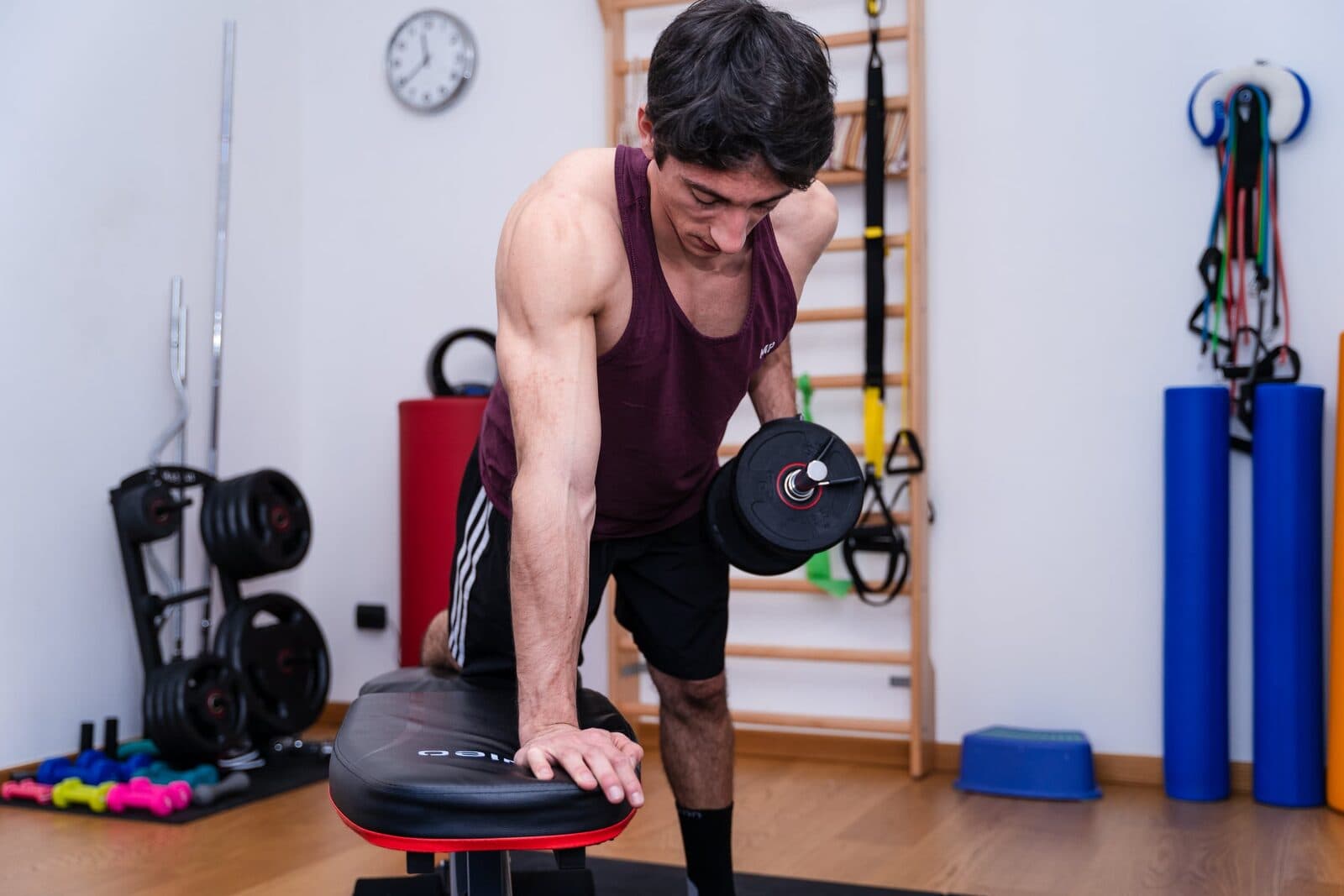
Just over half an hour a week of work with weights, bands or body weight, divided into two sessions, is therefore an investment with an extremely high value for money. Beyond that volume, for general health, the additional benefit becomes uncertain.
Mobility and stretching play a different role: they help comfort, stiffness and the quality of movement, but they do not replace either the aerobic part or the strength part.
How to really organise them
Finding 30 minutes of exercise a day is a problem of logistics, not motivation. Three anchor points in the day, chosen according to when you are most likely to manage it, not when it "would be ideal":
- Morning: this is usually the slot with the fewest interruptions, because nobody has yet had time to fill your diary. There is no proven "best" time of day for health: what counts is which slot you can genuinely protect in your week.
- Lunch break: twenty minutes of brisk walking breaks up sedentary time and covers a good part of the daily requirement. In the BMJ study cited above, sedentary time showed a rising association with mortality as it increased.
- Evening: replace part of the time spent sitting, rather than adding one more effort at the end of the day.
A realistic typical week, for someone starting from zero:
- Monday, Wednesday, Friday: 30 minutes of brisk walking, even split into two or three blocks.
- Tuesday, Thursday: 20-30 minutes of strength work for the large muscle groups.
- Weekend: an activity you enjoy: a hike, a bike ride, a sport. If the week got away from you, making up for it here still has value.
If today you walk ten minutes in total, do not start from this table: start from twenty minutes a day and add five minutes a week. Anyone over fifty or returning after a long break will find a more gradual path in the article on wellbeing over 50.
The role of online physiotherapy
Tele-rehabilitation is most useful in two situations: when there is pain or a limitation that makes it unclear what you can do, and when previous attempts always stopped at the same point. A physiotherapist can adapt loads and progressions to your case, rule out the movements that currently hurt you, and turn the generic goal of 30 minutes of daily exercise into a plan that works in your real week.
Ri-Hub offers online physiotherapy sessions at 29,90€.
In short
30 minutes of exercise a day remains an excellent target, but for the right reason: it is a practical way of reaching the recommended 150 minutes a week, not a magic threshold. The most profitable stretch of the curve is the beginning, minutes can be accumulated in pieces without losing their value, the weekly total matters more than how it is distributed, and the strength part, 30-60 minutes a week, is the one almost everyone forgets.
If the reason you are not moving is pain, that comes first: resolving it is what makes everything else possible.
You might also like:
Stretching Post-Allenamento: Routine Completa di Recupero Cardiopatia e Esercizio: Come Muoversi in Sicurezza Gonartrosi Esercizi: 15 Movimenti Per Convivere Bene Con l'Artrosi
Stay in touch with us Join our dedicated Facebook group: we answer all patients, give practical advice and clarify the most common doubts.
Sources
- World Health Organization 2020 guidelines on physical activity and sedentary behaviour, British Journal of Sports Medicine, 2020
- Non-occupational physical activity and risk of cardiovascular disease, cancer and mortality outcomes: a dose-response meta-analysis of large prospective studies, British Journal of Sports Medicine, 2023
- Dose-response associations between accelerometry measured physical activity and sedentary time and all cause mortality: systematic review and harmonised meta-analysis, BMJ, 2019
- The Effects of Continuous Compared to Accumulated Exercise on Health: A Meta-Analytic Review, Sports Medicine, 2019
- Association of the "Weekend Warrior" and Other Leisure-time Physical Activity Patterns With All-Cause and Cause-Specific Mortality: A Nationwide Cohort Study, JAMA Internal Medicine, 2022
- Association Between Physical Activity and Risk of Depression: A Systematic Review and Meta-analysis, JAMA Psychiatry, 2022
- Muscle-strengthening activities are associated with lower risk and mortality in major non-communicable diseases: a systematic review and meta-analysis of cohort studies, British Journal of Sports Medicine, 2022
Sources last checked: August 2026.
Need a consultation?
Start from the Ri-Hub questionnaire: a few questions about your case, you sign up, and you see who will follow you: a physiotherapist registered with the Register, whom you can write to in chat whenever you like. If you prefer to talk it through by voice, the first consultation is free, lasts twenty minutes and commits you to nothing: they arrive having already read what you wrote, and together you decide whether and how to continue.