It almost always happens around the twelfth week. You tell someone you keep training and the sentence comes back, delivered with the confidence of someone quoting a law: "no abs". Nobody explains which ones, why, or until when. And you stop everything, just to be safe.
Here is the short version first, then the numbers. The total ban has no study behind it: it is a precautionary rule born from anatomical reasoning and turned into dogma along the way. The honest version is less dramatic and more useful: two or three exercises become impractical for practical reasons, and the rest of the core work is not only allowed, it is what you really need.
"No crunches": how much is evidence and how much is caution
Let us start with the uncomfortable question: has anyone ever seen crunches cause harm in pregnancy? No. No study has tested them and found that they worsen anything. The ban comes from a syllogism: crunches shorten the rectus abdominis, the rectus abdominis is already stretched to its maximum in pregnancy, therefore crunches worsen diastasis. It sounds logical. The problem is that when someone went to measure it, the syllogism did not hold.
The closest data we have is a randomised trial published in the Journal of Physiotherapy on 70 women between 6 and 12 months after childbirth with a diagnosed diastasis: 12 weeks of head lifts, crunches and oblique crunches, five days a week, that is exactly the programme everyone says you should not do. The distance between the abdominal muscles did not get worse or better (mean difference 1 mm above the navel, 95% CI -1 to 4), while the thickness of the rectus abdominis (0.7 mm) and strength (9 Nm) increased. No worsening of the pelvic floor, nor of lumbar, pelvic or abdominal pain.
It must be said precisely, because this is the kind of slip seen often: that study was done after birth, not during pregnancy. It does not prove that crunches at 30 weeks are harmless. It shows that the idea the ban started from, "crunches widen the gap", was not seen even in the population where it was easiest to see.
A second piece of data complicates the picture further. In an ultrasound study of 26 women with diastasis and 17 controls, during a spontaneous crunch the distance between the abdominal muscles narrows (by 1.19 cm above the navel), but the linea alba deforms more; when the transverse abdominis is activated first, the gap narrows less and the linea alba deforms less. In other words, closing the gap, the thing everyone measures, is not necessarily the good thing. The authors remain cautious (their deformation index still needs validating), but the meaning is clear: how the tissue behaves matters more than how many centimetres you read.
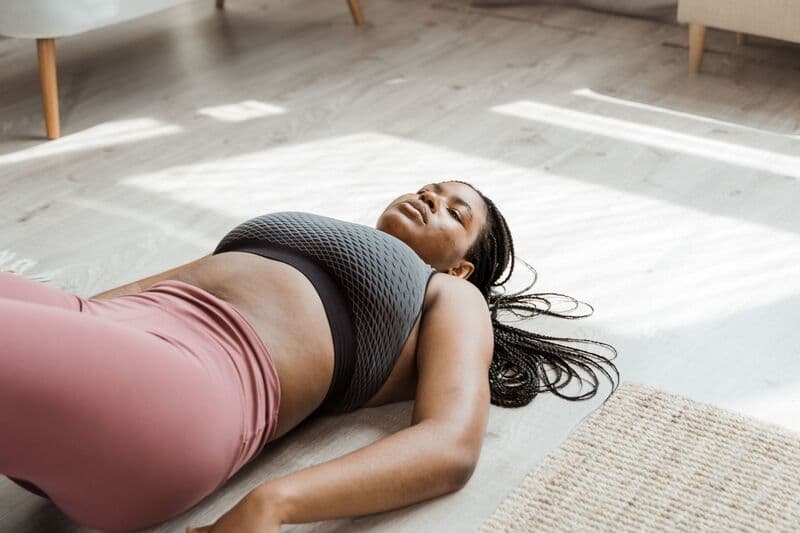
So why will you stop anyway at some point? For three much less dramatic reasons: they force you to lie on your back, they become uncomfortable as the belly grows, and they are ineffective for what you need now, which is pressure control and endurance, not trunk flexion strength. You stop because they are not needed, not because they are frightening.
Lying on your back: the data are less alarming than you think
Here we need a distinction that almost nobody makes, and it is the reason why this topic generates so much alarm.
The compression is real. In a cardiovascular MRI study, moving from the supine position to the left side at 32 weeks increased cardiac output by 24%, stroke volume by 35% and the left ventricular end-diastolic volume by 21%. It was a very small study, eight women in late pregnancy, but the physiology is not in question: the uterus presses on the inferior vena cava and venous return falls.
The body does, however, compensate. A second MRI study, on 12 women without symptoms and 10 with symptoms of supine hypotensive syndrome between weeks 34 and 38, measured the same sequence in both groups: less flow in the vena cava, less cardiac output, and more flow in the azygos vein as a compensatory circuit. The difference between those who felt unwell and those who did not was not the compression: it was how well that compensation worked. Those with symptoms had lower azygos flow. That is why the right rule is to listen to symptoms rather than look at the calendar.
And here is the logical leap that spoils everything. The data that frighten people most, those on supine position and birth weight, concern sleep, not exercise. An analysis of individual data from 4 case-control studies, on 1,760 women beyond 28 weeks, found that those who habitually went to sleep on their back (3.2%) had babies weighing 3,410 g versus 3,554 g on average after adjustment (a difference of 144 g, 95% CI -253 to -36) and a threefold risk of being small for gestational age according to the INTERGROWTH standard (adjusted OR 3.23, 95% CI 1.37 to 7.59), although with the customised standard the same increase was not statistically significant (1.63, 95% CI 0.77 to 3.44).
We are talking about hours of sleep, every night, in the last weeks: applying that figure to ninety seconds of exercise on your back is a category error. We covered the sleep topic in full in Sleeping in pregnancy: positions and what the studies say.
On exercise in the supine position, on the other hand, there is a dedicated systematic review: 7 studies, 1,759 women. In the three randomised trials, supervised programmes that included supine exercises were not associated with low birth weight. In the four observational studies there were no adverse maternal events, but abnormal foetal heart rate traces were recorded in 20 of 65 foetuses (31%) during a single supine session, and a 13% drop in uterine blood flow when moving from rest on the left side to dynamic supine exercise. The authors' conclusion is as honest as possible: the evidence is not sufficient to establish whether it is safe or whether it should be avoided.
The last piece is from 2025: 48 pregnant athletes performed a heavy strength protocol that included bench press, that is supine work. Foetal heart rate remained, before and after, within the normal range (110-160 bpm) and uterine artery pulsatility indices actually decreased; one woman had symptoms of vena cava compression and one foetus had bradycardia, which resolved within three minutes. In twelve cases in total a foetal tachycardia above 160 bpm was seen, never however at pathological levels. Not to be generalised, though: these were highly trained women, and the immediate effects were measured, not pregnancy outcomes.
Putting it all together: the 30 public health guidelines gathered in a review in the British Journal of Sports Medicine ask for some exercises to be modified, with the supine position cited precisely as an example, not eliminated, and they list persistent dizziness among the signs to stop the activity. The full picture, with the 150 minutes a week, is in Exercise in pregnancy: what is really safe.

What to really train: the transverse abdominis and breathing
With crunches out of the picture, what remains is the part that matters, and it is simpler than it seems.
The transverse abdominis is the deep layer that wraps the belly like a belt. It does not lift your torso: it regulates pressure. You train it like this: breathe out slowly through your mouth and, as the air leaves, let the belly gently draw inwards, as if you were fastening a belt one notch tighter. The belly should not harden or push outwards, and the ribs should not lock.
Breathing is the second half of the work: as the uterus rises the diaphragm loses space, and almost everyone ends up breathing only with the upper part of the chest. A breath that also expands sideways, into the ribs, restores coordination between the diaphragm, the deep abdomen and the pelvic floor, which are one single system, not three separate muscles.
And if you have to choose one thing to do, choose this. The Cochrane review of 46 studies and 10,832 women found that in continent women, pelvic floor training started during pregnancy probably reduces the risk of urinary leakage in the third trimester by 62% (RR 0.38, 95% CI 0.20 to 0.72) and leakage in the months after birth by 29% (RR 0.71, 95% CI 0.54 to 0.95, high-quality evidence). No abdominal exercise in pregnancy has numbers even remotely comparable. How to do it in practice is in Female pelvic floor: exercises and when they are needed.
Around this core, things work well in every trimester: quadruped work, anti-rotation and anti-extension exercises standing, asymmetrical carries, and an inclined plank on a raised surface for as long as it stays clean. But the rule for judging whether an exercise is fine today is not the list: it is the belly staying flat and the breath continuing.
Diastasis: how common it is and how to check it yourself
First thing, and it is there to ease anxiety: a separation of the abdominal muscles in pregnancy is normal. In the cohort of 300 first-time mothers that is the reference on the subject, diastasis was present in 33.1% already at 21 weeks, then in 60.0% at 6 weeks after birth, 45.4% at 6 months and 32.6% at 12 months. And at 12 months after birth, women with and without diastasis reported the same amount of lumbopelvic pain.
The check at home, if you want to do it, is this: lie on your back with your knees bent, place two or three fingers horizontally on the midline just above the navel and lift your head and shoulders slightly. Feel how many fingers fit into the gap and, above all, what the base is like: firm and elastic or soft. Repeat at the level of the navel and a few centimetres below. The threshold used in the research is two finger widths; European surgical guidelines refer to a separation greater than 2 cm, noting that the evidence on the topic is weak almost everywhere.
Two honest warnings. In pregnancy this measurement matters little, because a separation is an expected adaptation: it tells you your starting point, it does not diagnose anything. And palpating with your fingers is rough, with numbers that vary from one day to the next. The full postpartum route is in Abdominal diastasis: what really works.
As for the ridge that appears in the middle when you get up from bed, coning? It is a traffic light, not a diagnosis: it tells you that at that moment the pressure inside the abdomen exceeds what the wall contains. Change the lever, reduce the load, slow down. It does not tell you that you have hurt yourself.
Finally, on prevention, better not to promise anything: a review of 8 studies and 336 women calculated that prenatal exercise reduces the presence of diastasis by 35% (RR 0.65, 95% CI 0.46 to 0.92), but the authors themselves judge those studies to be of poor quality and conclude that non-specific exercise may or may not help. A signal, not a guarantee.
If you already trained
Here the evidence is the weakest of all, and the review of the 30 international guidelines says so explicitly: very few have anything to say to highly trained women. They are answering you with recommendations written for someone starting from zero.
What exists: a survey of 679 women who lifted at least 80% of their one-rep max during pregnancy. 71% kept doing exercises lying on their back; 66% reported no complications in pregnancy or childbirth, and 57% reported urinary leakage afterwards. According to the authors, the outcomes did not differ between those who did Olympic lifting, Valsalva or supine work and those who avoided them, and women who kept their training level until birth reported fewer reproductive complications than those who had stopped earlier. It is an online survey, with self-selection and recall after the fact: it should be read as an absence of alarm, not as proof of safety.
In practice: you do not stop, you adapt. Reduce the absolute load and keep the technical quality high, move supine exercises to an inclined bench or to standing, swap the Valsalva for an exhale on the effort, and use a flat belly and the breath as the criterion for admitting every set. There is a dedicated article on weights: Lifting weights in pregnancy: what you can really do.
What to really avoid
The real list is short, and none of these items is "abs":
- Holding your breath under effort. It is the most direct way to raise abdominal pressure against a wall already under tension.
- Staying on your back if you feel unwell. Dizziness, nausea, heart racing: turn onto your side, it is not a test of endurance.
- Full sit-ups and lifting both legs. Not because of a study against them, but because they have the worst ratio between pressure generated and usefulness.
- Ignoring the stop signals. Bleeding, fluid loss, regular and painful contractions, chest pain, dizziness that does not pass with rest, shortness of breath that persists even when still: you stop immediately and call the person following your pregnancy the same day, without waiting for the check-up already booked.
When you need a doctor first
There are situations where the first step is not an exercise programme:
- a hard or painful lump on the midline or around the navel that does not go back in when you lie down;
- sudden, severe abdominal pain, especially with nausea or vomiting: it needs to be assessed the same day, not at the next visit;
- a pregnancy with known contraindications to physical activity, which the person following you will already have indicated;
- urinary leakage or a feeling of vaginal heaviness that appears or gets worse: these are not to be put up with, they are to be assessed.
The rest, such as lower back discomfort, a tight belly or breathlessness on a slope, is material for adaptation, not for stopping. On back pain, the number one reason people look for core exercises in pregnancy, the real figures are in Back pain in pregnancy: causes, remedies and safe exercises.
What a physiotherapist can do
Almost everything needed here is not therapy: it is someone watching you while you do it. The transverse abdominis and breathing are hard to learn from a video, because the difference between doing them well and badly lies in details you cannot see from inside: the belly swelling instead of drawing in, the ribs locking, the downward push instead of the inward draw.
It works well by video call, because the real work is yours, done at home, a few minutes a day for months. With us you start with a free first consultation of twenty minutes: you show us what you are already doing, we look at it together and tell you what to change from tomorrow. Later sessions cost 29,90 €. And if something appears that needs to be looked at in person, we tell you straight away instead of letting you lose weeks.
Sources
- 2019 Canadian guideline for physical activity throughout pregnancy, British Journal of Sports Medicine, 2018
- Public health guidelines for physical activity during pregnancy from around the world: a scoping review, British Journal of Sports Medicine, 2023
- Is supine exercise associated with adverse maternal and fetal outcomes? A systematic review, British Journal of Sports Medicine, 2019
- Pelvic floor muscle training for preventing and treating urinary and faecal incontinence in antenatal and postnatal women, Cochrane Database of Systematic Reviews, 2020
- Effects of exercise on diastasis of the rectus abdominis muscle in the antenatal and postnatal periods: a systematic review, Physiotherapy, 2014
- Curl-up exercises improve abdominal muscle strength without worsening inter-recti distance in women with diastasis recti abdominis postpartum: a randomised controlled trial, Journal of Physiotherapy, 2023
- Behavior of the Linea Alba During a Curl-up Task in Diastasis Rectus Abdominis: An Observational Study, Journal of Orthopaedic & Sports Physical Therapy, 2016
- Diastasis recti abdominis during pregnancy and 12 months after childbirth: prevalence, risk factors and report of lumbopelvic pain, British Journal of Sports Medicine, 2016
- European Hernia Society guidelines on management of rectus diastasis, British Journal of Surgery, 2021
- Quantitative cardiovascular magnetic resonance in pregnant women: cross-sectional analysis of physiological parameters throughout pregnancy and the impact of the supine position, Journal of Cardiovascular Magnetic Resonance, 2011
- Hemodynamic changes in women with symptoms of supine hypotensive syndrome, Acta Obstetricia et Gynecologica Scandinavica, 2020
- Association of Supine Going-to-Sleep Position in Late Pregnancy With Reduced Birth Weight, JAMA Network Open, 2019
- Pushing limits: the acute effects of a heavy-load resistance protocol and supine exercise on fetal well-being, BMJ Open Sport & Exercise Medicine, 2025
- Impact of heavy resistance training on pregnancy and postpartum health outcomes, International Urogynecology Journal, 2023
Sources last checked: September 2026.