Knee arthroscopy recovery: you left the operating theatre with two small plasters, a swollen knee and a sheet of instructions written in a hurry. This guide explains what happens in the weeks that follow, which exercises make sense, which warning signs should not be postponed and, a point almost nobody addresses, what the research really says about the results of this operation.
Recovery after arthroscopy is not a single thing: very different procedures fall under the same name. Removing a piece of meniscus, stitching it, treating a cartilage defect or removing a loose fragment are operations that ask different things of the knee, and therefore require different timescales.
⚠ Important: read this before continuing
The exercises and advice in this article are general guidance and may not suit your situation. Every person has a unique clinical history: what works for others could be counterproductive for you.
Want a professional's opinion? Start with the questionnaire: you sign up and see who will follow you, a physiotherapist registered with the Albo chosen for your case, whom you can write to in chat. If you would rather hear a voice first, the first consultation is free and we look at your situation together.
The signs that cannot wait
We put these at the top, not at the bottom, because they are the only part of this article with a deadline. Call your surgeon or your doctor if you notice:
- fever above 38 °C in the days after the operation;
- wounds that are red, hot, swollen or discharging heavily or with a foul smell;
- pain that gets worse day after day instead of easing;
- the knee locking suddenly and no longer straightening.
And go to the emergency department, without waiting for the follow-up appointment, if you have a swollen, hard, hot or painful calf, especially if sudden breathlessness or chest pain appears: this is how a deep vein thrombosis presents, which can travel to the lung.
The other side of the coin should also be stated, so as not to frighten anyone needlessly: these events are rare. The Cochrane review on preventing thromboembolism after knee arthroscopy gathered eight studies involving 3,818 adults without a previous thromboembolic event, in which some participants received a preventive drug or stocking and some did not, and it counted seven cases of pulmonary embolism in total, with no deaths in any of the groups. Rare does not mean impossible: it means it is worth knowing the symptoms and then stopping worrying about it.
What knee arthroscopy is
It is a minimally invasive technique: through two or three small incisions the surgeon introduces a camera and instruments, and works while looking at a screen. Compared with open surgery it involves less pain, minimal scarring and a quicker recovery. The operation usually lasts a few tens of minutes and can be performed under local, spinal or general anaesthesia depending on the case and the practice of the centre.
The most frequent indications are partial meniscectomy (removal of the damaged portion of meniscus), meniscal repair, treatment of cartilage defects and removal of loose bodies or a symptomatic plica.

The awkward question: was that operation necessary?
This is where most guides on recovery after arthroscopy skirt around the issue. We will not, because it is the information that changes your expectations the most.
On degenerative meniscal tears (those that appear with the years, without a specific trauma, typical from around 35-40 onwards) the literature is among the most solid in orthopaedics, and it is uncomfortable. The Finnish FIDELITY study randomly assigned 146 people aged 35 to 65, with symptoms from a degenerative tear of the medial meniscus and without knee osteoarthritis, to either partial arthroscopic meniscectomy or a sham operation: same operating room, same incisions, same diagnostic arthroscopy, but in the control group the meniscus was not touched. At twelve months there was no significant difference between the two groups in any of the three main outcomes: Lysholm score, WOMET score and pain after exercise.
A second Norwegian randomised study compared arthroscopy with twelve weeks of supervised exercise in 140 adults (mean age 49.5 years) with a degenerative medial meniscal tear documented on MRI: at two years the difference on the KOOS4 functional score was 0.9 points, which is clinically irrelevant, while at three months thigh strength had improved more in the group that did exercise. In 2017 an international guideline published in the BMJ went as far as recommending against arthroscopy in nearly all patients with knee degeneration.
But the story does not end there, and it is right to tell it in full. In the same Norwegian study, 19% of participants assigned to exercise nonetheless went on to surgery within two years, although, the authors note, with no additional benefit. A German systematic review of six randomised studies on non-traumatic meniscal lesions found results that overlapped between meniscectomy and control treatment (physiotherapy, arthroscopic lavage or cortisone) in five of the six studies, and in the sixth, to be honest, those who had been operated on reported significantly less pain and fewer symptoms. In three of the included studies, moreover, 21-30% of patients in the physiotherapy arm improved only after switching to meniscectomy. In other words, there is a minority of people for whom the conservative pathway is not enough and the operation resolves the problem. The difficulty today is that we cannot recognise them in advance.
And above all: these data concern degenerative meniscus tears, not all of them. A traumatic tear in a young person, a knee that genuinely locks, a root tear of the meniscus or a free fragment that gets caught are different situations, in which arthroscopy continues to have a clear role. If you are unsure which applies to you, our article on symptoms and diagnosis of a meniscal tear can help you place it.
How to use this information in practice
It does not serve to regret a choice already made; it serves two very concrete purposes.
If you have already been operated on and, weeks later, the knee is not what you hoped for, this does not automatically mean that you got the rehabilitation wrong or that something went wrong. On a degenerative meniscus the operation itself may simply not have been the decisive lever. The levers that remain to you (strength, mobility, progressive loading, managing weight and activities) are the ones worth investing in, and they are the same ones that, in the studies, held their own against surgery.
If you have not had the operation yet, know that a supervised exercise programme is not a fallback for those afraid of the scalpel: in randomised studies it reaches the same results at two years, with in addition a gain in strength in the short term. Trying it first does not close any door.
What changes recovery: the procedure, not the name
Partial meniscectomy. This is the quickest recovery: tissue is removed and there is nothing that has to heal, so loading is usually allowed straight away, "as tolerated", and the return to normal activities is measured in weeks.
Meniscal repair. Here the tissue has to heal, and biology cannot be accelerated by good will: you think in months, with initial restrictions on loading and deep flexion. On this point a systematic review went through studies of restrictive protocols (limited loading) and accelerated ones (immediate loading and early mobility), with at least two years of follow-up, finding good or excellent clinical results in both cases, from 70 to 94% with the conservative protocol and from 64 to 96% with the accelerated one, although they could not be compared directly, because of the heterogeneity of surgical techniques and of the criteria used. Put simply: there is no single "right" protocol; there is the one your surgeon chose for your repair, and it needs to be followed.
Treatment of cartilage defects (for example microfracture). This is the longest pathway, because the repair tissue has to be protected while it matures: limited loading for weeks and a return to sport pushed much further out.
Loose bodies and plica. Quick recovery, similar to that of partial meniscectomy.
The week counts you find in timetables on recovery after knee arthroscopy around the web are averages of different protocols: use them to grasp the order of magnitude, not to judge whether you are "behind".
The first days after knee arthroscopy
Pain. Usually mild to moderate, manageable with the prescribed medication.
Swelling. It is normal, not a failure: it can stay with you for a couple of weeks and tends to worsen on the days when you walk more. If you want to understand how to manage it without chasing it, we have written a dedicated guide to post-operative oedema.
Wounds. They need to be kept clean and dry until the check-up.
Movement. You start straight away, with small and frequent movements: the knee hates staying still.
Loading. As indicated by the surgeon, which depends on the procedure and not on how you feel at the moment.
The phases of rehabilitation
Days 1-3
Ice at short intervals, several times a day, compression and elevation of the limb to contain the swelling. Ankle pumps and quadriceps contractions several times a day. Walking with crutches if indicated.
Days 4-7
Work on mobility: heel slides, active flexion and extension within the limits allowed. Straight leg raises and isometrics are added. Walking progresses towards full loading, if the protocol allows it.
Weeks 1-2
The priority is full extension: a knee that does not straighten completely alters the gait and causes further loss of quadriceps strength. For strengthening, mini squats and low step-ups are introduced. After a partial meniscectomy, crutches are usually dropped at this stage.
Weeks 2-4
Progressive strengthening (squats within the permitted range, leg press, stationary cycling), balance and proprioception exercises, gradual return to full daily activities.
From one month onwards
For simpler procedures you start thinking about the return to sport, if the strength and control criteria are met, not because enough time has passed on the calendar. For repairs and cartilage work this is instead the phase of advanced strengthening, with the sporting movement still far off.
An important point: before trying these exercises, make sure you have received a correct diagnosis. People often assume they have one problem, when the real cause of the pain is another. Doing the wrong exercises can make the situation worse rather than better.
The exercises, one by one
A common starting point is 3 sets of 10 repetitions for the strengthening exercises, increasing only when the knee responds well the next day.
Ankle pumps. They can be done straight away, even in bed: move the ankle up and down, often during the day. They help circulation.
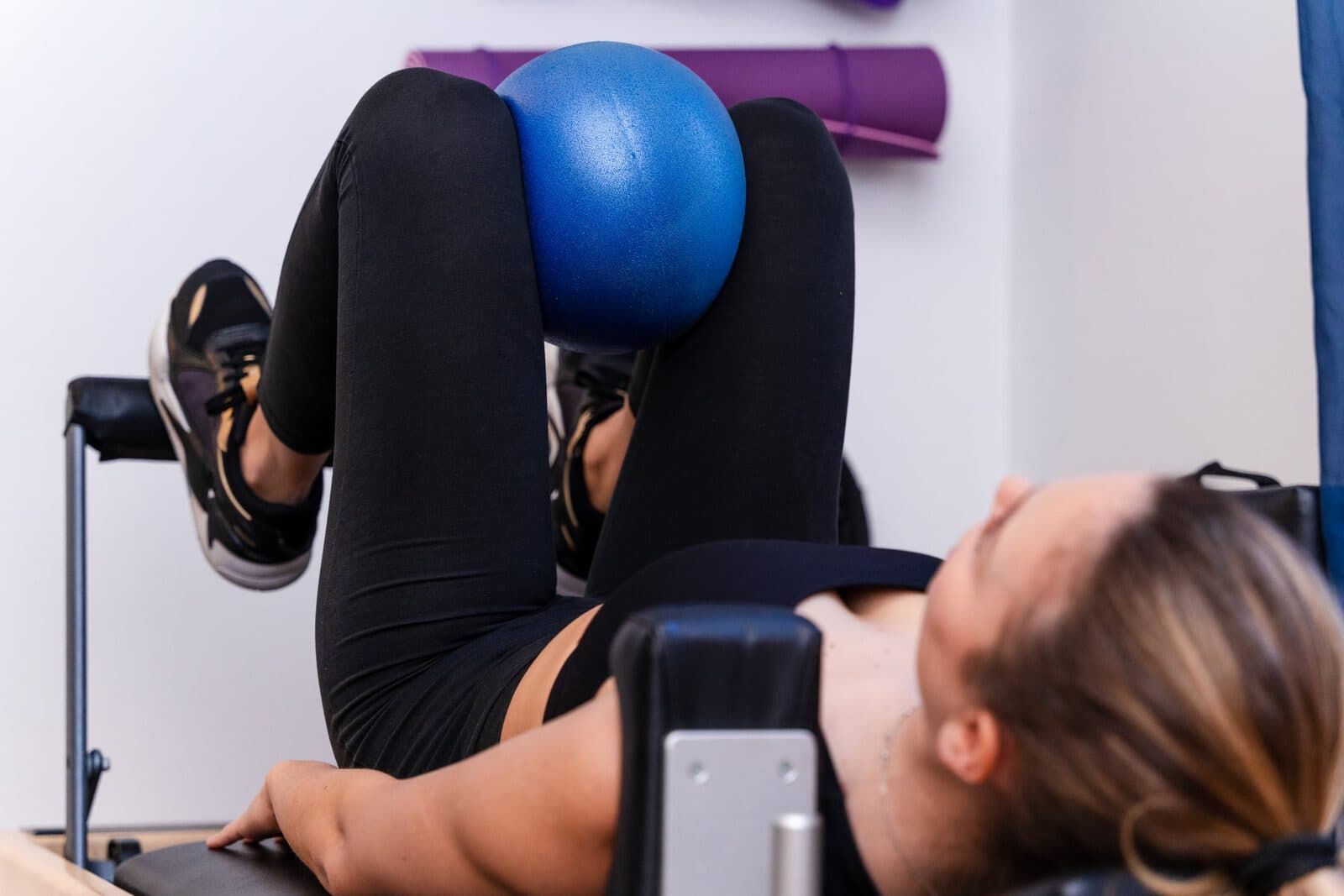
Isometric quadriceps contractions. Leg straight, tighten the thigh by pressing the knee towards the bed and hold the contraction for a few seconds. Repeat in short sets several times a day: this is the exercise that slows the loss of strength.
Heel slides. Lying down, slide the heel towards the buttock as far as the knee allows, then return. It recovers flexion without forcing.
Straight leg raise. Leg straight, quadriceps contracted, lift the limb about ten centimetres and lower it slowly. If the knee "gives way" in extension while you lift, you are still too early: go back to the isometrics.
Mini squats. When loading is permitted. Standing, a reduced bend, weight distributed on both feet.
Step-ups. On a low step, going up with the operated leg and controlling the descent. The slow descent is the part that really trains.
Stationary cycling. When flexion allows it, with a high saddle and minimal resistance. It is the gentlest way to regain mobility and stamina.
The quadriceps: where recovery is really lost
If there is one reason to take rehabilitation after knee arthroscopy seriously, this is it. A systematic review of four studies measured quadriceps strength after arthroscopic partial meniscectomy, comparing the operated limb with the healthy one: in the first month the gap is marked in all the studies; between one and six months it remains present, but with a size that varies a great deal from study to study; and it shrinks to weak differences only beyond six months. It should be said that the effect was clear-cut in only 65% of the data: it is a solid trend in direction, less precise in magnitude.
The paradox lies entirely there: after a partial meniscectomy you are walking and working again within a few weeks, and at that point almost everyone stops the exercises, while the thigh is still behind. The authors stress that a prolonged quadriceps weakness can contribute to the risk of joint degeneration over time, because it is the quadriceps that absorbs the loads reaching the knee. Feeling well is not the same as being strong.
Advice for an orderly recovery
Follow your protocol, not your brother-in-law's. Each procedure has different constraints, and the limits on loading after a repair are not an excess of caution.
Use ice when needed. It helps keep pain and swelling under control in the early phases.
Do not stop as soon as you stop feeling pain. It is the most common mistake, and the research on the quadriceps explains why.
Do not overdo it in the opposite direction either. A knee that is more swollen and warm the day after training is a message: you asked for too much, so reduce and try again.
Keep the leg raised when you rest, in the first days, to drain the swelling.
If after months the knee is not coming along
It happens, and a recovery after knee arthroscopy that stalls months later is one of the situations in which it is worth being reassessed, rather than repeating the same programme endlessly. There are three questions to bring to the professional: is extension really complete? Has quadriceps strength been measured, rather than estimated by eye? And is the pain I have now the same as the pain I had before the operation? If the answer to the last question is yes, and the tear was degenerative, the picture needs rereading, perhaps in the direction of an arthritic knee, for which different pathways exist, as explained in the guide on what to do about knee osteoarthritis.
Ri-Hub: support in recovery
If you have had a knee arthroscopy, Ri-Hub offers telerehabilitation with physiotherapists registered with the Albo. We guide you with exercises calibrated to your operation and your protocol, with periodic checks on your progress, especially on strength, which is the part that is lost in silence. If you are looking for a more specific pathway on the meniscus, you will also find our guide to meniscus rehabilitation.
If you have been given crutches and nobody explained how to use them, read How to walk with crutches.
Sources
- Arthroscopic partial meniscectomy versus sham surgery for a degenerative meniscal tear - New England Journal of Medicine, 2013
- Exercise therapy versus arthroscopic partial meniscectomy for degenerative meniscal tear in middle aged patients: randomised controlled trial with two year follow-up - BMJ, 2016
- Arthroscopic surgery for degenerative knee arthritis and meniscal tears: a clinical practice guideline - BMJ, 2017
- The Treatment of Non-Traumatic Meniscus Lesions - Deutsches Ärzteblatt International, 2015
- Effects of arthroscopic partial meniscectomy on quadriceps strength: a systematic review - Journal of Sport Rehabilitation, 2012
- Weightbearing Versus Nonweightbearing After Meniscus Repair - Sports Health, 2015
- Interventions for preventing venous thromboembolism in adults undergoing knee arthroscopy - Cochrane Database of Systematic Reviews, 2022
Last check of the sources: August 2026.
You might also like:
Stay in touch with us
Join our dedicated Facebook group: we answer all patients, give practical advice and clear up the most common doubts.
Need a consultation?
Start with the Ri-Hub questionnaire, a few questions about your case, you sign up, and you see who will follow you: a physiotherapist registered with the Albo, whom you can write to in chat whenever you like. If you prefer to talk it through, the first consultation is free, lasts 20 minutes and commits you to nothing: they arrive having already read what you wrote, and together you decide whether and how to go on.