A groin pain that appears when you sit for a long time, get into a car or squat. Many people point to it instinctively with the C-shaped hand around the hip, a gesture so common in clinic that it has a name.
It is often the picture of femoroacetabular impingement, or FAI as it is known in English.
What happens in the hip
The hip is a ball-and-socket joint: the head of the femur rotates inside the acetabulum, the cavity of the pelvis. In femoroacetabular impingement the two surfaces come into contact in an abnormal way during movement, especially when the hip flexes and rotates inward.
Three forms are described:
- cam: the head of the femur is not perfectly spherical and "rises" against the rim;
- pincer: the acetabulum covers the head excessively;
- mixed, which is the most frequent.
Repeated contact can irritate the labrum, the ring of fibrocartilage around the socket, and the cartilage.
How it presents
- pain in the groin, sometimes also on the side or in the buttock;
- worse in deep flexion: low seating, cars, squatting;
- worse in sports with changes of direction;
- stiffness in internal rotation of the hip;
- sometimes clicking or catching, if the labrum is involved.
One study has described the physical and functional limitations observed in these people: loss of internal rotation is one of the most consistent findings, and also one of the targets of the work.

A note on imaging
Having a cam or pincer morphology does not mean having a disease. These shapes are also found in many people with no symptoms at all, and they are particularly common in those who did high-impact sport while growing.
The general principle therefore applies: the finding is not the diagnosis. It needs to be read together with the clinical picture, otherwise you end up treating an X-ray instead of a person.
Surgery or not: what the studies say
It is the question that almost always comes up, and the literature offers a direct comparison.
A 2022 systematic review compared conservative with surgical management in femoroacetabular impingement. A 2021 comparative study looked at hip arthroscopy versus conservative therapy.
The practical message is this: surgery has a role, but it is not the first step, and the comparison only makes sense after a conservative route has been followed seriously, that is structured and carried on for the time it needs, not two weeks of generic exercises.
What the conservative route includes
Managing the positions that provoke the impingement. In the irritated phase, deep flexion and internal rotation combined are reduced: very deep squats, low seating, aggressive stretching in that direction. It is temporary, not forever.
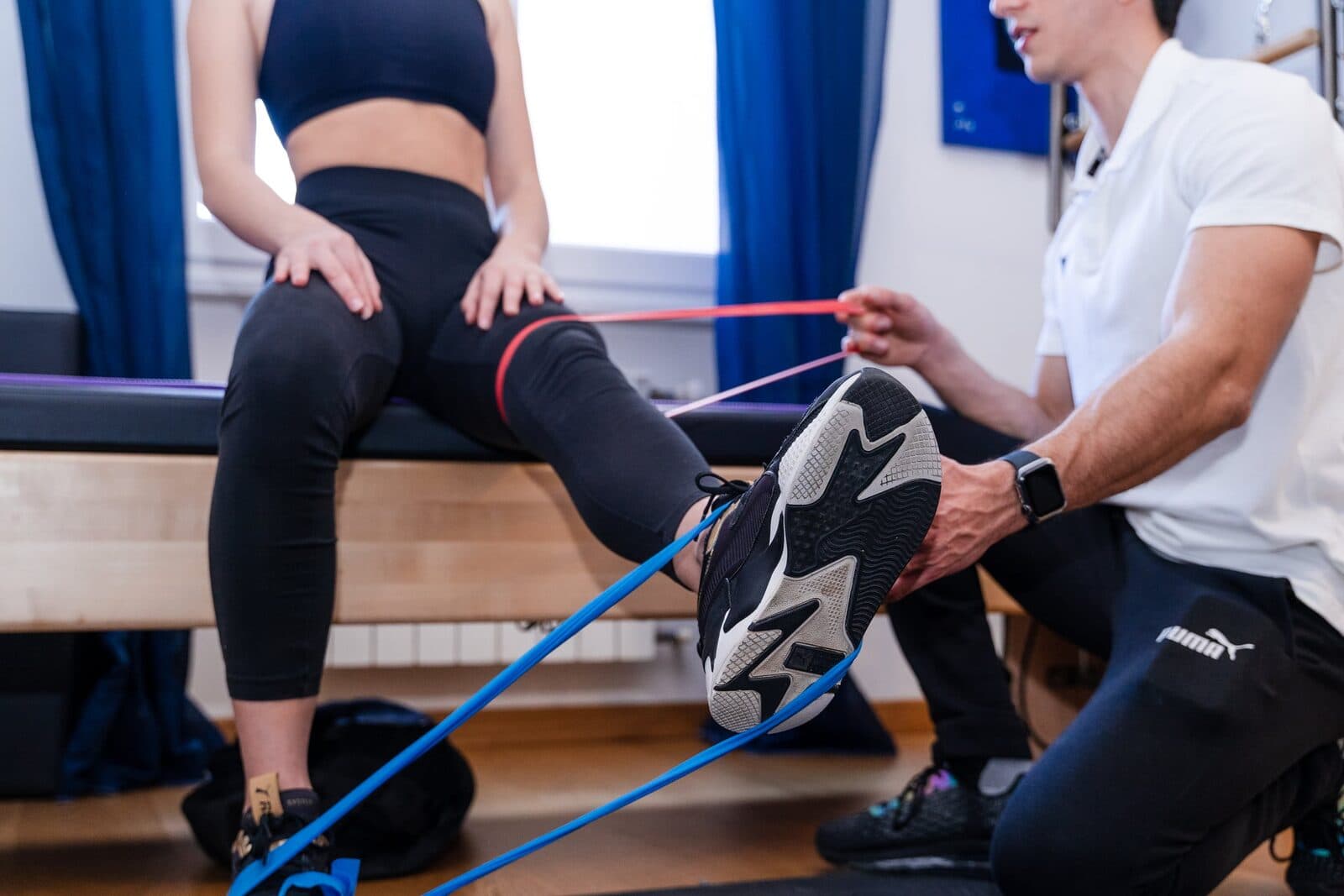
Strengthening the glutes and the deep muscles of the hip. This is the core of the work: a hip that is better controlled reduces the abnormal contact during movement.
Working on the control of movement of the hip and pelvis. A systematic review with meta-analysis examined lower limb biomechanics in this syndrome, and it is the rationale for this part of the programme.
Adapting sport instead of stopping it. Changing range, loads and specific movements keeps load capacity. Stopping altogether reduces it, and makes the return more difficult.
Being followed
Femoroacetabular impingement is one of the conditions where the difference between a conservative route done well and one improvised also changes the decision about surgery.
With Ri-Hub the first consultation is free: a physiotherapist on the Italian professional register assesses mobility and control of the hip, sets the strengthening programme and helps you understand which movements are feeding the symptom. Follow-up sessions cost 29,90€.
If the pain is more in the groin than in the hip, also see Groin pain: causes, symptoms and how to resolve it.
If you are an athlete and the pain appears during changes of direction, the chapter is Sports hernia: exercises and complete guide.
If the pain is on the side of the hip and not in the groin, the picture is different: Trochanteric bursitis.
Sources
- Conservative vs. Surgical Management for Femoro-Acetabular Impingement: A Systematic Review of Clinical Evidence (Journal of clinical medicine, 2022)
- Arthroscopic Hip Surgery versus Conservative Therapy on Femoroacetabular Impingement Syndrome: A Meta-Analysis of RCTs (Orthopaedic surgery, 2021)
- Physical impairments and activity limitations in people with femoroacetabular impingement: a systematic review (British journal of sports medicine, 2015)
- Lower limb biomechanics in femoroacetabular impingement syndrome: a systematic review and meta-analysis (British journal of sports medicine, 2018)
Last source check: September 2026.