The lunge is one of the few exercises that trains one leg at a time, and that is why it is worth keeping even when squats are already in your programme.
It can be done bodyweight or loaded, at home or in the gym, and it adapts to any level. Here you will find the technique, the variations in order of difficulty and the four mistakes that make it uncomfortable instead of useful.
⚠ Important: read this before continuing
The exercises and advice in this article are general guidance and may not suit your situation. Every person has a unique clinical history: what works for others could be counterproductive for you.
Want a professional's opinion? Start from the questionnaire: you sign up and see who will follow you, a physiotherapist registered with the Register chosen for your case, whom you can write to in chat. If you would rather hear their voice, the first consultation is free and we look at your situation together.
What it is
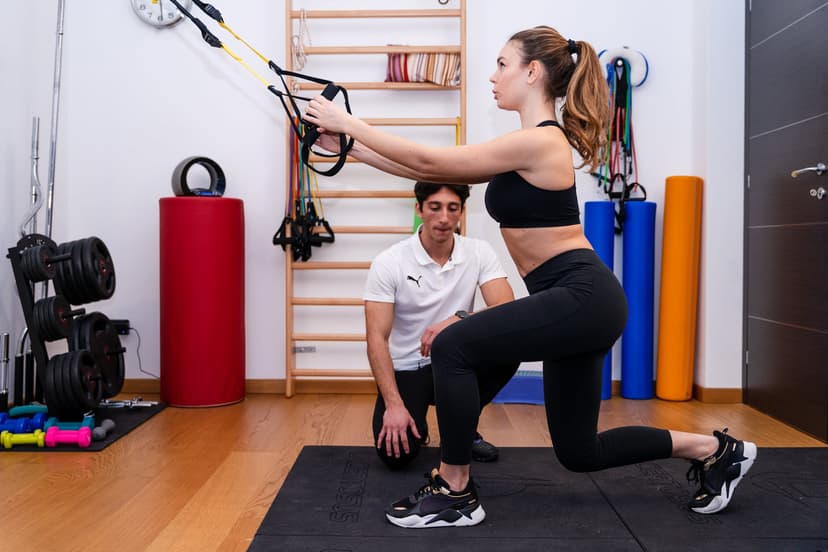
A step forward or backward, with both knees bending and the front leg bearing most of the weight. It is the movement that most resembles what the body does when walking and running: landing on one leg, with the other balancing.
It can be static, staying in place, or walking. There are front, reverse and lateral versions, which are not equivalent to one another.
Which muscles it works
The quadriceps and gluteus maximus do most of the work, and the glute is especially active on the way up. If the movement you are interested in is hip hinging with a still back, that has a name and a technique of its own: the hip hinge. The hamstrings stabilise the knee, the adductors and abductors maintain alignment, and the trunk works to stop you swaying.
This last part is the added value over the squat: on one leg, the pelvis has to control itself.
What it is for
Strength on one leg. In a squat the stronger leg compensates for the weaker one without you noticing; here it cannot. If instead you are looking for the movement that loads the glute more than any other, it is the hip thrust. It is the most direct way to uncover and reduce an asymmetry.
Balance and pelvic control, which carry over to walking, running and changes of direction.
Knee stability, for the simple reason that progressive loading improves a joint's tolerance: what handles more load hurts less.
An important point: before trying these exercises, make sure you have received a correct diagnosis. People often think they have one problem when the real cause of the pain is something else. Doing the wrong exercises can make things worse rather than better.
How to do it
Standing, feet at hip width. Step forward and lower by bending both knees, until the rear knee nearly touches the floor. Torso upright. Push through the front foot to come back up, and alternate.
A note on the most repeated rule of all, the one that says the knee must never go past the toes. Stopping the knee from moving forward reduces the load on the knee but shifts it, and to a greater extent, onto the hip and lower back: a study on the barbell squat that compared the two executions shows this. A knee that moves forward a little is not a mistake: in people with long femurs it is anatomically unavoidable. The real mistake is another one, and it is in the list below.
The variations, in order
Reverse (step backwards): the best tolerated by people with a sensitive knee, because the impact is lower and control is greater. This is where it is best to start.
Front: more demanding on deceleration.
Lateral: shifts the work onto the adductors and abductors, and is useful for people who play sports with changes of direction.
Walking: adds continuity and breathing demand.
Deficit (front foot raised): increases the range, and is only worth it once the basic version is easy.
Jumping: explosive and advanced, to be kept for last.
Advanced variations
When the basic versions are easy.
Bulgarian split squat (back foot on a bench): the most demanding of all, because it concentrates almost all the load on the front leg. It is also the best for working on an asymmetry.
With trunk rotation towards the front leg at the bottom of the movement: adds work for the obliques and a little thoracic mobility.
Jumping, already mentioned above, remains the last step.
The lunge as mobility
The low position of the lunge is also one of the best stretches for the hip flexors of the back leg: hold it for 20-30 seconds instead of standing up straight away.
From there, adding trunk rotation and the arm reaching up, you arrive at the world's greatest stretch, which combines hip and thoracic rotation in one movement; lowering onto the forearms instead leads to the lizard pose.
It should be said, however, what not to expect: the idea that stretching the hip flexors corrects pelvic alignment and removes back pain is far more popular than it is proven. Do it for the range of motion, which is already a good reason.
Load
Dumbbells at the sides: the simplest progression, and the one that adds load without complicating balance.
Kettlebell held at the chest (goblet): demands more work from the trunk and keeps the torso more upright.
Barbell on the shoulders: requires a technique that is already solid and a balance on a single support that not everyone has. The front rack (barbell at the front) and overhead (weight above the head) versions demand much more from the trunk and shoulders, and only make sense if those qualities are already there.
In every case the load goes up when the last two repetitions are hard but the technique holds, not before.
The four mistakes
The knee collapsing inwards. This one does matter: the knee must follow the direction of the foot. It is almost always a problem of glute strength rather than attention, and the exercise that loads them most specifically is the monster walk with a band.
A step that is too short, which forces the knee into a closed angle and concentrates all the load there.
Pushing with the back foot instead of the front one: it shifts the work onto the wrong leg and cancels the point of the exercise.
The torso collapsing forward, which generally means excessive load or a weak trunk.
Where to put it
On leg day or in a full-body session: three sets of 10-12 per leg. Done bodyweight it also works as a dynamic warm-up.
Combined with the squat, the work is complete: the squat loads more, the lunge uncovers the asymmetries that the squat hides. And if you are wondering whether squats harm the back, the measured answer is in do squats hurt your back?; for step-by-step technique there is correct squat.
In short
Start with the bodyweight reverse lunge, make sure the knee does not collapse inwards, and add load when the technique holds. And you do not need to keep the knee behind the toes: you need to keep it aligned. If you want someone to watch how you do it, the physiotherapists at Ri-Hub do this by video call.
Sources
- Effect of knee position on hip and knee torques during the barbell squat, J Strength Cond Res, 2003
- The Resistance Training Dose Response: Meta-Regressions Exploring the Effects of Weekly Volume and Frequency on Muscle Hypertrophy and Strength Gains, Sports Med, 2026
- Exercise for osteoarthritis of the knee, Cochrane Database Syst Rev, 2024
Sources last checked: September 2026.
You might also like:
Ergonomia Ufficio: Guida Completa per una Postazione di Lavoro Salutare Scoliosi Adulti Esercizi: Programma Completo per la Postura Periartrite Spalla: Cos'è, Sintomi, Cause e Come Curarla Definitivamente
Stay in touch with us Join our dedicated Facebook group: we answer all patients, give practical advice and clarify the most common doubts.
Need a consultation?
Start from the Ri-Hub questionnaire: a few questions about your case, you sign up, and you see who will follow you: a physiotherapist registered with the Register, whom you can write to in chat whenever you like. If you prefer to talk it through by voice, the first consultation is free, lasts twenty minutes and commits you to nothing: they arrive having already read what you wrote, and together you decide whether and how to continue.