
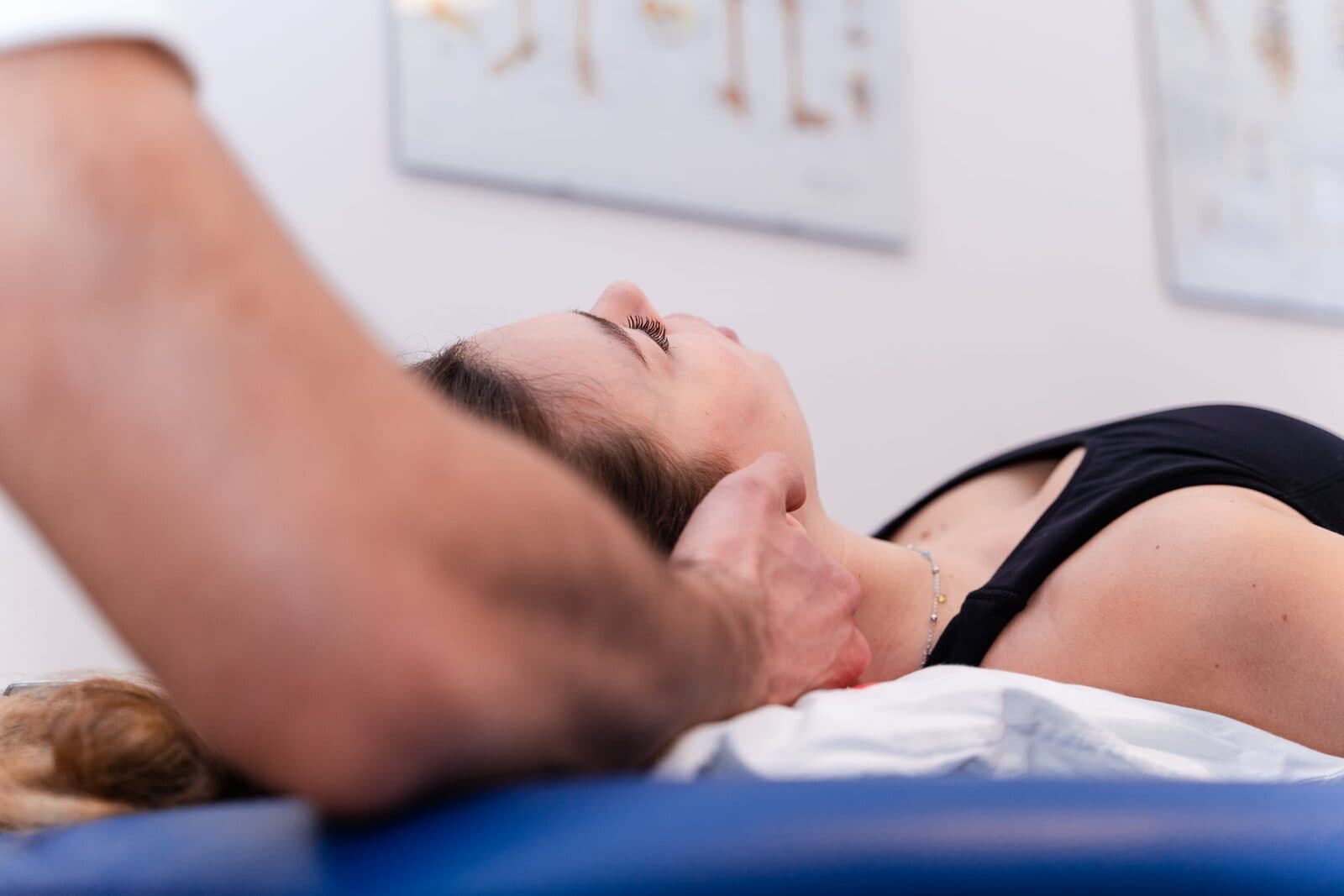
Office neck stretches: it is one of the most frequent searches from people who spend eight hours in front of a monitor and by the end of the day feel their neck like a board. Desk exercises are useful, and you will find all of them below, but it is worth starting with an honest clarification that almost nobody makes.
The idea that stretching the neck prevents and cures neck pain is much more popular than it is proven. The Cochrane review of exercise for mechanical neck disorders, when it isolates stretching used on its own, reports low-quality evidence suggesting that it may change neither pain nor function. It is exactly what we all do when the neck pulls, and it is probably the least effective if it remains the only thing done.
This does not mean that stretching at your desk is useless: it means it should be used for what it is, a break from staying still and an immediate relief, and alongside it should go the work that the evidence really supports. In this guide you will find 9 office neck stretches to do while seated, what the literature says about each of the promises that usually accompany these articles, and the signs that call for an assessment rather than a routine.
⚠ Important: read this first before going on
The exercises and advice in this article are general guidance and may not suit your situation. Everyone has a unique clinical history: what works for others could be counterproductive for you.
Want a professional's opinion? Start with the questionnaire: you register and see who will follow you, a physiotherapist on the official register chosen for your case, whom you write to in chat. If you would rather hear their voice first, the first consultation is free and we look at your situation together.
First of all: when it is not a question of the desk
In the great majority of cases, a neck that pulls after a day at the computer is a mechanical and benign problem. There are, however, situations in which the symptom should be handled with an assessment rather than a routine of exercises. Stop and ask for an opinion, without waiting for it to pass, if you notice:
- Real weakness in an arm or hand, not just pain: your grip gives way, you cannot lift what you used to lift.
- Persistent tingling or numbness following a specific path down the arm to particular fingers.
- Difficulty walking, an unsteady gait, loss of balance, or loss of dexterity in the hands (struggling to do up buttons, turn a key, write).
- Problems controlling the bladder or bowel.
- Pain that started after a trauma: a fall, a road accident, a direct blow.
- Pain accompanied by fever, unexplained weight loss, or a history of cancer or immunodeficiency.
- Pain that never changes in any position and wakes you regularly at night.
- An unusual headache in intensity or in its sudden onset, different from the ones you know.
None of these pictures improves because you stretch your trapezius at lunchtime, and some get worse if time is lost. The physiotherapy guidelines dedicated to neck pain, updated in 2017, place precisely the screening for these pictures before any treatment choice.
What the evidence really says
The neck is a heavily studied region, and the results are not what you would expect from reading the web.
Stretching alone is the weak part. The Cochrane review of exercises for mechanical neck disorders included 27 randomised studies, with 2,485 participants analysed out of 3,005 randomised. For chronic neck pain there is evidence of moderate quality in favour of strengthening the neck, shoulder blades and upper limb, with an effect on pain from moderate to large immediately after treatment (SMD −0.71; 95% CI −1.33 to −0.10). Programmes that combine strengthening and stretching show a small to large benefit on pain (SMD −0.33; 95% CI −0.55 to −0.10), maintained in the long term. For stretching in isolation, on the other hand, the evidence is of low quality and suggests that it may not change pain or function. For acute neck pain no evidence was found. The same authors close with a warning that is right to report: no high-quality evidence was found, and uncertainty remains about the effectiveness of exercise for the neck.
There is, however, one study that points in the opposite direction, and it is fair to cite it. A randomised study conducted on 96 office workers with moderate to severe neck pain (at least 5 out of 10) present for at least three months gave everyone a leaflet with ergonomic advice, and an additional group a programme of neck and shoulder stretching, twice a day, five days a week, for four weeks. At the end of the study the group that stretched had a greater improvement: 1.4 points less on the visual analogue pain scale (95% CI −2.2 to −0.7), 4.8 points less on the Northwick Park questionnaire and 14 points more on the physical dimension of the SF-36 questionnaire. Those who did the exercises at least three times a week improved significantly more on function and quality of life than those who did them less often.
How do these two things fit together? Like this: a structured and repeated stretching programme, in people who already have chronic pain, adds something to ergonomic advice alone, but we are talking about 1.4 points on a scale from 0 to 10. It is a real and measurable help, not a cure, and it concerns a routine followed consistently for weeks, not the thirty seconds we give ourselves when we notice the neck hurts.
On prevention there is an encouraging finding, with reservations. A systematic review with meta-analysis from 2023 gathered 5 randomised studies involving 1,722 participants with no neck pain at the start, 80% of whom were office workers: with moderate certainty, exercise interventions probably reduce the risk of a new episode of neck pain within 12 months (OR 0.49; 95% CI 0.31 to 0.76) compared with no intervention or a minimal one. The authors specify, however, two limitations: the result did not hold up in sensitivity analyses for missing data, and the clinical relevance of the effect remains unclear. Three of the five studies had a high risk of bias.
Strengthening also holds up in office workers. A 2024 meta-analysis specifically on office workers with chronic neck pain included 8 randomised studies: strengthening the muscles of the neck, shoulders and shoulder blades reduces pain and disability in a statistically significant way. Here too, however, honesty requires saying the rest: all eight studies had a high risk of bias and the overall certainty of the evidence was judged to be low.
The practical summary for those who work at a computer is this: stretching the neck at the office is a good habit and gives relief, but if your neck has been hurting for weeks, the lever with the best evidence is strengthening, not stretching. If the pain has been with you for months, it is also worth reading how to manage neck pain that won't go away.

And posture? It is the weakest link in the reasoning
The typical article on this topic starts from an assumption taken for granted: the head forward at the monitor pulls on the muscles, the muscles tire, pain arises. It is a coherent story, but research has not confirmed it.
A systematic review with meta-analysis gathered 15 cross-sectional studies on forward head posture. In the 10 studies comparing people with neck pain and people without symptoms, adults with pain showed on average a more forward head (mean difference 4.84; 95% CI 0.14 to 9.54, so just short of non-significance). In 8 studies significant correlations emerged between posture and pain intensity (r = −0.55) and disability (r = −0.42) in adults and older people. In adolescents, however, the difference between the two groups was not significant (mean difference −1.05; 95% CI −4.23 to 2.12), and the authors identify age as an important confounding factor.
The decisive point is that all the included studies were cross-sectional: they photograph a single moment and do not say what came first. It may be that posture promotes pain, or that pain changes the posture of the person who suffers from it.
What the data does tell us is the amount of exposure. A systematic review with meta-analysis of prospective cohort studies with at least one year of follow-up found that using a computer or mouse for more than 4 hours a day is associated with a higher risk of arm, neck and shoulder complaints (RR 1.25; 95% CI 1.08 to 1.44), along with a higher body mass index (RR 1.05; 95% CI 1.02 to 1.08). It is not the shape of your back that weighs most: it is the time spent still in the same position, whatever it is.
There is also a negative result that deserves space, because it dismantles a much-sold solution. A Cochrane review from 2019 assessed workplace interventions designed to get people standing or walking more (height-adjustable desks, office treadmills, pedometers, multi-component programmes), across 10 studies and 955 participants: for neck symptoms it found no significant differences either with pedometers (SMD −0.05; 95% CI −0.68 to 0.78) or with multi-component interventions in the short term (RR 1.00; 95% CI 0.76 to 1.32). For height-adjustable desks, it should be specified, the neck was not measured: for those the review reports no significant differences in back symptoms. The quality of the evidence was low or very low, and the authors' conclusion is that the available evidence shows no reduction in musculoskeletal symptoms in the short, medium or long term. Buying a standing desk, on its own, is not the answer.
If you are interested in the broader posture question, we discuss it here: desk kyphosis and how to correct it.
Office neck stretches: the 9 exercises to do seated
None of these office neck stretches requires equipment, and none stands out in an open-plan office. The guiding criterion applies to all of them: move slowly, stay in a zone where discomfort does not exceed a mild level and fades quickly, never force the end of the range and do not hold your breath. If a movement increases the tingling along the arm, stop it.
1. Chin tuck. Seated, eyes level, draw the chin backwards as if making a double chin, without lowering the head. Hold for a few seconds and release. It is not the definitive postural correction that is often described, but it is a simple way to regain control of movement in the upper neck. If you want to refine how you do it, we have a dedicated guide to the chin tuck.
2. Slow head rotations. Turn the head towards one shoulder and then towards the other, slowly, staying within a comfortable range. It helps remove the sensation of stiffness and reminds the nervous system that the movement is safe.
3. Side bend. Bring the ear towards the shoulder without raising the shoulder itself. Hold the position for a few dozen seconds and change sides. It works the lateral neck muscles.
An important point: before trying these exercises, make sure you have received a correct diagnosis. People often assume they have one problem when the real cause of the pain is something else. Doing the wrong exercises can make things worse instead of better.
4. Upper trapezius stretch. As in the previous exercise, but gently guiding the head with the hand on the same side, while the other hand rests on the chair. It is the most effective at giving immediate relief and for that reason the most loved. Keep it for what it is: a complement.
5. Neck isometric against the hand. This is the piece missing from almost all desk routines, and it is the one with the best evidence in the literature. Place your palm on your forehead and push the head against the hand without allowing any movement, holding for a few seconds; repeat with the hand behind the head and then on both sides of the head. The neck works while staying still: it is the safest entry point to strengthening when the area is irritable, and it belongs to the family, strengthening, that has the best evidence in the Cochrane review. With a necessary caveat: in the studies, strengthening was a structured and progressive programme carried on for weeks, not a few seconds of pushing against your hand between emails. This exercise is the doorway into that family, not its equivalent.
6. Shoulder circles. Lift the shoulders, roll them back and then down, describing a large, slow circle. It moves the shoulder girdle, which is the base the neck works from, and breaks the fixity of the seated position.
7. Chest opening. Interlace your hands behind your back, if you can reach, and move the arms away from the trunk, opening the chest. Alternatively, rest your hands on the armrests and open the shoulders. It counteracts the closed-forward position held for hours.
8. Shoulder hold. Lift the shoulders towards the ears, hold the contraction for a few seconds and release slowly. Despite the name it usually goes by, it is not a stretch but a small muscle activation, and that is why it is worth including.
9. Upper back extension. Interlace your hands behind your head, support your head and draw the elbows back, opening the chest and slightly extending the upper back against the backrest. It is the opposite of the movement you spend the day doing.
Nine movements are more than you will manage each time, and that is perfectly fine: choosing three or four and really repeating them is worth more than remembering all of them and doing none. If you are looking for a fuller sequence to do away from the office, here is an Exercises for Cervical Pain: The Routine That Works.
How often to do them
Here we need to be clear: there is no demonstrably better interval than others. The authors of the Cochrane review explicitly list the optimal dosage as a question still open, so any precise number you read around, including those I could write myself, is clinical practice, not evidence.
What has some support is the weekly frequency: in the office workers study, those who followed the programme at least three times a week improved significantly more on function and quality of life than those who did it less often, and the protocol involved two sessions a day for five days a week. Consistency weighs more than the time of day.
From there, the sensible practical rule is simple: change position often, and use office neck stretches as an opportunity to do so. A short break now and then, perhaps linked to something you already do (the end of a call, coffee, the start of a meeting), works better than a reminder you end up ignoring. The goal is not to reach a quota; it is not to stay still in the same position for hours.
Setting up your workstation: why it still matters
If posture is not the proven cause of pain, why do we keep recommending that you set up your desk? For a different reason from the one usually given. A well-adjusted workstation does not put you in a "correct" position: it reduces the effort needed to stay there, and makes it easier to change position during the day.
Monitor at eye level, forearms resting, a backrest that supports the lower back, feet on the floor, phone raised instead of the head lowered. These are zero-cost adjustments that are worth making, provided nobody sells you the idea that they are enough: workstation and office neck stretching work together, not one in place of the other. And it is better to be explicit about how much this advice is worth: the Cochrane review of workplace interventions seen above did not show a reduction in neck symptoms, so setting up your workstation is common sense and comfort, not a treatment backed by evidence. The time you spend still, on the other hand, does have prospective data behind it.
One last note, which here is offered as a clinical observation and not as a finding from the studies cited: in periods when sleep is poor and work is under pressure, the neck tends to make itself felt more. It is not "it's all in your head" and it is not a diagnosis, but if the pain appears precisely in those weeks, it is worth taking that into account before blaming the chair.
What to expect, honestly
Office neck stretches do what they do: they break up the stillness, give an immediate sense of relief and bring your attention back to an area you spend the day ignoring. If your neck is simply tired at the end of the day, that may be enough.
If, on the other hand, the pain has been there for weeks or months, office neck stretches remain a good side dish but not the main course. The main course is a progressive strengthening programme for the neck, shoulders and shoulder blades, carried on consistently for a sufficient time: the thing that works best in the literature and also the one almost everyone skips, because it is less pleasant and the results do not arrive in thirty seconds.
How we can help
In these cases the value of an assessment lies in three concrete things: working out whether your symptoms really come from the neck, ruling out the pictures that require something else, and building a progressive programme that you can actually keep up. With Ri-Hub this path can be followed from home or from the office, by video call with qualified physiotherapists: tele-rehabilitation suits this well precisely because the work consists of exercises to repeat over time, with someone who checks how they are done and updates the loads when needed.
Desk stretching gives relief, but on its own it does not change the story: what really helps, with the evidence behind it, is in Exercises for the Neck: What Really Works.
Sources
- Exercises for mechanical neck disorders, Cochrane Database of Systematic Reviews, 2015
- The effectiveness of a neck and shoulder stretching exercise program among office workers with neck pain: a randomized controlled trial, Clinical Rehabilitation, 2016
- Effectiveness of Exercise Interventions for Preventing Neck Pain: A Systematic Review With Meta-analysis of Randomized Controlled Trials, Journal of Orthopaedic & Sports Physical Therapy, 2023
- The influence of exercise on pain, disability and quality of life in office workers with chronic neck pain: A systematic review and meta-analysis, Applied Ergonomics, 2024
- The Relationship Between Forward Head Posture and Neck Pain: a Systematic Review and Meta-Analysis, Current Reviews in Musculoskeletal Medicine, 2019
- Computer use duration and body mass index as risk factors for arm, neck, and shoulder complaints among regular computer-using workers: A systematic review and meta-analysis, Work, 2026
- Workplace interventions for increasing standing or walking for decreasing musculoskeletal symptoms in sedentary workers, Cochrane Database of Systematic Reviews, 2019
- Neck Pain: Revision 2017, Journal of Orthopaedic & Sports Physical Therapy, 2017
Sources last checked: August 2026.
You might also be interested in:
Frozen Shoulder (Adhesive Capsulitis): Symptoms, Stages, Exercises and Recovery Plantar Fasciitis: Causes, Symptoms, Remedies and Effective Exercises Cervical Remedies: 12 Effective Solutions to Eliminate Neck Pain
Stay in touch with us Join our dedicated Facebook group: we reply to all patients, give practical advice and clear up the most common doubts.
Do you need a consultation?
Start with the questionnaire on Ri-Hub. A few questions about your case, you register, and you see who will follow you: a physiotherapist on the official register, whom you write to in chat whenever you like. If you would rather talk it over by voice, the first consultation is free, lasts 20 minutes and commits you to nothing: they arrive having already read what you wrote, and together you decide whether and how to go on.