


The glute bridge, the "bridge" for the glutes, is one of the most used exercises in the gym and in rehabilitation: you do it on the floor, with no equipment, and it lets you train hip extension starting from a very low level. Glute bridge variations exist precisely for this: to make the same movement easier or harder depending on where you are today.
Before going into detail, though, let us make one thing clear that almost no article on this exercise says. That the bridge makes the glutes grow and work is reasonably well documented. That strengthening the glutes "protects the back", "saves the knees" or corrects injuries at their root, on the other hand, is not proven. It is a belief common in the fitness world, repeated so often that it sounds like a fact: the literature, when you actually read it, is much more cautious. You will find the numbers in the dedicated section, and above all how to keep using this exercise well anyway.
⚠ Important: read this before continuing
The exercises and advice in this article are general guidance and may not suit your situation. Every person has a unique clinical history: what works for others could be counterproductive for you.
Want a professional's opinion? Start from the questionnaire: you sign up and see who will follow you, a physiotherapist registered with the Register, chosen for your case, whom you write to in chat. If you would rather hear their voice, the first consultation is free and we look at your situation together.
First of all: when the bridge is not the answer
Many people come to this exercise because they have pain in the back, hip or knee. In the vast majority of cases these are common musculoskeletal pains, which improve with movement. In a minority of cases, however, behind the same symptom there is something that needs to be assessed first and that no exercise can fix.
Go to the emergency room, today, if along with back pain you notice:
- numbness in the "saddle" area (perineum, genitals, inner thighs);
- difficulty urinating, or holding in urine or stools;
- weakness that gets worse in one or both legs, or a foot that drops when you walk.
These are signs of cauda equina syndrome, a true emergency.
Book a medical check-up before starting any programme if you recognise one of these situations:
- pain that is present even at rest and at night, and does not change position after position;
- fever, chills, general malaise, or unexplained weight loss;
- a personal history of cancer, even many years ago;
- a recent trauma, or known osteoporosis or prolonged cortisone therapy (risk of vertebral fracture);
- deep groin pain with a hip that is increasingly stiff and a limp that is getting worse;
- a calf that is swollen, warm, painful and red on one side only;
- a recent hip or spine surgery, with precautions still in place from the surgeon.
Even in late pregnancy, prolonged lying on your back needs to be agreed on: there are alternative versions done sitting or leaning at an incline.
If you do not fall into any of these categories, you can carry on with peace of mind.
What the research really says
The bridge works the glutes and makes them grow: this holds up
This is the solid part. A study published in Frontiers in Physiology randomised young, untrained people to nine weeks of supervised training (15 to 17 sessions) with hip thrust (18 participants) or back squat (16 participants), with the same number of sets. The growth in glute cross-sectional area, measured by MRI, was similar in the two groups. Squats grew the quadriceps and adductors more; strength gains followed the exercise practised (those who did squats improved at squats, those who did hip thrusts improved at hip thrusts), while deadlift and isometric push strength improved in a similar way.
One detail worth mentioning, because it is usually left out: the growth concerned the gluteus maximus. The gluteus medius and minimus, as well as the hamstrings, showed little or no growth in either group. This is a useful reminder when you read promises about variations "for the gluteus medius".
Two practical consequences, both useful. The first: if your goal is the glutes, the loaded bridge is as legitimate a choice as squats, and much more accessible if your knees or back are sensitive. The second: it is not "superior". Anyone who presents it as the definitive shortcut is selling something.
"This variation activates the glutes more": be careful what that means
All the marketing of variations rests on a single argument: electromyography, that is, how much electrical signal a muscle produces during the exercise. In the same study, electrical activity was recorded during the first training session: all the glute points measured showed a higher average amplitude in the hip thrust than in the squat, yet this did not consistently predict the muscle growth obtained after nine weeks.
This is the most important point in this article. More electrical signal in a single repetition does not automatically mean better results over time. So when you read "this variation activates the glute 40% more", the honest translation is: at that moment, in that laboratory, that muscle produced more signal. Whether you will have stronger glutes in two months depends mostly on how much load you can handle, how many sets you do and how consistent you are.
There is also a detail that flips the hierarchy we hear repeated everywhere. An electromyography study on ten men compared the barbell hip thrust with the barbell glute bridge: the hip thrust produced more activity in the vastus lateralis (quadriceps), while the glute bridge produced more activity in the gluteus maximus, both peak and average, and more average activity in the gluteus medius. The authors conclude that the glute bridge is, at the very least, a valid substitute for the hip thrust for activating the gluteus maximus, and in their data, on that parameter, even better, and that studies on hypertrophy are needed to understand which of the two transfers better. It is a small sample, of men only, from a single session: it does not prove that the floor bridge is better. It shows that "the hip thrust is king" is a slogan, not a finding.
"Weak glutes = back, knee, ankle pain": here the castle collapses
This is the claim the original article took for granted, and it is the least supported.
On the knee there is something good, but it must be read carefully. A systematic review with meta-analysis of 14 studies and 673 participants with patellofemoral pain showed that adding hip strengthening to knee strengthening reduces pain more than knee work alone (mean difference -1.5; 95% CI: -2.3 to -0.8) and improves activity (SMD 0.7; 95% CI: 0.2 to 1.3), with results maintained even after treatment ended. The detail that almost nobody reports is in the authors' own conclusions: these improvements happened without a measurable increase in strength. In other words, it works, but not because "you strengthened the weak glutes". The mechanism is something else, and we do not yet understand it well.
On running injuries, a systematic review examined 11 studies (out of 1,841 initial articles) on the relationship between hip abductor strength and injuries in distance runners. Significant differences emerged only for iliotibial band syndrome: three of five studies found weakness in the injured runners, and the two methodologically strongest both found a relationship. For patellofemoral pain, tibial periostitis, tibial stress fractures and Achilles tendinopathy, the authors conclude that the role of abductor weakness remains unclear. It should be added that much of these data are cross-sectional: they photograph people who are already injured, and do not tell us whether the weakness was a cause or a consequence.
On the back, finally, the idea that the bridge "protects the lower back" has no specific evidence. A Cochrane review of 29 randomised trials and 2,431 participants with chronic non-specific low back pain compared motor control exercises with other options: compared with minimal intervention they work (in the long term, mean difference in pain -12.97; 95% CI: -18.51 to -7.42), but they are not clinically superior to other forms of exercise. The authors' final recommendation is that the choice of exercise should depend on the preferences of the patient and the therapist, on training, costs and safety.
How to still use this exercise well
None of this means throwing the bridge away. It means changing the promise.
The glute bridge is an excellent exercise because: it starts from the floor and is therefore accessible to almost anyone; it loads the hip without asking much of the knees and spine; it has a very long progression scale, from the simple lifting of the pelvis to the barbell; and it lets you train one leg at a time, which is valuable after an injury. These are good enough reasons. There is no need to promise that it will save your back.
And if you have pain going on, the reasoning flips over: not "I strengthen the glutes because they will be the problem", but "I find out what the problem is, and then I choose the exercises accordingly". The bridge can well be part of the plan: it simply is not the plan.
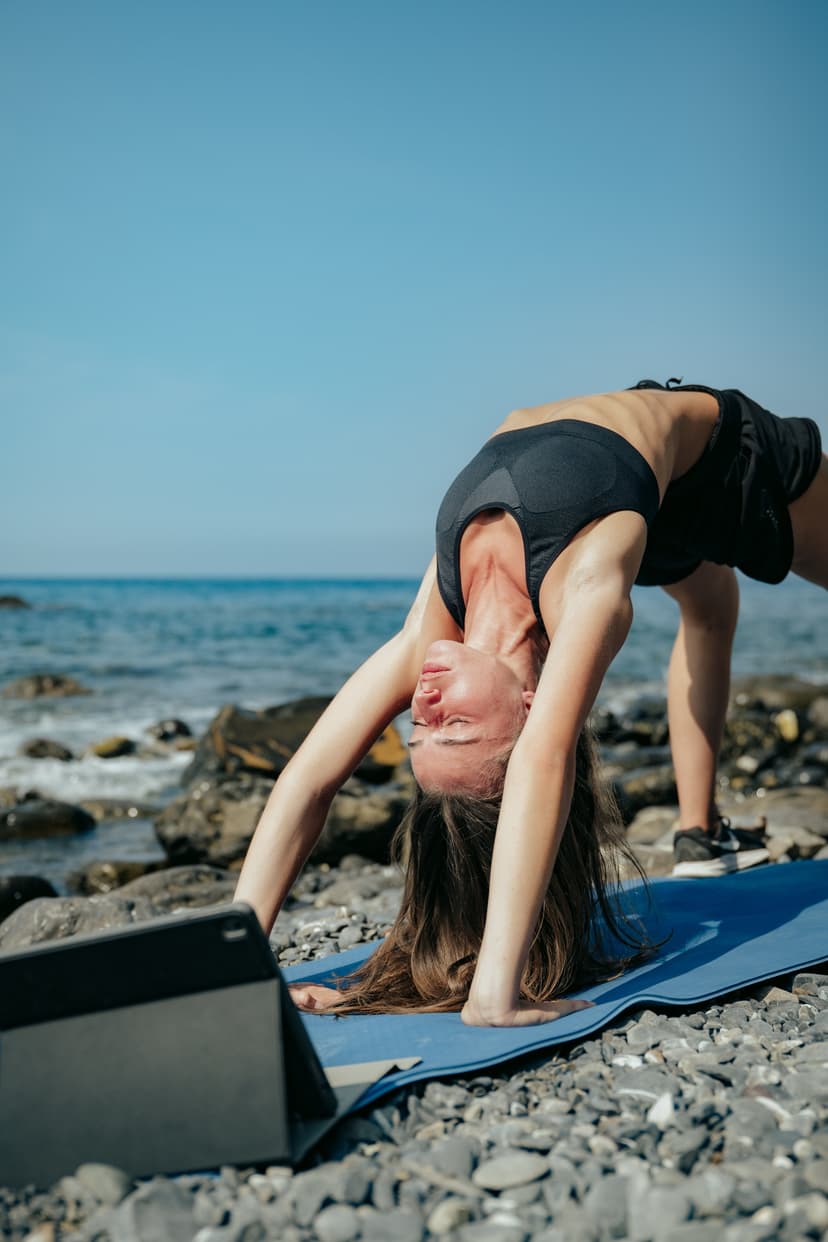
Why the glutes matter anyway
The gluteus maximus is the main hip extensor and one of the largest muscles in the body. Together with the medius and minimus it also governs abduction (moving the leg out to the side), external rotation and pelvic control when you are standing on one leg, so in every step, every run and every flight of stairs.
The gluteus medius in particular is what stops the pelvis from dropping on the side of the raised leg. When this control is missing you can see it with the naked eye: the knee collapsing inward in a squat, or the pelvis tilting at every landing. It is a control that can be observed and trained, and some glute bridge variations target it directly, bearing in mind, however, that "training control" does not automatically mean making that muscle grow, nor that the knee collapse always depends on hip strength.
On one point it is worth being precise: that a sedentary life "switches off" the glutes is a figure of speech, not a diagnosis. People who sit a lot generally use the whole posterior chain little, and the answer is to move more, not a miracle exercise.
The basic glute bridge
Starting position. Lie on your back, knees bent, feet flat on the floor at hip width, arms along your sides with palms facing down. Your feet should be close enough to your glutes that you can almost touch your heels with your fingertips.
An important tip: before trying these exercises, make sure you have received a correct diagnosis. We often think we have one problem, but the real cause of the pain is another. Doing the wrong exercises can make the situation worse instead of better.
Execution. Contract your glutes and lift your pelvis towards the ceiling, creating a straight line from shoulders to knees. Hold the position for a couple of seconds, then lower slowly until you return to the starting position.
Key points. Do not overextend the lower back: the movement comes from the hip, not from the spine. Stop when shoulders, hips and knees are in line. Keep your abdominals lightly engaged and breathe normally.
As a starting point, 3 sets of 15 to 20 repetitions are a reasonable reference. If the last repetitions cost you nothing, there is no need to add twenty more: it is time to move to a more demanding variation.
The glute bridge variations, from the simplest to the most demanding
Marching in place
It introduces instability without increasing the load.
Execution. Lift your pelvis in the bridge position. Keeping the pelvis still and the hips level, lift one foot a few centimetres off the floor. Put it back down and repeat with the other foot, alternating as if you were marching.
The challenge lies in not letting the pelvis tilt or rotate when one foot is in the air. It is also a good test: if you always give way on the same side, you have found an asymmetry to work on. Roughly 10 to 15 alternations per side.
Single leg
Execution. From the basic position, extend one leg towards the ceiling or keep it straight out in front. Lift your pelvis using only the leg on the floor, keeping the hips level.
It is much more demanding than the basic version, because all the load passes onto one side and at the same time the pelvis must be kept under control. It is especially useful for those who run, jump or change direction: in real life, weight-bearing on a single limb is the norm. Roughly 8 to 12 repetitions per leg, stopping when the pelvis starts to give way.
With an elastic band
Execution. Place a mini band just above the knees. During the bridge, actively push your knees outwards against the resistance, keeping the tension throughout the movement.
It is the variation that adds an abduction task to the extension movement, so it also engages the gluteus medius. Useful for those who see their knees collapse inward in squats, lunges or running, and handy as a warm-up before a leg session. Remember, however, the two limits seen above: more perceived activation does not in itself guarantee more results, and in the nine-week study the gluteus medius is precisely the area that did not grow noticeably with either exercise. Roughly 15 to 20 controlled repetitions.
Frog bridge
Execution. Lying on your back, bring the soles of your feet together and let your knees fall outwards, butterfly-style. From this position lift your pelvis by contracting your glutes.
With the hips externally rotated, the quadriceps and hamstrings take part less and the movement concentrates on hip extension: it is the typical choice for those who "don't feel" their glutes in the classic versions. The open position also requires a fair amount of external rotation mobility, so it should be dosed: the knees go down as far as they go, without forcing. Roughly 15 to 20 repetitions.
Raised feet
Execution. Rest your feet on a bench, a step or a sturdy chair, then perform the bridge.
By raising the support the hip starts from a more flexed position and the movement becomes wider, with more work in the lower part of the range, where on the floor you would be stopped by the ground. It is the intermediate step before the full hip thrust. Roughly 12 to 15 repetitions; make sure the raised surface does not slip.
Hip thrust (shoulders elevated)
Execution. Rest the upper part of your back, at the level of the shoulder blades, on a bench. Feet on the floor, knees bent. Start with the pelvis low and rise until your shoulders, hips and knees are in line.
The real advantage of the hip thrust is not that it "activates more", but that it is the most comfortable position for lifting a lot of weight safely: barbell, dumbbell or plate resting on the hips. And it is progressive loading, not the variation itself, that drives adaptation. Roughly 8 to 12 repetitions per set, increasing the weight over time.
With weight
Once you have mastered the technique, adding resistance is the most direct way to progress.
- With a dumbbell. Rest a dumbbell on your hips, holding it with your hands. Accessible and sufficient for a long progression phase.
- With a barbell. For higher loads. You need a pad or a folded towel, otherwise pressure on the iliac crests becomes the limiting factor before the glutes do.
- With a kettlebell. Easy to position and stable, a good compromise at home.
Start light and increase gradually. Technique is never traded for an extra kilo: if your back arches to finish the repetition, the weight is too heavy.
With a Swiss ball
- Feet on the ball. Rest your feet on the ball and lift your pelvis: it requires continuous control so as not to lose your balance.
- Bridge curl. More advanced. Start with your legs straight and your feet on the ball, lift your pelvis and at the same time bend your knees, drawing the ball towards you. It works the hamstrings a lot as well as the glutes.
Here a clarification drawn from research on instability training is worth making: on unstable surfaces the core stabilising muscles show more electrical activity, and programmes that use them improve trunk stability, but peak isometric strength, rate of force development and power are reduced compared with the same execution on a stable surface, with differences that depend on the exercise, equipment, load and the level of the person training. Put simply: the ball is an excellent tool for control, a mediocre choice if your goal is strength. Roughly 10 to 12 repetitions.
The mistakes I see most often
Overextending the lower back. Going "higher" by arching the back instead of extending the hip. The spine stays neutral: you stop at the straight line.
Pushing with the quadriceps. If the weight ends up on the balls of your feet, the work shifts to the thighs. Look for the push from your heels, with your feet firmly planted.
Holding your breath. Breathe out as you rise, breathe in as you lower. No breath-holding manoeuvre is needed at these loads.
Going fast. Bouncing repetitions count for little. Controlled rise, short pause at the top, slow lowering.
Feet too far away. If your heels are far from your glutes the movement shifts onto the hamstrings, and it is not rare for them to cramp. Bring them closer.
Collecting variations. This is the most underrated mistake: people try all the glute bridge variations for a week each and progress in none of them. Adaptation comes from repeating the same movement while gradually increasing the difficulty.
A reasonable progression
There is no calendar that suits everyone: what follows is an order of difficulty among the glute bridge variations, not a deadline. Move to the next step when the previous one is clean and controlled, not when the week has passed.
- Basic bridge, 3 sets of 15 to 20, until technique and feel are solid.
- Marching in place and elastic band, to add the pelvic control task.
- Single leg and frog bridge, to raise the intensity on one side only.
- Raised feet, to increase the range of movement.
- Hip thrust with progressive loading, when the goal becomes strength or hypertrophy.
Muscle soreness in the days after the first sessions is normal. Sharp pain during the exercise, or back pain that lasts beyond 24 to 48 hours, is not: stop and get it checked.
How a physiotherapist can help you at a distance
The part where an outside eye really helps is not "knowing that the frog bridge exists": it is understanding whether your pelvis rotates in the single-leg version, whether you are compensating with your lower back, and above all whether the bridge is the right exercise for your problem or whether you are training something that has nothing to do with it.
With Ri-Hub you can do this assessment by video call: the physiotherapist watches you perform the exercise, corrects you live and builds a progression tailored to you, with goals you can check over time instead of a generic list of exercises.
In summary
Glute bridge variations are a long, well-built ladder: you start on the floor with no equipment and work up to the barbell, and everyone can find the step that suits them. That this makes the glutes grow is documented. That it automatically protects the back, hips and knees, no: and anyone who promises you that is oversimplifying.
Use it for what it is: an accessible, progressive exercise that trains hip extension well. Choose one or two variations, increase the difficulty gradually and stay consistent for a few months. It is far more effective than alternating ten different exercises hoping for the magic one. And if you have pain going on, get a diagnosis first: it is the step that makes everything else useful.
You might also be interested in:
Forward Head Posture: How to Correct the Head Forward Position Shoulder Pain Causes: Complete Guide to Understanding Your Problem Inner Elbow Pain: Causes, Symptoms and Effective Remedies
Stay in touch with us Join our dedicated Facebook group: we answer all patients, give practical advice and clear up the most common doubts.
Fonti
- Hip thrust and back squat training elicit similar gluteus muscle hypertrophy and transfer similarly to the deadlift, Frontiers in Physiology, 2023
- Electromyographic differences of the gluteus maximus, gluteus medius, biceps femoris, and vastus lateralis between the barbell hip thrust and barbell glute bridge, Sports Biomechanics, 2024
- Hip and Knee Strengthening Is More Effective Than Knee Strengthening Alone for Reducing Pain and Improving Activity in Individuals With Patellofemoral Pain: A Systematic Review With Meta-analysis, Journal of Orthopaedic & Sports Physical Therapy, 2018
- Hip abductor strength and lower extremity running related injury in distance runners: A systematic review, Journal of Science and Medicine in Sport, 2017
- Motor control exercise for chronic non-specific low-back pain, Cochrane Database of Systematic Reviews, 2016
- Instability resistance training for health and performance, Journal of Traditional and Complementary Medicine, 2017
Last source check: August 2026.
Need a consultation?
Start from the questionnaire on Ri-Hub. A few questions about your case, you sign up, and see who will follow you: a physiotherapist registered with the Register, whom you write to in chat whenever you like. If you would rather talk it through by voice, the first consultation is free, lasts 20 minutes and commits you to nothing: they arrive having already read what you wrote, and together you decide whether and how to go on.


