Hip exercises: the hip is involved in every step, every time you get up from a chair, every flight of stairs. It is natural to want to keep it mobile and strong. What follows is the complete programme (mobility, strengthening, stretching), but first you will find something that most articles leave out: what the research really shows about these exercises, and where a convenient story is told that has never passed the test.
I will give the conclusion up front, so you know what to expect. The strengthening part has solid evidence in people who have hip pain. The mobility and stretching part serves a different purpose from the one usually attributed to it: it does not realign the pelvis and it does not prevent injuries. Continuing to present it as "correcting imbalances" is wrong, but removing it from the programme would be just as wrong: only the reason you do it changes.
⚠ Important: read this before continuing
The exercises and advice in this article are general guidance and may not suit your situation. Everyone has a unique clinical history: what works for others could be counterproductive for you.
Want a professional's opinion? Start with the questionnaire: you sign up and see who will follow you, a physiotherapist registered with the Albo chosen for your case, whom you message in chat. If you would rather hear a voice, the first consultation is free and we look at your situation together.
First of all: when hip pain is not a job for exercises
The hip and groin are areas where problems pass through that have nothing to do with muscle stiffness, and some of them cannot wait. If you recognise yourself in one of these situations, an exercise programme is not the first step: a medical assessment is.
- Fever, general malaise, acute pain with inability to bear weight. An infected joint behaves this way and needs to be seen urgently.
- A fall, even a minor one, in an older person or someone with known osteoporosis, followed by groin pain and limping: a femoral fracture must be ruled out before any exercise.
- Groin pain that appeared after a sudden increase in running or load, which gets worse when hopping on one leg. This is the picture that raises suspicion of a stress fracture of the femoral neck, and continuing to load it makes it worse. Particular care is needed if there is absent menstruation, an eating disorder or a period of strong calorie restriction.
- Prolonged use of corticosteroids, heavy alcohol use, chemotherapy, sickle cell anaemia, with groin pain that grows over the weeks: these are the factors associated with necrosis of the femoral head.
- A history of cancer, unexplained weight loss, pain that never changes with position and wakes you at night. Musculoskeletal pain usually changes with movement; pain that stays identical in every position needs investigating.
- Long-lasting morning stiffness, several joints involved, swelling. This points towards an inflammatory form, which has its own diagnostic and therapeutic pathway.
- Pain that runs below the knee with tingling or loss of strength: often the hip is only where you feel it, while the origin is in the lower back.
- A child or adolescent who limps and complains of pain in the hip or knee should always be seen: at that age there are growth-related hip problems that present exactly like this.
Outside these cases, hip exercises are normally a reasonable path. But it is worth knowing what they really work for, and what they do not.
If instead you have a diagnosis of hip osteoarthritis, the path changes in some important respects, such as dosage, what to expect and what is not worth chasing: you will find it in hip osteoarthritis: exercises and what the research says.
What the research really says about hip exercises
Where the evidence is good: the hip that hurts
In hip osteoarthritis, exercise is the foundation of treatment, not a side dish. The international OARSI guidelines place education and structured exercise programmes among the core treatments for hip osteoarthritis: they are the starting point on which everything else is built.
The quantitative figure, though, has to be told in full. A systematic review with cumulative meta-analysis of 18 randomised trials measured the effect of exercise in hip osteoarthritis compared with no treatment: at the end of the programme pain improved with a standardised mean difference of -0.38 and function of -0.31, and at 6-9 months after the end the effect was still present but smaller (-0.23 on pain, -0.29 on function). The authors write that most estimates are small and that it is not clear whether they are clinically relevant. It is a real and repeated benefit, not a miracle: anyone who promises you that hip exercises cure osteoarthritis is selling you something.
There is then the pain on the side of the hip, the one that burns over the greater trochanter and stops you sleeping on your side: gluteal tendinopathy. A randomised study published in the BMJ compared three routes in 204 people (167 women, average age 54.8 years): an education-on-loading plus exercise programme, a cortisone injection, and waiting. At eight weeks, 51 of 66 participants in the education and exercise group reported improvement, compared with 38 of 65 with cortisone and 20 of 68 waiting; at one year exercise was still ahead of cortisone on self-reported improvement (51 of 65 against 36 of 63), although at that point the intensity of pain did not differ between the two groups. And a decisive clarification before printing the list: that programme was 14 sessions over eight weeks guided by a physiotherapist, not a list of exercises copied from the internet. The result supports supervised exercise, not do-it-yourself.
Finally, the knee. A meta-analysis of 14 studies and 673 participants with patellofemoral pain showed that adding hip strengthening to knee strengthening reduces pain more than knee work alone (mean difference -1.5 points) and improves activity. The most interesting detail is counterintuitive: the improvement came without a measurable increase in strength. So yes, working on the hip helps the knee, but not for the reason everyone tells.
Where the evidence is missing: the story of "imbalances"
You know the standard story: you sit down, the hip flexors shorten, the pelvis tilts forward, the glutes "switch off", and from there comes the back pain. You lengthen the flexors, activate the glutes, and the pelvis returns to position. It is an elegant explanation. It has also been tested, and it did not hold up.
A 2024 systematic review with meta-analysis of 23 studies and 969 healthy people measured exactly this: the effect of stretching and strengthening on spinal and pelvic posture. Stretching had no effect, either immediately (d = 0.01) or after weeks of practice (d = -0.19, not significant). Strengthening, by contrast, produced a large improvement (d = -0.83). But here comes the step that is usually omitted because it is uncomfortable even for those who defend strengthening: analysing the regions separately, strengthening worked on the thoracic and cervical spine (d = -1.04) and did not work on the lumbar and lumbopelvic region (d = -0.23, not significant). That is precisely where the hip sits. The authors' conclusion is clear: the evidence, of moderate certainty, does not support the use of stretching as a treatment for muscle imbalance.
The same fate awaits the idea that lengthening protects against injury. A meta-analysis of 25 randomised trials, 26,610 participants and 3,464 injuries separated the types of intervention: stretching did not reduce injuries (relative risk 0.963, 95% confidence interval 0.846-1.095, so compatible with no effect), while strength training reduced them to less than a third (0.315) and proprioceptive work roughly halved them (0.550). The necessary caution applies: those studies are in sporting populations, not in the office worker who wants to feel better at work.
And the hip-back link? It exists, but it is weaker than it is sold to be. A 2024 systematic review that gathered 54 observational studies found that people with non-specific back pain do in fact show less hip movement, particularly in internal rotation, and more weakness of the hip abductors and extensors than people without pain. But these are observational studies: they capture a difference, they do not tell us which came first. A stiff, weak hip may contribute to back pain, or it may be the consequence of months of moving little because the back hurts. This study design cannot tell the two apart. In fairness, the authors, precisely because of these differences, invite clinicians to assess and treat the hip in people with back pain too: what is missing is evidence that the hip is the cause, not the usefulness of looking at it.
One exception in favour of flexibility should be mentioned, for fairness: in a review of sports-related groin pain, prospective data of moderate quality indicate reduced hip abduction flexibility as a risk factor for groin pain in people who play rotational sports. So mobility is not useless in absolute terms: in a very specific context, measured before the pain appears, something predicts it. Even here, though, the picture is not linear, and it is worth saying so: in the same review, retrospective data, collected when the pain was already present, point in the opposite direction, with greater abduction flexibility in symptomatic athletes. It is another good reason not to turn "I am not very flexible" into a diagnosis.
How to use this routine anyway
None of the above tells you to stop: hip exercises remain a good idea, but the order and the expectations change.
Put the bulk of your time into strengthening: it is the part that holds up both in treatment (osteoarthritis, gluteal tendinopathy, patellofemoral pain) and in reducing injury risk. Keep mobility for what it is: a way of moving with more freedom, of warming up before loading, of feeling better after hours sitting down. If after a stretching lunge you walk more comfortably, that is a real benefit and it is enough for you, only it is not a "straightened" pelvis. And if you have been stretching your flexors for months waiting for your back pain to go, you are not lacking consistency: you are using the wrong lever.

Hip anatomy: who does what
To understand what you are training, it helps to know the muscles involved.
Glutes. The gluteus maximus extends and externally rotates the hip; the gluteus medius and minimus abduct and stabilise the pelvis when you stand on one leg. They are the engines of walking, running and jumping, and they are also the tendons involved in lateral hip pain.
Hip flexors. The iliopsoas and rectus femoris bring the thigh towards the chest. They are the ones blamed for "shortening" from sitting: that they become less tolerant of lengthening is plausible, that this reorganises the pelvis is the unproven part.
Adductors. They bring the leg towards the midline and control changes of direction. They are the main players in sports-related groin pain.
External rotators. Piriformis, obturators and gemelli rotate the hip outwards and work hard in single-leg stance.
Abductors. Tensor fasciae latae, gluteus medius and minimus move the leg away from the body and stop the pelvis dropping on the side that is not bearing weight.
An important piece of advice: before trying these exercises, make sure you have received a correct diagnosis. People often think they have one problem when the real cause of the pain is another. Doing the wrong exercises can make the situation worse instead of better.
Mobility: use it to move better, not to straighten yourself
These movements stay in the programme. The reason changes: they serve to get you comfortable for the strength work and to break up hours of sitting, not to correct a posture.
Hip circles. Standing on one leg, draw large circles with the knee of the other leg. 10 circles per direction, per side. An excellent first movement in the session.
Lunge flexor stretch. In a lunge position, move your pelvis forward until you feel tension in front of the thigh of the back leg. 30 seconds per side. Keep it as an opener, not as a cure for back pain.
90/90. Seated on the floor, one leg in front bent at 90 degrees and one behind at 90 degrees. Rotate the torso towards the front leg. 30 seconds per side. It works the rotations, which are the most neglected movements in training.
Butterfly position. Seated, soles of the feet together and knees allowed to drop towards the floor. 30 seconds.
Deep squat hold. Lower yourself into a full squat and stay there, holding on to a support if needed. 30-60 seconds.
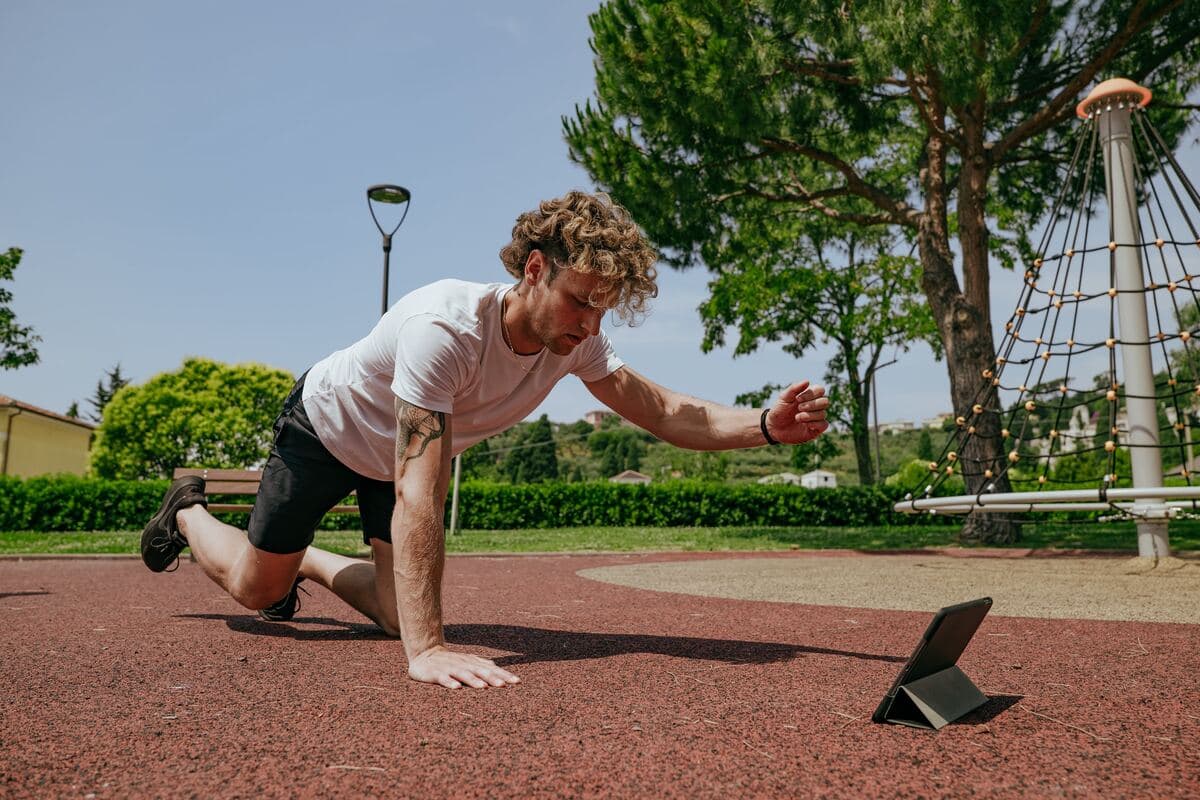
Frog position. On all fours, open the knees as wide as possible with the feet turned out and push the pelvis back. 30 seconds.
Glute strengthening: the part that matters most
This is where the best time of your week goes: among all the hip exercises, these are the ones with the most solid evidence. The criterion is not the number of exercises but progression: when a set becomes easy, add load, slow down the descent or move to the single-leg version.
Glute bridge. Lying on your back, knees bent, lift the pelvis by pressing through your heels. 3 sets of 15.
Single-leg bridge. As above but with one foot lifted. 3 sets of 10 per side.
Hip thrust. Back resting on a bench or sofa, lift the pelvis with or without added load. 3 sets of 12. This is the version that lets you really load the muscle.
Clamshell. Lying on your side, knees bent, lift the upper knee while keeping the pelvis still. 3 sets of 15 per side.
Side-lying abduction. On your side, upper leg straight, lift it towards the ceiling without rotating it. 3 sets of 12 per side.
Fire hydrant. On all fours, lift a bent leg out to the side. 3 sets of 12 per side.
Band walk. Band above the knees, side steps keeping the tension. 2 sets of 10 steps per direction.
Functional strengthening: the whole chain together
These exercises do not isolate anything, and that is their strength: they train the hip within the movements you actually use.
Squat. The basic movement for hips, knees and glutes. 3 sets of 15.
Lunges. Forwards, backwards and lateral. 3 sets of 10 per leg. Lateral lunges are the most neglected and the most useful for the adductors.
Step-ups. Step onto a raised surface, controlling the descent. 3 sets of 10 per leg.
Single-leg Romanian deadlift. Standing on one foot, lower yourself by bringing the torso forward and the pelvis back. 3 sets of 10 per side. It trains strength and balance together.
Single-leg squat. A reduced version of the single-leg squat, even just lowering down onto a chair. 3 sets of 8 per side.
Stretching: what to expect, honestly
Stretching is a good way to finish a hip exercise session, and for many people it leaves a sense of freedom. What the meta-analyses say is that it does not change posture and that, in athletes, it does not reduce injuries: use it for how it makes you feel, not as structural therapy.
Piriformis. Lying on your back, cross the ankle over the opposite knee and pull the thigh towards your chest. 30 seconds per side.
Adductors. Seated with the legs apart, hinge forward from the hip. 30 seconds.
Tensor fasciae latae. Standing, cross one leg behind the other and lean sideways. 30 seconds per side.
Quadriceps. Standing, bring the heel towards the buttock while keeping the pelvis still. 30 seconds per side.
Happy baby. Lying on your back, grab your feet and bring the knees towards your armpits. 30 seconds.
One week of hip exercises, reorganised
Compared with the classic alternation of mobility and strengthening, this version gives more room to the part with the best evidence.
Monday and Thursday: strength. Short warm-up (hip circles, marching on the spot), glute exercises, functional exercises, final stretching. About 30 minutes. These are the two sessions not to skip.
Tuesday and Friday: mobility and recovery. All the mobility movements plus full stretching. About 20 minutes. If the week gets shorter, this is the session you can sacrifice.
Wednesday and Saturday. Aerobic activity of your choice: walking, swimming, cycling. Or rest.
Sunday. Rest, or some light movement if you feel like it.
A caveat about the numbers: the sets, repetitions and minutes above are a reasonable starting point from clinical practice, not a dosage validated by a study. In the studies that work, the programme is personalised and progresses over time, which is exactly what a plan copied from the internet cannot do.
Four pieces of advice that hold up to scrutiny
Progress, do not repeat. The benefit of strengthening comes from gradually increasing the load. Doing the same 15-rep glute bridge for a year is not training, it is maintenance.
Break up sitting, but for the right reason. Getting up often and moving is good for circulation, for discomfort and for mood. You are not doing it to "reopen" a shortened flexor.
Do not chase the sensation of tightness. The feeling of being "short" on one side does not match a measurement of muscle length: it is a sensation, and it is not enough to decide the programme.
Work in all planes. Extension, abduction, rotations and adduction: rotations are the ones everyone forgets, and internal rotation is precisely the movement that is most reduced in people with non-specific back pain (the observational review cited above).
When to get checked
See a doctor or a physiotherapist if you have severe hip or groin pain, if the pain limits your daily activities, if there has been a trauma, if you notice a change in the shape or function of the hip, or if after a few weeks of regular work nothing has changed. The reverse also applies: if the pain worsens precisely with the exercises, it is not "normal for it to hurt at the start", it is information to take to whoever is assessing you.
If you want a hip exercise programme built around your situation, Ri-Hub can help. Our physiotherapists work through telerehabilitation: assessment, choice of exercises that make sense for your case, and checking how you perform them, which is what makes the difference between programmes that work in studies and lists of movements.
You might also be interested in:
Herniated Disc Exercises: 12 Effective Movements to Heal and Feel Better
Cervical Osteoarthritis: Symptoms, Causes and How to Manage It with Exercise
Patellofemoral Syndrome: Causes, Symptoms and Effective Rehabilitation
Stay in touch with us
Join our dedicated Facebook group: we reply to all patients, give practical advice and clear up the most common doubts.
Sources
- OARSI guidelines for the non-surgical management of knee, hip, and polyarticular osteoarthritis, Osteoarthritis and Cartilage, 2019
- Effect of exercise therapy in patients with hip osteoarthritis: A systematic review and cumulative meta-analysis, Osteoarthritis and Cartilage Open, 2023
- Education plus exercise versus corticosteroid injection use versus a wait and see approach on global outcome and pain from gluteal tendinopathy: prospective, single blinded, randomised clinical trial, BMJ, 2018
- Hip and Knee Strengthening Is More Effective Than Knee Strengthening Alone for Reducing Pain and Improving Activity in Individuals With Patellofemoral Pain: A Systematic Review With Meta-analysis, Journal of Orthopaedic & Sports Physical Therapy, 2018
- Effects of Stretching or Strengthening Exercise on Spinal and Lumbopelvic Posture: A Systematic Review with Meta-Analysis, Sports Medicine - Open, 2024
- The effectiveness of exercise interventions to prevent sports injuries: a systematic review and meta-analysis of randomised controlled trials, British Journal of Sports Medicine, 2014
- Hip biomechanics in patients with low back pain, what do we know? A systematic review, BMC Musculoskeletal Disorders, 2024
- Movement Patterns and Muscular Function Before and After Onset of Sports-Related Groin Pain: A Systematic Review with Meta-analysis, Sports Medicine, 2016
Last check of the sources: August 2026.
Need a consultation?
Start with the Ri-Hub questionnaire: a few questions about your case, you sign up, and you see who will follow you: a physiotherapist registered with the Albo, whom you message in chat whenever you like. If you would rather talk it through by voice, the first consultation is free, lasts twenty minutes and commits you to nothing: they arrive having already read what you wrote, and together you decide whether and how to continue.