


It is midnight, you look at them in the bassinet and they are kicking as if pedalling uphill. Or it is the opposite: they lie there calmly, and for an hour you have been wondering whether it is normal that they move so little. In both cases the question is the same: how much should a newborn move?
Here is the answer straight away, and it is an uncomfortable one: it is the wrong question. Those who assess motor development in the first months do not count movements, they look at their form. There is a validated observational method, the assessment of General Movements according to Prechtl, which looks at the variability, fluidity and complexity of spontaneous movement, and with that gaze it says things that cranial ultrasound and the traditional neurological examination do not. It is a method that was born and has stayed within clinical research, although a major part of the studies that validated it were carried out in Italy.
And there is a second part of the answer, just as important: it is a clinical tool, not something to do tonight on the sofa with your phone. Let me explain why.
What "general movements" are
They are the basic spontaneous movement of the young baby: they are present from foetal life until the end of the first half-year and they are not responses to a stimulus. The baby makes them on their own, awake and calm.
The clinical description, taken from the review by Einspieler and Prechtl, is surprisingly aesthetic. They involve the whole body in a variable sequence of arms, legs, neck and trunk. They increase and decrease in intensity, strength and speed. They have a gradual beginning and end. The rotations along the axis of the limbs and the small changes of direction make them fluid and elegant, and create the impression of complexity and variability.
Then there is the sentence that reverses every parent's intuition: if the nervous system is compromised, general movements lose their complex and variable character and become monotonous and poor. They do not disappear, and they do not necessarily decrease. They become impoverished.
A baby can therefore kick a great deal and always in the same way, and another can move calmly but in a very rich way. Between the two, the one that reassures the clinician is the second.
Why "kicks a lot" alone says almost nothing
This is not an opinion: it has been measured, and the comparison is clear.
The systematic review published in Developmental Medicine and Child Neurology in 2018 gathered 47 studies on the ability of early spontaneous movement to predict cerebral palsy. Within scales other than Prechtl's method, the items measuring amount of movement and asymmetric postures showed weak associations with the outcome. The assessment based on quality, by contrast, proved the strongest predictor of all.
Technology, which should have an advantage on quantity, does not yet hold up either. A systematic review from 2021 examined 23 studies that quantified movement before 6 months of corrected age using video, accelerometers and body tracking: in identifying the babies later diagnosed with cerebral palsy, sensitivity ranged from 44% to 100% and specificity from 59% to 95%. A range that wide means one thing: counting is not enough yet.
And then there is normal variability, the reason why comparisons at the park do nothing but harm. The World Health Organization study followed 816 healthy children in five countries to build the real windows for motor milestones: sitting without support arrives between 3.8 and 9.2 months, walking alone between 8.2 and 17.6 months. And 4.3% of the children never crawled on all fours. None of them had a problem.
Fidgety movements: the window between 3 and 5 months
Here lies the heart of the method.
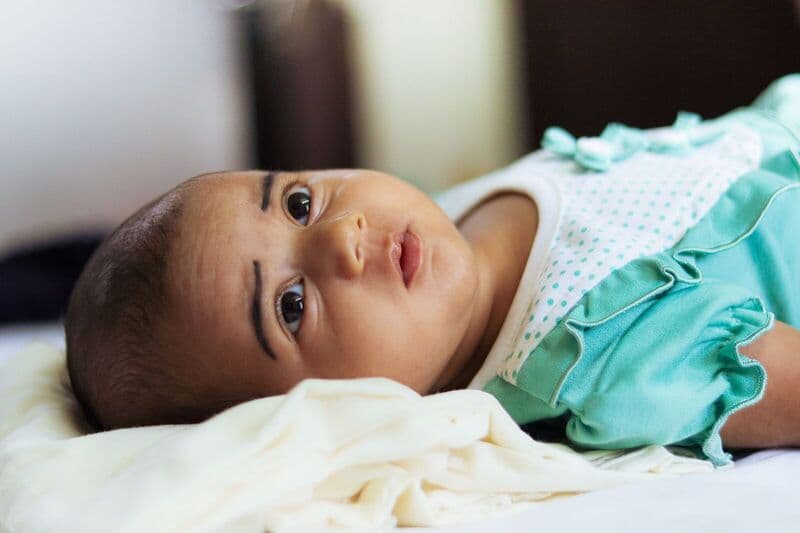
Around two to three months the repertoire changes and a new pattern appears: fidgety movements, a continuous jiggling. They are small movements of moderate speed, with variable acceleration, of the neck, trunk and limbs, in all directions, and in the awake baby between 3 and 5 months they are the dominant pattern: a tingle of adjustments that never stops still and never repeats itself exactly.
The study that made them famous dates from 1997, in the Lancet: 130 infants followed in five hospitals, classified as low or high risk on the basis of cranial ultrasound, video-recorded for months and re-evaluated neurologically up to 2 years of corrected age. The results, which hold for that population:
- 67 of 70 babies with normal fidgety movements (96%) had a normal neurological outcome;
- the total absence or abnormal quality of fidgety movements was followed by neurological abnormalities in 57 of 60 cases (95%): 49 cerebral palsies and 8 between developmental delay and minor neurological signs;
- sensitivity 95% and specificity 96%, against 80% and 83% for cranial ultrasound performed on the same babies.
A review devoted specifically to these movements, published in the Jornal de Pediatria, adds the piece that frightened parents need: practically all babies with present and normal fidgety movements develop normally, even when cranial ultrasound or the clinical history had raised fears to the contrary. It is one of the few cases in which a clinical sign serves more to reassure than to alarm.
That same review is, however, honest about the other side: abnormal fidgety movements (as opposed to their absence) are a non-specific sign with low predictive power. On their own, they say little about a single baby.
The other signal: "cramped-synchronised" movements
The second pattern the method looks for is the opposite of the jiggling: stiff movements, without normal fluidity, in which the muscles of the limbs and trunk contract and relax almost all together.
The reference study is Italian, from the University of Modena, published in 2002 in Archives of Pediatrics & Adolescent Medicine: 84 preterm infants with cranial ultrasound abnormalities, video-recorded from birth and observed blind.
The 33 babies with constant or predominant cramped-synchronised movements all developed cerebral palsy, and the earlier the pattern appeared, the worse the motor outcome. In the 8 in whom the pattern was transient, the outcome split: mild cerebral palsy where fidgety movements subsequently disappeared, normal development where they appeared.
But the line I want you to read is a different one. The study pools together the 13 babies with consistently normal general movements and the 30 with a "poor" repertoire: of those 43, 84% had a normal outcome and the remaining 16% a cerebral palsy with mild motor impairment. If the phrase "poor repertoire" has stuck in your head since a hospital ward and you have not slept since, keep two things in mind: the figure is not separated for the two groups, and in a group composed this way, more than four children in five were doing well at 2 to 3 years.
How accurate it really is (and where it stops being so)
This is the part that makes the method credible.
The 2013 systematic review, which selected 19 studies out of 351 and assessed their quality with standardised criteria, calculated for the assessment of general movements a sensitivity of 98% (95% confidence interval: 74 to 100%) and a specificity of 91% (83 to 93%). In the same comparison, cranial ultrasound stood at 74% and 92%, the neurological examination at 88% and 87%, and term MRI between 86% and 100% sensitivity.
Two caveats, and they are the authors' own, not mine. The first: that 74 to 100% interval for sensitivity is enormous, and must be read for what it is. The second, more important: all the included studies concerned high-risk populations, preterm infants born between 23 and 41 weeks and low-birth-weight babies. The authors write in black and white that in low-risk babies the accuracy remains unclear and still needs to be studied.
The 2018 review of the 47 studies adds the decisive detail, the one about when:
- in the fidgety window (10 to 20 weeks of corrected age): sensitivity 97% (93 to 99), specificity 89% (83 to 93);
- in the early window, from birth to 6 weeks: sensitivity 93% (86 to 96) but specificity 59% (45 to 71);
- cramped-synchronised movements seen early reverse the profile: sensitivity 70% (54 to 82) but specificity 97% (74 to 100).
That 59% is the number every parent should know. It means that observation done too early often gets it wrong, and gets it wrong in the alarming direction. The review's conclusion is explicit: fidgety movements have the strongest predictive validity, but cannot be considered in isolation, precisely because of the number of false positives.
One final clarification comes from an Australian study of 259 high-risk babies, assessed in the fidgety window (12 to 20 weeks) in four neonatal intensive care units and a cerebral palsy service: 184 (71%) came back for the 2 to 3-year follow-up, and it is on those that the numbers were calculated. For identifying cerebral palsy the assessment held up: sensitivity 97.6%, specificity 95.7%. But for any abnormal developmental outcome the sensitivity dropped to 57.9%. It is not a general developmental test: it is a tool aimed at cerebral palsy, in babies who are already at high risk.
The boundary: why it is not something to do at home
Now the part that matters more than all the numbers put together.
First: it is a skill that has to be learned. One study analysed 700 assessment forms containing 8,019 judgements, collected in the final tests of 18 courses held between 1997 and 2002. After standardised training of 4 to 5 days, 83% of the assessments were correct and the distinction between normal and abnormal reached 92%. Note well: after days of training, with standardised videos, one judgement in six remained wrong, and the greatest difficulty lay precisely around the threshold.
Second: the home video exists, but it is a channel, not a verdict. A multicentre study published in BMJ Open asked 86 families of high-risk babies, followed in follow-up programmes in Norway, Denmark and Belgium, to film their children following precise criteria for framing, light and phone stability: of the 130 videos, 121 (96%) met the required standards, and over 90% of the parents said they had not become more worried by using those instructions. But the videos were judged by a certified assessor, within a pathway already under way.
Third: artificial intelligence has not yet got there. A 2026 systematic review with meta-analysis included 105 studies, of which 28 could be synthesised quantitatively: the pooled accuracy was 0.884 (0.838 to 0.918) for predicting the diagnosis. But the authors conclude that the certainty of the evidence remains very low, because of heterogeneity and risk of bias. Promising, not ready.
Put the three things together and you get the boundary: a tool validated in high-risk babies, within a narrow age window, with a trained assessor. The 2017 synthesis in JAMA Pediatrics adds the last constraint: before 5 months of corrected age, the most predictive tools are term MRI (86 to 89% sensitivity), Prechtl's general movements (98%) and the Hammersmith neurological examination (90%), and they must be used in combination with the clinical history, never on their own.
Filming your baby, healthy and born at term, to look for fidgety movements on YouTube means using a tool outside the context in which it was measured. The most likely result is not an early diagnosis. It is a sleepless night.
So why do we talk about it
Because time, here, really matters. The same 2017 synthesis recalls that cerebral palsy affects about 1 in 500 live births, that it was historically diagnosed between 12 and 24 months and that today it can be identified before 6 months of corrected age. And the international guideline of 2021 on early intervention, built on 16 systematic reviews and 27 randomised studies, puts as its first principle the immediate referral to treatment as soon as the baby meets high-risk criteria, without waiting for a definitive diagnosis.
The other side of the scale is also needed, the one nobody tells a parent who has just been frightened: in high-income countries, among people with cerebral palsy, 2 in 3 walk, 3 in 4 talk and 1 in 2 has intelligence within the normal range.
Red flags: the thresholds made clear
Go to the emergency department today, do not wait for the paediatrician, if you notice:
- rhythmic, repetitive movements that are always the same and that do not stop when you gently hold the arm or leg still, perhaps with a fixed gaze or pauses in breathing;
- a baby who is suddenly floppy and unresponsive, who does not respond as usual or stops feeding and is unusually drowsy.
Call the paediatrician within a few days, without waiting for the next health check, if you notice:
- an arm or a leg that moves always less than the other, in a constant way and not occasionally;
- constant stiffness, with the body arching and fists clenched that never open beyond the first months;
- a very low tone: the head flopping, the baby slipping through your hands, seeming like "a rag doll";
- the loss of a skill already acquired;
- the head always and only turned to the same side.
The American Academy of Pediatrics document on motor delays also helps you know what to expect next: the assessment of muscle tone is the pivot of the examination, and from there two different routes start: brain MRI if the tone is high, creatine kinase testing in the blood if it is low. It insists on one point: the investigations and the referral to an early intervention programme should be done in parallel, not one after the other.
If your concern is about a baby who seems too floppy, the full picture is in Hypotonia in the newborn: when to worry (and when not to). If instead it concerns the automatic movements that appear and disappear on their own (the Moro, grasping, stepping), those are a different chapter, explained in Newborn primitive reflexes: what they are and when they disappear.
What you can do, concretely
Stop counting. Take five minutes at a good moment, when the baby is awake, fed and not tired, place them on the mat in a bodysuit, with no toys over their head, and watch. Do not look for how much they move: look for whether it changes. If one sequence does not resemble the previous one, if the arms rotate and not just rise, if the direction changes while a movement is under way.
Watch in the right window. Between 3 and 5 months the jiggling of fidgety movements should be the dominant pattern in the awake baby. Before that period, even professionals get it wrong more often.
If your baby was born preterm, corrected age matters. For a baby of 30 weeks it is a difference of two and a half months, which at this age changes everything. How it is calculated and for how long it is used is explained in Premature babies and motor development: corrected age explains almost everything.
If the doubt remains, take it to the paediatrician, with a video. Not to diagnose on your own, but because a baby in a clinic, undressed and in the arms of a stranger, almost never shows the movement that worries you at home. Three minutes: baby awake and calm, lying on their back on the mat in a bodysuit, phone steady on a support, the whole body inside the frame, good light, no adult hand in the shot. These are the conditions the European multicentre study taught parents, and in 96% of the videos they were enough to make the recording assessable.
Where we come in
With Ri-Hub Junior a physiotherapist who follows children and teenagers works by video call. It is fair to say straight away what we do not do: complex neurological and neuromuscular conditions are not treated online. If there is a suspicion of a neurological problem, the route is the paediatrician and the reference centre.
What we can do is the part before that: look together at what you see and tell you whether your doubt is the kind that dissolves with observation, or whether it should be taken to the paediatrician straight away and with the right words. The first consultation lasts 20 minutes and is free.
Start the questionnaire: the first consultation lasts 20 minutes and is free
Sources
- Prechtl HF et al., An early marker for neurological deficits after perinatal brain lesions, Lancet 1997
- Einspieler C, Prechtl HF, Prechtl's assessment of general movements: a diagnostic tool for the functional assessment of the young nervous system, Ment Retard Dev Disabil Res Rev 2005
- Kwong AKL et al., Predictive validity of spontaneous early infant movement for later cerebral palsy: a systematic review, Dev Med Child Neurol 2018
- Bosanquet M et al., A systematic review of tests to predict cerebral palsy in young children, Dev Med Child Neurol 2013
- Ferrari F et al., Cramped synchronized general movements in preterm infants as an early marker for cerebral palsy, Arch Pediatr Adolesc Med 2002
- Einspieler C et al., Fidgety movements: tiny in appearance, but huge in impact, J Pediatr (Rio J) 2016
- Novak I et al., Early, accurate diagnosis and early intervention in cerebral palsy, JAMA Pediatr 2017
- Morgan C et al., Early intervention for children aged 0 to 2 years with or at high risk of cerebral palsy: international clinical practice guideline, JAMA Pediatr 2021
- Goyen TA et al., Sensitivity and specificity of general movements assessment for detecting cerebral palsy in an Australian context: 2-year outcomes, J Paediatr Child Health 2020
- Valentin T et al., The effectiveness of training in Prechtl's method on the qualitative assessment of general movements, Early Hum Dev 2005
- Adde L et al., In-Motion-App for remote General Movement Assessment: a multi-site observational study, BMJ Open 2021
- Artificial intelligence in Prechtl's General Movements Assessment: a systematic review and meta-analysis, J Neonatal Perinatal Med 2026
- Technology-assisted quantification of movement to predict infants at high risk of motor disability: a systematic review, Res Dev Disabil 2021
- WHO Multicentre Growth Reference Study Group, WHO Motor Development Study: windows of achievement for six gross motor development milestones, Acta Paediatr Suppl 2006
- Noritz GH, Murphy NA, Motor delays: early identification and evaluation, Pediatrics 2013
Last source check: September 2026.



