
Unstable ankle: if you feel that your ankle is not reliable, that it could give way at any moment, or if you have suffered repeated sprains, you are probably dealing with ankle instability. This condition, also known as chronic ankle instability, is a common problem that can significantly limit daily and sporting activities. In this complete guide to the unstable ankle you will discover why it happens, how to recognise it and, above all, which exercises can help you regain stability and confidence.
Ankle instability is not something you have to live with. With the right exercise programme, most people manage to strengthen the ankle significantly and reduce or eliminate the feeling of instability. The key lies in muscle strengthening and proprioceptive training.
⚠ Important: read this before continuing
The exercises and advice in this article are general indications and may not suit your situation. Every person has a unique clinical history: what works for others could be counterproductive for you.
Want a professional's opinion? Start from the questionnaire: you register and see who will follow you, a physiotherapist on the Italian professional register chosen for your case, whom you write to in chat. If you would rather hear their voice, the first consultation is free and we look at your situation together.
What Chronic Ankle Instability Is
Chronic ankle instability is a condition that typically develops after one or more sprains of the ankle. It is characterised by: repeated giving way of the ankle, a sense that the ankle is unstable or unreliable, persistent pain, recurrent swelling, and difficulty with activities on uneven surfaces.
Here a figure circulates - "up to 70% develop chronic instability" - which is worth looking at closely, because it is true in one sense and misleading in another.
If we isolate people at their first sprain, with no previous ankle injuries, the meta-analysis of 15 studies gives this pattern:
| at 3 months | at 6 months | at 12 months | |
|---|---|---|---|
| sense of instability | 37.9% | 16.1% | 8.1% |
| residual pain | 48.6% | 21.5% | 6.7% |
That is: most first sprains resolve. The high percentages that are quoted refer to different populations - often people with repeated sprains, which is another matter altogether.
There is, however, one number that does not fall in the same way: 15.8% have a new sprain within twelve months. This is why rehabilitation must be completed even when the pain has already gone - relapse is more frequent than the symptoms that remain.
Instability can be of two types: mechanical instability (true laxity of the ligaments due to incomplete healing or repeated injuries) and functional instability (the perception of instability due to proprioceptive and neuromuscular deficits, even without true laxity). The two types often coexist.
Causes of the Unstable Ankle
The main causes of the unstable ankle include:
Repeated sprains: Each sprain further damages the ligaments and the mechanoreceptors (the sensors that inform the brain about the position of the ankle).
Incomplete rehabilitation: Failing to complete an adequate rehabilitation programme after a sprain is the main cause of chronic instability.
An important point: before trying these exercises, make sure you have had a correct diagnosis. People often think they have one problem, but the real cause of the pain is another. Doing the wrong exercises can make the situation worse instead of better.
Muscle weakness: The peroneal muscles (on the outer side of the leg) are essential for stabilising the ankle. Their weakness contributes to instability.
Proprioceptive deficit: Sprains damage the receptors that allow the brain to perceive the position of the ankle, slowing down protective responses.
Ligamentous laxity: Ligaments that have healed incompletely may remain looser than normal.

Symptoms
The typical symptoms of the unstable ankle include:
Giving way: The ankle that "gives out" or buckles, especially on uneven surfaces or during sporting activities.
Sense of instability: The perception that the ankle is not reliable, even when it does not actually give way.
Recurrent sprains: Repeated episodes of sprain.
Pain: Persistent pain in the ankle, especially during or after activity.
Swelling: Recurrent swelling, especially after activity.
Avoidance: A tendency to avoid certain activities or surfaces out of fear of giving way.
If, alongside the insecurity, there is a specific pain on the outer side of the hindfoot, in the small hollow just in front of and below the ankle bone, that picture has its own name - and a debated one: sinus tarsi syndrome.
Diagnosis
The diagnosis of the unstable ankle is based on:
History: History of sprains, frequency of giving way, limitations in activities.
Clinical examination: Tests of ligamentous laxity (anterior drawer, talar tilt test), assessment of muscle strength, proprioceptive tests, functional assessment.
X-rays: To rule out fractures or bony abnormalities.
MRI: To assess the condition of the ligaments and other structures if necessary.
Treatment
The treatment of the unstable ankle is mainly conservative:
Therapeutic exercise: it is the pillar, and on the proportions between its two components there are numbers.
In the meta-analysis of 9 randomised studies and 341 patients, balance training improved the instability score and sports function compared with doing nothing - and, in direct comparison with strengthening, it was superior on both the instability score and function in daily activities.
On duration there is another useful indication: in the meta-analysis of 15 studies and 586 participants, programmes beyond four weeks are the ones that improved daily function and dynamic balance. Below that threshold the benefit stopped at sports function.
Put into practice: strengthen the peroneals, but do not skip the work on one leg, and it is what must be carried on for months, not for three weeks.
Braces: A brace can support the ankle during high-risk activities while you work on strengthening.
Taping: Functional taping can provide support and proprioceptive feedback.
Surgery: Reserved for cases that do not respond to conservative treatment after 3-6 months of well-conducted rehabilitation. The options include ligament reconstruction.
Exercises
Here is a progression of exercises to strengthen the unstable ankle:
Phase 1: Basic strengthening:
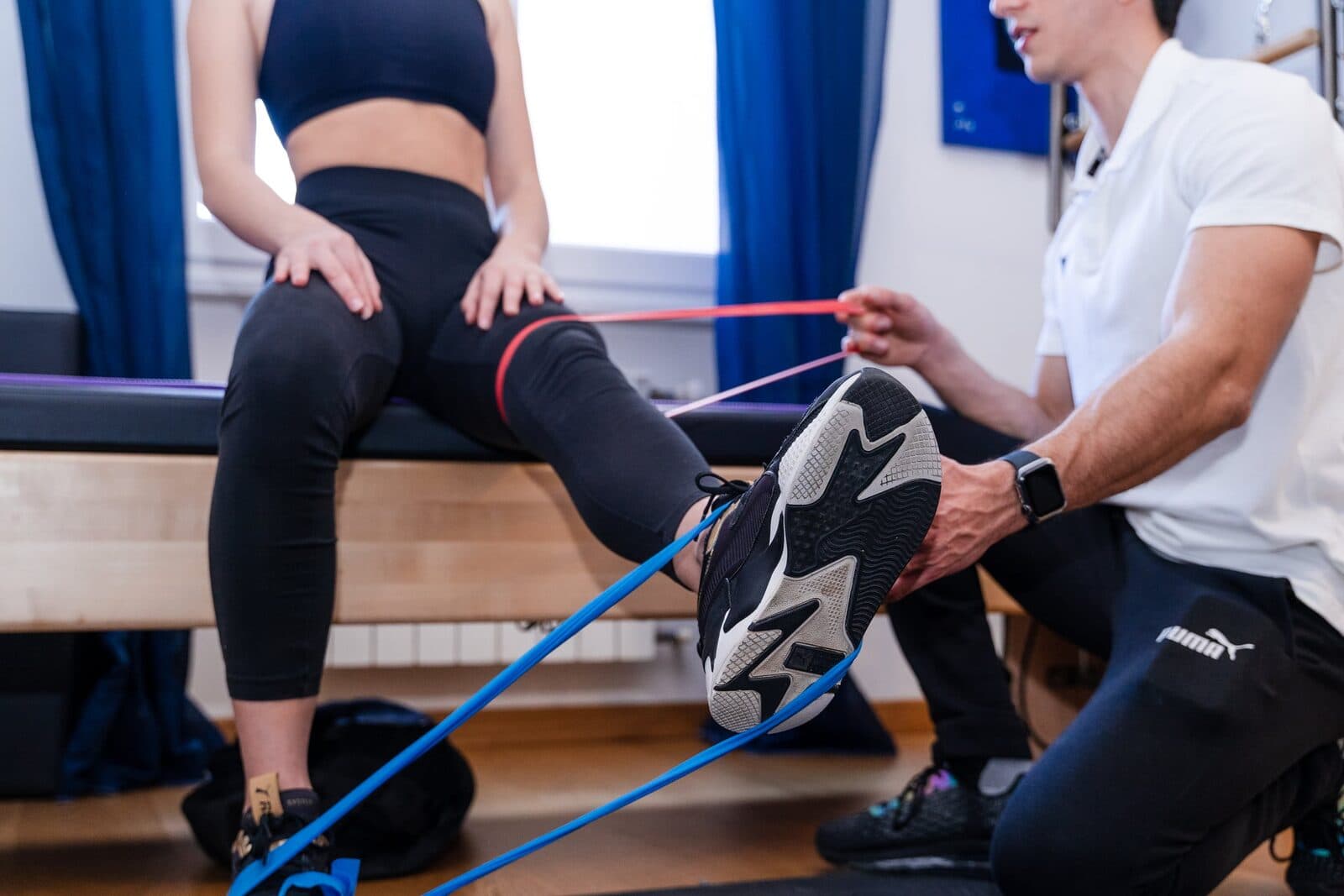
Band strengthening - eversion: Seated, band around the foot, move the foot outwards against resistance. 3 sets of 15.
Band strengthening - dorsiflexion: Band around the foot, pull the foot upwards. 3 sets of 15.
Bilateral calf raises: Rise onto the toes. 3 sets of 20.
Phase 2: Basic proprioception:
Single-leg stance on a stable surface: Stand balanced on one leg, eyes open. 3 sets of 30-60 seconds.
Single-leg stance with eyes closed: Progress by closing the eyes. 3 sets of 20-30 seconds.
Single-leg calf raises: Rise onto the toes of one foot only. 3 sets of 12 per side.
Phase 3: Advanced proprioception:
Single-leg stance on a cushion: 3 sets of 30 seconds.
Single-leg stance on a balance board or wobble board: 3 sets of 30 seconds.
Perturbations: In single-leg stance, someone gently pushes you in different directions.
Phase 4: Dynamic exercises:
Lateral hops: Side hops on one leg. 3 sets of 10.
Hops in 4 directions: Jump forward-back-right-left on one leg. 3 sets.
Controlled landings: Jump and land while controlling the ankle. Progress to single-leg landings.
Phase 5: Sport-specific:
Agility exercises: Zig-zag running, changes of direction, exercises specific to your sport.
How Long It Takes to Strengthen an Unstable Ankle
With a consistent exercise programme, most people notice significant improvements after 6-12 weeks. However, to achieve lasting results and prevent relapses, it is important to continue the exercises over the long term.
The key is consistency: regular exercise (4-5 times a week) gives better results than sporadic sessions.
Prevention
To keep the ankle stable and prevent sprains:
Keep up the exercises: Even after improvement, maintain a maintenance programme 2-3 times a week.
Warm-up: Before physical activity.
Suitable footwear: Wear appropriate shoes with good support.
Pay attention to surfaces.
Brace during sport: If necessary.
If you have an unstable ankle and want a personalised exercise programme to strengthen it, Ri-Hub can help. Our physiotherapists offer assessments and programmes via tele-rehabilitation. You will receive a progressive plan specific to your situation, focused on strengthening and proprioception. Do not live with an unstable ankle: contact Ri-Hub to regain confidence in your movements.
You might also be interested in:
Bunion Exercises: Complete Guide to Reducing Pain and Deformity
Swimmer's Shoulder: Prevention, Symptoms and How to Treat It
Stay in touch with us
Join our dedicated Facebook group: we answer all patients, give practical advice and clear up the most common doubts.
Sources
- The presence of persistent symptoms 12 months following a first lateral ankle sprain: A systematic review and meta-analysis - Foot Ankle Surg - 2022
- A systematic review and meta-analysis of balance training in patients with chronic ankle instability - Syst Rev - 2024
- Effectiveness of exercise therapy on chronic ankle instability: a meta-analysis - Sci Rep - 2025
Last source check: September 2026.
Need a consultation?
Start from the questionnaire on Ri-Hub - a few questions about your case, you register, and see who will follow you: a physiotherapist on the Italian professional register, whom you write to in chat whenever you like. If you would rather talk it through by voice, the first consultation is free, lasts 20 minutes and commits you to nothing: they arrive having already read what you wrote, and together you decide whether and how to continue.
If the swelling has stayed alongside the instability, and you wonder whether the two are connected, read Swollen ankle: causes, what to do and when to worry.