
The ankle swells. Sometimes after a sprain, sometimes for no apparent reason; sometimes in the evening, sometimes all day. Before looking for remedies, there is one question that narrows the field more than any other.
Is one ankle swollen, or are both?
From there two different paths begin, with different protagonists.
First: when not to wait
Go to the emergency department, without delay, if one ankle swells quickly and at the same time calf pain, warmth and redness of the leg appear: this is the picture that raises the suspicion of a deep vein thrombosis, and it must be ruled out straight away.
In any case get assessed in the short term if the swelling comes with difficulty breathing - even just lying down or climbing stairs - or if the ankles swell together with rapid weight gain over a few days. These are signs that concern the heart and kidneys, and no exercise addresses them.
And if the ankle is hot, red and very painful without a trauma, with or without fever, a medical assessment is needed: an acutely inflamed joint is not treated with movement until it is known why it is inflamed.
One ankle: the local path
When only one is swollen, the cause is almost always where you can see it.
After a recent trauma. A sprain, even a mild one, swells. In the first weeks this is normal and part of the process.
After a sprain from months ago. This is the case we see most often, and the one that is most underestimated. Swelling that never fully goes away, accompanied by a sense of instability - the ankle "giving way" on uneven ground, insecurity going down stairs - describes chronic ankle instability: a sprain that has healed in the tissues but not in the control of movement.
An inflammation of the joint, with or without arthritis. Here the swelling typically comes with stiffness, especially in the morning or after being still.

Both ankles: the general path
When both are swollen, and especially when the swelling appears in the afternoon and disappears overnight, the main suspicion is of a venous or postural kind: blood struggles to climb back, and the fluid builds up in the lowest part.
There is one situation in which this pattern breaks down, and it is normal that it does: in the first days after childbirth the ankles can swell more than during the nine months of pregnancy, because the water that accumulated in the tissues still has to re-enter circulation and leave through the kidneys. How long this lasts and what is worth doing in the meantime is in why the feet swell after childbirth.
There are also causes that must be recognised before looking for remedies: some medicines - among the most common certain blood-pressure drugs - cause ankle swelling as a known effect; heat makes it clearly worse; pregnancy makes it common; and conditions of the heart, kidneys, liver or thyroid must be ruled out when the swelling is persistent, painless and symmetrical.
The practical point: swelling on both sides, painless and stable over time, is not a problem that is solved by the physiotherapist. The first step is your GP.
The quick map
| What you notice | Where to look |
|---|---|
| One ankle, swollen after a recent sprain | acute trauma |
| One ankle, swollen for months, with giving way | chronic ankle instability |
| One ankle, hot and red, without trauma | doctor, urgent assessment |
| One ankle, with calf pain and warmth in the leg | emergency department |
| Both, swollen in the evening and down in the morning | venous or postural origin |
| Both, persistent and painless | doctor: heart, kidneys, liver, medicines |
| Both, with breathlessness or rapid weight gain | medical assessment in the short term |
What physiotherapy can do
On two of the paths described, the work is there, and it has been measured.
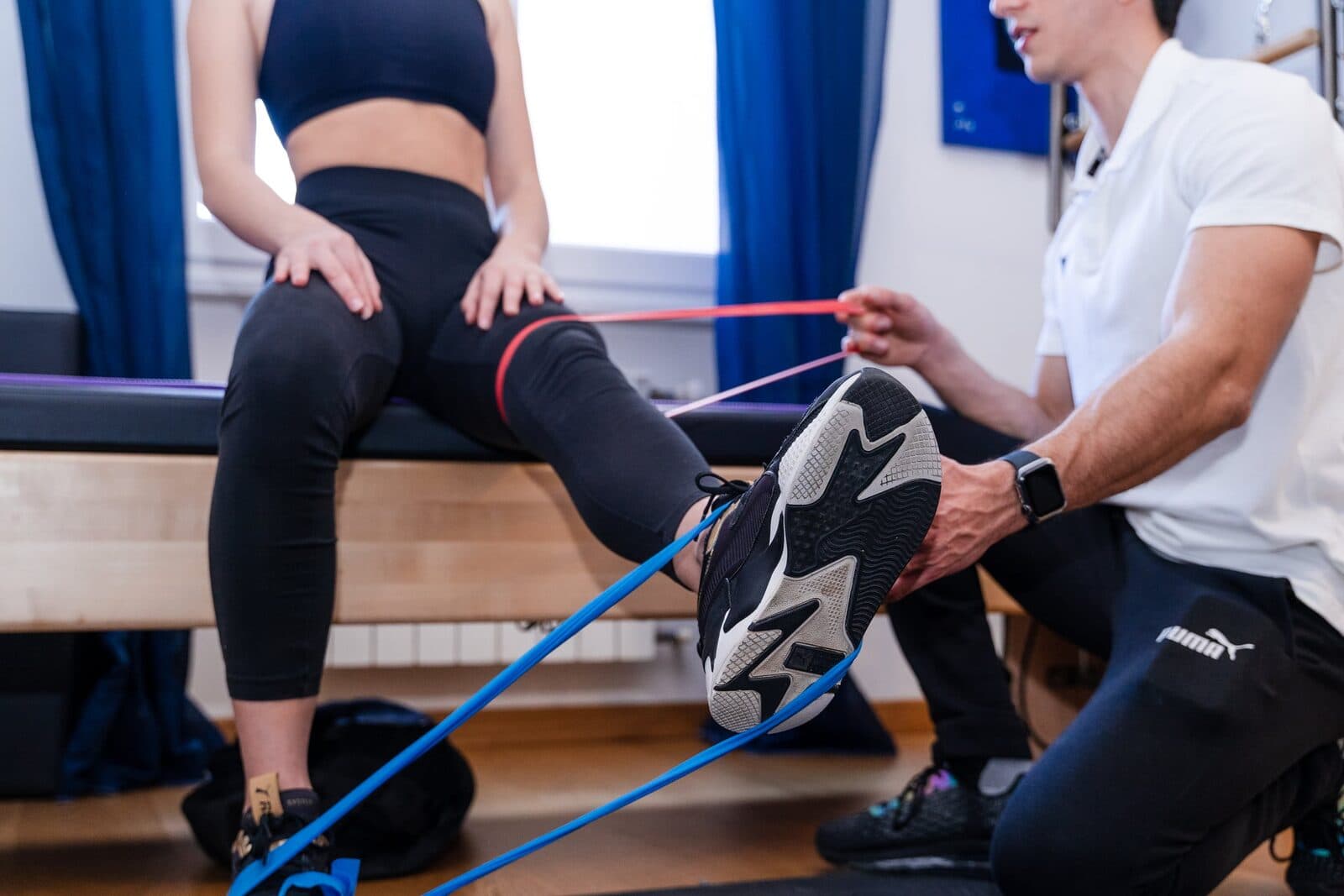
On chronic ankle instability - the swelling that remains after a sprain, together with giving way - the evidence is solid. A 2025 meta-analysis evaluated the effectiveness of therapeutic exercise on this condition, and a systematic review from 2024 focused specifically on balance training. This is not a detail: it is the reference treatment, and the part that is most often skipped after a sprain treated only with rest and ice.
On swelling of venous origin the lever is movement. A Cochrane review examined physical exercise in non-ulcerated chronic venous insufficiency, and a body of studies focuses on the calf pump: the mechanism by which contraction of the leg muscles pushes blood upwards. An ankle that moves little is a pump that does little work - and this is why the swelling worsens on days spent still, whether standing or seated. In pregnancy the same mechanism works amplified - almost half as much extra fluid in circulation and the uterus compressing the pelvic veins - and there the useful part is knowing how to tell predictable swelling from swelling that should be reported: when swelling of hands and feet in pregnancy is normal and when it is not.
On elastic compression there is an evidence-based consensus document defining its indications in venous and lymphatic disorders. It needs saying in full: it is useful when the cause is that, the compression class must be chosen by someone who has assessed you, and in some arterial conditions it is contraindicated. It is not an accessory to buy on the spur of the moment. If you are pregnant, stockings have been studied separately, and it is worth knowing what to expect before spending money: how much they really help on varicose veins and spider veins in pregnancy.
The two things to do right away, while you wait
These apply in almost all non-urgent cases, and they do not replace the assessment:
- Raise the leg above heart level for twenty minutes, a couple of times a day - not resting on a low stool, which does not help;
- Move the ankle actively, pointing the toes up and down repeatedly: this is what activates the calf pump, and it works better than keeping still with the leg raised.
Getting support
A swollen ankle can be the leftover of a sprain never fully recovered, or the signal of something that has nothing to do with the ankle. Telling the two apart is the first step, and it does not require a test: it requires someone to look at the whole picture.
With Ri-Hub the first consultation is free: a physiotherapist on the Italian professional register takes your history, checks whether the swelling is local or general and whether there is instability underneath - and if the picture is medical, they tell you, instead of having you do exercises that are beside the point. Subsequent sessions cost 29,90€.
If the swelling came with a recent sprain and you want to know where you should be by now, read Ankle sprain: recovery times and rehabilitation.
If alongside the swelling you feel the ankle giving way, the chapter is Unstable ankle: causes, exercises and how to strengthen it.
If you spend many hours seated and the swelling is more in the legs than the ankle, the useful exercises are in Leg circulation: exercises for people who sit all day.
Wondering how much it would cost to be followed? The cost depends on how many sessions are needed, not on the single rate: the figures are in How much physiotherapy for the ankle costs.
Sources
- Physical exercise for the treatment of non-ulcerated chronic venous insufficiency - The Cochrane database of systematic reviews, 2016
- Indications for medical compression stockings in venous and lymphatic disorders: An evidence-based consensus statement - Phlebology, 2018
- A systematic review and meta-analysis of balance training in patients with chronic ankle instability - Systematic reviews, 2024
- Effectiveness of exercise therapy on chronic ankle instability: a meta-analysis - Scientific reports, 2025
Last source check: September 2026.