
Bird dog exercise - also written birddog - is one of the movements most taught in gyms and physiotherapy clinics, and one of the most misunderstood. It is presented as the remedy that "strengthens the deep muscles" and protects the back. The literature tells a more sober story, and it is worth knowing before dedicating months of training to it.
The bird dog teaches a real skill: moving arms and legs while keeping the spine still. It is a low-load exercise, easy to grade, that almost everyone tolerates. What has not been proven is that it is superior to other ways of training, or that it works by correcting a specific fault in the deep muscles. In this guide you will find the technique, the mistakes that cancel its purpose, the variations - and the evidence that exists and the evidence that is missing.
⚠ Important: read this before continuing
The exercises and advice in this article are general indications and may not be suitable for your situation. Every person has a unique clinical history: what works for others could be counterproductive for you.
Want a professional's opinion? Start with the questionnaire: you sign up and see who will follow you, a physiotherapist registered with the Italian Register chosen for your case, whom you write to in chat. If you would rather hear their voice, the first consultation is free and we look at your situation together.
First of all: when back pain is not an exercise problem
The vast majority of back pain is benign and improves with movement. A minority is not. Before getting down on the mat on all fours, check that you do not have any of these signs: they are the reasons for calling a doctor rather than looking for an exercise.
- Loss of bladder or bowel control, difficulty urinating, or numbness in the area in contact with the saddle (perineum, inner thighs): this picture requires urgent medical assessment, not postponing until tomorrow.
- Real weakness in a leg or a foot that worsens over the days: a foot that drops, a knee that gives way, difficulty climbing stairs.
- Night pain that does not settle in any position, or that systematically wakes you up.
- Fever, chills, general malaise together with back pain.
- Unexplained weight loss, or a personal history of cancer.
- Trauma (a fall, an accident) or known osteoporosis and pain that appeared suddenly.
None of these signs is managed with the bird dog. In all other cases - the majority - moving is the right path. The American College of Physicians guidelines for chronic low back pain in fact recommend starting with non-drug treatments, and put exercise at the top of the list, together with approaches such as spinal manipulation, yoga, tai chi and cognitive behavioural therapy.
The full list of warning signs that should be seen by a doctor before a physiotherapist is in urgent symptoms.
What the research really says
Here is the point that almost no article on this exercise addresses.
Stabilisation exercises work, but no better than the others. The Cochrane review on motor control exercises - the family to which the bird dog belongs - gathered 29 randomised trials and 2,431 participants with chronic non-specific low back pain. Verdict: compared with a minimal intervention the benefit exists and is clinically relevant (in the long term, mean difference on pain of -12.97 points; 95% CI from -18.51 to -7.42). Compared with other forms of exercise, however, no clinically important difference emerges, at any point of follow-up. For completeness: the same review finds that motor control gives similar results to manual therapy too (moderate to high quality evidence), while it proves superior to the comparison "exercise plus instrumental physical therapies" (short-term pain, mean difference -30.18) - but this last figure rests on evidence of very low to low quality, and the comparison is with a different package, not with exercise alone. The authors conclude that the choice of exercise should depend on the preferences of the patient and the therapist, on the training of the latter, on costs and on safety.
An independent meta-analysis of stabilisation exercises reaches the same place: 29 included studies, of which 22 with pain data (2,258 patients) and 24 on disability (2,359). Compared with any alternative treatment or control, the long-term advantage exists on a statistical level - pain -6.39 and disability -3.92 points on a 0-100 scale - but the difference between the groups is clinically insignificant. And in the direct comparison with other forms of active exercise, no difference remains, either statistical or clinical.
A third meta-analysis, of 5 studies and 414 participants, finds an advantage of core stability work over generic exercise only in the short term (mean difference on pain -1.29; on disability -7.14). On pain that advantage had already faded at 6 and at 12 months; on long-term disability the study provides no data.
A clarification that changes how all these numbers should be read. None of these reviews studied the bird dog. They studied programmes of exercise - usually individualised, progressive and supervised by a physiotherapist - of which the bird dog is at most one ingredient among many. There is no literature that measures this single movement performed alone on the mat at home. When it is said here that "it works but no more than other things", one is talking about the family to which it belongs, not about evidence on it.
What this means in practice. The bird dog is a good exercise, and continuing to suggest it makes sense. But if someone tells you it is the exercise that fixes your back, they are promising more than is known. What the evidence shows is that the choice of form matters much less than is made out: what moves the results is the fact of training, not which exercise you choose. Paradoxically, this is good news: you can choose the exercise that suits you, that does not hurt you and that you can keep up for months. If that is the bird dog, excellent.
And prevention? Here the evidence is more solid, but it concerns exercise in general, not this movement in particular. A meta-analysis of 21 randomised trials and 30,850 people showed that exercise combined with education reduces the risk of an episode of low back pain (RR 0.55; 95% CI 0.41-0.74), with moderate-quality evidence. No study isolates the bird dog on its own.
The "weak core" as a cause. The idea that back pain arises from weak or "switched off" deep muscles, and that exercise works because it reawakens them, is a suggestive model that the evidence does not confirm. If that mechanism were the true one, exercises designed specifically to train it should beat the others: they do not. Keep doing it, but for the right reason.
What it trains, concretely
Beyond the promises, the bird dog has precise technical features that make it useful in a programme.
Resisting extension. When the leg goes back, the pelvis tends to tilt and the lumbar area to arch. The task is to prevent this. It is a work of control, not of maximal strength.
Resisting rotation. Extending opposite arm and leg creates a couple that tends to rotate the trunk. Preventing this brings the obliques and the lateral trunk muscles into play.
Asymmetric and measured activation. An electromyographic study on 29 healthy volunteers analysed the activity of the trunk muscles in various stabilisation exercises: in the bird dog the greatest activity was found in the internal oblique on the side of the raised arm and in the contralateral spinal erector. It is therefore not an exercise "for the abs": it is a crossed control task, and this explains why it feels more like balance than effort.
Crossed pattern. Right arm with left leg is the same pattern as walking and running: a context familiar to the nervous system.
Low load. It is the most concrete reason why it is used early in rehabilitation: the spine stays unloaded, and those who are afraid of moving take it on more willingly than a deadlift or a long plank.
Muscles involved
The bird dog does not isolate anything: it distributes light work across many areas that have to cooperate.
An important tip: before trying these exercises, make sure you have received a correct diagnosis. People often think they have one problem, but the real cause of the pain is another. Performing the wrong exercises can make the situation worse instead of better.
Abdominal wall: transversus abdominis, internal and external obliques, rectus abdominis. They work in a stabilising way - to prevent a movement, not to produce it.
Posterior trunk muscles: spinal erectors, multifidus, quadratus lumborum. They help keep the spine still while the limbs move.
Gluteus maximus: extends the hip, that is, brings the leg back. It is the engine of the gesture from the lower side.
Posterior deltoid and scapular muscles: they bring the arm forward and hold the shoulder blade in position, which is the part that gives way first when you get tired.
Correct technique, step by step
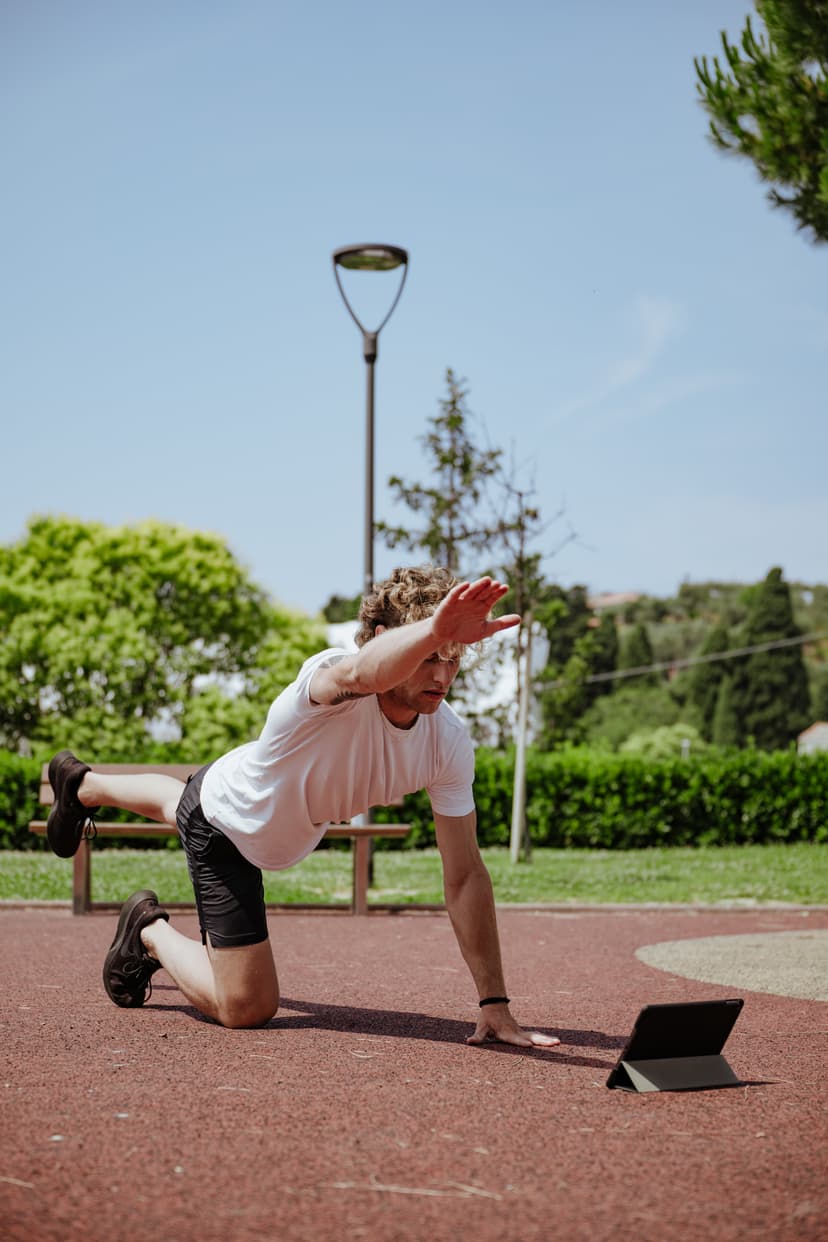
Starting position. On all fours: hands under the shoulders, knees under the hips. Neutral back, that is, with the natural curves preserved - neither flat nor arched. Gaze at the floor, head in line with the rest of the spine.
Preparation. Lightly engage the abdominal wall, as if you were about to receive a push on your stomach. "Lightly" is the key word: a maximal contraction stiffens everything and stops you from breathing.
Extension. Bring the right arm forward and the left leg back, slowly and together. They stop when they are in line with the trunk, not beyond: lifting further adds no useful work, it only adds lumbar extension.
Hold. In position, from hand to foot there should be a single line. The hips stay parallel to the floor.
Return. Bring arm and leg back to the floor with the same control with which you took them out. The return phase is where most people lose the position.
Alternation. Repeat on the other side: left arm, right leg.
Common mistakes to avoid
Pelvic rotation. It is the number one mistake. When the leg rises, the pelvis rotates towards that side and the exercise stops doing what it should. The classic trick: imagine a glass of water resting on the lower back that must not spill. If you have a phone, rest it there and use it as a spirit level.
Lumbar hyperextension. Leg too high, back arching. It is the most common way of turning a control exercise into a stress on the area you wanted to protect.
Going fast. The bird dog is not a speed exercise: if the movement is rapid, inertia does the work instead of the muscles, and very little remains.
Holding the breath. Breathe normally throughout the set. If you cannot talk while doing it, you are gripping too hard.
Head extended. Looking forward instead of at the floor needlessly loads the cervical spine: the head stays in line with the spine.
Pushing through pain. A mild discomfort that does not get worse and disappears at the end of the set is acceptable. A pain that increases repetition after repetition, or that leaves you worse the following day, is a stop signal, not an obstacle to overcome.
Easier variations
If the full version makes you lose the position, it falls apart.
Arm only. On all fours, extend only the arm: the balance challenge is greatly reduced and you can concentrate on keeping the pelvis still.
Leg only. Both hands on the floor, extend only the leg. This is where you learn to resist hip extension without arching.
Toe touching. Extend arm and leg, but let the foot just touch the floor instead of lifting it fully. It reduces the destabilising moment while keeping the full gesture.
Advanced variations
When the basic version is clean and boring, the bar is raised.
Isometric hold. Stay in position for a few seconds before returning, instead of returning straight away.
Elbow-to-knee touch. From the extended position, bring elbow and knee together under the body, then extend again. It adds a dynamic and coordination component.
With an elastic band. A mini band around the wrists or ankles increases the muscular demand.
Unstable surface. Hands on a BOSU or knees on a cushion. It increases the demand for control, but it is a progression, not a requirement: nobody has to go through this.
Perturbations. In the extended position, small circles with the hand or the foot. You train the ability to react without losing your balance.
How to fit it into the programme
In the warm-up. Before a training session, a few sets per side: it prepares the trunk without tiring it.
In a stability circuit. It pairs well with the dead bug, the plank and the pallof press, which all demand control in different directions.
As active recovery. Between sets of heavy exercises, as an active pause.
As a maintenance routine. If you have a history of recurrent episodes, a short, regular block is more sustainable than a long session now and then - and for prevention the evidence concerns programmes carried on over time, not isolated sessions.
How much and how often
It must be said honestly: there is no demonstrated optimal dose for this exercise. The numbers that circulate - three sets of ten, every day - are practical conventions, not study results. What can reasonably be said:
- It is a low-load exercise, so most people tolerate it even on consecutive days.
- A few repetitions done well are worth more than many done badly: when the pelvis starts to rotate, the set is over, regardless of the number you had in mind.
- Slowing down is the simplest way to make it harder, without touching the equipment.
- The progression criterion is quality, not counting: first it becomes clean, then it becomes longer or more demanding.
Particular situations
Chronic low back pain. It is one of the most common uses and it makes sense: low load, easy gradation. But it should be part of a broader programme of exercises for chronic low back pain, not used as a single exercise. Remember the starting point: the advantage over other forms of active exercise is not proven.
After spinal surgery. The Cochrane review on rehabilitation after lumbar disc surgery included 22 randomised trials and 2,503 participants. Programmes started 4-6 weeks after the operation are better than doing nothing for pain and function in the short term (5 studies, 272 patients for pain). Comparing the different types of programme with one another - multidisciplinary rehabilitation, graded activity, strength and stretching - no differences emerge; the only exception recorded by the review is that high-intensity programmes seem to reduce pain and disability a little faster than low-intensity ones, on just 2 studies and 103 patients and with very low-quality evidence. No differences, on the other hand, are found between supervised exercise and exercise done at home. The overall quality of the evidence is low to very low. A reassuring point: none of the studies reported an increase in the rate of re-operations linked to exercise. The timing and the methods, however, are decided by whoever operated on you - not by an article.
Pregnancy and postpartum. (What is safe and what is not, trimester by trimester: exercise in pregnancy.) The all-fours position is generally comfortable in pregnancy and the load on the spine is minimal. On effectiveness precision is needed: a meta-analysis gathered 32 studies of every design, for 52,297 women overall. The data on probability come from 13 randomised trials: exercise in pregnancy does not reduce the probability of having low back or pelvic girdle pain, either during pregnancy or after birth. The data on intensity come from another 15 randomised trials: those who exercised report pain that is less intense during pregnancy and in the early postpartum period (standardised mean difference -1.03; 95% CI from -1.58 to -0.48). In both cases the quality of the evidence ranges from very low to moderate. Translated: it helps you feel better, not avoid the problem. And if it is not your first pregnancy the starting point is higher: in the Norwegian cohort of 75,939 women, pelvic girdle syndrome affected 11% of those having their first child and 18% of those who already had one, as we explain in why the pelvis hurts more in a second pregnancy. It must always be agreed with whoever is following the pregnancy.
If nothing changes after a few weeks
It happens, and it is useful information, not a failure. If the pain does not move despite regular, well-performed work, there are three reasonable hypotheses: the exercise is too easy and needs progressing; the overall load of your day (work, sleep, stress, other activities) weighs more than the exercise session; or the starting problem is not what you thought. In all three cases the answer is not to add repetitions, but to have someone look at the situation.
Telerehabilitation: why it can help
The limit of the bird dog done alone is that the mistakes that matter - pelvic rotation, lumbar extension, scapular compensation - are exactly the ones that cannot be seen from the inside.
With Ri-Hub you can consult qualified physiotherapists from home, for 29,90 euro per session. The physiotherapist watches how you perform it, corrects in real time, chooses the variation suited to your level and - if needed - tells you that for your case there is a more sensible exercise than this one.
Conclusion
The bird dog is a well-built exercise: low load, easy progression, intelligent control demands and tolerable even for those who are afraid to move their back. These are excellent reasons to include it in a programme.
It is not, as far as we know today, the exercise that fixes back pain, nor the correction of a deep fault. Systematic reviews say that exercises of this family beat doing nothing and draw level with other forms of movement. This shifts the right question from "which is the best exercise" to "which exercise will I be able to do for the next six months". If the answer is the bird dog, you have made a good choice - and now you also know why.
You will find this and 82 other exercises, each with execution, common mistakes and variations, in the exercise library.
Sources
- Motor control exercise for chronic non-specific low-back pain, Cochrane Database of Systematic Reviews, 2016
- An update of stabilisation exercises for low back pain: a systematic review with meta-analysis, BMC Musculoskeletal Disorders, 2014
- A meta-analysis of core stability exercise versus general exercise for chronic low back pain, PLoS One, 2012
- Prevention of Low Back Pain: A Systematic Review and Meta-analysis, JAMA Internal Medicine, 2016
- Trunk muscle activation during stabilization exercises with single and double leg support, Journal of Electromyography and Kinesiology, 2012
- Noninvasive Treatments for Acute, Subacute, and Chronic Low Back Pain: A Clinical Practice Guideline From the American College of Physicians, Annals of Internal Medicine, 2017
- Rehabilitation after lumbar disc surgery, Cochrane Database of Systematic Reviews, 2014
- Exercise for the prevention and treatment of low back, pelvic girdle and lumbopelvic pain during pregnancy: a systematic review and meta-analysis, British Journal of Sports Medicine, 2019
Last source check: August 2026.
You might also be interested in:
Unstable Ankle: Causes, Strengthening Exercises and Treatment
Shoulder Pain Causes: Complete Guide to Understanding the Origin
Stay in touch with us
Join our dedicated Facebook group: we reply to all patients, give practical advice and clear up the most common questions.
Need a consultation?
If you feel something is wrong while doing it - a sharp pain, a discomfort that stays the next day, one side behaving differently from the other - that is the moment to ask, not to keep pushing by changing videos. A physiotherapist watches how you perform it and tells you whether it is technique, load or something to assess before: 20 minutes on a video call, free and with no credit card.