

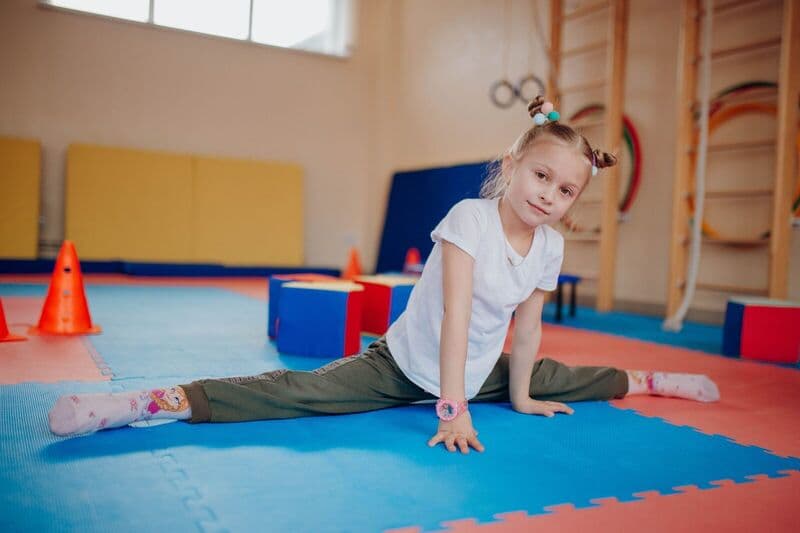
It is half past seven. The plate is still half full and your child has already slid forward: bottom on the edge of the chair, back curved like a banana, cheek on the hand, one leg tucked underneath. You tell them to sit properly. They straighten up for twenty seconds. Then they get up to fetch water they do not need. At school, your child's teacher tells you, it is the same story.
I will give you the two answers straight away, because they are less obvious than they seem.
The first: sitting still is not only a matter of willpower, it is a motor task, and the control it requires matures much later than we think. A child who struggles to keep their trunk upright while their hands are busy is not "just uncomfortable": they are looking for support. An elbow on the table is a support. A head on the hand is a support. A foot tucked under the bottom is a support. And when the supports are no longer enough, they get up.
The second, the most concrete thing in the whole article: look at the feet. If they dangle in mid-air, you have already found part of the problem, and it can be fixed tonight with a box.
First of all: this is not an article about ADHD
Let us say so straight away, because it is probably why you ended up here.
A child who will not sit still brings one thing to mind, and the internet pushes everything in that direction. We do not make behavioural diagnoses and this article does not make one: neither to tell you your child has something, nor, just as importantly, to reassure you that they do not.
What we can speak to with competence is the other half of the question, the one almost nobody looks at: trunk stability while seated. It is real, it is measurable, and it can be sorted out in a few minutes without buying anything. If the problem stays exactly the same after it has been sorted out, that is already useful information, and at that point the right place is the paediatrician. I will come back to the when at the end.
Sitting and staying seated are two different things
In the developmental record it says when your child first sat up on their own, and it happened very early. The WHO Motor Development Study followed 816 children in five countries to build the windows of normality for motor milestones: for sitting without support the range runs from 3.8 to 9.2 months (1st to 99th percentile), the narrowest of the six milestones measured.
But "sitting" and "staying seated still while you eat, write or listen" are two different tasks. The second requires keeping the trunk stable while the arms and head move, and this is where development is very slow.
A Dutch study used electromyography to measure what happens in the muscles of 29 typical children aged 2 to 11, compared with 10 adults, while they reached out an arm sitting down. The result is the most useful thing you can know on this subject: the development of postural adjustments while seated is non-linear, prolonged, and at eleven it is still not complete. In particular, anticipatory muscle activation, which is consistently present in adults, was practically absent across the whole 2-11 age range.
It is worth spelling out, because it explains tonight's scene. When you reach for the salt, your trunk gets ready before the arm moves: you do not even notice it. Your child, largely, does not: they lean off balance and then correct. Correcting means moving. What you see as restlessness, from a motor point of view, is often adjustment.
And the systems that hold all this together mature even later. A study of 140 children aged from 3 years 5 months to 16 years 2 months, plus 20 adults, broke down balance by sensory channel: proprioception seems to mature already by 3-4 years, but vision and the vestibular system reach adult levels only at 15-16. It is a measurement taken standing, not seated, and that should be said; but it still makes an important point: the balance department of an eight-year-old is not an adult in miniature, it is a building site.
Up to when is it normal not to hold a position for long?
Here I have to disappoint you, and it is better that way: there is no study that establishes how many minutes a child of a given age should be able to stay still. Even the guidelines do not venture numbers on seated time: the WHO 2020 guidelines recommend reducing sedentary behaviour at all ages, but state explicitly that the evidence was not sufficient to quantify a threshold for sedentary behaviour, and that, incidentally, is already a different question (how much sitting time is harmful to health, not how many minutes a child can stay still). If someone gives you a precise figure, such as "at six they must manage fifteen minutes", they are making it up.
Instead of a number, you can use two observations.
The first: do not watch whether they move, watch whether they can come back. All children move at the table. What counts is whether, when you ask, they climb back into a decent position and hold it for a while, or whether after three seconds they are hanging off their elbow again. In the second case they are not being disobedient: they are running out of fuel.
The second: watch whether they always look for the same support. Those who compensate do it repetitively: always that elbow, always that leg underneath. Variety is a good sign; monotony of support, less so.
The easiest thing to fix: the feet
When the feet do not rest on the floor, the weight of the legs pulls forward over the edge of the seat. The child has only two solutions: slide forward until the feet find something, or hang on to the table with elbows and forearms. You see both every evening.
There is also a direct measure, though a small one. A study of 15 typically developing children (mean age 9.3 years) compared the seated reach test with and without foot support: with the feet supported the distance reached was significantly greater in all four directions. It should be taken for what it is: a small sample, a study designed to measure the reliability of the test, and trunk and pelvis angles that did not change significantly. But the direction is consistent with what you see at home: with the feet on the ground a child can lean further without losing balance, so they have less need to hold on.
And the problem is more widespread than you might imagine, although the measured data mostly concern older children than yours. In three schools in Chile, among 195 young people aged 12.5-14.5 (eighth school year, roughly Italy's third year of middle school), the seat height matched the popliteal height only in 14% of cases in two of the three schools and in 28% in the third; the desk relative to the seat was too high for 99-100% of the students. And at primary level the same thing is measured: in a school in Hong Kong, among 214 students in fifth and sixth grade, the authors write that almost none had a chair with an appropriate seat height.
Translated into five checks, to do tonight, without buying anything:
- Do the feet rest fully on the floor? If they dangle: a footrest, a sturdy box, a ream of paper. Nothing else is needed.
- Are the knees bent at roughly ninety degrees, with the thighs almost horizontal? If the feet do not reach the floor the seat is too high, and that is by far the most frequent case.
- Is there two or three fingers' width between the front edge of the seat and the crease behind the knee? If the seat is too deep, they either lean their back against the back rest with their legs dangling, or they rest their feet and give up the back rest.
- Is the table at the height of their elbow when seated? Arms relaxed, elbow at ninety degrees: that is the height. A table that is too high lifts their shoulders and forces them to haul themselves up.
- The "table removed" test: ask them to sit for twenty seconds with their hands in their lap, without leaning on anything. If without the table in front of them they collapse at once, that table was not a table: it was a crutch.
A clue, not a rule: in the Dutch study on postural adjustments four conditions were tested (a horizontal seat with and without extra load, tilted 15 degrees forward, tilted 15 degrees backward), and the authors suggest that the forward-tilted one is the most efficient for postural control. It is a laboratory observation on 29 children, not a trial, but if you have a wedge cushion it is worth a try.
For the details on desks and chairs, which measurements really matter and which are only marketing, see Desk and chair for homework: what really matters.
What trains through play (and what does not need buying)
Seated posture is not trained by sitting. It is trained in games in which the trunk has to hold steady while the arms do something else, which is exactly the task you ask of them at the table:
- the wheelbarrow (you hold their ankles, they walk on their hands for three metres);
- crawling under the table or through a tunnel;
- throwing and catching a ball while sitting on the floor with legs crossed, without using the hands for support;
- walking like a bear, like a crab, like a crayfish;
- climbing, at the park or on a children's bouldering wall;
- swinging on the swing, in a hammock, on a rocking seesaw.
Here I have to be precise about what the research shows and what it does not: there is no study that says "the wheelbarrow improves posture at the table". What exists concerns movement in general, and it is solid nonetheless. A meta-analysis of 22 articles describing 19 interventions on basic movement patterns found large effects on overall motor competence (standardised mean difference 1.42, 95% confidence interval 0.68 to 2.16) and on locomotor skills, and medium effects on object control (0.63). With two honest caveats: many of the included studies had poor scores on the risk-of-bias indicators, and the programmes that worked were run by someone who taught, physical education teachers or trained instructors, not simply extra free time. On how much, the WHO 2020 guidelines recommend for children and young people aged 5 to 17 an average of 60 minutes a day of moderate-to-vigorous activity across the week, plus muscle-strengthening activity.
And now the part that saves you money. Unstable surfaces are not magic. In a randomised trial of 27 healthy teenagers aged 13-15, six weeks of trunk work twice a week increased the strength of the trunk muscles by 8-22%, but doing it on unstable surfaces gave no significant advantage over stable surfaces, except on a single flexibility test. The sample was small and the participants were adolescents, not six-year-olds; but the direction is useful: what trains is the exercise, not the wobbly cushion.
If you want the full repertoire by age band, I have put it in Active games for children: what to suggest, age by age.
Balls, cushions and active seating: what the evidence really says
The inevitable question, with a clear answer: the evidence on "dynamic" seating is thin, and almost all of it was gathered in children with ADHD.
The most cited study, the one on exercise balls in place of chairs, is a single-subject design on three children with ADHD in fourth grade: it showed an increase in the time actually spent seated and in the legible words produced, and both the teacher and the children preferred the balls. Interesting, but three children do not make a recommendation. A later study of 23 children (11 with combined-type ADHD, 12 without) compared a classic chair, a ball and active seating: the best results were with active seating, again in the ADHD group.
How I read it: if you already have a ball or an air-cushion, try it, it does no harm and some children like it. But it is not the first thing to do, it is not a cure, and it comes after the footrest, which costs nothing and rests on firmer reasoning.
Movement breaks work, but not on what you think
If the postural task lasts too long, the solution is not a better chair: it is to break it up.
A systematic review selected 18 studies on movement breaks and active learning in the classroom, starting from 2,929 articles: classroom behaviour improved in 9 of 11 interventions, with breaks of moderate-to-vigorous activity over 10 minutes, or shorter and more intense breaks of 5 minutes. A second review, covering children and young people aged 4 to 18, reaches similar conclusions on attention and time on task.
But here is the limit nobody mentions: on cognitive outcomes and academic performance the same authors say there was not enough support, and methodological quality ranged from low to moderate (risk of bias between 33% and 64.3%). The break gives you a child who feels better sitting down afterwards, not a child who gets better marks. At the table and during homework, that is already what you need.
In practice: before the fuel runs out, not after. Getting up to carry the plate, five minutes of stairs between one task and the next, a change of position at every change of subject.
When it is attention and not posture
Some signals shift the suspicion, and it is worth recognising them rather than going around them.
The first is context. Postural fatigue is selective: it shows up when the task goes on, when the workstation is wrong, towards evening. If instead your child cannot sit still in any context, not even in the ones they really love, the postural explanation explains little.
The second is other signals together: they lose things, do not finish what they start, get distracted mid-sentence, interrupt, seem not to listen. This is not a checklist to tick and not a diagnostic criterion: no diagnosis is made by reading an article, and this article is not proposing one. It is simply why, in that case, the postural explanation on its own explains little: posture does none of that.
The third is duration and places: it has gone on for months, and it is not only you who notices it: school reports it too.
If your situation matches this description, the right place is the paediatrician, not the physiotherapist. The American Academy of Pediatrics guidelines, updated in 2019, say exactly this: it is the paediatrician, or the primary care doctor, who starts the assessment for a child or young person aged 4 to 18 who has school or behavioural problems, following a care algorithm that includes screening for associated conditions (anxiety, depression, learning and language disorders, sleep disorders). It is not a box to tick, it is not decided by watching a child at the table, and it is not our area.
And if the picture is instead that of a child who is generally clumsy, who falls, bumps into things, struggles with a ball and with shoelaces, that is a different chapter: you will find it in Clumsy child: when coordination is a disorder.
Red flags: when not to wait
These are not to be observed, they are to be taken to the doctor. With explicit thresholds.
- Any regression: they used to do things they no longer do (ran, climbed stairs, sat better six months ago). Paediatrician within a few days, not "let us see if it passes".
- Struggles to get up from the floor and helps themselves by pressing their hands on their own legs to haul up, or climbs stairs one step at a time holding on, or tires much faster than peers when walking. Paediatrician, at any age: in boys this is the situation in which a simple blood test (creatine kinase) is requested. The diagnosis of Duchenne muscular dystrophy often comes after age four, with a delay that can reach two years from the first signs, and this test is inexpensive and sensitive.
- Back pain that wakes them at night, or that lasts for more than four weeks without a single day of improvement. Back pain in children is not rare: in a meta-analysis of 59 studies the twelve-month prevalence, estimated from the 13 studies that measured it, is 33.6%; but these two features make it something to assess.
- Fever, weight loss, a child who is clearly unwell along with the pain: medical assessment straight away.
- Weakness or loss of strength in one leg, tingling that does not go away, difficulty walking, problems controlling wee and poo: A&E, the same day. This is not a matter for physiotherapy, neither online nor in a clinic.
- Does not sit still in any context, for more than six months, and school also reports it: paediatrician, for attention, not for posture.
What a physiotherapist can do (and what they cannot)
A therapy is almost never needed because a seven-year-old cannot sit through dinner. What is needed is for someone to watch how they really sit, at their own kitchen table and on their own chair, and to tell apart the three things that always get mixed up: how wrong the workstation is, how much trunk control they have for their age, and how much the problem is not motor at all and needs to go elsewhere.
It works well by video call, precisely because the place to watch is your home and not a clinic: it is enough to set the camera at the side while your child eats or does homework. With Ri-Hub Junior you start with a free 20-minute first consultation: we tell you what to change today and, if needed, which games make sense for them. Up to age 10 sessions last 50 minutes and cost 59,90 €; from age 11 to 18 they are standard sessions at 29,90 €.
If instead a complex neurological or neuromuscular condition is involved, the right place is not us: those pathways require in-person assessments and specialised centres.
In the meantime, tonight: look at the feet. It is free, it takes ten seconds, and it is the one thing nobody has checked yet.
What really improves movement, across the 19 randomised studies that measured it: sport and school performance.
Sources
- WHO Motor Development Study: windows of achievement for six gross motor development milestones: Acta Paediatrica Supplement, 2006
- Development of postural adjustments during reaching in sitting children: Experimental Brain Research, 2003
- Effect of age and sex on maturation of sensory systems and balance control: Developmental Medicine & Child Neurology, 2006
- Reliability and comparison of trunk and pelvis angles, arm distance and center of pressure in the seated functional reach test with and without foot support in children: Gait & Posture, 2017
- Mismatch between classroom furniture and anthropometric measures in Chilean schools: Applied Ergonomics, 2010
- Anthropometric evaluation for primary school furniture design: Ergonomics, 2007
- Fundamental movement skill interventions in youth: a systematic review and meta-analysis: Pediatrics, 2013
- Effects of core strength training using stable versus unstable surfaces on physical fitness in adolescents: a randomized controlled trial: BMC Sports Science, Medicine and Rehabilitation, 2014
- Systematic review of acute physically active learning and classroom movement breaks on children's physical activity, cognition, academic performance and classroom behaviour: BMJ Open Sport & Exercise Medicine, 2018
- Effect of classroom-based physical activity interventions on attention and on-task behavior in schoolchildren: a systematic review: Sports Medicine and Health Science, 2021
- Classroom seating for children with attention deficit hyperactivity disorder: therapy balls versus chairs: American Journal of Occupational Therapy, 2003
- Dynamic Seat Assessment for Enabled Restlessness of Children with Learning Difficulties: Sensors, 2022
- World Health Organization 2020 guidelines on physical activity and sedentary behaviour: British Journal of Sports Medicine, 2020
- Clinical Practice Guideline for the Diagnosis, Evaluation, and Treatment of Attention-Deficit/Hyperactivity Disorder in Children and Adolescents: Pediatrics, 2019
- Detecting early signs in Duchenne muscular dystrophy: comprehensive review and diagnostic implications: Frontiers in Pediatrics, 2023
- Prevalence of low back pain in children and adolescents: a meta-analysis: BMC Pediatrics, 2013
Last source check: September 2026.



