

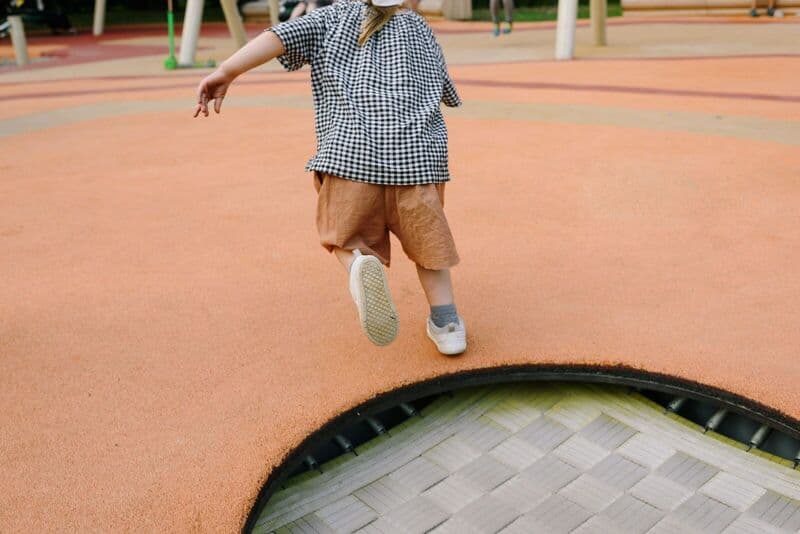
There is an afternoon in the gym, or on a lawn, and a child is trying. They put their hands on the ground, push, and then stop there: head tilted to one side, the body not turning. The others around them roll forwards and backwards as if it were nothing. They try again twice, then go off to do something else. And you ask yourself the question nearly every parent asks sooner or later: is it normal that at this age they cannot do a somersault?
The short answer is that almost always there is nothing wrong with the child: there is something that has not been taught. And the part worth reading is the why.
Basic motor skills are three families, not one
When people talk about basic movement patterns, or, in the scientific literature, fundamental movement skills, they mean a group of movements that sit underneath everything else. A systematic review dedicated to the terminology describes them as the "building blocks" of more complex movements, and, which says a lot about the state of the field, found that about a quarter of the studies published between 2000 and 2015 did not even give an explicit definition of them.
They fall into three families:
- Locomotor: moving your body through space. Running, jumping with both feet, hopping on one foot, galloping, sliding sideways, climbing.
- Object control: managing something that moves. Throwing, catching, kicking, striking, dribbling.
- Stability: controlling the body while its orientation changes. Balancing, turning, landing, rolling.
The somersault belongs to the third family, and that is why it is rarely talked about. A 2015 study had to build from scratch a battery to measure stability skills in children aged 6-10, precisely because research had focused almost only on locomotion and ball skills. The interesting result of that study is twofold: stability turned out to be a factor independent of the other two, it is not the sum of running and throwing, and children who did gymnastics did significantly better than those who had never done it.
In plain terms: rolling does not arrive as a gift from running. It has to be practised.
The age windows, as far as they are really known
Honesty is needed here, because tables far more precise than the data allow are circulating online.
The most useful snapshot comes from a cross-sectional study of 2,200 children in Tehran aged between 2.5 and 14, assessed with a scale that classifies each movement as mature or immature. Mastery of walking and running appeared already from age 2.5. Mastery of the more complex locomotor skills (jumping, hopping on one foot, skipping, climbing a ladder) and of all ball skills emerged instead around age 6. And under age 9 almost all of them were still not widespread: hopping on one foot, jumping, skipping and every ball skill.
At age 9, in that sample, throwing was mastered by 100% of boys and 89% of girls, catching by 89% and 65%, while kicking lagged well behind (45% and 41%). From age 11 onward everyone was competent at all skills except, once again, kicking.
Two caveats before using these numbers as a yardstick. The first: it is an Iranian sample, measured with a specific tool, and not an Italian norm. The second, more important: these numbers describe what children do, not what they could do. They are a snapshot of average exposure, not a biological timetable.
And the somersault? It is not there. It does not appear in the standard batteries, so there is no reference age below which a child can be said to be late. Anyone who gives you one is making it up. If you are interested in milestones that do have a normative age, we have gathered them in when a child starts to jump, run and climb stairs.
The data that changes decisions: they do not arrive on their own
This is the part that matters most in the article, and it comes from the reference meta-analysis on motor interventions in children.
In the groups that received a structured programme the average effect on motor skills was d = 0.39 (statistically significant), with similar improvements for object control (d = 0.41) and for locomotor skills (d = 0.45). In the control groups, that is children left to free play alone, the effect was d = 0.06 and not significant. The authors place this in the first lines of the abstract, and it is worth translating it word for word: children do not develop these skills naturally through maturation processes; they must be learned, practised and reinforced.
A systematic review published in Pediatrics in 2013, of 22 studies (6 of them randomised), found large effects on overall motor competence and on locomotor competence, and a medium effect on object control, while noting that many of the included studies had a high risk of bias. A more recent review, from 2025, brought together 33 studies from 14 countries: the pooled estimate, which however comes from nine of those interventions rather than all thirty-three, is SMD 0.69, with very high heterogeneity between studies. The analyses indicate that the sessions that work are 60 minutes or more, at least three times a week, for 10-20 weeks.
That they do not arrive on their own is also visible when looking at populations. In three representative Australian surveys between 1997 and 2010, on almost 14,000 young people aged 9 to 15, the percentage performing the measured movements correctly almost never exceeded 50%, even as the years passed and the children grew.
And now the honest counterweight, because the literature is not all enthusiastic. In one of the largest randomised studies on this topic, 46 Norwegian kindergartens, 819 children, 18 months of intervention with 50 hours of training for staff, there were improvements, but small ones: 0.17 on object control at 7 months and 0.21 on locomotor skills at 18 months, with no effect on balance. In Italy, a programme for preschool children tested on 119 children aged 3-6 improved balance, aiming and manual dexterity compared with the standard curriculum, but with only three kindergartens involved and one month between the start and the final measurement.
The reasonable summary is this: teaching works better than not teaching, but it is not magic. It needs consistency, and it needs someone to show the movement.
Why it matters later on
The strongest argument for dealing with this is not aesthetic. It is that motor competence in childhood is associated with how much people move afterwards.
The most cited longitudinal data come from an Australian cohort: children assessed at school in 2000 and contacted again as adolescents in 2006-07. Those who were competent in ball skills (kicking, catching, throwing) were, as teenagers, 10% to 20% more likely to do vigorous physical activity. Models linking childhood competence to time spent as adolescents in moderate-to-vigorous activity and in organised activity explained 12.7% and 18.2% of the variability respectively. The same group showed that the link largely passes through perceived competence: those who feel capable in sport stay in it.
A systematic review from 2010 had already classified the evidence of an association between motor competence and physical activity in children and adolescents as strong, along with a positive link to cardiorespiratory fitness and an inverse one with weight. A 2023 meta-analysis of 61 studies and over 22,000 adolescents confirms positive but modest correlations (r between 0.20 and 0.26).
And here the limit has to be stated, because it is the one nobody writes. A systematic review from 2022 that brought together mediation analyses, longitudinal studies and experiments classified the pathway from motor competence to physical activity as "indeterminate": the strong evidence concerns the pathway mediated by physical fitness, in both directions. And in the youngest children the opposite direction seems to apply: a meta-analysis of children aged 3-6 found correlations of 0.20 between motor skills and movement, but the available longitudinal studies suggest that in early childhood it is movement that drives the skills, not the other way round.
Read in practical terms, this does not change what to do. It only changes the promise: you are not buying a sporty teenager. You are removing an obstacle that, if it stays, tends to make them stop.
How they are trained, through play
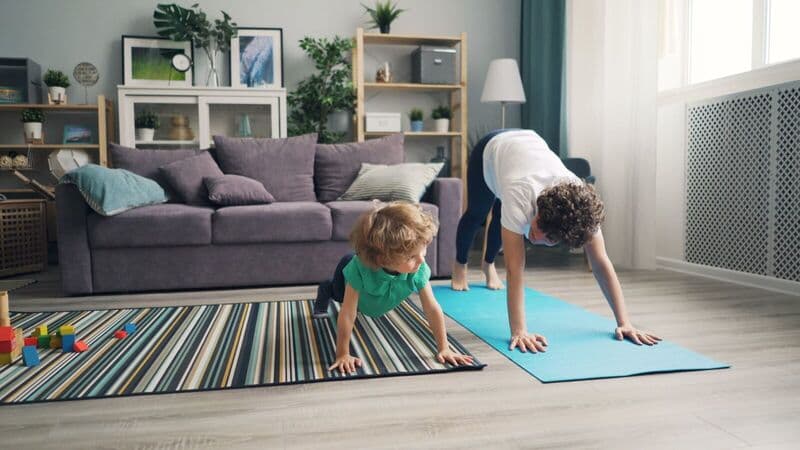
The principle is one only: someone has to show the movement and have it repeated. It is not training, it is company with an intention.
For locomotor skills. Hopscotch with chalk (hopping on one foot is the item that stays behind the longest). Jumping down from a low step, landing with bent knees. Sideways galloping along the corridor. Obstacle courses with cushions and chairs to go under, over and around.
For ball skills. Start with a balloon: it flies slowly and gives time to react, which is the real obstacle in catching. Then a large, soft ball, thrown from above towards the chest, with cupped hands and bent elbows. Then against a wall. Then targets on the ground to hit. Thirty repetitions done laughing beat any explanation.
For stability, somersault included. Rolling sideways on the grass, fully, from one end to the other. Walking along a line, then along a low kerb. The statue game. For the actual somersault: a slightly inclined surface (a mat on a large cushion), hands on the ground near the feet, chin well tucked to the chest, eyes on the navel, and the push starting from the legs. The two safety rules are simple and non-negotiable: never push on the back of the neck, and never insist if they complain of neck pain. If the head does not go under, that is the only thing to correct; everything else comes afterwards.
One thing about girls, with an Italian figure. A study of 8,500 Italian children aged 3 to 11 found that boys scored higher in ball control at every age, while in locomotor skills there were no overall differences and, if anything, girls did better at ages 6, 7 and 8. It is a cross-sectional study on a convenience sample, so it does not say why. But it says very clearly where to intervene: if nobody ever throws a ball to your daughter, that column stays empty.
If you want the version by age band, with what to propose at two years old and what at eight, it is in active games for children, age by age.
Red flags: when it is not a question of practice
A somersault that does not work is not a symptom. These things are, and they need looking at without waiting:
- They have lost a skill they already had. This is the most important signal of all, in any area of development, and it is never "a phase".
- Falls increase instead of decreasing with age, they walk swaying, struggle to climb stairs, or to get up from the floor have to press their hands on their own legs. In a Brazilian cohort of 173 children with Duchenne muscular dystrophy, the first symptoms noticed by parents were frequent falls (35.5%), an abnormal gait (31.4%), difficulty with stairs (17.2%) and difficulty getting up from the floor (8.9%): noticed on average at 3.4 years, but with diagnostic confirmation arriving on average at 6.9 years. That gap is the reason it is worth naming them.
- Stable asymmetry: always using the same leg, always falling on the same side, holding one arm differently from the other.
- Pain, anywhere, that accompanies movement.
- The difficulty stays stable over time and is taking something concrete away: dressing alone, keeping up in gym class, writing at the class's pace, playing with others without giving up. This is where a developmental coordination disorder is considered. International clinical practice recommendations ask for two things together: that the motor skill is below expectation with equal opportunities to learn it, and that the difficulty interferes persistently with everyday activities. And they advise against a formal diagnosis before age 5, unless the impairment is severe: in that case at least two motor assessments three months apart are needed. We cover this in depth in clumsy child: when coordination is a disorder.
Outside these cases, the path is the same for everyone: more opportunities, repeated often, with someone showing how.
If you want a hand setting it up
A guided pathway serves three concrete purposes: working out which of the three families is behind (often it is not the one parents think), building a progression that starts from where the child really is, because an exercise that is too hard only teaches them to avoid it, and giving you a dose that is sustainable: fifteen minutes almost every day rather than an hour when someone remembers.
With Ri-Hub a physiotherapist who works with children and teenagers is involved, and the first consultation is free: 20 minutes by video call in which you watch the child move, understand where the bottleneck is and set up the work to do at home. It is a pathway that works well at a distance, because most of the progress happens on the living-room rug and in the park, not in a clinic. Follow-up sessions cost 29,90 €. The whole line dedicated to children and teenagers is on Ri-Hub Junior.
Need a consultation?
Start with the questionnaire: 20 minutes by video call with a physiotherapist on the Italian professional register, who arrives at the call having already read your case. No credit card is needed: the first consultation does not commit you to anything.
Sources
- Getting the fundamentals of movement: a meta-analysis of the effectiveness of motor skill interventions in children: Child: Care, Health and Development, 2012
- Fundamental movement skill interventions in youth: a systematic review and meta-analysis: Pediatrics, 2013
- Effectiveness of school-based interventions on fundamental movement skills in children: a systematic review and meta-analysis: BMC Public Health, 2025
- Effects of a staff-led multicomponent physical activity intervention on preschooler's fundamental motor skills and physical fitness: The ACTNOW cluster-randomized controlled trial: IJBNPA, 2024
- Animal Fun: Supporting the motor development of Italian preschoolers: Acta Psychologica, 2022
- Prevalence of fundamental movement skill proficiency among Iranian children aged 2.5-14 years: Journal of Science and Medicine in Sport, 2021
- Sex Differences in Gross Motor Competence in Italian Children Aged 3-11 Years: Journal of Functional Morphology and Kinesiology, 2025
- Fundamental Movement Skills Are More than Run, Throw and Catch: The Role of Stability Skills: PLoS One, 2015
- Fundamental motor skills: A systematic review of terminology: Journal of Sports Sciences, 2018
- Childhood motor skill proficiency as a predictor of adolescent physical activity: Journal of Adolescent Health, 2009
- Perceived sports competence mediates the relationship between childhood motor skill proficiency and adolescent physical activity and fitness: IJBNPA, 2008
- Fundamental movement skills in children and adolescents: review of associated health benefits: Sports Medicine, 2010
- Through the Looking Glass: A Systematic Review of Longitudinal Evidence, Providing New Insight for Motor Competence and Health: Sports Medicine, 2022
- Association between fundamental motor skills and physical activity in the early years: A systematic review and meta-analysis: Journal of Sport and Health Science, 2020
- Associations Between Motor Competence and Physical Activity, Physical Fitness and Psychosocial Characteristics in Adolescents: Sports Medicine, 2023
- Thirteen-year trends in child and adolescent fundamental movement skills: 1997-2010: Medicine & Science in Sports & Exercise, 2013
- Is late diagnosis of Duchenne muscular dystrophy still a reality?: European Journal of Paediatric Neurology, 2025
- International clinical practice recommendations on the definition, diagnosis, assessment, intervention, and psychosocial aspects of developmental coordination disorder: Developmental Medicine & Child Neurology, 2019
Last source check: September 2026.



