

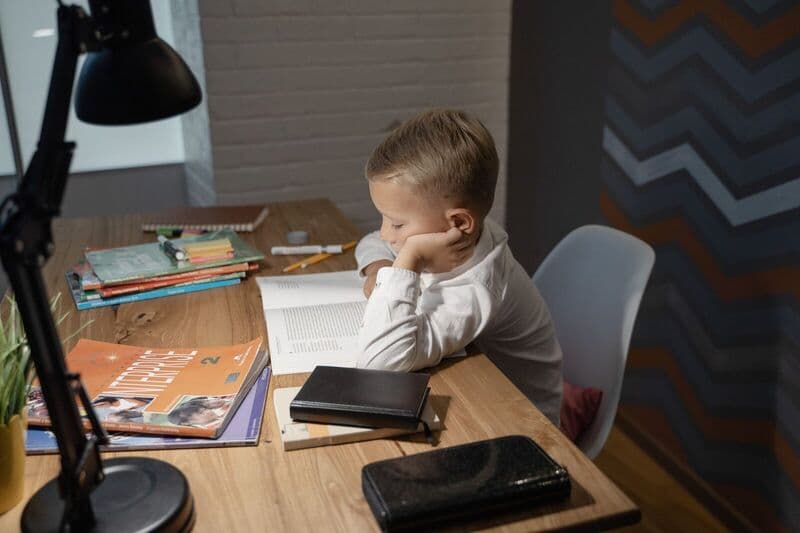
Six hours of school. Then lunch, and by three he is already at the desk. At seven he gets up, puts a hand behind his back and says it hurts. You look at the chair, look at how he was sitting, half crooked, one leg folded under him, neck forward, and think the problem is there.
Here are the two answers straight away, then I will show you where they come from.
The first: time spent sitting is associated with back pain at school age, but the association is much more solid than the proof that it is the cause. Almost everything you read online comes from studies that take a single snapshot, and with that design you cannot know whether it is sitting time that hurt the back or whether those already in pain sit more.
The second, which is the one where you really have some grip: the most useful clue is not how he sits, it is how long he stays still without changing anything. But this is a reasonable hypothesis, not a demonstrated fact: in the only experiment in which children's continuous sitting was actually reduced, musculoskeletal discomfort did not change. I will tell you the whole story later on.
What the numbers really say
Let us start with the biggest data point. A systematic review with meta-analysis examined 49 observational studies on the relationship between sedentary behaviour and low back pain, keeping 27 in the actual meta-analysis. Among children and adolescents, a sedentary lifestyle was associated with back pain with an odds ratio of 1.41 (95% CI 1.24 to 1.60); long periods of TV watching gave 1.23 (1.08 to 1.41) and the use of computers, mobile phones and consoles 1.63 (1.36 to 1.95).
These are real associations. But read the line that almost nobody reports: all 27 studies that entered the meta-analysis were cross-sectional, including the surveys of children and adolescents from which the three figures above come. That is, they measured at the same moment how long the young person was sitting and whether he had pain. With that design the causal arrow cannot be established, and indeed the authors conclude by speaking of a moderate increase in risk: association, never cause.
The picture in the rest of the literature is consistent but just as cautious. In 1,001 young people aged 10 to 17, the prevalence of low back pain was 18%, higher among the inactive and sedentary. In another sample of 1,011 students, 18.0% reported back pain and 17.4% neck pain, with a clear jump between the youngest and the oldest: 25.1% against 12.4% for low back pain. In 1,628 secondary school students, 46.7% reported low back pain, with associations to daily tablet use over three hours (prevalence ratio 1.46) and mobile phone use over three hours (1.36).
The order of magnitude is clear: one adolescent in five, and in some samples almost one in two, has back pain. And the frequency rises precisely in the years when hours spent on books increase.
There is, however, only one way to go beyond association, and that is to follow young people over time.
The study that follows young people for a year
This is the piece that carries most weight. 757 Brazilian secondary school students followed for twelve months: the cumulative incidence of new episodes of low back pain was 18.9% (95% CI 16.2 to 21.8), with marked differences between boys (14.8%) and girls (24.1%).
The predictors of a new episode, adjusted for the other factors:
- daily time spent on a tablet: OR 3.21 (1.41 to 7.30)
- daily time spent on a mobile phone: OR 1.49 (1.11 to 2.00)
- using the mobile phone lying down: OR 1.49 (1.05 to 2.12)
- sitting posture while using the tablet: OR 4.34 (1.19 to 16.60)
- mental health in the "clinical" range (compared with those in the normal range): OR 2.81 (1.76 to 4.48)
- female sex: OR 1.78 (1.23 to 2.59)
Look at the confidence interval for posture: from 1.19 to 16.60. It is compatible with an almost null effect and with an enormous one at the same time: it means that this figure, on its own, tells you almost nothing. The only two predictors with a genuinely narrow interval are time spent on the mobile phone (1.11 to 2.00) and mental health (1.76 to 4.48). Even the tablet time, with its 1.41 to 7.30, indicates a direction more than a measure.
Keep this in mind, because it is the point where research and common sense part ways.
Why the clue points to duration more than posture
There is one experiment that explains the mechanism well, and I will tell it with its limitations in hand.
Ninety people, 61 with no history of back pain and 29 with, were made to sit for one hour on an office chair without a backrest, while the electrical activity of the back muscles, the spinal posture and the perceived pain were recorded. At the end the participants were divided into two groups: those who had developed pain and those who had not.
The result is counterintuitive. Between the two groups there was no biomechanical difference: neither in spinal posture nor in muscle activity. The only significant difference was another one: those who developed pain moved less on the chair, making fewer micro-adjustments (p = 0.004). The authors' conclusion, verbatim, is that pain induced by prolonged sitting does not seem to be due to posture or muscle activity, and that it could instead depend on micro-movement strategies.
The limitations need stating right away: they were adults, in a laboratory, with transient pain provoked within an hour. It does not automatically transfer to a sixteen-year-old doing homework. But it shifts the right question: not "how is he sitting", but "how much is he staying still".
And there is a second clue, from the opposite direction. The Campbell review of 2026 searched 21 databases for all studies on school programmes that teach young people back health, ergonomics and correct posture: 1,327 papers screened, 34 read in full, and only two judged of sufficient quality to be included. None "excellent". The two good studies showed improvements in knowledge and behaviour at 3 to 8 months, with reservations about risk of bias. Precision is needed here, because this is the point where the review is cited out of context: the outcomes it evaluated are knowledge of the back, ergonomics and postural behaviours. Pain was not among the outcomes. So it does not say that teaching posture reduces back pain, and it does not say the opposite either: it says the evidence is too thin and too fragile even for the easiest goal, that is, changing what young people know and do.
If the subject is the workstation itself, height of the desk, height of the seat, what is needed and what is not, I covered it in full in Desk and chair for homework: what really matters. Here the point is different: a decent workstation is the first thing you buy, and the last thing that solves the problem.
How to organise a study session
Now the practical part. I give you the rules together with the level of evidence behind them, so you know what you can rely on.
1. Blocks of 25-30 minutes, then two to three minutes standing. The exact interval is not validated by any study: what is known is that shortening long blocks is feasible. In an 8-month trial in two primary school classes with height-adjustable desks, the desk group reduced, during lesson hours, the time spent in continuous sitting blocks longer than 10 minutes and increased the number of times they got up. In fairness: in the same study musculoskeletal discomfort did not change. The desks changed the way children sat, not the pain. And the study involved 48 children in total.
2. The break should be standing and moving, not scrolling on the phone. There is a review of six randomised trials with 210 adult participants that tested "exercise snacks", micro-breaks of 2 to 10 minutes that interrupt prolonged sitting. Four out of six studies showed a significant reduction in musculoskeletal discomfort compared with sitting or passive rest, and breaks with targeted stretching, strengthening or moderate-intensity activity (for example climbing stairs) worked better than low-intensity walking or passive rest. Again in fairness: five of the six studies were at high risk of bias, and the participants were adults at work, not teenagers doing homework.
3. Change position, rather than looking for THE position. This is the hypothesis that comes out of the micro-oscillation study, and it stands as a hypothesis: the authors write that pain could depend on micro-movement strategies, not that it has been demonstrated. The idea is that the back does not need one perfect pose held for three hours, but variation. Studying standing at the kitchen counter for one subject, sitting for another, repeating while walking along the corridor: that is not disorder, it is the simplest way to get that variation.
4. Phone during a break is not a break. Time on the mobile phone and tablet appears as a predictor in the only prospective study available, and the most likely explanation is trivial: it keeps you still. If the break from homework is ten minutes of seated scrolling, the block of continuous sitting has not been interrupted, it has only been extended. If the pain is in the neck more than the back, the discussion changes a little and you will find it in Children, screens and the neck: how much posture really matters.
5. Look at the whole day, not only homework. Six hours at a school desk plus three at a desk is nine hours. In a study that followed adolescents for two years with objective measurements, time spent in prolonged sitting rose by 26.4 minutes a day, the number of sitting interruptions fell by 8 a day and moderate-to-vigorous activity fell by 19 minutes a day. The sample at follow-up was small (67 young people out of 324 at baseline), so the precise number matters less: the direction of the drift does matter.
6. Factor in the period, not only the desk. If the pain appeared in the month of tests, after a change of school or during a phase of short nights, that is clinical information, not background detail. In the Brazilian data, mental health in the clinical range is among the strongest predictors of low back pain: OR 2.81 in the prospective study of 757 students, prevalence ratio 2.62 in the cross-sectional study of 1,628, there, higher than any device-related variable.
Physical activity: perhaps protective, but the evidence is mixed
This is the part where it is easy to exaggerate, so I will go carefully.
The most favourable finding comes from the study of 1,001 young people aged 10 to 17: having been inactive from childhood through adolescence and having at the same time high sedentary time doubled the probability of low back pain, with an OR of 2.40 (1.38 to 4.18), independently of sex, age, body mass index, abdominal obesity and socioeconomic status. Introducing sleep quality attenuated the association but did not eliminate it (OR 2.19). It is a cross-sectional study: it says the two things travel together, not that one causes the other.
Then there is the systematic review of 9 studies and 75,233 young people aged 9 to 19, all judged to be of high quality. One cohort study and five cross-sectional studies found an association between physical activity and low back pain; the remaining three found none. The pattern that emerges is U-shaped: higher risk both in those who move very little and in those who train very much. The authors speak of moderate evidence and call for prospective studies.
And then there is the uncomfortable data point, which is right to keep. In 906 Danish young people aged 11 to 15, with physical activity measured for a week by accelerometer rather than by questionnaire, and 625 re-assessed at two years, there was no association, either at one point in time or over time, between levels of physical activity and spinal pain. When you stop asking young people how much they move and measure it on their bodies, the effect fades.
What to do with this, concretely. Movement remains the right recommendation, for sleep, for mood, for metabolism, and probably for the back too, but do not promise that enrolling him in a gym will make study-related back pain disappear. The thing you have most grip on is more mundane and closer to hand: breaking up long blocks, which remains a reasonable bet rather than a certainty, given that the only experiment that managed it did not change the children's discomfort.
Red flags: when not to wait
Everything you have read so far applies only if the picture is one of mechanical back pain: it appears during or after study, improves with movement, changes with position. If even one of the signs below is present, the way forward is not the desk: it is the paediatrician, straight away.
- Night pain: not a complaint when turning in bed, but pain that wakes him, or that is there at rest.
- Constant pain that never changes with position. In the prospective study of 261 young people who came to a paediatric orthopaedic clinic for back pain, the authors identify precisely constant pain as a sign of an underlying condition.
- Fever, even if modest but persistent, together with the pain.
- Weight loss, reduced appetite, unexplained tiredness or pallor.
- Neurological symptoms: pain running down the leg, tingling, numbness, weakness, a foot that gives way.
- Problems controlling urine or stools appearing together with the pain, or leg weakness that worsens by the hour. This is the most urgent item: here you do not book an appointment, you go to the emergency department today.
- Pain after a significant trauma (a fall from height, an accident, a violent collision).
- Morning stiffness lasting more than half an hour that improves with movement.
- Pain lasting beyond three to four weeks with no improvement at all, or that progressively worsens.
The explicit threshold, the one to write down somewhere, has three levels: sphincter problems or worsening weakness → emergency department, today, do not wait until tomorrow. Any other item on this list, even just one → paediatrician today. Three to four weeks with no improvement at all, even without any of these items → get seen anyway. What counts is not how much it hurts, it is how long it lasts, and young people tend to minimise and stop doing things without explaining why.
A caveat on the numbers, so as not to frighten you in the other direction. In that paediatric orthopaedic clinic 34% of young people had an identifiable condition, but that is a selected population: these are young people already referred to a specialist, not young people with back pain at home. And the appropriateness guidelines for paediatric imaging, updated in 2024, are clear: in transient pain, with a normal physical examination and no neurological deficits, X-ray or MRI rarely bring a benefit; they should be done straight away, on the other hand, when clinical and laboratory data suggest an infection or a tumour. If you want the full picture on frequency, causes and imaging, it is all in Back pain in children and adolescents: when to worry.
What a physiotherapist can do
When the red flags are not present but the pain continues, the useful work is almost all reasoning: reconstructing how the study day really looks, how many blocks, how long, with what real interruptions, understanding when the pain appears and what eases it, checking whether anything has changed in recent weeks across school, sport and sleep, and then building a sustainable routine instead of a list of prohibitions.
It is work that also goes well by video call, because it mainly requires an accurate history, a few movements to observe and a plan that he then carries out at home, at his own desk. With Ri-Hub Junior you start with a free first consultation of twenty minutes with a physiotherapist registered with the Register who works with children and teenagers: you tell us how it has been going, we look together at how he moves, and we tell you whether anything else is needed. From age 11 to 18 you continue with the standard session at 29,90 €.
And the part that matters most: if even one red flag is present, the first step is not us, it is the paediatrician. Fever, night pain, weight loss, neurological symptoms or sphincter problems require an in-person medical assessment and, if needed, tests. The same goes for complex neurological and neuromuscular conditions, which we do not follow online. We will say so straight away, and we will say it during the free first consultation too if it emerges there: we would rather point you elsewhere than have you lose weeks.
On the relationship between movement, attention and grades, with the real numbers: sport and school performance.
And when the pain no longer goes away: pain that does not go away in young people, how common it is.
Sources
- Association between sedentary behavior and low back pain: a systematic review and meta-analysis, Health Promotion Perspectives, 2021
- Incidence and factors associated with low back pain in adolescents: a prospective study, Brazilian Journal of Physical Therapy, 2021
- Transient perceived back pain induced by prolonged sitting in a backless office chair: are biomechanical factors involved?, Ergonomics, 2019
- Can exercise snacks alleviate musculoskeletal discomfort in prolonged sitting? A systematic review of randomized controlled trials, BMC Public Health, 2026
- School-Based Educational Interventions for Improving Knowledge of Back Health, Ergonomics and Postural Behaviour of School Children Aged 4-18 Years, Campbell Systematic Reviews, 2026
- Impact of an 8-Month Trial Using Height-Adjustable Desks on Children's Classroom Sitting Patterns and Markers of Cardio-Metabolic and Musculoskeletal Health, International Journal of Environmental Research and Public Health, 2016
- Longitudinal Changes in Sitting Patterns, Physical Activity, and Health Outcomes in Adolescents, Children, 2018
- Association of sedentary behavior and early engagement in physical activity with low back pain in adolescents, European Spine Journal, 2022
- Physical activity and low back pain in children and adolescents: a systematic review, European Spine Journal, 2021
- No associations between objectively measured physical activity and spinal pain in 11-15-year-old Danes, European Journal of Pain, 2016
- Back and neck pain prevalence and their association with physical inactivity domains in adolescents, European Spine Journal, 2017
- Low back pain in adolescents and association with sociodemographic factors, electronic devices, physical activity and mental health, Jornal de Pediatria, 2020
- Evaluation of a systematic approach to pediatric back pain: the utility of magnetic resonance imaging, Journal of Pediatric Orthopaedics, 2015
- ACR Appropriateness Criteria Back Pain-Child: 2024 Update, Journal of the American College of Radiology, 2025
Sources last checked: September 2026.



