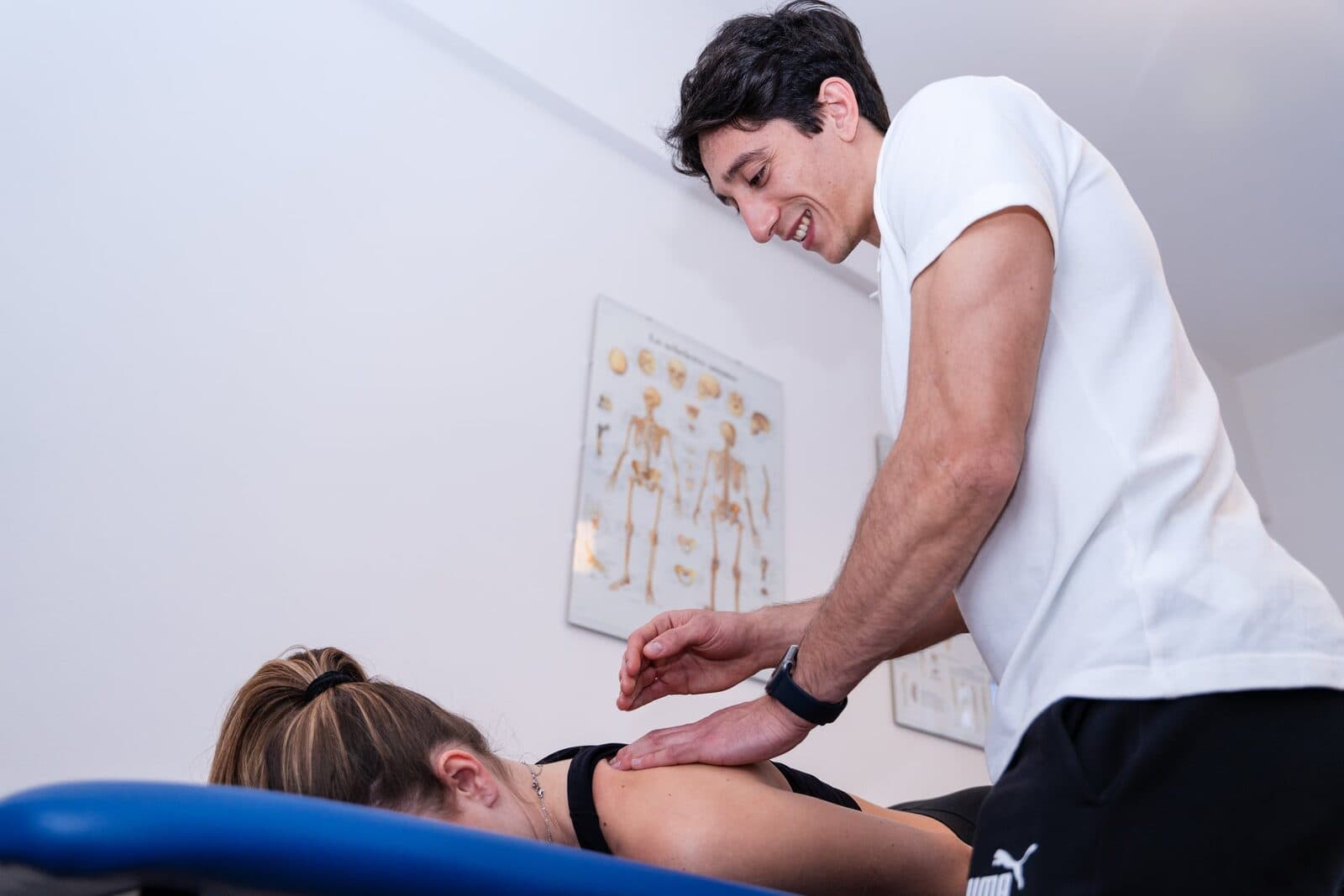
If after a painful episode you have started avoiding certain movements, such as bending, lifting, running or turning your neck, you have not become lazy and you are not making anything up. That behaviour has a technical name, kinesiophobia, and it has a precise logic: your alarm system has learned that a certain movement hurts and is trying to protect you. The problem is that, beyond a certain point, the protection costs more than it gives back.
This guide explains what kinesiophobia is, how much it really matters in recovery (less than is said around, but not little), how it is measured and, above all, what works according to the studies, with the real numbers, including the disappointing ones.
⚠ Important: read this before continuing
The exercises and advice in this article are general guidance and may not suit your situation. Every person has a unique clinical history: what works for others could be counterproductive for you.
Want a professional's opinion? Start from the questionnaire: you sign up and see who will follow you, a physiotherapist registered with the Register, chosen for your case, whom you write to in chat. If you would rather hear their voice, the first consultation is free and we look at your situation together.
Your Pain Is Real: Let's Start From Here
Before anything else, a clarification that is worth more than the rest of the article: fear of movement is not the cause of your pain, and your pain is not "in your head".
Back pain is the leading cause of disability worldwide, and the years lived with disability it causes rose by 54% between 1990 and 2015. In the vast majority of people it is not possible to identify a specific nociceptive cause, while a small but real share has a well-defined structural cause: a vertebral fracture, a tumour, an infection. Within this same picture, central mechanisms of pain modulation and beliefs about pain play an important role in the development of persistent and disabling low back pain.
The two things go together. Pain is a real phenomenon, produced by a real body; fear is one of the factors that can maintain it and amplify its consequences, not the only ingredient and almost never the first. Anyone who tells you "it's just anxiety" is skipping a piece, and anyone who tells you that you just need to "not think about it" is giving you useless advice.
The classic definition describes kinesiophobia as an excessive and debilitating fear of movement, arising from the feeling of being vulnerable to an injury or a relapse. The word "irrational", which often appears in that definition, is unfortunate: that fear is almost always the logical consequence of a real painful experience, sometimes reinforced by things you were told.
Before Working on Fear, Rule Out What Needs Ruling Out
This is the step that articles on kinesiophobia skip, and they should not.
Serious spinal conditions are uncommon but they do exist. A systematic review of 22 studies and over 41,000 patients who arrived at the emergency department with low back pain found a prevalence of conditions requiring immediate or urgent treatment of between 2.5% and 5.1% in the prospective studies (vertebral fractures, spinal tumours, infections, compression of the spinal cord or cauda equina, vascular conditions). The same review notes that the diagnostic accuracy of most "red flags" has been measured by only one study: they are not a perfect filter, and clinical judgement is needed.
Put simply: if you have a fever, unexplained weight loss, a history of cancer, pain that never changes with any position, real loss of strength, bowel or bladder control problems, or a major trauma behind you, the first thing to do is not to win the fear: it is to get assessed. A path of gradual re-exposure to movement is built after someone has looked at your case, not before.

Why Fear Turns Into a Vicious Circle
The reference framework is called the fear-avoidance model, and it was described in its modern form in 2000 by Vlaeyen and Linton, who gathered the evidence on the role of pain-related fear in the onset and maintenance of chronic disability.
The pattern is this. A painful episode is interpreted as threatening; the threatening interpretation generates fear; fear leads to avoidance, to moving "on guard", to constantly monitoring the body's sensations; prolonged avoidance produces deconditioning and worsens physical performance; the deconditioned body confirms the initial prediction, and the cycle starts again.
Two clarifications that the model itself makes clear and that are often forgotten:
- This path concerns a minority of people with acute low back pain, not all of them: the 2007 review of the evidence defines it precisely this way, a model that explains why a minority of acute episodes becomes a chronic problem.
- Fear is "an essential feature in the development of a chronic problem for a substantial part of patients", not for everyone. If you do not recognise yourself in it, you are not an odd case.
The flip side is the useful part: those who face movement instead of avoiding it tend to see fear decrease over time. It is the mechanism on which the treatments described further on are based.
How Much It Weighs (and What Weighs More)
Here the data are less spectacular than they are often portrayed, and it is right to know this.
A Norwegian prospective study followed 123 people with acute low back pain and 50 with chronic low back pain for one year, measuring fear-avoidance beliefs with the FABQ questionnaire. The result: fear-avoidance beliefs predicted pain and disability at 12 months, even after accounting for sociodemographic variables and pain. But in the same study general psychological distress was a stronger predictor, and when it was entered into the models the association between FABQ and pain/disability disappeared.
It is an honest finding and must be read for what it is: fear of movement matters, but it is rarely the main variable, and focusing only on it often means looking at the finger rather than the moon. Mood, sleep, stress load, and work and financial context weigh as much as or more than fear. If you recognise yourself in this picture, the article on the psychological aspect of chronic pain deals with the issue more fully.
How It Is Measured: the TSK Scale
Kinesiophobia is not estimated by eye, it is measured with a questionnaire: the Tampa Scale of Kinesiophobia (TSK).
A 2023 systematic review examined 41 studies on the psychometric properties of the scale in people with musculoskeletal pain. There are five versions (TSK-17, TSK-13, TSK-11, TSK-4 and one specific to temporomandibular disorders). Almost all show good to excellent test-retest reliability (intraclass correlation coefficient between 0.77 and 0.99) and good internal consistency. The authors recommend using the TSK-13 and the TSK-17, because they are valid, reliable and sensitive to change; the TSK-11 has shown inconsistent validity across studies, and the TSK-4 does not yet have a defined reliability.
Why it matters to you: clinical guidelines recommend that professionals check for the presence of kinesiophobia, because it can contribute to the persistence of pain and disability. If your physiotherapist has you fill in a questionnaire of this kind, they are not psychoanalysing you: they are taking a starting measure to see whether, session after session, that number moves.
What Really Works, and How Much
Explaining the pain helps, but education alone changes little
Pain neuroscience education (PNE) consists of rebuilding the way a person interprets their own pain, making it less threatening. Does it work? Partly, and it is worth being precise.
A systematic review with meta-analysis of 12 randomised trials (755 participants) calculated that, compared with controls, PNE on its own produces effects of little clinical relevance on pain (−5.91 points out of 100 in the short term) and on disability (−4.09 points out of 100). On kinesiophobia, on the other hand, the effect is clinically relevant in the short term: −13.55 points out of 100. On pain catastrophising the effect becomes relevant in the medium term.
The message is clear: understanding how pain works mainly shifts fear and catastrophic thoughts, much less the pain itself. That is not little, but it is one piece of the path, not the whole path.
A consistent finding comes from chronic neck pain: a meta-analysis of 7 randomised trials with 479 people found that PNE reduces kinesiophobia with a moderate effect (Hedges' g −0.44) and that none of the studies reported adverse events.
Combining it with exercise is the part that makes the difference
This is where the difference shows. A systematic review with meta-analysis published in Pain in 2022 compared "PNE plus exercise" against "exercise alone" in 5 high-quality randomised trials (460 participants). The combination performed better on all the outcomes measured: pain (−2.09 points out of 10), disability, kinesiophobia and catastrophising.
But the authors' caveats must also be read, and they are important:
- The certainty of the evidence was low for pain and disability, moderate for kinesiophobia and very low for catastrophising.
- The results concern only the short term (within 12 weeks): long-term data were available in just 2 studies and could not be analysed.
So yes, adding the explanation to exercise is worthwhile, but we are talking about a benefit demonstrated in the short term and on still fragile evidence. Anyone who sells it to you as a definitive breakthrough is overstating it.
On movement itself, the umbrella of Cochrane reviews on physical activity and exercise for chronic pain in adults (21 reviews, 381 studies, over 37,000 participants) is equally measured: the quality of the evidence is low, the favourable effects on pain intensity and physical function exist but are mostly small to moderate and not consistent across reviews. On the other hand, and this is the point that matters for those afraid of moving, the adverse events reported are few and mostly consist of an increase in muscle soreness, which subsided after a few weeks. No harm.
Graded exposure: a clinical protocol, not a do-it-yourself job
Graded exposure in vivo is the treatment designed specifically for fear of movement. It does not mean "grit your teeth and move": it means building together with a professional an individual hierarchy of feared movements, ordered from least to most threatening, and tackling them in sequence, checking each time what really happens compared with what was expected.
What the data say:
- The early studies were very small. A 2002 study of six patients with chronic low back pain and strong fear of movement observed that improvements in fear and catastrophising appeared during in vivo exposure and not during generic graded activity, and held up at one year. Six patients: a signal, not a proof.
- The most robust multicentre randomised trial (85 patients with chronic non-specific low back pain and at least moderate fear) gave a more sober result: in vivo exposure was effective but not more effective than operant graded activity in improving functional disability and the main complaint. It was, however, clearly superior in reducing catastrophising and the perceived danger of activities, and precisely these two reductions mediated its effect. About half of the patients, in both groups, reported clinically relevant improvements.
Two practical consequences. The first: the benefit of gradually increasing the load is obtained even with a good programme of progressive activity; targeted exposure is mostly useful when fear and catastrophic thoughts are in the foreground. The second: the hierarchy of movements must be built around you, and improvising it on your own exposes you to the opposite risk: an attempt that is too ambitious and goes badly, confirms the worst prediction and sets you back by months.
How to Recognise It in Yourself
Some recurring signs, to use as a point for reflection and not as a diagnosis:
- You systematically avoid activities you used to do without thinking, and the list of things you avoid keeps getting longer instead of shorter.
- You move "on guard": stiff, slow, blocking movements in advance even when they do not hurt.
- You use braces, corsets or aids beyond the period for which they were prescribed.
- You constantly check the body's sensations, looking for the signal that something is getting worse.
- In the way you talk about it, phrases like "my back is ruined", "I can no longer do that movement", "if I move I get worse" keep coming back.
If you find yourself mainly in the last point, the central theme may be more the catastrophising of pain than fear of movement in the strict sense: these are close but distinct things, and they are treated in a slightly different way.
Where to Start
The first steps have a modest and precise goal: to gather evidence that refutes the catastrophic prediction, with a low margin of risk.
Walk, and keep track. Walking is the form of movement easiest to dose. Choose a duration you are reasonably sure you can tolerate, do it for a few days, and only when that holds, increase it slightly. Consistency matters more than intensity.
Increase a little, and one thing at a time. When progressing, change one variable at a time: either the duration, the load or the difficulty of the movement. Changing three together makes it impossible to understand what worked, or what bothered you.
Expect a little muscle soreness and do not read it as damage. It is the most common adverse effect recorded in studies of exercise for chronic pain, and in the reviews it subsided after a few weeks. A pain that rises during the activity, stays tolerable and settles by the next day is usually not an alarm signal; a pain that grows from day to day, or that changes in nature, should instead be discussed with a professional.
If you are in the middle of an acute episode, the priority is different. In that case the first hours have their own rules, explained in the article on acute low back pain and the first 48 hours. The work on fear comes afterwards, not during.
What a Physiotherapist Does
The value of a professional in this scenario is not motivational: it is technical.
It serves to distinguish real limitations from anticipated ones: many people discover in a session that they can do a movement they had excluded for months, and that verification is itself part of the treatment. It serves to build the exposure hierarchy on the specific case, to dose the progressions and to decide when to stop. It serves to measure: a TSK at the start and repeated over time says whether the path is really shifting something or whether the strategy needs changing. And it serves to recognise the cases in which the dominant theme is not fear but persistent pain or psychological distress, which require a different approach and sometimes other specialists.
A detail that is not secondary: part of fear of movement arises from phrases said by healthcare professionals. "Your spine is in bad shape", "don't do that movement any more", a report read without context. If you have heard a sentence like that and have been avoiding things ever since, it is worth questioning it with someone who can look at the complete picture. Low back pain is the area where this happens most often.
Kinesiophobia and Online Physiotherapy
Online physiotherapy fits this type of path well for a practical reason: much of the work consists of exercises to do at home, with small progressions and frequent checks. The physiotherapist watches how you perform the movement, corrects it, and decides the next step, and does so in the environment where that movement will really be needed.
It must be said honestly that there are no studies showing that the remote mode is superior to in-person care specifically for kinesiophobia: what the evidence supports is the content of the path (explanation of pain plus progressive exercise), not the channel through which it is delivered. The channel matters for a different and concrete reason: if it reduces drop-outs and lets you be consistent, consistency is exactly what produces the benefit in the studies.
In Summary
Fear of moving after pain is not a character flaw: it is a learned, understandable response, and in some people it becomes one of the engines that keep the problem going. It is not the sole cause, nor, according to the best data, the heaviest factor: general psychological distress weighs more.
What works is known, but it must be told for what it is: explaining pain reduces fear more than it reduces pain; combining the explanation with exercise gives better results in the short term, on evidence of low certainty; graded exposure is effective and especially useful for catastrophic thoughts, but it does not beat a good progressive activity programme on disability. None of these paths is fast, all have a very favourable risk profile, and none replaces an assessment that first rules out the causes that need to be ruled out.
You might also be interested in:
Pain Catastrophising: What It Is and How to Overcome It Chronic Pain: The Psychological Side and How to Manage It Chronic Back Pain: The Treatments That Work
Stay in touch with us Join our dedicated Facebook group: we answer all patients, give practical advice and clear up the most common doubts.
Need a consultation?
Start from the questionnaire on Ri-Hub. A few questions about your case, you sign up, and see who will follow you: a physiotherapist registered with the Register, whom you write to in chat whenever you like. If you would rather talk it through by voice, the first consultation is free, lasts 20 minutes and commits you to nothing: they arrive having already read what you wrote, and together you decide whether and how to go on.
And the question underneath the fear, with the numbers: if it hurts, do I have to stop?
Sources
- Vlaeyen JWS, Linton SJ, Fear-avoidance and its consequences in chronic musculoskeletal pain: a state of the art, Pain, 2000
- Leeuw M, Goossens ME, Linton SJ, et al., The fear-avoidance model of musculoskeletal pain: current state of scientific evidence, Journal of Behavioral Medicine, 2007
- Hartvigsen J, Hancock MJ, Kongsted A, et al., What low back pain is and why we need to pay attention, The Lancet, 2018
- Galliker G, Scherer DE, Trippolini MA, et al., Low Back Pain in the Emergency Department: Prevalence of Serious Spinal Pathologies and Diagnostic Accuracy of Red Flags, The American Journal of Medicine, 2020
- Grotle M, Vøllestad NK, Brox JI, Clinical course and impact of fear-avoidance beliefs in low back pain: prospective cohort study of acute and chronic low back pain, Spine, 2006
- Dupuis F, Cherif A, Batcho C, et al., The Tampa Scale of Kinesiophobia: A Systematic Review of Its Psychometric Properties in People With Musculoskeletal Pain, The Clinical Journal of Pain, 2023
- Watson JA, Ryan CG, Cooper L, et al., Pain Neuroscience Education for Adults With Chronic Musculoskeletal Pain: A Mixed-Methods Systematic Review and Meta-Analysis, The Journal of Pain, 2019
- Lin LH, Lin TY, Chang KV, et al., Pain neuroscience education for reducing pain and kinesiophobia in patients with chronic neck pain: a systematic review and meta-analysis of randomized controlled trials, European Journal of Pain, 2024
- Siddall B, Ram A, Jones MD, et al., Short-term impact of combining pain neuroscience education with exercise for chronic musculoskeletal pain: a systematic review and meta-analysis, Pain, 2022
- Geneen LJ, Moore RA, Clarke C, et al., Physical activity and exercise for chronic pain in adults: an overview of Cochrane Reviews, Cochrane Database of Systematic Reviews, 2017
- Vlaeyen JW, de Jong J, Geilen M, et al., The treatment of fear of movement/(re)injury in chronic low back pain: further evidence on the effectiveness of exposure in vivo, The Clinical Journal of Pain, 2002
- Leeuw M, Goossens MEJB, van Breukelen GJP, et al., Exposure in vivo versus operant graded activity in chronic low back pain patients: results of a randomized controlled trial, Pain, 2008
Last source check: August 2026.