

It is the question that comes right after the questionnaire, and it has two different answers depending on how the service is built. Some services put a grid of profiles in front of you and let you pick. We do not: we assign you one, with name, photo and register number.
It is worth explaining why, because at first glance it may seem that we are taking a freedom away from you.
Why We Don't Have You Choose From a List
Choosing a healthcare professional from a grid of photos is a task nobody is really equipped for, and not for lack of intelligence: for lack of information. To choose well you would already need to know which skill your case calls for, and if you knew that, you probably would not need to ask.
In practice, people choose with what they have: the face, the number of stars, whoever is at the top of the list. These criteria have no relation to whether that person knows how to treat your problem.
We do the matching ourselves, based on what you have described. It is not a black box: underneath are the same things a colleague would look at when reading your history.
What Matching Is Based On
- the area and the type of problem: an operated shoulder, a low back pain that has lasted two years and a knee that has been swollen for three days do not call for the same person;
- how long it has lasted: a recent problem and a chronic one are approached with different strategies, and not everyone works equally well with both;
- whether there has been a surgery or an injury, and how long ago;
- age, which is sometimes the main variable: for a child you need paediatric competence, which is a profession of its own;
- specific skills, when the case calls for them: the pelvic floor after childbirth, for example, is not a chapter everyone knows;
- what you want to get back to doing, because a sporting goal and a goal of everyday independence lead to different pathways.
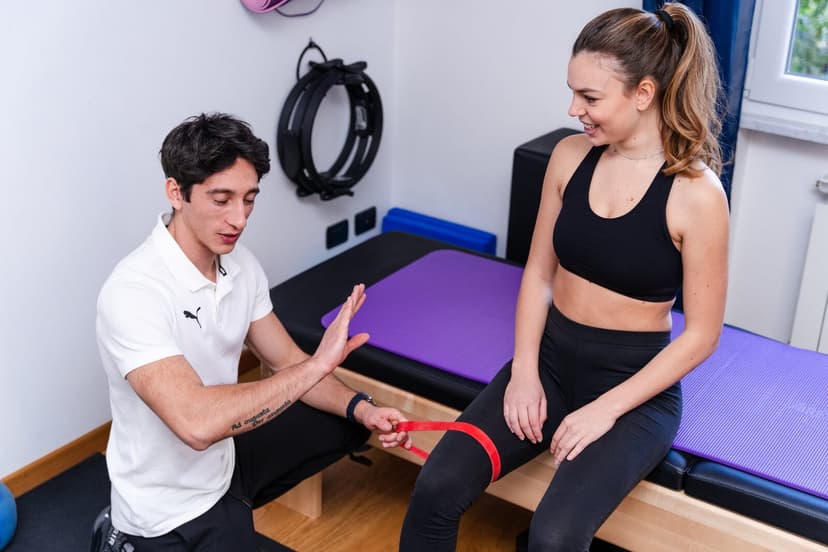
It Is a Proposal, Not an Assignment
This is the part that matters: you can change physiotherapist whenever you like, without explanations and without discussion.
The matching is our best hypothesis with the information we have. A hypothesis can be wrong, and some things, such as whether you understand each other, whether the way they explain things works for you, whether you feel at ease, cannot be inferred from a questionnaire. If it does not work, you change: this is expected, it is not a complaint.
We have covered this in more depth in can I change physiotherapist, and when it makes sense.
And It Is Always the Same Person
This is the other half of the answer, and for the outcome it matters as much as the first.
We do not rotate professionals between patients. The physiotherapist assigned to you is the one who does your first, free introductory consultation, the one who follows you through your sessions, the one who replies to you in chat between sessions, and the one who updates your exercises when something is not working.
The reason is not sentimental, it is clinical. A rehabilitation pathway is made of continuous adjustments: an exercise that works this week needs progressing next week, a pain that moves changes the working hypothesis, a goal reached opens another one. Whoever saw you the first time keeps the starting point in mind, and can recognise a small improvement that does not show up on a chart. Someone who sees you for the first time at the fifth session cannot.
What You See Before Talking to Them
At the end of the questionnaire you receive their name, their photo and their register number, which can be verified. Physiotherapy in Italy is a regulated healthcare profession: registration with the register kept by the TSRM and PSTRP professional bodies is compulsory to practise, and anyone who is not registered is not a physiotherapist, however they present themselves.
Then the first consultation: twenty minutes, free, with them. It serves them to assess your case, and it serves you to understand whether they are the right person before you have spent anything. If that consultation shows that we are not the right answer for you, they will tell you so there and then.
To find out how the rest of the pathway works, and why they are the one who proposes the sessions instead of selling them to you in a package, see how Ri-Hub works.