On the bike the knee performs a movement thousands of times per ride. If the position is off by a little, that little gets multiplied, and the spot where it hurts almost always tells you which setting to review.
⚠ Important: read this before continuing
The exercises and advice in this article are general indications and may not suit your situation. Every person has a unique clinical history: what works for others could be counterproductive for you.
Where it hurts → what to check
| Where | Most likely cause | Correction |
|---|---|---|
| Front, below or around the kneecap | Saddle too low or too far forward; gears too hard | Raise the saddle, move it back, pedal with a higher cadence |
| Back, in the popliteal fossa | Saddle too high or too far back | Lower the saddle by 2-3 mm at a time |
| Inner side | Cleats too far out, knees drifting inwards | Move the cleats, check the width of the movement |
| Outer side | Iliotibial band; cleats too far in or foot rotated | Move the cleats, check the free rotation |
Front knee pain is by far the most common, and a low saddle is the number one cause.
The right saddle height
Practical method: sitting on the saddle, place your heel on the pedal with the crank at the bottom. The leg must be fully straight, without the hips rocking. When you then pedal normally, with the ball of the foot, the knee will stay slightly bent, at around 25-35 degrees at bottom dead centre.
If you rock your hips to reach the pedal, the saddle is too high. If you feel you are "pressing down" with the knee very bent, it is too low.
Change it by 2-3 millimetres at a time, and try only one change per full ride. Anyone who moves everything together no longer knows what worked.
Fore-aft position
With the crank horizontal, a plumb line dropped from the front of the kneecap should fall roughly above the pedal axle. A saddle too far forward loads the front of the knee; too far back pulls on the back structures.
Gears
Pedalling hard at low cadence is one of the most underestimated causes of front knee pain. Staying at around 80-90 revolutions per minute reduces the force applied with each turn. If you find yourself pushing at 60 on a climb, the problem is the gear, not the knee.
What to train off the bike
Cycling is a movement on a single plane and does not train the muscles that stabilise the side of the hip: those who ride a lot and nothing else often arrive with weak glutes.
- Single-leg bridge, 3×10 per side
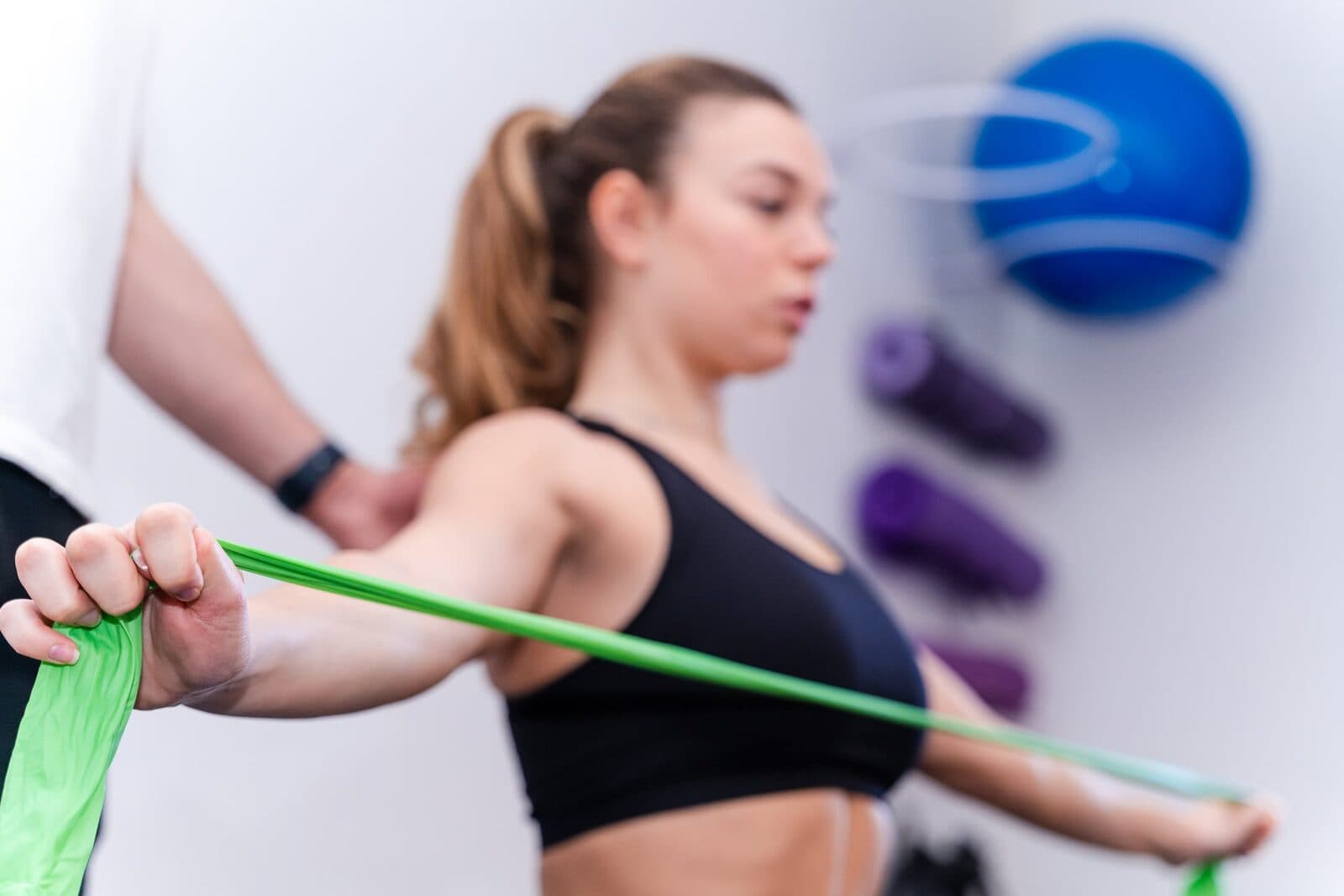
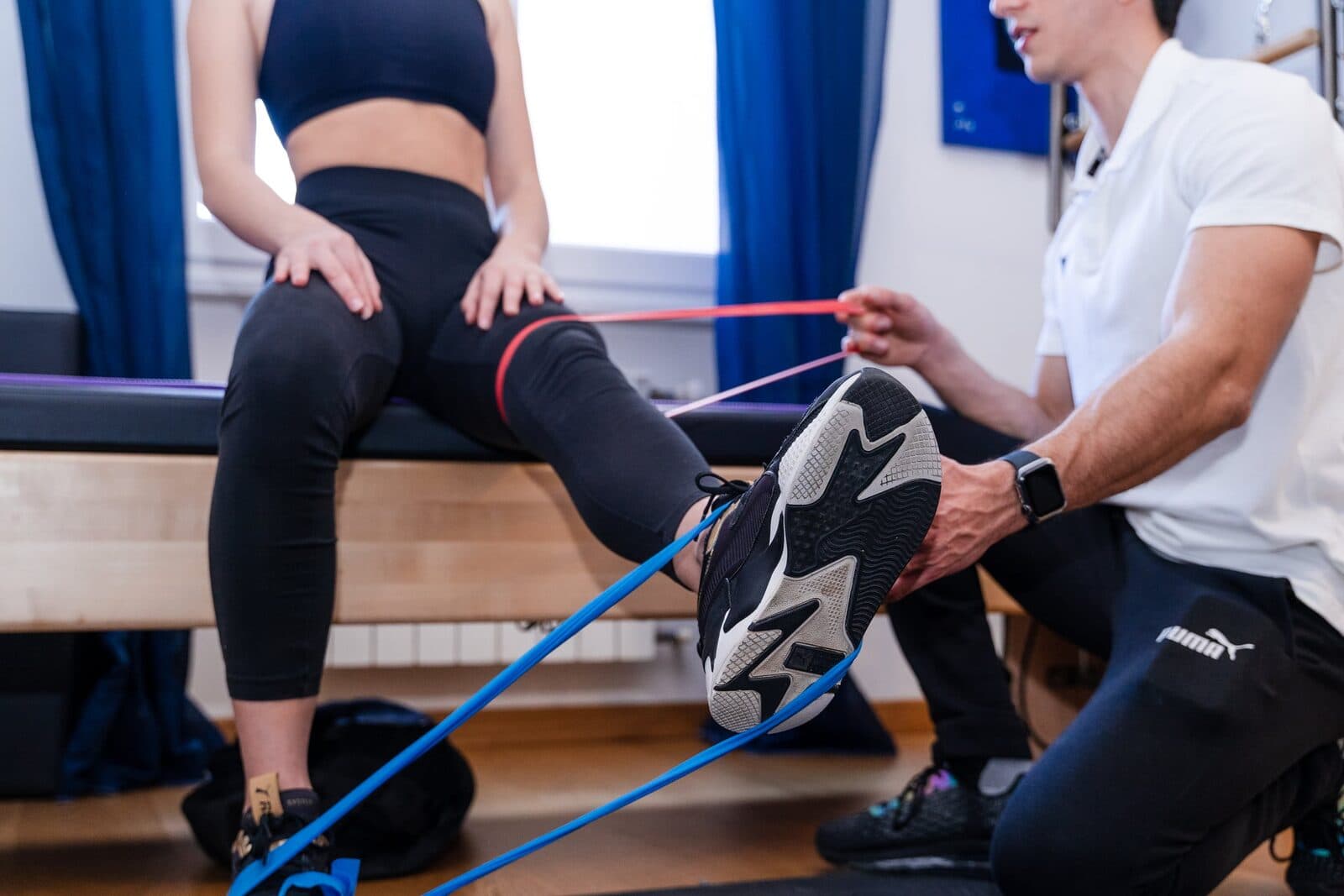
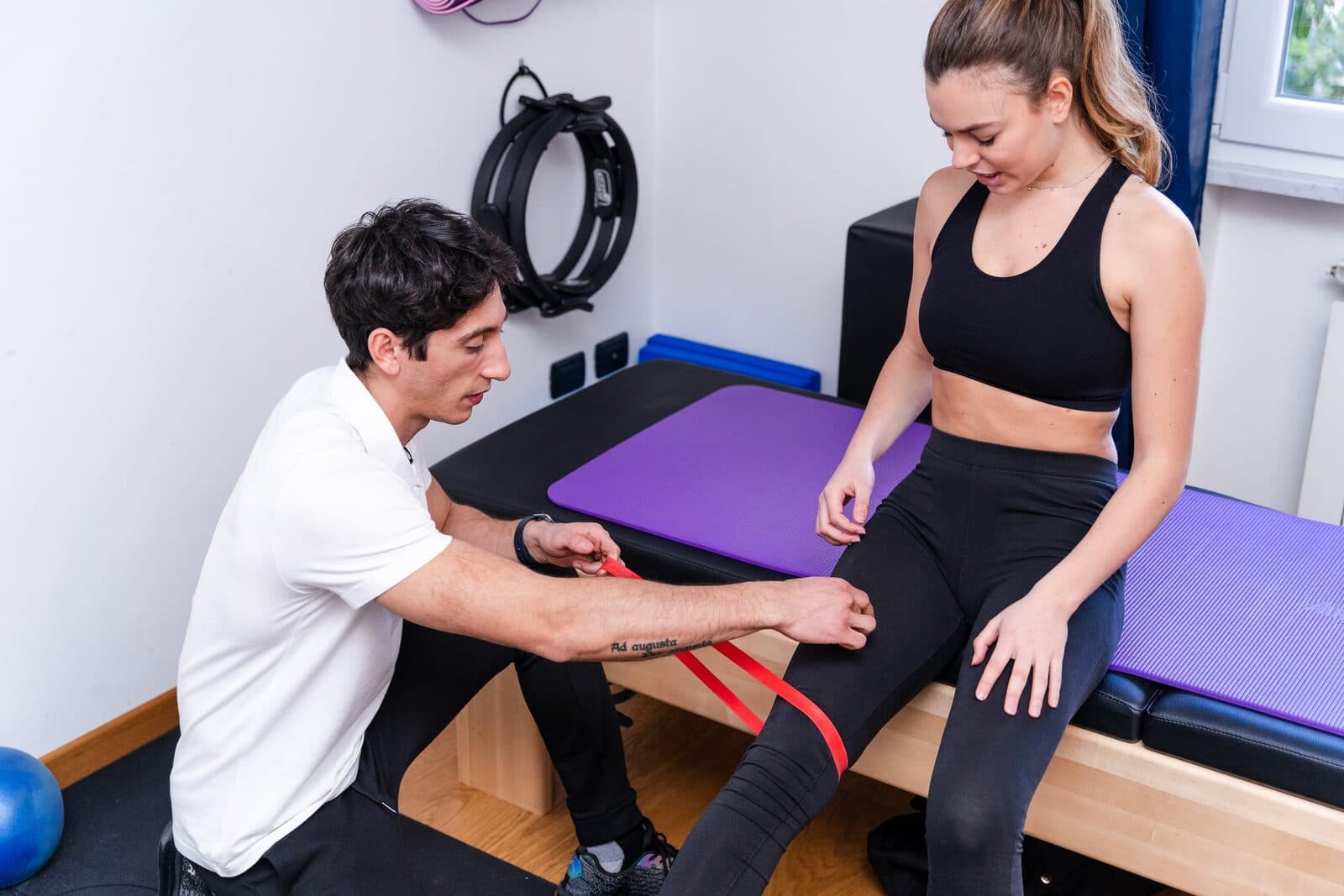
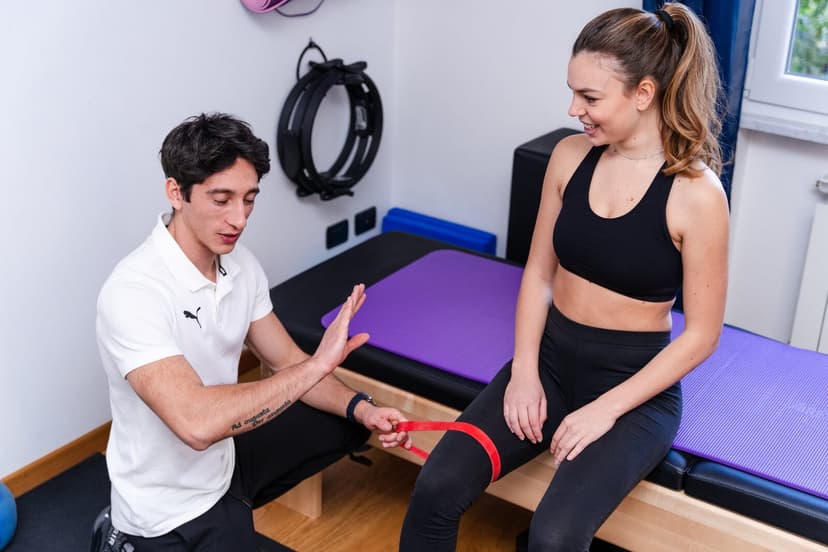
- Hip abduction with a band, 3×15
- Partial single-leg squat, 3×8 per side
- Controlled lunges, 3×8
Twice a week. This is also the reason why bike pain sometimes does not resolve just by moving the saddle.
When it is not the position
If the pain appeared without you changing anything, if the knee swells or gives way, or if it hurts even when walking, it is not a setting problem and needs to be looked at on its own.
Need a consultation?
Start from the Ri-Hub questionnaire: a few questions about your case, you register, and you see who will follow you: a physiotherapist on the Italian professional register, whom you can write to in chat whenever you like. If you would rather talk it through by voice, the first consultation is free, lasts twenty minutes and commits you to nothing: they arrive having already read what you wrote, and together you decide whether and how to proceed.
Sources
- Effect of bike-fit in the perception of comfort, fatigue and pain: J Sports Sci: 2017
- The effectiveness of exercise interventions to prevent sports injuries: a systematic review and meta-analysis of randomised controlled trials: British Journal of Sports Medicine, 2014
Last source check: September 2026.