


The moment you notice it is almost never the scales. It is your son saying “I'm tired” after two flights of stairs. It is him taking his T-shirt off as late as possible at the pool. It is the remark thrown out by a classmate, which you heard and he pretended not to hear.
And so the question comes: how do I get him moving?
Before answering, two boundaries, because without them this article could do more harm than good.
The first: this is not about diet. The dietary side of a growing child belongs to the paediatrician and the dietitian, and it is not a bureaucratic detail. A food plan improvised at home, with the best intentions in the world, is one of the most effective ways to create a complicated relationship with food. We deal with how a body moves.
The second: we are not looking for someone to blame. Not your son, who chose nothing. And not you either.
How much movement is really needed (and why that number is not your starting point)
The WHO 2020 guidelines on physical activity and sedentary behaviour indicate, for children and adolescents, an average of 60 minutes a day of moderate to vigorous activity across the week, plus regular muscle-strengthening activity, an indication the document addresses to all age groups. The same guidelines recommend reducing the time spent sitting still, while noting that the evidence was not enough to set a numerical threshold.
But the same document contains two sentences that nobody usually quotes, and which matter more to you than the 60 minutes: some movement is better than none, and more is better than little.
If your son moves for ten minutes a day today, this month's target is not sixty: it is fifteen. The 60 minutes are the horizon, not the entrance exam, and treating them as an entrance exam is the quickest way to fail by the second week.
It is not laziness: for him, moving really costs more
This is the part that, in my view, changes a parent's perspective more than any other.
When a child with obesity walks, his knee is not doing the same work as the knee of a healthy-weight classmate on a smaller scale: it is doing different work. In a biomechanics study of 20 children aged 8-12, ten of healthy weight and ten with obesity, the patellofemoral contact forces during walking were 1.98 times higher in the group with obesity, and remained 1.81 times higher even after normalising for the area of the kneecap's joint surface. In other words: it is not only that there is more weight, it is that the weight passes over a surface that has not grown in proportion.
A second study from the same line of research measured the inner compartment of the knee during twenty minutes of walking on a treadmill. At the start of the test, the share of load passing through the inner side was 85% in children with obesity against 63% in those of healthy weight; by the end of the twenty minutes it had risen to 90% against 72%. The loading rate on that compartment was 1.78 times greater. And one detail that applies to everyone: over the twenty minutes the loading rate increased by 17% in both groups.
These are small studies (ten children per group) based on musculoskeletal models: they do not say that your son will get hurt. But they say two very useful things. The first: the same walk, for him, is not the same walk: his knee does a different job, not the same job on a smaller scale. Be clear about what was measured: the load on the joint, not the effort he feels or the calories he burns. But it is enough to make the explanation “it's just laziness” hard to believe. The second: within the same twenty-minute walk the load grows. From there to concluding that twenty minutes split into two tens are better than twenty in a row is a step nobody has measured: it is a reasonable inference, not a result. But it makes starting with short, repeated sessions a defensible choice, not a shortcut for lazy people.
And the feet? A systematic review of 13 cross-sectional studies found that the prevalence of flat foot in children with obesity varies enormously between studies, from 14% to 67%, with almost all the studies indicating more flat foot as weight increases. The authors are honest to the end: the diagnostic methods differed from one another and none of the studies had assessed pain or complications. So: an association, yes; consequences, still to be demonstrated.
On pain there is some data. In a cross-sectional study of 150 children aged 9-12 at a primary school, the prevalence of foot pain was 10.7% and that of lower-limb pain 27.3%: these percentages refer to the whole sample, not only to overweight children. The more interesting result is another: among all the variables analysed (age, sex, sports participation, foot posture index, knee alignment), the only ones significantly associated with both foot pain and lower-limb pain were overweight and obesity. A single cross-sectional study, which does not prove a cause, but the direction is consistent with the biomechanics.
If in this story a precise pain appears in the heel when he runs or jumps, it is worth reading what happens with heel pain in children: it is a common and manageable situation, but it needs to be recognised.
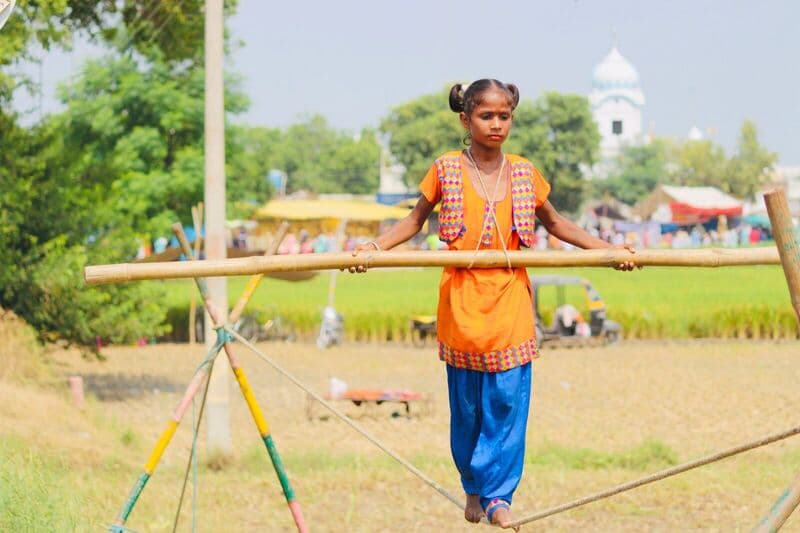
There is also a skills element, and nobody taught him it
A systematic review with meta-analysis of 59 studies from 22 countries looked for the factors associated with gross motor competence in children and young people aged 3-18. Age was found to be a correlate of motor competence. Weight status, sex and socioeconomic level were consistently associated with motor competence only for some aspects of it, not for all, and this holds for all three, not only for weight.
This is not a judgement on your son: it is useful news. It means that, beyond weight, there is often a gap in repertoire. Jumping, landing, changing direction, catching a ball in the air are movements that are learned by practising them, and a child who has for years avoided the occasions to practise them has simply accumulated fewer of them: which makes him clumsier, therefore more exposed to teasing, therefore better at avoiding. It is a circle, and it is broken from the side of skill, not from the side of effort.
We have written a full piece on how that repertoire is built, valid at any weight: motor games age by age.
Why competitive team sport often fails
It is the most common advice: “enrol him in football, so he moves”. Sometimes it works very well. Often it does not, and the reason is not the discipline.
The review on weight stigma in children and adolescents describes how body-related victimisation is very frequent among those who are heavier and comes from peers, teachers and sometimes parents themselves. Among the documented consequences: psychological distress (depressive symptoms, low self-esteem), worse school and social outcomes and, this is the key point, dysfunctional eating behaviours, less physical activity and further weight gain. It is a synthesis of mostly observational studies, so not a proven causal relationship. But the direction is too consistent to ignore.
In practical terms: the problem is not “football”. The problem is putting a child who is ashamed of his body in a setting where he gets picked, compared, timed and watched arriving last twice a week in front of twenty people. You are not buying movement: you are buying one more reason not to move.
The criterion is not the sport, it is three questions: is there selection? is there continuous public comparison? does someone say out loud times, weights or positions? If the answers are no, even a team sport is fine, and the social side becomes the engine. If they are yes, it is better to wait until he has built some foundations. We have a dedicated article on readiness criteria: when a child is ready for a sport.
What the evidence says about the interventions that work
Here we need to be precise, because this is where most of the myths are told.
A network meta-analysis published in 2026 compared 12 types of exercise across 63 randomised trials and 2,724 young people with overweight or obesity. The first finding is the one nobody quotes, and it comes from the pairwise comparisons: 40% of the types of exercise showed no significant effect on BMI, and 30% showed none on body fat percentage. At the top of the BMI ranking: continuous moderate-intensity aerobic activity, high-intensity interval training, combined aerobic and strength training, moderate-to-vigorous aerobic activity and multicomponent exercise. For body fat percentage the combined training moves to the top, followed by strength work alone. The authors' conclusion is far from a headline: the type should be chosen according to goal and feasibility, in order to improve adherence.
On combined training there is a dedicated meta-analysis, of 29 studies and 2,195 participants: aerobic plus strength training improves body composition and metabolic parameters, with a suggested prescription of at least three sessions of more than 60 minutes a week for 12 weeks or more. A note of honesty: in that analysis an inflammation marker (hs-CRP) did not improve significantly.
Then there is the finding that puts everything in proportion, and it should be said to a parent before they get carried away. The Cochrane review of 70 randomised trials and 8,461 children aged 6-11 assessed interventions combining diet, physical activity and behaviour change. Compared with control, at longest follow-up: BMI -0.53 kg/m2 (95% confidence interval from -0.82 to -0.24; 24 studies, 2,785 children), BMI z-score -0.06 (37 studies, 4,019), weight -1.45 kg (17 studies, 1,774). The individual estimates, as you can see, rest on a subset of the studies, not on all seventy. Real effects, but small and short-term, with evidence of low or very low quality. Serious adverse events are very rare: 29 of the 31 studies that looked for them reported none. And a detail that works as a shield against false promises: some data suggested that the BMI reduction obtained right after the intervention was no longer evident at less than six months' distance, a point the authors flag as needing verification in further studies.
So movement should be proposed, but not as a tool to make your son lose weight. It should be proposed for what it really brings at that age: motor skills, strength, independence, cardiometabolic health and a decent relationship with one's body.
On psychological wellbeing, too, there are no easy promises. An umbrella review of 112 studies and 21,232 children and young people found that physical activity reduces psychological symptoms in all the groups examined, but with a weak strength of association and evidence of moderate to very low credibility. And for self-esteem, the only meta-analysis conducted specifically in children with obesity showed no effect.
The role of the family, measured
“Move together” is good advice. But there are two versions of it, and the numbers tell them apart clearly.
A meta-analysis of 115 studies separated modelling (the parent moving and setting an example) from support (accompanying, enrolling, organising, being present). Modelling is associated with the child's physical activity in a weak way (r = 0.16), support in a moderate way (r = 0.38). With an important correction: when the children's activity was measured objectively rather than reported, support also dropped to r = 0.20. These are associations, not proof of cause.
And for completeness, one uncomfortable fact: a Cochrane review compared the same interventions with and without a component aimed at parents. Note what it looked at: programmes aimed at the general population of 2-18 year olds, not treatments for children who already have a high weight. On the children's physical activity, no difference was found (standardised mean difference 0.04 for moderate-to-vigorous activity, 95% confidence interval -0.41 to 0.49, 2 studies, 80 participants). The sample is tiny: it is not proof that involving parents is useless, it is proof that we do not know yet.
What we do know is that practical support is the part that correlates best: making movement easy matters more than talking about it.
How to set it up, in practice
Start with something that does not expose him. Walking, cycling, swimming, climbing stairs, strength work at home: no audience, no comparison, no stopwatch. Cycling and water have one extra advantage, consistent with the load data seen above: they let you accumulate minutes without putting weight on knees and feet every time. This is a mechanical argument, not a result proven in a study, and I give it to you as such.
Dose it in short, repeated blocks. Three times ten minutes are worth your thirty, and they are almost always easier to reach.
Include strength, not only breath. The WHO recommends regular muscle-strengthening activity at all ages, and in the network meta-analysis strength work is among the top options for body fat percentage. With a child, this means climbing, pushing, dragging, jumping from low heights, carrying real loads around the house: not barbells.
Buy skills before kilometres. With a poor repertoire, ten minutes of “catch, throw, jump, land, change direction” done well are worth more than half an hour of running he hates.
And the most important one. No scales as the measure of progress, no comparison with siblings or classmates, no comments about the body, not even affectionate ones. Progress is measured as “last week it was two flights of stairs, now it's three”.
If the real problem is getting him started, one last option: in a randomised trial of 46 children with overweight or obesity, a home-based exergaming programme (video games that require movement, an hour three times a week for 24 weeks, with remote coaching) achieved an adherence of 94.4% and improved blood pressure, cholesterol and moderate-to-vigorous physical activity compared with control. On BMI z-score the difference was significant in one analysis and only marginal in the main one (p = 0.065), and the sample is small. But as an entry point for children who are ashamed to go out, that 94.4% says something.
When a doctor is needed first
There are situations where you do not start with movement, you start with a visit. See the paediatrician if there is pain that does not go away within a few days; if there is hip or knee pain with limping; if the pain wakes him at night; if a knee or foot is visibly changing shape; if he has breathlessness that is out of proportion to the effort; if he snores loudly with pauses in his sleep.
And there is a red flag that is not about the bones. The same review on weight stigma lists, among the documented consequences of body-related victimisation, depressive symptoms, low self-esteem and suicidal ideation. If your son isolates himself, stops doing things he used to enjoy, talks about himself in very harsh terms or lets you understand that he would rather not be here, this is not a phase to wait out and it is not managed with more sport: talk to the paediatrician or to a child and adolescent psychologist straight away.
And let us repeat it, because it is the most important thing in this article: the dietary side is not ours, it belongs to the paediatrician and the dietitian. If someone proposes a food plan for your son without being one of the two, change your interlocutor.
How we can help you
The part that is our responsibility is the motor one: understanding the state of your son's movement repertoire, how much load he can handle today without getting hurt, where it makes sense to start and with what progression, and then following him as he advances, with no spectators.
We do this online, by video call, with child-development physiotherapists. For a child who is ashamed, this is not a second-best option: it is his own home, in shorts, with no waiting room and no one watching him walk in. You can find everything on the Ri-Hub Junior page.
The first consultation is free and lasts 20 minutes: it is there to work out whether there is a sensible path to follow and, if there is not, to tell you so.
Sources
- World Health Organization 2020 guidelines on physical activity and sedentary behaviour, British Journal of Sports Medicine, 2020
- Comparative Effects of 12 Exercise Modalities on Body Mass Index and Body Fat Percentage in Youth With Overweight or Obesity: A Systematic Review and Network Meta-Analysis, Obesity Reviews, 2026
- Diet, physical activity and behavioural interventions for the treatment of overweight or obese children from the age of 6 to 11 years, The Cochrane Database of Systematic Reviews, 2017
- Caregiver involvement in interventions for improving children's dietary intake and physical activity behaviors, The Cochrane Database of Systematic Reviews, 2020
- Effects of aerobic exercise combined with resistance training on body composition and metabolic health in children and adolescents with overweight or obesity: systematic review and meta-analysis, Frontiers in Public Health, 2024
- Correlates of Gross Motor Competence in Children and Adolescents: A Systematic Review and Meta-Analysis, Sports Medicine, 2016
- Weight Stigma in Youth: Prevalence, Consequences, and Considerations for Clinical Practice, Current Obesity Reports, 2020
- Umbrella Systematic Review and Meta-Analysis: Physical Activity as an Effective Therapeutic Strategy for Improving Psychosocial Outcomes in Children and Adolescents, Journal of the American Academy of Child and Adolescent Psychiatry, 2024
- Parental correlates in child and adolescent physical activity: a meta-analysis, International Journal of Behavioral Nutrition and Physical Activity, 2015
- The effects of pediatric obesity on patellofemoral joint contact force during walking, Gait and Posture, 2019
- Pediatric obesity and walking duration increase medial tibiofemoral compartment contact forces, Journal of Orthopaedic Research, 2016
- Pes planus and paediatric obesity: a systematic review of the literature, Clinical Obesity, 2015
- Influence of childhood overweight and obesity on foot and lower limb pain in a population of primary school children, Archives of Medical Science, 2026
- Home-based exergaming among children with overweight and obesity: a randomized clinical trial, Pediatric Obesity, 2018
Last source check: September 2026.


