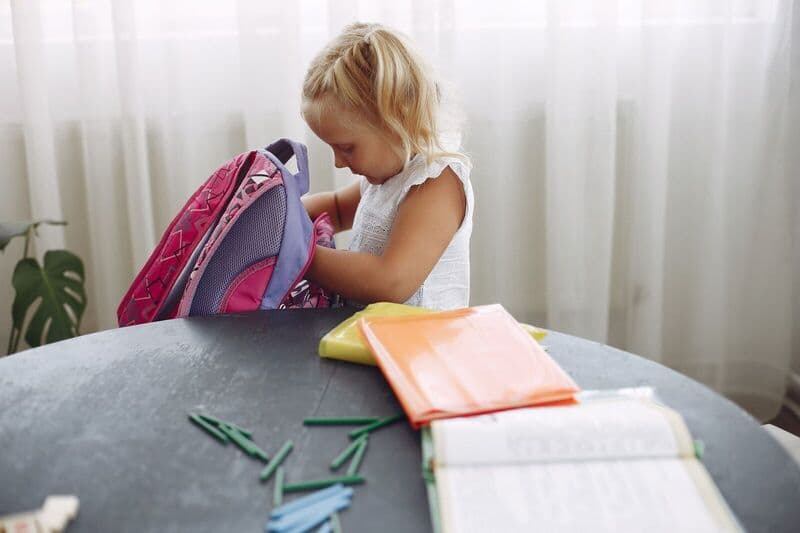
On the exercise book there is a line that starts uphill and ends halfway down the line below. Your child's teacher told you something that has stayed with you: "holds the pen badly". Now you watch them doing homework: the thumb wrapped over the index finger, the wrist turned in a way that looks uncomfortable just to see, and after five lines the hand shakes as if it had a cramp. You wonder whether it is laziness, whether it is dysgraphia, whether you should have noticed earlier.
Here is the answer straight away, because it is less dramatic than you fear: the way your child holds the pen is, almost always, not the problem. The studies that compared different grips on speed and legibility were designed precisely to find that difference, and they did not find it. What matters lies elsewhere: in the fine control of the fingers, in what sits beneath the hand, and in how much real writing the child does. There is, however, a short list of signs, further down in a section of its own, that deserves an assessment without waiting.
How a grip develops (and why nobody really teaches it)
Around the age of one, the crayon is held in a fist, in the palm, and the whole arm does the moving: the mark comes from the shoulder. Between two and three years the fingers settle on the shaft with the palm facing down, the pronated grip, and the movement passes to the elbow. Between three and four years the fingers are in the right place but remain fixed: these are static grips, where the wrist and forearm do the moving. Only later, usually between four and a half and six, the dynamic grip arrives, with the fingers moving on their own while the rest of the hand stays still.
This sequence is a description, not a timetable. When Schneck and Henderson tested it on 320 children without difficulties aged 3 to 6 years and 11 months, the progression was there, but much less clear-cut than the schema suggests: already 48% of the youngest used a mature grip, against 90% of the oldest. And among the oldest the common grips were two: the dynamic tripod and the lateral tripod, the one with the thumb resting sideways on the index finger, which many parents consider a fault.
A more recent figure calls for even more patience: among 219 Australian children in their first year of school, mean age 5 years and 10 months, 60.3% still used a static grip. If your child is five or six and their fingers do not yet move on their own, you are where the majority is.
The "wrong" grips that write very well
Here are the most solid numbers in the article. A Canadian group filmed 120 fourth-graders while they wrote, classified the grips into six categories (four mature, one immature and one alternating) and measured speed and legibility with a standardised test. Multiple linear regression found no significant effect of a mature grip, either on legibility or on speed.
One could object that the difference shows up with fatigue, when the "good" grip should pay off. The same researchers repeated the measurement before and after ten minutes of continuous copying, designed precisely to tire the hand. Afterwards, legibility got worse and speed went up (they wrote faster and worse), but in the same way for all grips, with identical perceived fatigue across the groups (F = 0.37; P = 0.895). The authors' conclusion: the dynamic tripod offers no advantage over the lateral tripod or the two quadrupod grips, and the result calls into question the practice of having everyone adopt it.
This is not an isolated result. In 46 fourth-graders, the dynamic tripod and atypical grips had already been compared on short and long tasks: legibility declined on the long tasks (length matters), but between the two grips there was no difference. On cursive, a study of 101 fourth-graders photographed each grip: 99 of them used one of four (dynamic tripod 38, lateral tripod 22, lateral quadrupod 21, dynamic quadrupod 18), with similar average speeds across all four.
Someone looked for the difference where the eye cannot see it, in the forces. Using an instrumented stylus and a pressure-sensitive pad, on 74 fourth-graders, no differences between grips emerged; when grouped by thumb position, those with the thumb adducted showed higher forces, without this translating into worse speed or legibility. The practical indication from the authors: deal with speed and with how the letter is formed, more than with how the pen is held.
Where the evidence becomes uncertain (because it must be said)
It would be convenient to stop here, but it would not be honest. A 2023 review mapped the whole literature on grip and writing in school age and found only 13 articles: an inefficient grip can be associated with less legibility and more fatigue, but overall the evidence is inconclusive.
And a 2026 study of 500 students in third, fourth and fifth grade adds the most useful nuance. 34% had handwriting that teachers judged poor; there the dynamic tripod was less frequent (33.5% versus 50.0%) and immature grips carried a higher risk of poor handwriting (odds ratio 2.01, 95% CI: 1.38-2.93). It looks like a refutation of everything else, and yet it is not: in the multivariate analysis the grip was no longer independently predictive, while slowness in finger dexterity (388 seconds versus 309.7) and the class attended remained. The immature grip is not the cause: it is a marker that accompanies a hand that is still not very skilled. The authors conclude that interventions should target fine motor control, not retraining the grip.
The hand that tires after five lines
Tiring when writing is not a defect: after ten minutes, as you have read, everyone's gets worse.
It also helps to know how much work that hand does in a day. Observing six full school days in three classes, minute by minute, children spent between 37.1% and 60.2% of their time in fine motor activities, with actual writing taking between 3.4% and 18.0%. That is an enormous amount of finger work, spread over hours.
So: a hand that tires after half an hour of homework is a normal hand. A hand that hurts (not "tired", hurts) is a different matter, and you will find it in the red-flags section.
What lies beneath the hand: trunk, shoulder, forearm
The reasoning is intuitive: to move the fingers well you need a steady base, and the base is pelvis, trunk and shoulder. A child curled up on a chair that is too high uses the shoulder to hold themselves up instead of guiding the hand.
The intuition has some truth in it, but it needs scaling down. In a study of 278 children aged 3 to 11, standing postural stability and seated manual control were measured with computerised tools on different days. The raw correlation was strong, but much of it depended on the fact that older children do better at everything: corrected for age, it remained significant but modest, and postural stability explained between 1% and 10% of the variability in manual tasks.
An Italian study of children aged 7-10 points in the same direction: no relationship between general motor coordination and writing, while visuo-spatial skills were linked to both. The clumsy child is not automatically the child who writes badly.
This does not mean the workstation does not matter: it is an easy intervention with a modest benefit, worth doing because it costs little, not because it solves the problem. Feet flat on the floor or on a footrest, pelvis at the back of the seat, forearm on the table, paper tilted and held still with the other hand. The two measurements that matter are set out in Desk and chair for homework: what really matters.
What is trained through play, and what is not
Here the literature is less generous than the catalogues of educational games would like. The most direct comparison is a study of 38 children aged 6-11 with handwriting difficulties, randomly assigned to handwriting practice, sensorimotor intervention or no intervention, for five weeks. The practice group improved moderately; the sensorimotor group improved in some components but got worse at writing; the controls did not change. It is a small study and about twenty years old, but it is the cleanest comparison we have.
Later reviews are consistent: the 2018 review of 13 studies finds small to medium improvements in legibility, mixed evidence on speed and no programme superior to another; the review of interventions for 4-6 year olds selected 7 studies out of 785 and found not a single randomised trial.
And psychomotor work? A Spanish study from 2026 on 34 children aged 5-6, non-randomised, compared six weeks of psychomotor work with the usual school routine: the active group improved clearly in graphomotor performance (3.14 points of difference, 95% CI: 1.68-4.59; Hedges' g = 1.48) and in all the motor tests. But on the scale completed by teachers, the only item that differed at the end was precisely the grip, and the two groups already differed at the start on that item: the authors themselves ask for caution. On legibility, nothing. We discuss it in Psychomotor work: what it is and when it really helps.
So, concretely, what to do at home:
- Write and draw, little and often. Five to ten minutes a day are worth more than an hour on Sunday: shopping lists, cards, comics, as long as it is real writing and not a punishment.
- Work vertically. Paper taped to the wall, a whiteboard, an easel: the wrist extends on its own and the shoulder works, without anyone needing to correct anything.
- Load the hand through play. Firm modelling dough, clothes pegs, tweezers, scissors, small construction toys: they build strength and dexterity in the young child. It is the part with the weakest evidence, I say so plainly, but it takes time away from nothing.
- Do not turn the grip into an issue. If you correct it every time they sit down, the message that comes across is not "hold the pen like this", it is "writing is the thing you get wrong".
- And if you are the one reading this: if your hand hurts and not just tires, say so. It is not an excuse: it is information that helps whoever has to help you.
Red flags: when an assessment really is needed
Up to here I have spent the article reassuring you. This section is the opposite, and it must be read carefully, because these are the cases where waiting is not the right choice.
- Pain in the hand, wrist or forearm during or after writing. Not tiredness: pain. This is the most important signal in the whole list.
- Disproportionate fatigue: cannot manage ten minutes of writing that classmates handle without problems, and starts avoiding written tasks to escape it.
- Handwriting that gets worse from one term to the next instead of improving. The normal trajectory is the opposite, as you can see below.
- A difficulty that stays identical at the end of second grade, with teaching that has been adequate.
- Very lax joints, with widespread pain beyond the hand and frequent sprains. In a series of 125 children followed at a tertiary centre for joint hypermobility, 40% reported difficulty with writing tasks, with symptoms beginning on average at 6.2 years and diagnosis at 9.0. It is a selected series: it says it is worth considering when there are other signs of laxity, not that hypermobility is a frequent cause of poor handwriting.
- To the paediatrician straight away, without going through us, if the child loses skills they already had, if tremor or real weakness appears, or if the hand changes together with other neurological signs. Here it is not a matter of writing.
On the third point there is a finding that defuses half of the anxieties in second grade. A Dutch study gave a standardised writing test twice in the same school year to 169 second-graders (7-8 years old) and 70 third-graders (8-9 years old): the share of dysgraphic handwriting fell from 37% to 17% during second grade and stabilised at 6% in third grade, and the "at-risk" children continued to improve. The authors' practical rule is the best I know: handwriting must be dysgraphic consistently over time before anything is decided. A single snapshot is not a diagnosis; two measurements months apart that say the same thing are.
Dysgraphia: who certifies it (and why it is not us)
If the suspicion is a specific learning disorder, the pathway is different. Dysgraphia is spoken of when a child, despite adequate teaching, shows a writing skill that is not consistent with their age and cognitive level: the definition requires simpler explanations to be ruled out first, with standardised tests, not by looking at an exercise book.
There is also a practical reason not to stop at the hand. In a series of 27 children from first to fifth grade who were also assessed with oculomotor tests, the pictures were very varied: 26% had mild difficulties that the writing test did not even pick up, 33% moderate, 41% overt dysgraphia, and in this last group oculomotor disorders appeared in 55% of cases. These are few children who had already reached a specialist centre and do not describe the general population, but they illustrate a principle: behind difficult handwriting there can be vision, attention or language.
Certification is done by a team: child neuropsychiatrist, psychologist, speech therapist, following the pathways of the health service or of an accredited centre. A physiotherapist does not do it, and we do not either.
What we can do (and what we cannot)
Our part is smaller and more concrete: fine motor skills and writing posture. We look at how they sit, where the forearm rests, how hard they press on the paper, whether the fingers move or whether all the movement comes from the wrist, how long they hold up before the quality collapses, and whether there is pain. We tell you what to change, what to train and, very often, that what you are watching is within the normal range. If something else emerges, our job is to direct you, not to hold you back.
With Ri-Hub Junior you start with a free 20-minute first consultation by video call with a physiotherapist on the Italian professional register who works with children and teenagers: you show us your child writing two lines at their desk, as they usually do, and we talk it through. For children up to age 10 sessions last 50 minutes and cost 59,90 €; from age 11 to 18 the standard session at 29,90 € applies. We stay out of complex neurological and neuromuscular conditions, which are not treated online.
In three lines
An unusual grip, on its own, rarely explains poor handwriting: those who looked for a difference in speed and legibility did not find it, not even after ten minutes of continuous writing. What counts more is finger dexterity, a stable base under the hand, which matters less than is often said, and how much real writing the child does. Get it assessed when pain appears, when fatigue is out of proportion, or when the handwriting gets worse instead of better: in the other cases the normal trajectory is upward, and it needs time.
Sources
- Descriptive analysis of the developmental progression of grip position for pencil and crayon control in nondysfunctional children: American Journal of Occupational Therapy, 1990
- Effect of pencil grasp on the speed and legibility of handwriting in children: American Journal of Occupational Therapy, 2012
- Effect of pencil grasp on the speed and legibility of handwriting after a 10-minute copy task in Grade 4 children: Australian Occupational Therapy Journal, 2012
- Writing forces associated with four pencil grasp patterns in grade 4 children: American Journal of Occupational Therapy, 2013
- Pencil grasp and children's handwriting legibility during different-length writing tasks: American Journal of Occupational Therapy, 2001
- Pencil grips, legibility, and speed of fourth-graders' writing in cursive: American Journal of Occupational Therapy, 2003
- A Scoping Review of Grasp and Handwriting Performance in School-Age Children: Physical & Occupational Therapy in Pediatrics, 2023
- Finger Dexterity and Pencil Grasp Patterns as Correlates of Handwriting Proficiency: A School-Based Cross-Sectional Analytical Study: Indian Pediatrics, 2026
- Handwriting Readiness among Digital Native Kindergarten Students: Physical & Occupational Therapy in Pediatrics, 2021
- The relationship between a child's postural stability and manual dexterity: Experimental Brain Research, 2014
- The role of general dynamic coordination in the handwriting skills of children: Frontiers in Psychology, 2015
- Fine Motor Activities in Elementary School Children: A Replication Study: American Journal of Occupational Therapy, 2020
- The effects of sensorimotor-based intervention versus therapeutic practice on improving handwriting performance in 6- to 11-year-old children: American Journal of Occupational Therapy, 2006
- Curriculum-Based Handwriting Programs: A Systematic Review With Effect Sizes: American Journal of Occupational Therapy, 2018
- A systematic review of occupational therapy intervention for handwriting skills in 4-6 year old children: Australian Occupational Therapy Journal, 2020
- Effect of a Psychomotor Intervention on Motor Competence, Graphomotor Performance and Writing Proficiency in 5- to 6-Year-Old Preschool Children: Children, 2026
- Handwriting development in grade 2 and grade 3 primary school children with normal, at risk, or dysgraphic characteristics: Research in Developmental Disabilities, 2011
- Exploratory Investigation of Handwriting Disorders in School-Aged Children from First to Fifth Grade: Children, 2023
- Disorder of written expression and dysgraphia: definition, diagnosis, and management: Translational Pediatrics, 2020
- Joint hypermobility syndrome in childhood. A not so benign multisystem disorder?: Rheumatology (Oxford), 2005
Last source check: September 2026.