In dance the hip is the area that pays the most, for a reason that seems paradoxical: not because dancers are stiff, but because they spend years asking that joint for more range than it has.
What is asked of the hip, and why it is so much
En dehors, the held external rotation, is not a position taken for an instant: it is the basic set-up of hours of class. Everything else is built on top of it: legs lifted beyond ninety degrees, arabesques that demand extension, jumps and landings on one leg repeated thousands of times.
In reviews of dancers' injuries, hip and groin are among the most frequent sites, and the great majority of the pictures are from overuse, not trauma: there is no single moment when you hurt yourself, there is a week in which the load has risen faster than the capacity to bear it.
The part that cannot be trained: the bone
Here is something that many people are not told early enough. How much external rotation you have available depends largely on the shape of the bone: the orientation of the femoral neck, the depth and inclination of the acetabulum. These characteristics are defined during growth and do not change afterwards, neither with stretching nor with willpower.
Two dancers with the same commitment can have a very different en dehors, and it is not a matter of dedication.
The practical point is what is done with this information. Anyone without the degrees from the hip tends to take them from elsewhere: rotating from the knee, turning the feet out on the floor, or compensating with the lumbar area. This is the mechanism by which a hip limitation becomes pain in the knee, the foot or the back.
What can be trained is everything else: the rotation you have, the control you have over it, and the strength with which you sustain it when you are tired.
The pictures met most often
Femoroacetabular impingement. In dancers with a clinical diagnosis of impingement, differences in range and strength are seen compared with those who do not have it. The pain is anterior, in the groin, and appears in the positions of deep flexion with rotation, that is, in almost everything a dancer does. We wrote about it in detail in the guide to femoroacetabular impingement.
Acetabular labral tear. Often associated with impingement. It can cause groin pain with a sensation of locking or a deep snap.
Snapping hip. The snap felt when moving the leg, usually the iliopsoas tendon passing over a bony prominence, or the band over the greater trochanter. If it does not hurt and does not limit, it is benign, and it is common. It becomes a problem when it comes with pain, and then the target is the load, not the snap.
Flexor and adductor tendinopathies. From repeated load. The pain appears in the specific movement and at first goes away with rest.
Stress fractures. The picture not to miss: deep groin pain that worsens under load, which at first goes away with rest and then begins to persist. In anyone who has increased the load or has insufficient nutrition it must be ruled out, and it is not managed with exercises.
What really prevents injury
In dance people stretch an enormous amount and load very little, and this is exactly the opposite of what the data suggest.
In the reference meta-analysis of preventive interventions, 25 randomised studies with over 26,000 participants, strength training reduced sports injuries to less than a third, proprioceptive work nearly halved them, and stretching is the only measure that did not reduce the risk.
Translated into a dance studio:
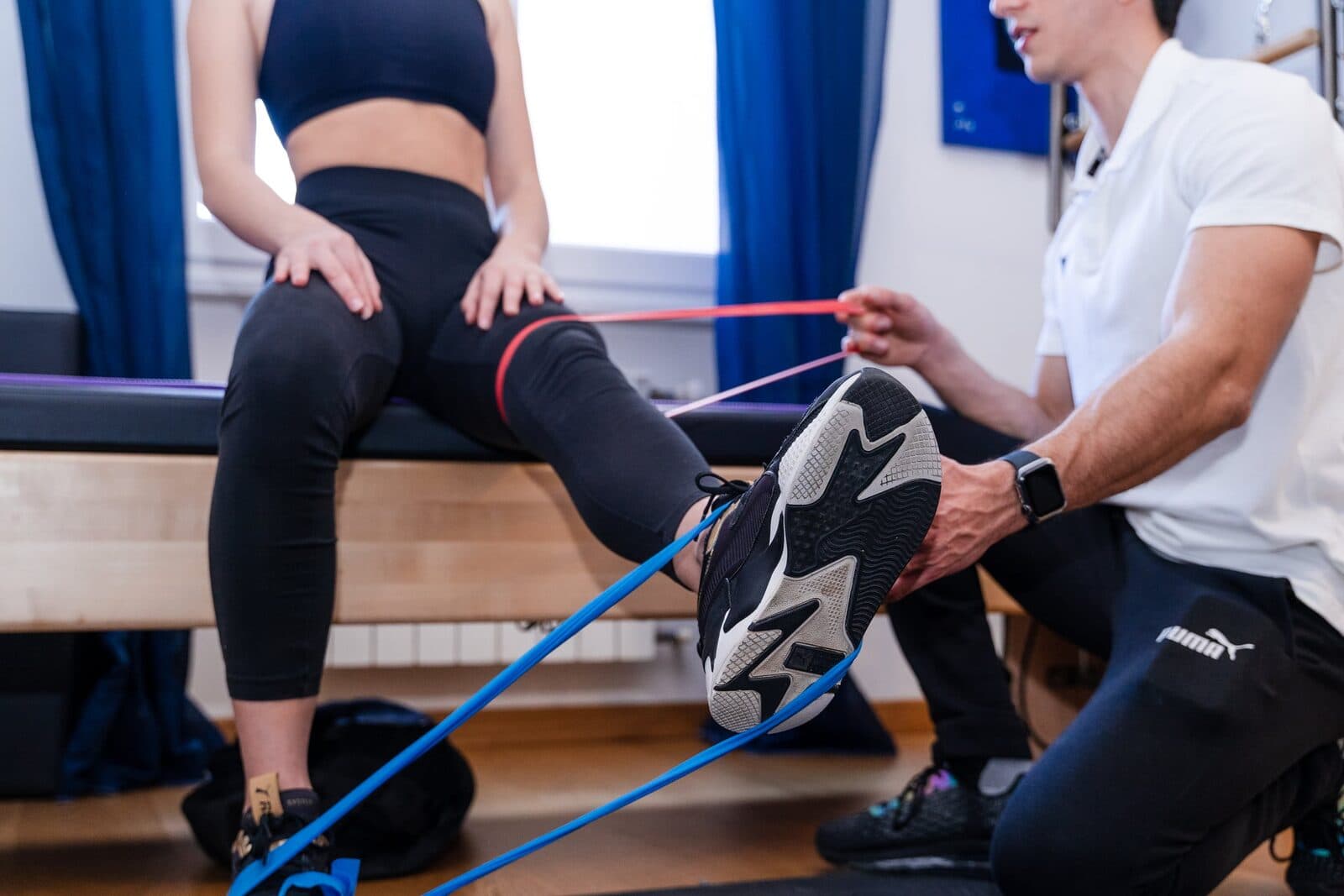
Hip strength, with real loads. Abductors and external rotators in particular: they are the muscles that control the pelvis on single-leg support. Two sessions a week, with the load increasing.
Eccentric control. Landings and descents are the moment when the load is at its highest: training them specifically is different from simply doing them.
Volume management. The risk period is when hours suddenly increase: the start of the year, preparation for a show, the return after a break. Most problems appear there.
Sleep and nutrition. In a discipline with pressure on weight, insufficient energy intake is a documented risk factor for stress fractures, and it is not a topic to handle with embarrassment.
Stretching remains useful, for range and for how you feel. It is simply not the defence, and it is the only thing that almost every class does.
When to stop
A deep groin pain that worsens under load and no longer goes away with rest. A sensation of locking or giving way. A new loss of range. A pain that always appears at the same point of the same movement.
Carrying on in class with any of these, hoping it passes, is how a six-week problem becomes a six-month one.
In summary
The hip of a dancer does not need more stretching: it needs more strength and a managed load. And it needs someone to say, early, that part of en dehors is bone, because that is the information that stops you taking it from the knee.
If you have a pain that always returns in the same movement, the physiotherapists at Ri-Hub can assess it by video call: the twenty-minute introductory consultation is free.
Sources
- Hip and Groin Injuries in Dancers: A Systematic Review: Sports Health, 2017
- Risk Factors for Lower-Extremity Injuries in Female Ballet Dancers: A Systematic Review: Clin J Sport Med, 2021
- Understanding hip pathology in ballet dancers: Knee Surg Sports Traumatol Arthrosc, 2022
- COMPARISON OF RANGE OF MOTION, STRENGTH, AND HOP TEST PERFORMANCE OF DANCERS WITH AND WITHOUT A CLINICAL DIAGNOSIS OF FEMOROACETABULAR IMPINGEMENT: Int J Sports Phys Ther, 2016
- The effectiveness of exercise interventions to prevent sports injuries: a systematic review and meta-analysis of randomised controlled trials: Br J Sports Med, 2014
Last source check: September 2026.
You might also be interested in:
Conflitto Femoro-Acetabolare dell'Anca: Cosa Fare Dolore Inguinale: Cause, Sintomi e Come Risolverlo Artrosi Anca: Esercizi per Mobilità e Meno Dolore
Need a consultation?
Start with the questionnaire on Ri-Hub: a few questions about your case, you sign up, and you see who will follow you: a physiotherapist registered with the Albo, whom you can write to in chat whenever you like. If you prefer to talk it through by voice, the first consultation is free, lasts twenty minutes and commits you to nothing: it starts with them having already read what you wrote, and together you decide whether and how to proceed.