Ankle circles are the exercise everyone knows and almost everyone does badly. They are excellent for one thing and useless for another, and it is worth knowing which is which.
⚠ Important: read this before continuing
The exercises and advice in this article are general guidance and may not suit your situation. Every person has a unique clinical history: what works for others could be counterproductive for you.
What they do and what they do not do
They do: warm up the joint, move the synovial fluid, maintain the range of motion you already have, and reduce the feeling of stiffness after hours sitting still or after a period of immobilisation.
They do not: increase dorsiflexion, that is, the ability to bring the knee past the toes. And that is exactly what you need to go down stairs, squat and run without compensating. Dorsiflexion is gained under load, not by moving the foot in mid-air.
So: circles for warming up and maintaining, something else to gain mobility.
How to do them properly
Seated or lying down, leg raised, move only the ankle while keeping the rest of the leg still. This is the most common mistake: you end up rotating the whole hip and the ankle does little work.
Draw circles as wide as possible, slowly, seeking the end of the movement in every direction. Ten circles in each direction, for each foot. Two or three times a day if you are recovering from immobilisation, once as a warm-up.
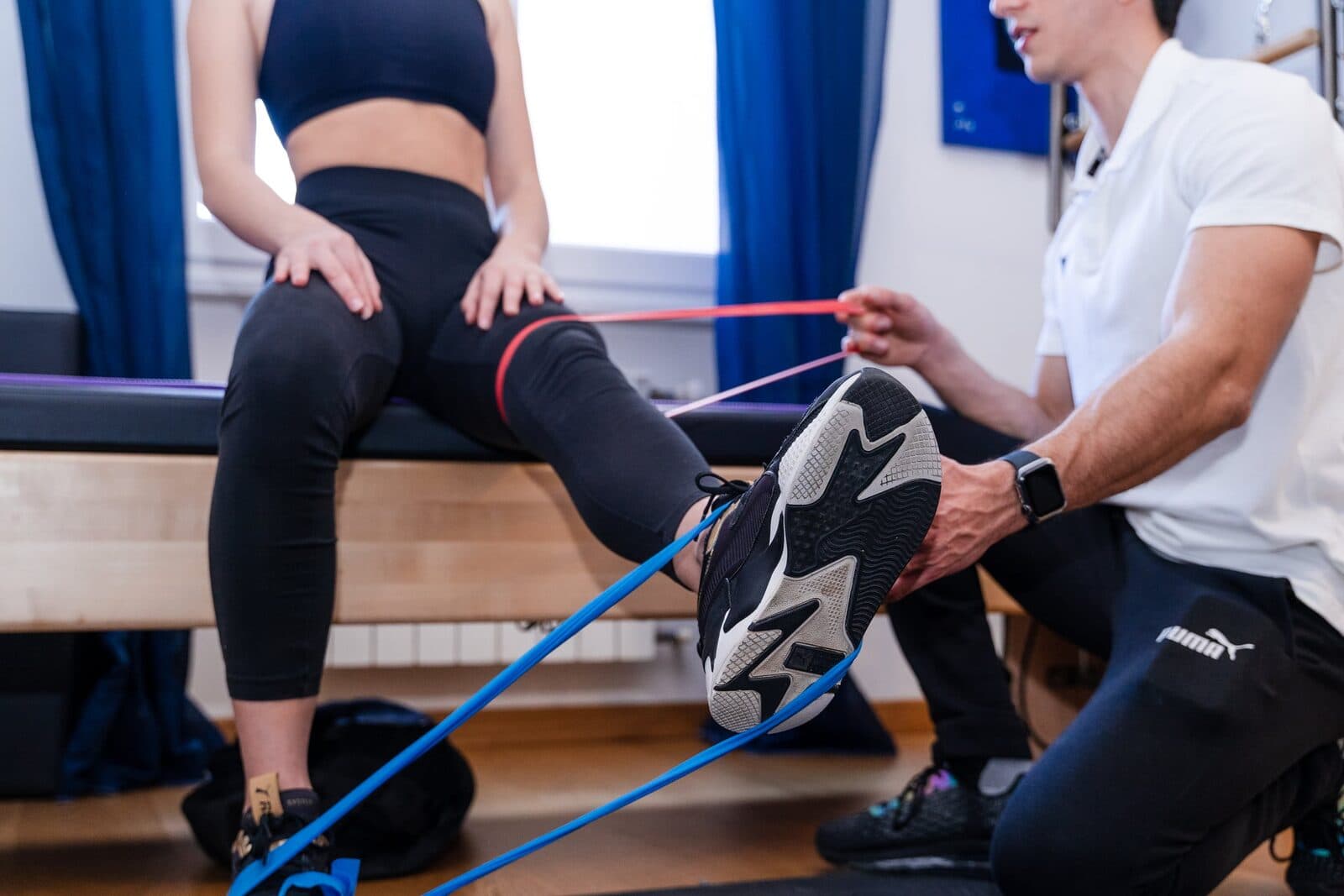
Useful variations: writing the alphabet with the tip of the foot (it forces you through angles that circles skip), and rotations with a small elastic band around the forefoot to add resistance.
What to add to gain real mobility
| Exercise | How | Dosage |
|---|---|---|
| Knee-to-wall | Standing in front of a wall, foot a few centimetres away: bring the knee to touch the wall without lifting the heel, then move the foot away until you can no longer reach | 3×10 per side, daily |
| Lunge with oscillation | In a lunge, rock forwards and backwards loading the front ankle | 3×10 per side |
| Heels-down squat | Descend keeping your heels on the floor, even if not very deep | 3×8 |
| Slow calf raise | Standing, rise onto the toes and lower over 3 seconds | 3×12 |
The knee-to-wall is also the test: measure in centimetres the distance between the toes and the wall when the knee can still reach it with the heel on the floor. Note the number, try again in three weeks. It is the only way to know whether you are improving instead of just believing it.
When not to do them
If there has been a recent sprain with swelling, wide circles in the early phases can irritate the joint: you start with small, pain-free movements up and down. And if after a trauma you cannot put weight on the foot for four steps, the priority is not mobility but ruling out a fracture.
Sources
Last source check: September 2026.
Need a consultation?
Start with the Ri-Hub questionnaire: a few questions about your case, you sign up, and you see who will follow you: a physiotherapist on the Italian professional register, whom you write to in chat whenever you like. If you would rather talk it through by voice, the first consultation is free, lasts twenty minutes and commits you to nothing: they arrive having already read what you wrote, and together you decide whether and how to go on.