Rotator cuff tear: a diagnosis that can worry, but that in most cases can be managed effectively with conservative treatment. A rotator cuff tear is one of the most common causes of shoulder pain, affecting millions of people every year, from athletes to workers, from young people to older adults. In this complete guide you will learn everything you need to know about the rotator cuff tear: how to recognise it, how it is diagnosed, what the treatment options are and how to recover full shoulder function.
If you have been diagnosed with a rotator cuff tear, do not despair. A rotator cuff tear responds very well to conservative treatment in the vast majority of cases. With the right combination of physiotherapy, specific exercises and patience, many people fully recover shoulder function without the need for surgery. Even complete rotator cuff tears can be managed successfully in a conservative way in selected patients.
⚠ Important: read this before continuing
The exercises and advice in this article are general indications and may not be suitable for your situation. Every person has a unique clinical history: what works for others could be counterproductive for you.
Want a professional's opinion? Start from the questionnaire: you sign up and see who will follow you, a physiotherapist on the Italian professional register chosen for your case, whom you write to in chat. If you would rather hear their voice, the first consultation is free and we look at your situation together.
Rotator Cuff Tear: What It Is
To understand a rotator cuff tear, it helps to know the anatomy of this structure.
What the rotator cuff is: The rotator cuff is a group of four muscles (supraspinatus, infraspinatus, teres minor and subscapularis) whose tendons wrap around the head of the humerus like a "cuff", stabilising the shoulder joint and allowing rotation and lifting of the arm. In a rotator cuff tear, one or more of these tendons is damaged.
The most affected tendon: The supraspinatus tendon is the one most frequently involved in a rotator cuff tear, because of its vulnerable anatomical position in the subacromial space, where it is subjected to compression during movement.
A rotator cuff tear can present with different degrees of severity:
Tendinitis: Inflammation of the tendon without significant structural damage. It is the mildest form of rotator cuff tear and responds quickly to conservative treatment.
Tendinopathy: Chronic degeneration of the tendon with changes to its structure. It is a form of rotator cuff tear that develops over time from overload or ageing.
An important point: before trying these exercises, make sure you have received a correct diagnosis. People often think they have one problem, but the real cause of the pain is another. Doing the wrong exercises can make the situation worse instead of better.
Partial tear: A break that affects only part of the thickness of the tendon, without going through it completely. This rotator cuff tear can be on the bursal side (upper) or the articular side (lower).
Complete tear (full thickness): A break that goes through the entire thickness of the tendon, creating a "hole" in the tendon. It is the most significant rotator cuff tear, but it can still be treated successfully in a conservative way in many cases.
Symptoms of a Rotator Cuff Tear
The symptoms of a rotator cuff tear vary depending on the type and severity.
Pain: It is the main symptom of the tear. The pain is typically located on the lateral or anterior side of the shoulder, in the area of the deltoid. It worsens when lifting the arm to the side or overhead, reaching for objects or performing activities above the head. The pain of a rotator cuff tear can radiate towards the arm but rarely beyond the elbow.
Night pain: One of the most annoying symptoms of a rotator cuff tear is pain that gets worse at night, especially when sleeping on the affected side. Many patients with a rotator cuff tear report waking up repeatedly because of the pain.
Weakness: A rotator cuff tear can cause weakness in arm movements, especially in lifting to the side or in rotations. In complete tears, the weakness can be significant and make it difficult to lift the arm.
Difficulty with daily movements: A rotator cuff tear can make activities such as combing your hair, dressing, fastening a bra, reaching things up high or bringing the arm behind the back difficult.
Clicking and crackling: Some people with a rotator cuff tear report noises or a sensation of clicking during shoulder movements.
Painful arc: The typical pain of a rotator cuff tear often appears within a specific range of movement (typically between 60° and 120° of abduction), when the tendon is compressed in the subacromial space.
Causes of a Rotator Cuff Tear
A rotator cuff tear can result from several causes.
Degeneration with age: The natural wear of the tendons with ageing is the most common cause of a rotator cuff tear. After 40, the tendons begin to degenerate, losing elasticity and the capacity to regenerate. After 60, partial or complete rotator cuff tears are very common, even in people without symptoms.
Overload and repetitive movements: Activities that require repetitive movements above the head (swimming, tennis, volleyball, baseball, painting work, bricklaying) cause repeated micro-traumas to the tendons, leading over time to a rotator cuff tear.
Acute trauma: A fall onto the arm, a sudden movement or a sports injury can cause an acute cuff tear. In young people, a traumatic rotator cuff tear is often the main cause.
Impingement syndrome: Chronic compression of the tendons in the subacromial space can lead over time to a rotator cuff tear, through continuous friction and wear.
Poor blood supply: An area of the supraspinatus tendon (the "critical zone") has reduced blood supply, which predisposes it to degeneration and to a rotator cuff tear.
Diagnosis of a Rotator Cuff Tear
The diagnosis of a rotator cuff tear is based on a clinical examination and instrumental tests.
Clinical examination: The doctor or physiotherapist will perform specific tests for a rotator cuff tear. The Jobe test (empty can test) assesses the supraspinatus, the Patte test the infraspinatus, and the lift-off test the subscapularis. These tests provoke pain or weakness if there is a tear in the corresponding cuff tendon.
Ultrasound: It is a very useful test for visualising a rotator cuff tear. It is inexpensive, non-invasive and can show tendinitis, partial and complete tears. Ultrasound is often sufficient to diagnose a rotator cuff tear.
Magnetic resonance imaging: It is the most accurate test for a rotator cuff tear. It shows precisely the extent of the tear, which tendons are involved and the state of the muscles. It is particularly useful for planning any surgical procedure for this tear.
X-ray: Although it does not show the tendons, an X-ray can show indirect signs of a chronic rotator cuff tear (reduction of the subacromial space, upward migration of the humeral head) and rule out other conditions.
Conservative Treatment of a Rotator Cuff Tear
Conservative treatment is the first choice for most rotator cuff tears.
Physiotherapy: It is the cornerstone of treatment for the tear. A complete physiotherapy programme includes progressive strengthening exercises for the rotator cuff and scapular muscles, stretching, postural correction and movement re-education. Physiotherapy for a rotator cuff tear produces excellent results in most patients.
Therapeutic exercise: Exercises are essential for a rotator cuff tear. Strengthening the muscles that remain healthy can compensate for the damaged tendon, improving function and reducing pain. This is why many complete rotator cuff tears can be managed without surgery.
Relative rest: In the acute phase of a rotator cuff tear, it is important to avoid activities that cause pain, especially movements above the head. It does not mean immobilising completely, but temporarily reducing provocative activities.
Anti-inflammatory drugs: NSAIDs can help control pain and inflammation in this tear, especially in the acute phase. They should be used for limited periods.
Injections: In some cases of a rotator cuff tear, corticosteroid injections can give pain relief and allow more effective physiotherapy. They should be used with caution because repeated use can weaken the tendons.
Exercises for a Rotator Cuff Tear
Exercises are crucial for recovery from a rotator cuff tear.
Pendulum exercises (Codman): In the early phase of the tear, lean forward and let the arm swing gently in small circles and pendulum movements. This maintains mobility without stressing the tendons. 2-3 minutes, several times a day.
Assisted mobilisation: Use the other arm or a stick to guide passive movements of flexion, abduction and rotation. In a rotator cuff tear, this helps maintain the range of motion. 10-15 repetitions per movement.
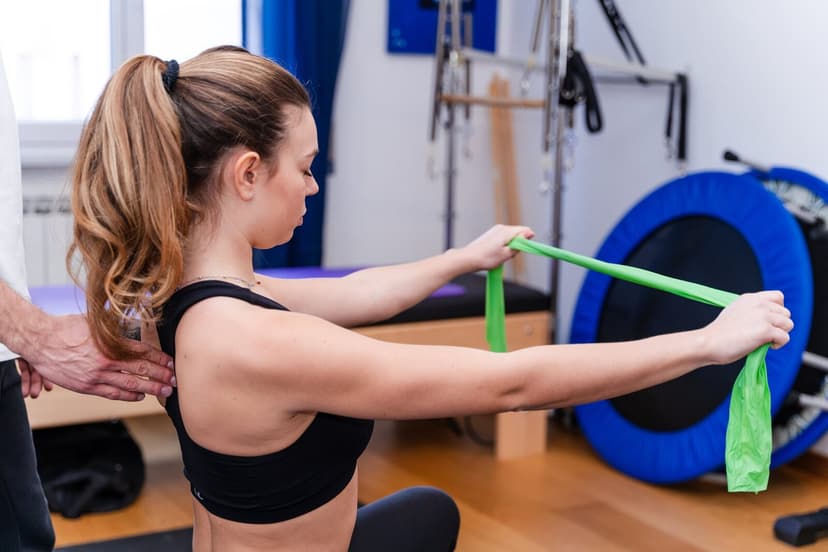
External rotation with a band: With the elbow at your side bent to 90°, rotate the forearm outwards against the resistance of a band. This exercise strengthens the external rotators, which is essential in a rotator cuff tear. Start with light resistance. 15 repetitions, 3 sets.
Internal rotation with a band: Same position, rotate inwards against resistance. For balanced strengthening in this tear. 15 repetitions, 3 sets.
Wall abduction (isometric): Standing beside a wall, push your arm sideways against the wall without moving it. This strengthens the supraspinatus safely in a rotator cuff tear. 5-10 seconds, 10 repetitions.
Prone Y-T-I: Lying face down, lift the arms in the Y, T and I positions. It strengthens the scapular muscles, essential for supporting a rotator cuff tear. 10 repetitions per position.
Progressive strengthening: As strength improves, gradually increase the resistance of the exercises for the tear. Progression must be gradual and guided by pain.
Rotator Cuff Tear: When to Consider Surgery
Surgery for the tear is considered in specific cases.
Acute traumatic tear in a young person: An acute rotator cuff tear from trauma in a young and active patient may benefit from early surgical repair to optimise recovery.
Failure of conservative treatment: If after three to six months of adequate physiotherapy the tear does not improve significantly, surgery can be considered.
Significant disabling weakness: If the rotator cuff tear causes a major weakness that significantly limits function and does not improve with exercises.
Large retracted tears: Some very large rotator cuff tears may require surgical assessment, although the options are sometimes limited.
Factors to consider: Age, level of activity, expectations, and the state of the tendons and muscles are all factors that influence the surgical decision for this tear.
Prognosis
A rotator cuff tear generally has a good prognosis with appropriate treatment.
Conservative treatment: The majority of patients with a rotator cuff tear (up to 70-80%) get good results with conservative treatment, including many complete tears in patients over 60.
Positive prognostic factors: Smaller tears, muscles in good condition, absence of atrophy, a motivated patient who is consistent with the exercises for the rotator cuff tear.
Recovery times: Significant improvement from a rotator cuff tear typically requires 3-6 months of consistent treatment. Full recovery can take 6-12 months.
Professional Support for a Rotator Cuff Tear
Physiotherapy is essential for treating a rotator cuff tear. A physiotherapist can assess your condition, create a personalised progressive exercise programme, correct your technique and guide you through the recovery process.
With Ri-Hub you can treat the tear with qualified professionals, comfortably from home. Our physiotherapists can assess your situation through remote rehabilitation, teach you the correct exercises, correct your technique in real time and monitor your progress.
Remote rehabilitation is particularly suitable for a rotator cuff tear because most of the treatment consists of exercises you can do at home with minimal equipment (bands). You can receive the professional guidance you need with the flexibility to follow the programme when and where you prefer.
Do not let a rotator cuff tear limit your life. With the right treatment, patience and consistency in the exercises, you can recover shoulder function and return to your activities. The Ri-Hub professionals are ready to accompany you through the full recovery process.
You might also be interested in:
Stay in touch with us
Join our dedicated Facebook group: we reply to all patients, give practical advice and clear up the most common doubts.
Need a consultation?
Start from the questionnaire on Ri-Hub: a few questions about your case, you sign up, and you see who will follow you: a physiotherapist on the Italian professional register, whom you write to in chat whenever you like. If you prefer to talk it through by voice, the first consultation is free, lasts twenty minutes and commits you to nothing: they arrive having already read what you wrote, and together you decide whether and how to continue.
Have you been prescribed a shoulder brace and do not know how long to wear it? We cover this in Shoulder brace: when it is needed and how to wear it.
Sources
- Surgery for rotator cuff tears: Cochrane Database of Systematic Reviews, 2019
- Manual therapy and exercise for rotator cuff disease: Cochrane Database of Systematic Reviews, 2016
- Comparative effectiveness of physical therapy interventions in adults with rotator cuff tendinopathy: a systematic review and network meta-analysis: British Journal of Sports Medicine, 2026
Last source check: August 2026.